


 SHARE:
[Editor’s note: Not only is it a bit rude to call someone a “featherbrain,” it’s also highly inaccurate, Louis Lefebvre writes in ‘A Bird’s IQ,’ translated from the original French by Pablo Strauss and out now from Greystone Books. In fact, when humans study birds, there’s a lot we can learn about ourselves. In this excerpt, Lefebvre shares a litany of innovative, sometimes bloody-minded, corvid meal acquisition tactics.]
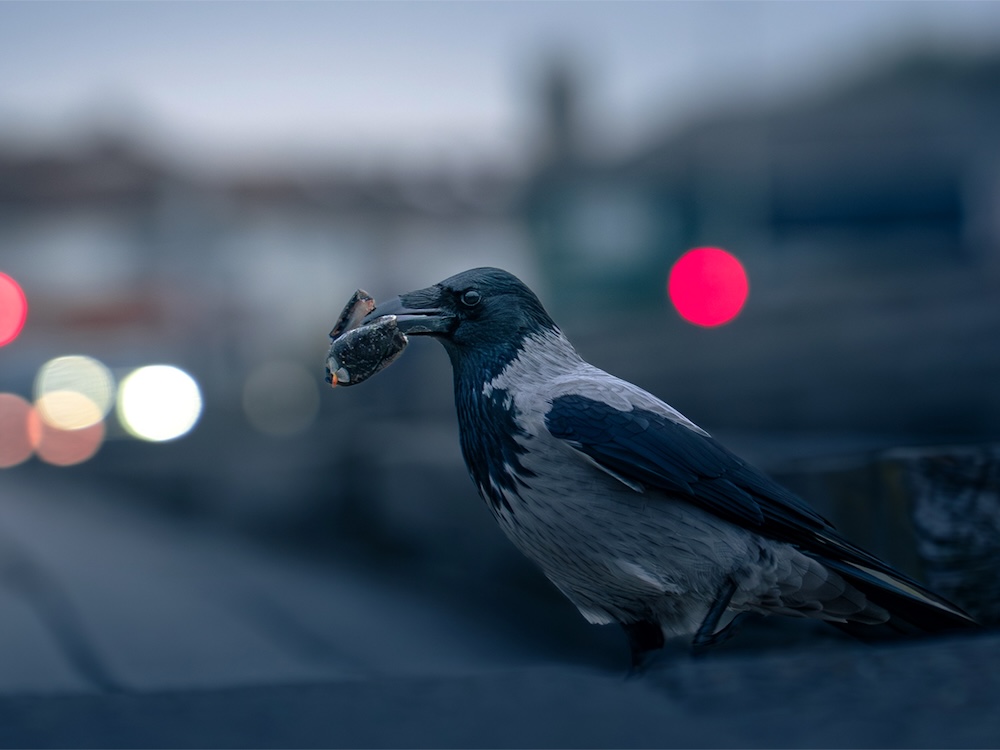
In descending order, the corvids with the most recorded innovations are the Eurasian carrion crow (Corvus corone), the common raven (Corvus corax), the Eurasian magpie (Pica pica), the house crow (Corvus splendens), and the American crow (Corvus brachyrhynchos).
Among the most jaw-dropping American crow innovations that have been observed was an individual disappearing for more than nine minutes into the near-vertical shaft of a decommissioned mine, only to emerge with a bat.
Another memorable feat is the crow that stole a fish from an otter while the latter was distracted by its accomplice, a second crow, which tugged on the otter’s tail.
Or how about the big-city crows in Toronto surveying the area around a downtown office tower to pick up birds who crash into windows, with one pair of crows even apparently chasing a kinglet in flight directly into one of these windows?
Another crow made a pointed tool out of a splinter of wood torn from the slat in a fence, and then used it as a probe to fetch a spider in a hole. And a Wisconsin crow picked up a dead fish from the mud of a dried-up pond and carried it to a birdbath, presumably to wash it off.
Turning to common ravens, there are many observed cases of them coming in after wolves and humans have killed prey and then eating the remains. At least five such cases involved biologists: in Montana, Crow White demonstrated that ravens were attracted specifically by gunshots in the forest, in comparison with other sounds (a horn, a human simply walking, a whistle) that attracted them in other habitats.
In Minnesota, Fred Harrington showed that imitating wolf howls was enough to change the direction of ravens in flight. And also in Minnesota, Paul Frame broadcast recordings of rabbit and deer distress calls, with the aim of trapping wolves; three times out of four, ravens turned up instead.
In Colorado, wildlife biologist Merle Richmond and his canoeing companion allowed themselves to be led by a common raven “squawking loudly and thrashing around” near a lakeshore. The raven “renewed its showy antics” if the biologists lagged too far behind, and the biologists eventually realized it was leading them directly to a nest of two Canada geese, who fled at the sight of humans. At this point the raven and its “silent partner” swooped in and nabbed “a gosling apiece,” which they carried off to eat on a stump across the bay.
Also in Colorado, Richard Engeman noted that ravens hang around fishers to eat the eggs released by spawning female brook trout when they’re captured and handled.
And it’s hard to top the case of a raven in California’s Death Valley National Park who turned on a water faucet — the only water source in times of drought in one of the world’s most arid places — by hopping onto the handle and then bending over to drink.
In 1987 on a camping trip in Kenya, Swedish zoologist Staffan Andersson observed a curious sequence of behaviour from a fan-tailed raven (Corvus rhipidurus) that has much to tell us about corvids’ tool-use tactics.
Given the rarity of tool use in nonhuman animals, we can surmise that such an innovation must be costly in terms of either energy or neural development. If corvids are anything like us, the easiest and most “tried and true” solution will be chosen over a more difficult one, at least until the easier solutions fail. As the saying goes: “Keep it simple, stupid!” And that’s exactly what Andersson observed in a raven who misunderstood what it had found in the campground.
The fan-tailed raven stole a ping-pong ball, which it clearly mistook for an egg. It first tried unsuccessfully to break the “egg” with its beak. Next, it dragged over a large stone, which it rolled on top of the “egg.” After that, it went to get a smaller stone, with which it, again unsuccessfully, struck the “egg.” When all else failed, the raven flew away with the ball, presumably to crack it by dropping it from heights at another location. A real egg of that size would of course have shattered with the first peck. But the ping-pong ball’s plastic shell demanded something else of the raven, which Andersson was lucky enough to observe in a natural field environment: the escalation of problem solving by means of incrementally more complex behaviours.
Specialists in animal tool use distinguish between two categories of differing cognitive complexity. In the first, proto-tool use, animals do not directly manipulate a detached object but instead use a feature of their environment.
The second category, known as tool use or sometimes true tool use, is reserved for cases where an object is directly manipulated by an animal. Striking prey with a rock is tool use; striking the same prey against a rock is proto-tool use. While the difference is often subtle, the fact is that the average brain size of birds using only proto-tools is smaller than that of the real tool users.
It may strike a human as odd that wielding a hammer requires greater intelligence than banging on an anvil, but the distinction is significant to animal cognition researchers. Take gulls and crows. Both drop prey on hard surfaces to break them, but while gulls never move beyond the “anvil” technique, crows progress to more sophisticated forms of tool use, as we saw so clearly with the Kenyan ping-pong ball “egg.”
In the Malaysian town of Butterworth, Penang, Indian house crows (Corvus splendens) were seen waiting at a red light for trucks loaded with grain sacks. When the trucks stopped at the light, the crows pecked holes in the sacks and fed on the grain, then flew off when the trucks left at the green light. In India, the same species is known to tear off manilkara leaves, insert them into a hole on a branch, and then remove them after a minute to eat the ants clinging to the leaf — a case of tool use reminiscent of chimpanzees’ technique with termites.
In Myanmar, ornithologist Salim Ali observed an Indian crow kill a rat by drowning it, periodically pulling its prey from the water to see if it was dead, and plunging it back in if not.
And in Hyderabad, Indian crows visit the frangipani trees whose flowers are regularly cut for Hindu rituals, and drink the natural latex that drips from the notches on the trees; in traditional Indian medicine, this latex is used for its antifungal, antibacterial, and gastroprotective properties, so this represents a potential case of self-medication by the bird.
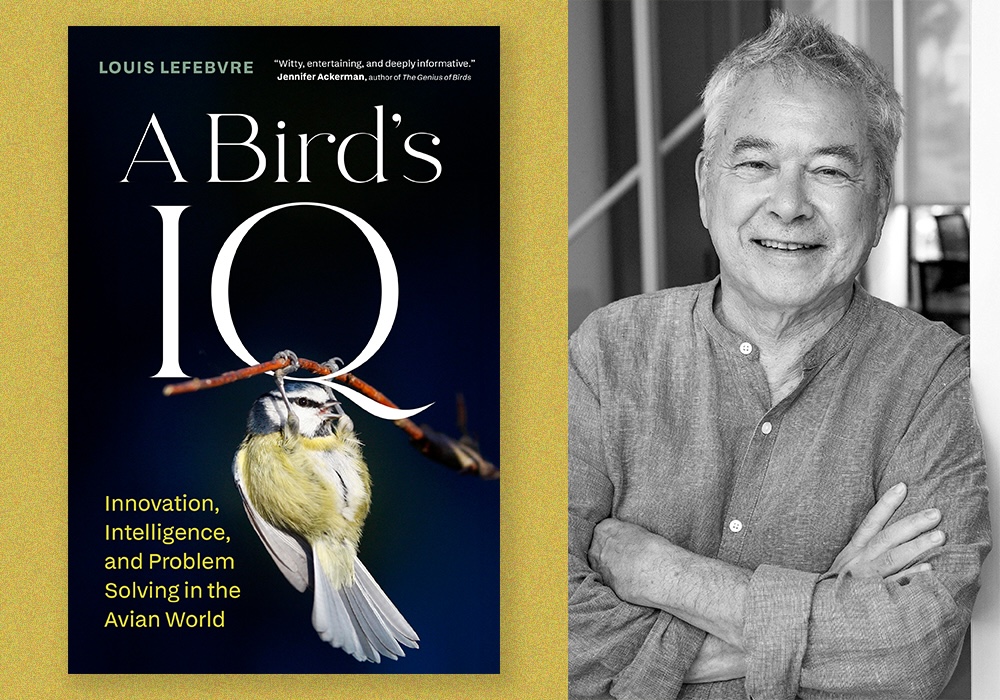
Excerpted from ‘A Bird’s IQ: Innovation, Intelligence, and Problem Solving in the Avian World’ by Louis Lefebvre. Copyright © 2026 Louis Lefebvre. Published by Greystone Books in May 2026. Reproduced by arrangement with the publisher. All rights reserved. ![[Tyee]](/design-article.thetyee.ca/ui/img/yellowblob.png)
Read more: Books, Environment











Tyee Commenting Guidelines
Please note that email notifications for replies are not currently working due to a software issue which may be resolved in a future update.
Comments that violate guidelines risk being deleted, and violations may result in a temporary or permanent user ban. Maintain the spirit of good conversation to stay in the discussion and be patient with moderators. Comments are reviewed regularly but not in real time.
Do:
Do not: