



 SHARE:
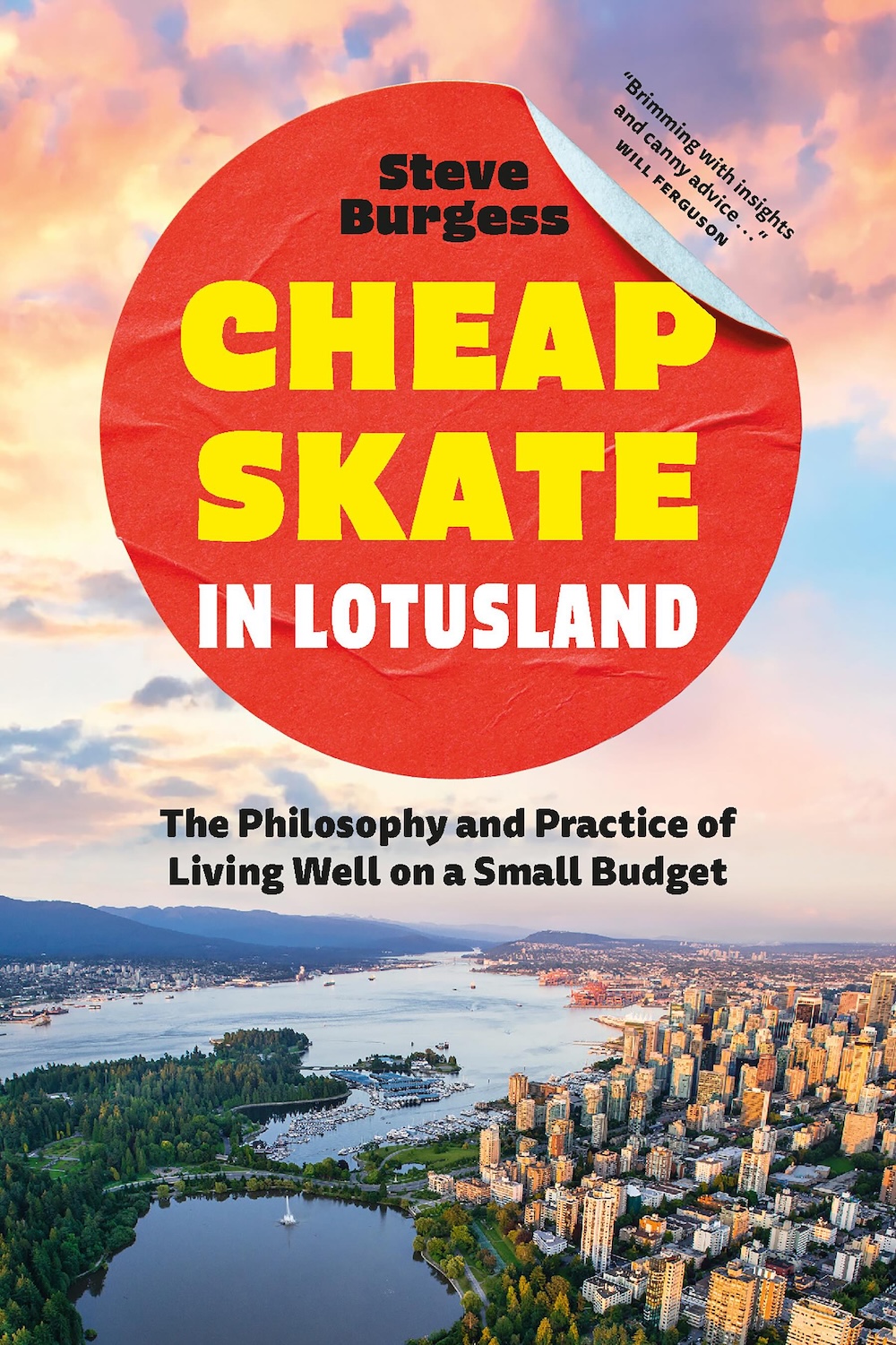
[Editor’s note: Exuberant, funny and imbued with a memorable sense of place, Steve Burgess’s latest book dives into the philosophy and practice of frugality. A blend of memoir and reportage, ‘Cheapskate in Lotusland: The Philosophy and Practice of Living Well on a Small Budget’ considers what it means to live well and live sustainability in Vancouver, an expensive city. In this excerpt from ‘Chapter One: Day in the Life of a Centipede,’ Burgess takes us through a day in his life as a professional writer and resident of Vancouver’s West End.]
What gets you out of bed each day? If you have a day job, it’s the alarm. If you have a family, it’s your kids. If you’re like me, it’s your bladder.
Up and into the bathroom, briefly glancing in the mirror at whatever bizarre hair sculpture my pillow has shaped that morning. Then off to the computer desk, grabbing a shirt from the lightly soiled garment pile without breaking shuffle. Check email, scan headlines and social media, and wait for brain functions to reach acceptable levels. It’s a gradual thaw.
I have followed the same regime for decades for a simple reason: at that point in the day, I do not want to burden my befuddled brain. It is too early for executive decisions. But although I have the great luxury of taking it slow in the mornings, the time for honest toil must come. We are all driven, more or less, by the need for sustenance.
Keeping up with rent, paying bills, putting food on the TV tray and cheese in the fridge — it all requires money.
I don’t start with coffee, as so many do. Caffeine is a precious resource, a magical elixir not to be squandered. First, breakfast. The menu is limited — muesli or granola, or two sandwiches made with multi-grain bread, sugarless peanut butter and sliced bananas. Either option is usually followed with flavoured yogurt, preferably strawberry. With luck it will be augmented by fresh strawberries — depends on whether I found any cheap berries on sale this week when I rode my bicycle to Sunrise Market in the Downtown Eastside. I rely on that local business to keep the vegetable crisper stocked at a reasonable price.
I live in Vancouver. They used to call it "Lotusland," a backhanded compliment that combined a nod to the city’s physical beauty with a vague implication that this is not a serious place. The beauty, at least, is inarguable.
My one-bedroom apartment is located about a block from Lost Lagoon and the surrounding glory of Stanley Park. It’s the kind of neighbourhood where the noise heard through the open window often comes from groups of schoolchildren on field trips.
I have lived in this city since September 1988, the last 20-odd years in this building. It’s a famously expensive town. Since I first made Vancouver my home, my monthly rent has increased roughly 350 per cent.
My income over those 37 years, excluding a couple of relatively brief spikes, has remained remarkably consistent. My rent is a butterfly, my income a caterpillar.
After breakfast, shower and shave. Music! I still have the ESS Heil AMT-4 stereo speakers that were my first major purchase almost five decades ago. They remain really great speakers. While such technology has been buried by layer after layer of advances in the history of musical delivery systems, I have languished in a technological backwater. I still have some old vinyl, and even cassettes, but these days I prefer to download songs and burn carefully curated playlists onto blank CDs. I have hundreds of such discs. One will be selected to launch the day. And at last it is time for coffee.
My coffee routine reveals a surprising number of financial and biographical insights. There is the habit itself, a relatively benign placeholder for a youthful alcohol addiction long since abandoned. There is the finicky method of preparation, a lengthy process that requires me to grind the dark-roast beans to the consistency of dust, pack them tight, then press the pump button at least 10 times to coax out the brutally powerful molasses I require. (It takes so long that I do my morning back exercises at the same time.)
There is the simple fact that I am the one making espresso for myself, rather than heading out to a cafe as I once did almost every day. Once upon a time my afternoons revolved around cafe life. But it became too costly. A seemingly modest daily expenditure was in fact a steady leak in the dam. Making coffee at home saves me hundreds of dollars per month. That’s important. Many of my personal habits have been shaped by a need for frugality.
Espresso made, I pour myself a tall tumbler of ice-cold water — my other favourite beverage — and sit down again at the computer, this time, hopefully, to work. This is what I have been saving that caffeine surge for — to slingshot my brain into productivity.
It’s a tricky moment. Will I squander that initial energy burst writing cute social media posts, reading Beatles history posts on Facebook and watching clips of Blaire Erskine doing her impersonation of the Mormon wives of TikTok?
Or will I force myself to produce some of the mildly lucrative writing that helps me pay the rent? Every day, it’s an even bet.
The apartment I sit in is a reliable comfort to me. It was once occupied by my writer friend Lila. It’s about 600 square feet, on the third floor of a five-storey ’50s-era building (there’s a little alcove in the wall for the telephone).
It has its drawbacks: the bathroom isn’t much bigger than an airport storage locker and the galley kitchen has enough available counter space for the Revolver album cover, but not Sgt. Pepper’s.
Arranging appliances is a game of Tetris. The microwave door opens over the sink, so it’s important to keep dirty dishes below the clearance level. I have become a better housekeeper over the years, but it’s all relative. Sometimes I think the fruit fly community has listed my apartment on Airbnb.
But it’s a great building in an ideal location. Flowering trees — magnolia, plum, cherry, horse chestnut — line the street. Lying in bed at night I hear faraway sirens answered by the keening chorus of coyotes in Stanley Park. Most of the annoying honking comes from geese. The neighbours are friendly, and our building manager, Joanne, runs a tight ship.
I am proud of my place. Since moving in I have filled it with treasures procured around the world. There are chairs of painted leather and ornate metalwork from Morocco, and on the wall above them a long wooden plank depicting the climactic battle of the Ramayana legend — carved figures of Rama and his monkey army battling Ravana and his demons, a scene apparently copied faithfully from the temple of Angkor Wat.
There is statuary from Bali — a fierce wooden Garuda, King of Birds, and a wooden Singha lion, guardian of wealth and prosperity, a socket in its back showing it once stood sentry at a Balinese house. There are framed propaganda posters from Vietnam, paper lamps from Laos, rugs from Morocco, Istanbul and Jerusalem, artifacts from Kathmandu and Cambodia, and a few Tibetan items I can’t really even talk about. Almost every item is connected to a memory, most of them pleasant.
'To me, Triscuit Mountain is postcard worthy'
Not all of the features are exotic artifacts. Over against the dining room wall you will find Triscuit Mountain. I’m proud of that too.
It used to rise from the floor like a snack-based Lego set, but then Joanne gave me some free-standing Ikea shelving, so now it climbs up each level like a terraced cracker plantation.
Triscuit Mountain speaks not only to my love of the salty crackers that contain only three ingredients and no trans fats, but also to my thrift, foresight and independence. I love Triscuits and desperately fear running out, but I balk at paying full price. So I wait for sale prices. When they come I do not stint. Triscuits have a long shelf life so I stock up.
And if the resulting stack of boxes is someone else’s idea of an eyesore, what of it? I’m the only one looking. To me, Triscuit Mountain is postcard worthy.
Triscuit Mountain (and its geographic companion, Toilet Paper Tower, located just across from the bathroom) is scientific evidence that I live alone. For some, solo life is a sad reality. I consider it perhaps my chief luxury. And it is a luxury — a rent-paying companion would do wonders for my budget, but I cherish my independence. Having a roommate would be like having a terrible job.
I love my job. Writing was not my first profession, but it is the realization of a dream that goes back almost as far as I can remember. Oceanographer, astronaut, famous actor — each of these had its moment of youthful aspirational enthusiasm. But the idea of being a writer was always there.
A 15-year career as a disc jockey in towns across Western Canada finally brought me to Vancouver, where a fortuitous firing that ended my radio career convinced me it was time to write. Like music, writing is a profession with a tiny elite and a massive underclass. I probably rank near the top of the Vancouver freelance cadre simply because I don’t do anything else for a living. But even that depends on your definition of living. My average annual income would not dry clean a month’s worth of Donald Trump’s ridiculous red ties.
Still, if you can scrape by doing the kind of writing you enjoy, there is, in my estimation, no better career.
Affordability is not just personal, but political
It is not every day that one stops, mid-routine, to look around and take stock. Familiarity blinds us to our circumstances, even those we may have longed for and worked hard to create. It’s a regrettable fact that many of us focus on absence rather than abundance — what we lack, rather than what we have. Dissatisfaction is chronic. As George Orwell once observed, "Any life when viewed from the inside is simply a series of defeats."
But if I freeze this frame and look around, I have to feel fortunate. I can’t say that I dreamed of living this life, that it is the realization of some vision board pieced together years ago. But in hindsight, it dovetails with whatever vague aspirations I may once have harboured. It fits. I seem to have blundered my way into a secular sort of Zen.
The question is: How? With years of financial earnings that have ranged from briefly respectable to appalling and usually hovered just north of dire, how am I on cruise control today? Frugality can spring from different impulses. For some, frugality is just one element of a wider philosophy, a means to achieve a simpler lifestyle.
Frugality can have an environmental motivation, as a practice of spending less to use less and leave a smaller footprint. At its most basic, frugality is about making the most of one’s resources and, in many cases, it’s about simply getting by.
A 2024 survey by pollsters at the Angus Reid Institute found 51 per cent of respondents reported that keeping up with household food needs was a challenge — a response rate that had been fairly steady for several years. For households making under $50,000 per year, that figure rose to 65 per cent; nearly two-thirds of Canadians were struggling to pay for groceries.
Nor is affordability just a personal issue. It is political. Waves of inflation that circled the industrialized world in the post-pandemic era ended up toppling governments at every level, as desperate electorates looked to assign blame. Demagogues and career politicians alike merely had to point to those in power and say, "They did this!" without offering any coherent strategies themselves.
Once the stalking horse of inflation had led them to power, the demagogues and populists were free to attack whatever rights and freedoms they chose to target. That’s not even to mention subsequent Trump tariffs intended to raise prices and destabilize international economies. In this way, rising prices and financial insecurity have threatened sovereignty and institutions of law and democracy, the bedrocks of civil society itself.
Any examination of frugality must also consider the actions of the huge corporations that dominate the retail market in North America. What are the destructive effects of the near monopolies that sit astride our towns and cities and starve the small businesses that once made up the fabric of community life?
The fox and the centipede
Ultimately though, the cost of living is a personal concern. Buffeted by global and national economic forces, we all have to make do as best we can. With a long history of modest and uncertain income, my own strategy has always emphasized frugality.
When I contemplate my financial status I often think of the parable of the fox and the centipede. Watching the centipede crawl across the forest floor, the fox observes, "You have so many legs. How do you know which ones to move, and in what order?" The centipede pauses. Forced to think about its actions, it becomes confused. It does not know what to do. Suddenly it cannot move. Stupid fox.
Can I play fox to my own centipede? Can I describe my own methods?
I have never made a budget. In place of a budget, I have a philosophy. Evidence of that philosophy can be found throughout my apartment.
That awkwardly placed microwave? Sourced from a nearby alley, spotted by the eagle-eyed Joanne. My 42.5‑inch LG TV? A cast-off from friends. The espresso machine? A gift. My suitcase was left beside the building’s dumpster, pristine but for one broken handle. My pantry is filled with discounts — in this kitchen, food items purchased at full retail price are as scarce as Democrats at a Wyoming barbecue.
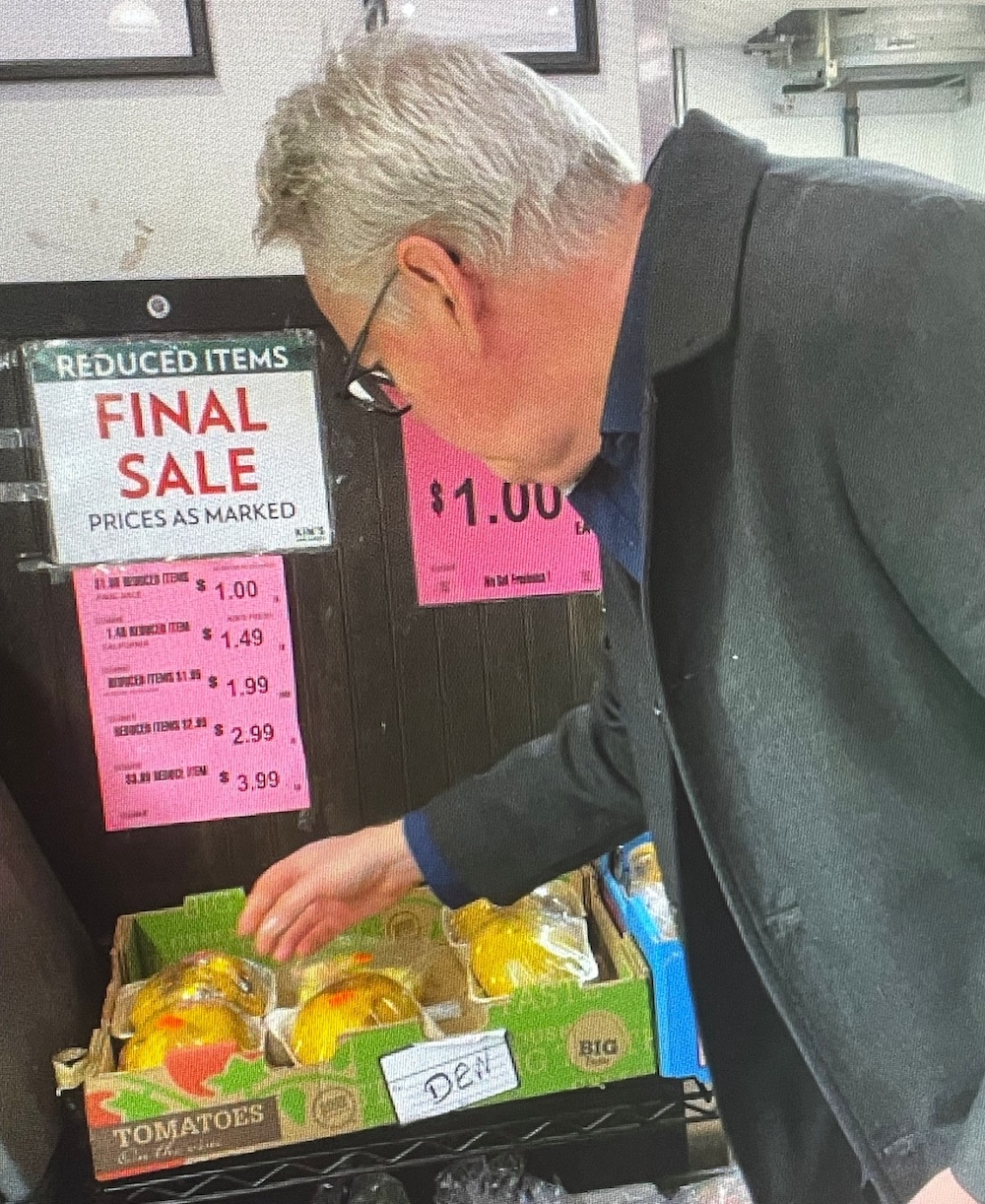
On a granular level, my guiding principle is that I will get what I need at the minimum possible expenditure, without fail. In a wider sense, it is that I will spend less than I earn. Charles Dickens summed it up in David Copperfield: "Annual income 20 pounds, annual expenditure 19 nineteen and six, result happiness. Annual income 20 pounds, annual expenditure 20 pound ought and six, result misery."
Live within your means. Easier said than done, but essential. As Dickens’s Wilkins Micawber points out, the alternative can put you in a spiral.
Smug advice is an industry. Think and grow rich, sucker! Learn the art of the grift … er, deal. Trump University paid out $25 million in fraud penalties.
Its students were supposed to get wealthy. Instead they got conned. There has long been a market for glib bullshit.
What drives our need for more?
I cannot claim to be a man with a simple 10-point prescription for wealth and happiness. I am not a strategist, planner or conceptual thinker. Driven mostly by innate impulses and insistent inner voices, I develop habits and routines. As my breakfast ritual suggests, these routines can slide toward the obsessive.
I understand that my situation is particular to me. It is dependent upon my own circumstances, including the fact that I am responsible for myself alone — no partner, no kids, no impoverished family members. It is helped by my ability to work from home in a city that allows for easy biking, walking and transit. I no longer drink alcohol, smoke or take drugs, be they cheap or expensive.
I am a single, childless, carless, teetotalling, low-income senior who does things like wash plastic wrap and stick it in a kitchen drawer. But being an obsessive loner is not all squeezing nickels, mumbling to yourself and growing out your fingernails — there’s a downside too.
I have an unsettling awareness of my own obsessive nature. It’s not quite at the level of what you’d see on a reality TV series, but my penny-pinching can get a bit weird. I see a little too much of myself in those TLC programs like Extreme Cheapskates and Extreme Couponing. Push myself a little further and I could perhaps be a legitimate object of horrified fascination, like the woman who measures laundry detergent with a syringe.
Mine, then, is not a universal prescription for financial health. Still, quirky as I am, I believe that my life makes for a legitimate case study. At least some of my behaviours are transferable. Plus, many of my habits are just weird enough to be entertaining. Even if you don’t learn much that’s useful, you will have the satisfaction of knowing there is someone out there who makes you look relatively normal by comparison.
And there are other examples out there. I will speak with people whose situations differ from my own and uncover their strategies for getting by in an increasingly expensive world. And I will talk to those who are asking the larger questions about our 21st-century lifestyles and consumer habits.
What drives our need for more? How can we learn to distinguish the necessary from the superfluous? How far can we go toward removing ourselves from the cycle of spending and waste? How can we come to grips with the effects of mass consumption on a warming and polluted planet?
And what of my own choices? Are they sustainable? Are they selfish? Am I a particularly egregious contributor to the existential crisis of climate change? What’s the real cost of those Triscuits I consume so greedily? Am I a responsible member of my community or a parasite? If my sole focus is on saving money, am I losing sight of a larger price to be paid?
The first stop on this journey must be the supermarket.
Come back to the Tyee next week for the second instalment of the ‘Cheapskate in Lotusland’ series, where we join Steve Burgess on one of his favourite weekly pastimes: grocery shopping.
‘Chapter One: Day in the Life of a Centipede’ from ‘Cheapskate in Lotusland: The Philosophy and Practice of Living Well on a Small Budget,’ Steve Burgess, 2026, Douglas & McIntyre. Reprinted with permission from the publisher. ![[Tyee]](/design-article.thetyee.ca/ui/img/yellowblob.png)







Notice about commenting changes
The Tyee’s commenting system will be moving to a new platform on Nov. 12. If you’re already a Tyee commenter you must register with the new system on or after Nov. 12 with your preferred username.More information can be found here.