


 SHARE:
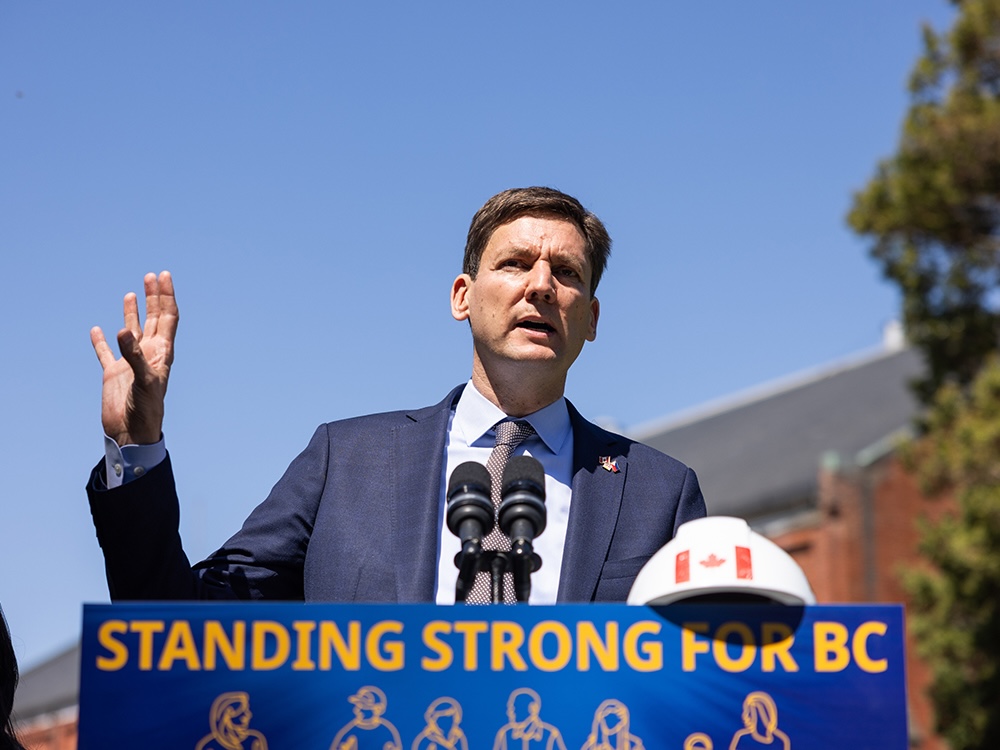
Canada’s drive to build the economy through expanded oil and gas production, regardless of the impact on carbon emissions, is laying bare new fault lines in Premier David Eby’s cabinet just as LNG Canada heads to a $33-billion Phase 2 expansion decision that would double its B.C. production.
Climate change is rebounding as a national concern. New data from the Angus Reid Institute shows some federal Liberal party support bleeding to the federal New Democrats because of climate concerns. The reverse is the case here: the BC NDP is at risk of losing climate voters to the BC Greens.
Eby’s slumping personal popularity suggests that Prime Minister Mark Carney’s new pipeline project with Alberta Premier Danielle Smith has been a net negative for Eby, despite broad support for the proposal among voters.
That’s all good news for BC Green Party Leader Emily Lowan, who expects to win environmental votes from disaffected NDP voters while she attacks Eby on class issues with her “Fight the oligarchs” campaign.
As raging wildfires encircled the Fraser Canyon community of Boston Bar, the tensions in Eby’s caucus came into the open July 24 with duelling statements by two cabinet ministers, each responsible for aspects of climate policy.
The trigger was cabinet’s decision to expedite FortisBC’s $2-billion Tilbury LNG project, formally approved by the Eby government in 2024. This new facility, located on the Fraser River in Delta, will allow the Port of Vancouver to refuel LNG-powered maritime shipping, the cleanest ships now at sea. Of all the LNG projects now in play in the province, Tilbury is one of the smallest.
First out of the gate was Energy and Climate Solutions Minister Adrian Dix, announcing that cabinet had passed an order-in-council granting Fortis a certificate of public convenience and necessity, saving the company a hearing in front of the British Columbia Utilities Commission. Construction could begin as early as next year. Dix celebrated the jobs, the investment and the dramatic emissions reductions from marine shipping.
Hot on Dix’s heels, with Eby’s approval, was Richmond-Steveston MLA Kelly Greene, minister of emergency management and climate readiness. Her statement, released by the BC NDP caucus and on Instagram, expressed her “disappointment” at what she termed “FortisBC’s decision.”
Her position on the project, Greene said, “has remained unchanged since before being elected to the legislature.” Her safety concerns, which date back to her years on Richmond city council from 2018 to 2020, have not been resolved by the many improvements made so far.
“I will continue to advocate for the mitigation of any safety issues identified going forward,” Greene declared. “As the representative for Richmond-Steveston, I will never stop lifting the voices of my constituents and never stop fighting for a better future.”
That did not sound like cabinet solidarity to Vancouver Sun columnist Vaughn Palmer, or experts consulted by Global TV. “Cabinet confidentiality?” asked Palmer. “Solidarity?” In a followup tweet, he wondered, “How far will Eby allow ministers to depart from cabinet solidarity?”
Eby shrugged it off. “Kelly Greene is an amazing MLA. She’s a huge champion for her community,” he told reporters. “There is space in our cabinet and in our caucus for disagreement.” Apparently, reporters did not ask for an assessment of Dix.
The Tilbury project is just across the river from Greene’s Richmond riding, where a few days later she was hanging out with former council colleague and NDP environmental icon Harold Steves, one of three MLAs who broke ranks to vote against then-premier Dave Barrett’s back-to-work legislation in 1975. If you’re a committed environmentalist looking for an NDP maverick role model, you can’t do better than Steves.
Greene is not alone in her opposition to Tilbury. Housing Minister Christine Boyle opposed Tilbury as a member of Vancouver city council, and Attorney General Niki Sharma was briefly a campaigner on the issue for Stand.earth before her election to the legislature.
Eby was himself so comfortable with Greene’s stance that his office assisted her in drafting her statement. It was Dix, however, announcing a cabinet decision in line with NDP policy since 2017, who was closer to Eby’s stated position on LNG, and to public opinion.
By framing Greene’s concerns as a safety matter, rather than a rejection of LNG development, the Eby team evidently hoped to minimize the focus on climate policy at the heart of the argument. That will not be easy.
Both Greene and Dix were in cabinet in March 2025, when Eby cancelled B.C.’s carbon tax, part of a national retreat on consumer carbon pricing that cost the B.C. budget $2 billion and contributed significantly to the 2026 deficit.
Both were there, as well, when the federal and provincial governments approved the Ksi Lisims LNG project, an entirely new LNG pipeline and terminal project that, despite its net-zero claims, will demolish any lingering remnants of CleanBC’s emissions reduction goals. There were no “disappointed” statements then.
Clearly, times have changed.
The stage had been set for the Greene-Dix faceoff two weeks earlier when two front-benchers declared their opposition to the new oilsands pipeline at the centre of Carney’s grand bargain with Smith.
Eby’s consolation prize for conceding the federal government’s right to drive the project forward was a $20-billion blowout announcement with Carney that upheld the tanker ban on the North Coast, supported B.C.’s North Coast Transmission Line, poured billions into the Fraser River tunnel crossing and much more.
The grandly named Canada-British Columbia Co-operative Prosperity Agreement would “power decades of jobs, prosperity [and] growth,” the government’s news release vowed. There was no mention of the Smith-Carney pipeline accord.
Two cabinet front-benchers were quick to fill that gap, heading to Instagram to make their views clear.
While Boyle, MLA for Vancouver-Little Mountain, welcomed much of the Carney-Eby agreement — the tanker ban, investments in child care, money for the tunnel — she made it clear she’s “against a new pipeline to the coast.” Citizens’ Services Minster Diana Gibson (Oak Bay-Gordon Head) went straight to the point: “I want to be on the record that I oppose a new oil pipeline to B.C.’s coast.” Both represent ridings with strong pro-environment voter blocs.
What will Boyle and Gibson say if LNG Canada announces a Phase 2 expansion as early as this fall, a decision Eby has worked hard to deliver? Time will tell.
The growing rift in NDP ranks was underlined July 15 by an open letter to Eby from 16 NDP luminaries, including 10 former MPs and MLAs. The letter was co-ordinated by the BC Climate Emergency Campaign, successor to the David Suzuki Institute’s Climate Emergency Unit, an initiative headed until 2025 by Seth Klein, spouse of Housing Minister Boyle and brother-in-law of federal NDP Leader Avi Lewis. (Klein reposted the letter on social media.)
The signatories didn’t pull their punches. Once “a leader on climate action,” the letter said, B.C. “is backtracking on nearly every metric of progress. B.C. no longer has a climate plan.... We are witnessing widespread capitulation to the fossil fuel industry under the guise of safeguarding our economy against U.S. threats and other geopolitical shocks.”
The tension between economic development and climate action is not new, although it’s long been clear that it’s possible to grow the economy and reduce emissions at the same time. It’s much harder, obviously, when the growth is actually driven by increasing emissions.
In 2017, former premier John Horgan managed the conflict two ways. First, he had won the leadership promising to support LNG development. No one in his caucus could have any illusions on that score. Second, he balanced his support for LNG with a pledge to implement a comprehensive emissions reduction regime.
The CleanBC plan, developed by then-environment minister George Heyman with the support of the BC Greens under then-leader Andrew Weaver, was announced in 2018 and backed up by legislation in subsequent years. Emissions from LNG Canada’s first phase were included in the base. Other projects with permits already in hand — Cedar LNG and Woodfibre LNG — were considered small enough to be manageable if they proceeded. (Now they have.)
Ksi Lisims was nowhere in sight, LNG Canada Phase 2 a distant dream. Now they’re here and CleanBC is not. Either project would blow through CleanBC emissions reduction goals. The balance struck in 2018 is gone.
Despite the rollbacks to CleanBC and the focus on LNG, Dix has been driving BC Hydro to make massive investments in renewable energy, committing to purchase thousands of gigawatt hours of solar and wind energy. Site C is on stream. New generating units are being added to existing dams. Work on the North Coast Transmission Line, which will bring green power to new mines in the province’s far north, is moving forward. These are critical initiatives but won’t reduce emissions on their own.
Unhappy MLAs who speak out against a government’s direction are nothing new. If they are loud or nasty enough, they may be sanctioned, even expelled from caucus. Life goes on.
Cabinet ministers who do so with the assistance of the premier’s office are an Eby innovation. For members of cabinet, the rules have been straightforward: you’re in or you’re out. Now, perhaps, it will be possible to take a separate stand, and even be sanctioned to do so.
Greene’s “disappointment,” combined with the Boyle and Gibson declarations, are symptoms of deeper divisions inside the government over LNG development, which is the core of Eby’s economic agenda.
This argument is far from over. ![[Tyee]](/design-article.thetyee.ca/ui/img/yellowblob.png)
Read more: Energy, BC Politics, Environment


Tyee Commenting Guidelines
Please note that email notifications for replies are not currently working due to a software issue which may be resolved in a future update.
Comments that violate guidelines risk being deleted, and violations may result in a temporary or permanent user ban. Maintain the spirit of good conversation to stay in the discussion and be patient with moderators. Comments are reviewed regularly but not in real time.
Do:
Do not: