


 SHARE:
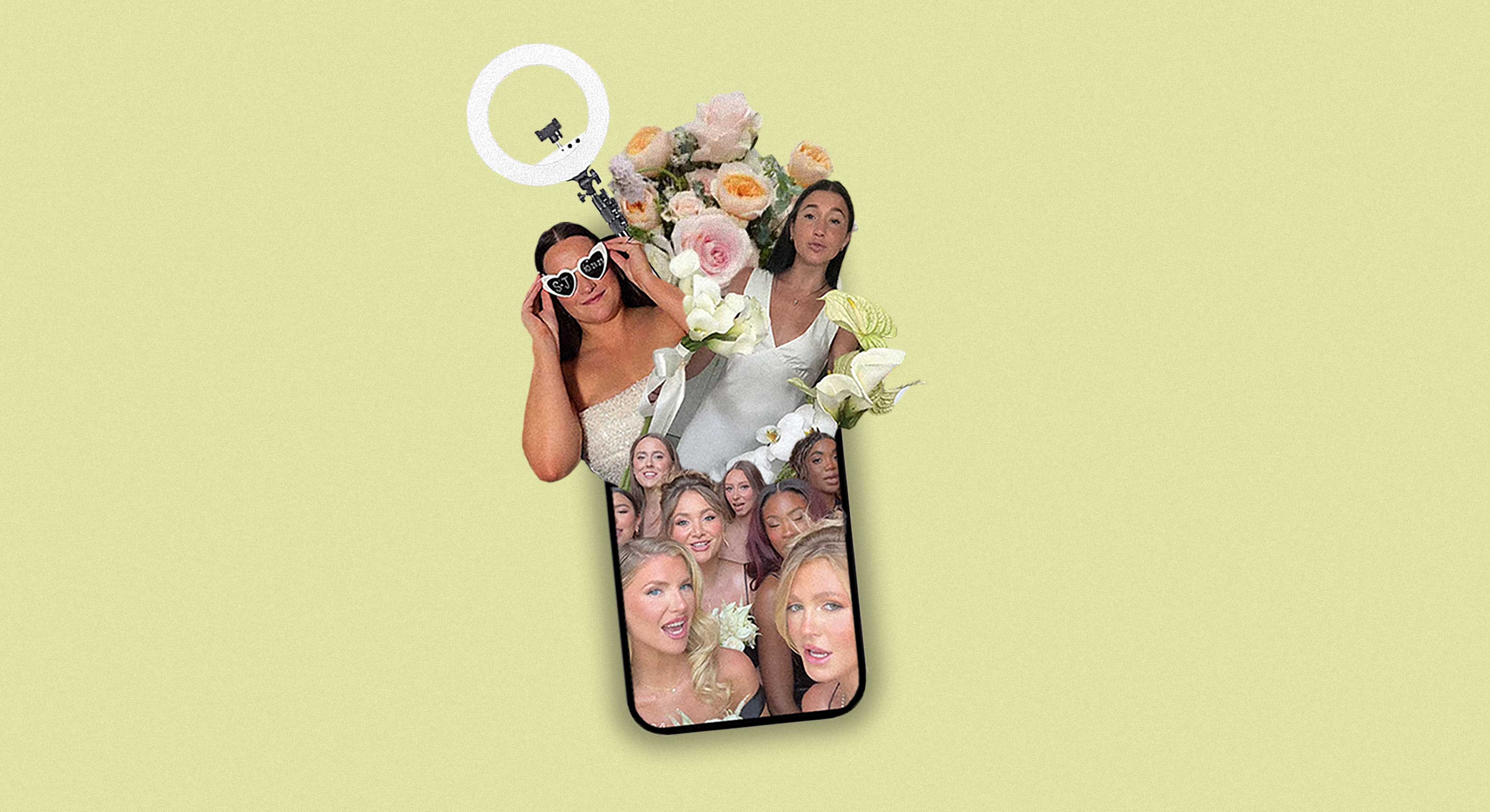
As soon as my partner and I committed to getting married next summer, I fell face first into #WeddingTok.
Like many corners of the internet, #WeddingTok — content on TikTok dedicated to wedding planning — is TARDIS-like in that it is bigger on the inside than it looks from the outside. You may wonder how much video content there really could be about planning a wedding (something a person ideally only does once), and yet there are over 21.7 million posts on the platform with the #wedding hashtag.
As someone prone to scrolling TikTok before I go to bed, my dreams are now haunted by the possibilities that #WeddingTok presents.
I close my eyes and see dried grass centrepieces and food truck reception catering. I’m startled awake by the thought of forgetting to pick out a signature cocktail, or worrying if simply risograph printing our invitations is enough, or if we should look into getting them embossed as well. My dreams are shifting landscapes of thrifted candle holders, hand-written guest cards and dog ring-bearers.
Simply put: #WeddingTok has consumed me.
My own wedding is still a year away. And yet every night during my nightly TikTok scroll before bed, I find myself leaning over to my fiancée (interrupting whatever library book she’s reading) to say, “What if we had a selfie mirror at our wedding?”
Or, “Look at these cocktail napkins with pictures of their cats. We could do that!”
Or, much more often, “Imagine if money was no object and we could do [insert outlandish thing like an ice cream truck or a claw machine here].”
And it’s all the fault of #WeddingTok. Whether I like it or not, it is changing how I think about my own nuptials.
An exercise in inadequacy
My fiancée and I will have been together for six years when we say “I do” next summer. When it comes to what our wedding looks like, I’d like to think we know each other and what we want out of our big day — or so I thought.
My nightly scroll of #WeddingTok has not only suggested to me that we need things we’ve never even thought of, such as monogrammed flower petal bags for our guests at the ceremony. It’s also telling us that we’re already way behind.
Creators on the platform like to self-identify as a bride of a certain year. A video might start with the hook “Things I’ve already done for my wedding as a 2026 bride,” or the inverse, “Things I will not be doing at my wedding as a 2026 bride.” The subsequent video will then dive into a familiar list of yucks (having a bridal party) and yums (dried floral arrangements) when it comes to a wedding.
But what’s really gotten me is the forecasting many of these women — because it’s almost always women — are doing for their weddings far down the line.
I’ve seen content from 2027 brides talking about how they need to be booking their photographers now. One post from a self-described 2028 bride shows how she’s already booked a venue, photographer and accommodations and started personalizing table numbers. 2028! That’s three years from now!
In a world where the popularity of platforms like TikTok encourages users to commodify and promote every aspect of ourselves and our identities, it makes sense that #WeddingTok has taken off. For creators, it’s a way to capitalize on a process they’re already in the thick of.
And for audiences — myself included — it’s an endless scroll primed for hyper-fixation and an almost ASMR-like sense of soothing repetition (the amount of times I’ve heard middling song-of-the-summer contender Alex Warren’s “The Ordinary” over a montage of floral arrangements and moodboards is truly limitless).
My first experiences of these videos sent me into a small panic. What do you mean we should already have thrifted 200 decorative glass bud vases if we plan on getting married in 2026? Is our wedding going to flop because we aren’t thinking of all of these things?
After pausing to reflect, I accepted that this corner of #WeddingTok should be a reminder that we all come into this a bit differently. Some people start planning their wedding when they are five years old. Some of us take a bit of a more roundabout way to get there. The end result — ideally, being married to the love of your life — is the same.
I didn’t always know I wanted to get married. That changed pretty quickly when Jasmine and I started dating, but before that I didn’t think it was in the cards for me. My ex before her was much more keen on tying the knot, and my lack of commitment to that vision in my mid-20s was one of the factors that led to the dissolution of that relationship.
Before that ex, I was freshly out as queer, and before that closeted to even myself. I wasn’t dating, let alone thinking about marriage.
As a kid, the idea of me, a “woman,” marrying a cis man felt so deeply foreign I never even considered floral arrangements or what I wanted to wear on my big day.
When I tried to picture myself in a wedding dress next to a grown version of the boys I went to high school with, there was a big hole in the picture where I should’ve been — like somebody had disappeared me like they do the girls in the America’s Next Top Model intro.
Obviously, that’s since changed. Accepting and seeing the mental image of me at my wedding, wearing a men’s suit with a beard and bride beside me — big gaping hole in the picture finally gone — was one of the things that really spurred my coming out as trans early in my relationship with Jasmine.
Now I’ve got the beard. I’ve got the bride. And suddenly, I have to consider all of the wedding nonsense.
When everything is content, what to do?
Before #WeddingTok I thought things were pretty straightforward when it came to planning a wedding. Book a venue. Get some food. Find a photographer. Channel the energy of Legally Blonde’s Elle Woods getting into law school: “What, like it’s hard?”
But planning a wedding in 2025 presents new challenges that are easily distilled into the popularity of #WeddingTok. For one, weddings are expensive: estimates of the average cost of a wedding in Canada range from $20,000 to $30,000.
And then there’s the issue of how everything in our lives, particularly milestone events like weddings, has become fodder for social media content. According to the wedding market research firm Splendid Insights, one in six couples hired a content creator for their wedding last year — that’s in addition to a photographer and videographer.
Gone are the days of simply getting a photographer to take your picture on your big day: now you need Reels, drone footage, highlights and the opportunity for your guests to do the same.
Thus, the existence of #WeddingTok makes sense to me. It is a crashed-together combination of capitalism (those affiliate links are flowing!) and the desire to turn our lives into content for consumption.
And I, with my nightly scrolling and fretting over centrepieces, am a willing participant.
One of the best things about a relationship is its individuality. No two people are alike, and no two bonds between people are alike.
And as I work to de-influence the grip that #WeddingTok has on me, I find myself returning to the real, tangible weddings that I do want to influence ours, rather than the endless scroll of posts I see online.
Earlier this year, two of our friends got married on a beach on the Sunshine Coast, with only a couple witnesses and the officiant present. Afterwards they soaked in a hot tub and barrel sauna. One of them wore a hand-me-down dress, and not long after saying “I do” she sat by the ocean knitting beside her new wife in the sun.
They taught us about doing things on your terms, and not giving into the pressure to do anything more or less than what you and your partner actually want.
Last year we went to Jasmine’s step-brother’s wedding in Saskatchewan, held on his 80-acre property outside of Saskatoon. He wore a kilt (with nothing underneath) and a main attraction of the reception was his new wife doing a gender-swapped “grab the garter with teeth” thing while working carefully to not expose his nether regions to the assembled crowd of family and friends.
They taught us about having fun, and embracing even the cringey parts of being silly.
My mom and step-father got married when I was 13. A few months earlier, they were in a devastating car accident on Highway 2 while on their way to Canmore to meet with their wedding planner.
My mom planned most of her wedding from a hospital bed, nursing a broken pelvis among a slew of other injuries. There was a period of time where it may not have happened. Had things gone slightly differently, they might not have even been there to get married.
But the day itself came and my step-father walked my mom down the aisle in her wheelchair. My sister and I were bridesmaids in matching dresses. We ate little cupcakes with yellow fondant daisies and danced into the night surrounded by friends and family. It was perfect.
Above all, their wedding taught me that not all of it really matters. The cupcakes with daisies were nice, the buffet was good, the dresses were beautiful.
But by far the most important thing about that day was that we made it there together as a family — especially considering how close we came to not. That’s what we remember 17 years later.
I’m appreciative of social media for the resources and massive amount of information it can give us. It’s fun to mindlessly scroll #WeddingTok late at night and fantasize about hand-written seating charts, custom crossword puzzles and elaborate arches and worry that we’re already behind the ball compared to everyone else getting married next year.
But when I think about what should be the best day of my life, I’m going to work to let social media’s influence roll off of me. What matters most is the lifetime we’ll get to spend afterwards. ![[Tyee]](/design-article.thetyee.ca/ui/img/yellowblob.png)
Read more: Gender + Sexuality, Media





Tyee Commenting Guidelines
Please note that email notifications for replies are not currently working due to a software issue which may be resolved in a future update.
Comments that violate guidelines risk being deleted, and violations may result in a temporary or permanent user ban. Maintain the spirit of good conversation to stay in the discussion and be patient with moderators. Comments are reviewed regularly but not in real time.
Do:
Do not: