


 SHARE:
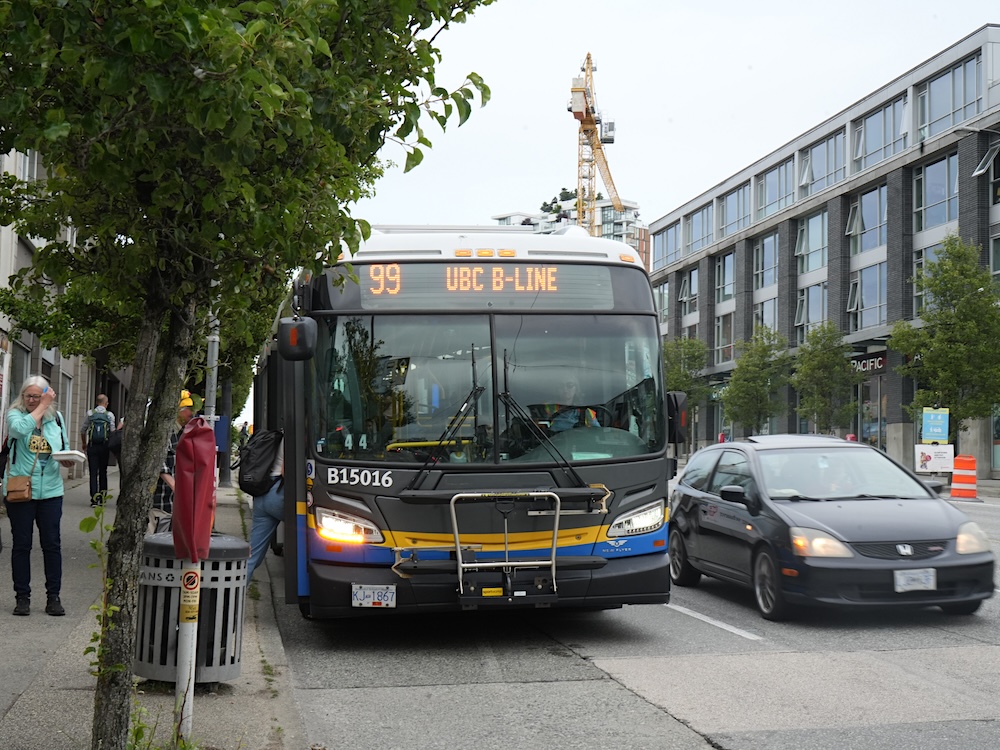
After a high World Cup ridership, TransLink’s 2025 Transit Service Performance Review may feel like a bit of a letdown.
The Metro Vancouver region grew by just under 5,300 people in 2025. Compare that with 2023 and 2024, when this part of B.C. expanded by more than 100,000 additional people annually.
Last year’s population decline was due in large part to a massive reduction in the number of international students and temporary workers, who typically take transit.
As a result, the number of TransLink riders overall actually decreased by 1.5 per cent or 3.3 million trips in 2025, over 2024.
This hit buses — 60 per cent of all transit boardings — and the Expo and Millennium SkyTrain lines the hardest. Meanwhile the Canada Line, SeaBus, HandyDart and West Coast Express all saw modest ridership increases in 2025.
But bus rides aren’t dropping evenly across the board, said Denis Agar, executive director of the non-profit Movement: Metro Vancouver Transit Riders, which advocates on behalf of transit users.
“In the places where transit got improved, transit ridership is up. And in the places where transit got cut back, transit ridership is down,” said Agar.
“It’s so obvious, and we just keep getting evidence that indicates that when you make transit faster, more reliable, competitive with driving, it will grow. It will absolutely attract people, basically, immediately to its service. And it will keep growing.”
TransLink reaped the benefits of a greater investment into Surrey, as overall ridership rose significantly in 2025. Out of the top 10 bus routes by growth over 2019 ridership — before the dip in riders during the height of pandemic restrictions — eight are in Surrey.
But TransLink also made cuts to some Vancouver bus routes in 2020 that have not been reversed. As a result, the top 10 bus routes with decreased ridership are all in Vancouver. Specifically, bus routes 20, 30 and 8 saw boardings drop more than 50 per cent in 2025, compared with 2019.
With TransLink facing a significant deficit in 2024 that could have resulted in up to 50 per cent service cuts had the province and municipalities not stepped in, Agar is paying attention to this public transit system snapshot.
“If you’re a person that rides transit, or cares about transit, or wants to see congestion go down, or wants to see climate change defeated, you should be interested in transit growing,” he said.
Benefits of improved transit access include saving families tens of thousands of dollars annually in car-related costs, reducing greenhouse gas emissions, improving air quality and freeing up roads for transporting goods we all rely on.
“If we just put buses on the roads, people will take them,” Agar said.
The costs of decreased ridership
You might think decreasing the number of buses on a route would save the transit authority money. But Agar said slower bus service is actually costing TransLink over $115 million annually, not to mention leading to overcrowded buses and, paradoxically, people turning away from transit.
“Any way that TransLink can save money is an opportunity for them to reinvest those savings into making transit better,” Agar said, adding his biggest takeaway from the performance review is that Metro Vancouver needs more buses.
TransLink is aware of this, he said, pointing to its “Bus Speed and Reliability” report. Running more buses increases the frequency of trips and “addresses overcrowding, reduces wait time and makes people’s commutes more reliable,” Agar said.
Other municipal investments such as adding a bus-only lane on a major thoroughfare to decrease travel time, for example, would pay for itself in just months, Agar said.
The bus route with the most ridership growth in 2025 — up 119 per cent compared with 2024 — is the 609 that runs through the Tsawwassen First Nation. TransLink extended the line to the Ladner Exchange, connecting riders to more routes than they previously had access to.
The 719/722 bus with service to Pitt Meadows and the Katzie First Nation had the second-highest growth with a 57 per cent increase in ridership. TransLink achieved this by increasing trip frequency and running on Sundays.
Ridership for these largely rural routes was pretty small to begin with, Agar said. But he was still surprised at the rapid growth they experienced after relatively modest changes.
“When you add service to a corridor, people flock to it. Those people become advocates for better transit,” Agar said, describing it as a feedback loop.
“They become people that are attuned to the day-to-day experience of transit and go, ‘Oh yeah, we should definitely have more buses here, we should have a SkyTrain here,’ etc.”
The municipal election connection
Public transit services are supported by a combination of funding and infrastructure support from municipal, provincial and federal governments.
The coming municipal elections may not bring a major, immediate expansion to transit — such as expanding the Broadway corridor SkyTrain all the way to the University of British Columbia, which will certainly require provincial and federal investments — on its own.
But Movement: Metro Vancouver Transit Riders has created separate transit pledges for municipal parties and for voters to take to help prioritize public transit this election.
For example, municipalities control where bus stops go, whether a traffic signal prioritizing bus lanes is installed, whether a street gets expanded to allow for more transit, or if bus bulbs (extensions to sidewalks to make bus operations smoother) are installed. Decisions to rezone transit routes for multi-family housing would also increase ridership, Agar said.
The Metro Vancouver Mayors’ Council on Regional Transportation, composed of delegates from each municipality, has a say over how TransLink spends its money, too.
“And to what level people will be taxed for transit expansion,” Agar said.
If it were solely up to TransLink, as outlined in its “Access for Everyone” plan, there would be a doubling of transit services in the Lower Mainland.
That would require significantly more funding for public transit, and Movement is concerned TransLink will find itself in another deficit situation next year if government funding levels don’t change.
The good news, Agar said, is the province has already committed to introducing a new investment tool for public transit. We just don’t know what it is yet.
“There are a lot of ideas out there that other transit agencies use, that we could use,” Agar said. That includes a sales tax solely for transit funding, or a vehicle levy.
Agar leans towards the levy, specifically how it’s done in Seattle, where drivers are charged 1.1 per cent of the value of their vehicle, instead of a flat rate for everyone.
Other places charge levies based on a vehicle’s weight. This would affect electric vehicles in particular, which have benefited from not paying the gas tax, Agar said.
“The main thing that I’m worried about is not whether the province is going to do this. They’ve been pretty consistent that they are,” he said.
But Agar is concerned the province will put a cap on how much money TransLink could collect, limiting how much the service can afford to expand.
“If we had enough resources, we could restore the transit service on all those routes in Vancouver that have been cut back,” he said. ![[Tyee]](/design-article.thetyee.ca/ui/img/yellowblob.png)
Read more: Transportation, Municipal Politics






Tyee Commenting Guidelines
Please note that email notifications for replies are not currently working due to a software issue which may be resolved in a future update.
Comments that violate guidelines risk being deleted, and violations may result in a temporary or permanent user ban. Maintain the spirit of good conversation to stay in the discussion and be patient with moderators. Comments are reviewed regularly but not in real time.
Do:
Do not: