

 SHARE:
For the last 40 years Ralph Nelson has started his workday with the tides. He gets up, checks the weather and gets ready to kayak from his boat up a salmon-bearing stream.
He doesn’t pack a lunch, even if getting to the salmon spawning pools will take all day. After all, there are hungry bears in the area.
As he paddles, he notes how many salmon are waiting at the mouth of the river. They’ll hang out and wait for the ideal conditions and are incredible at predicting when it’s about to rain, he told The Tyee.
He’ll paddle until the river is too shallow, and then he’ll walk until he finds the cool, calm pools where the salmon spawn.
He counts salmon along the way, checking the water temperature and keeping an eye out for sediment or debris in the water, the impacts of logging, high or low stream flow and how many predators are in the area.
Wolves can kill 5,000 pink salmon in a night, taking only one bite out of the back of the fish’s head. Bears prefer to heave female salmon onto the bank and eat the eggs, he said.
Nelson is a charter patrolman, a job sometimes called a creek walker.
Creek walkers are contracted by Fisheries and Oceans Canada — often referred to as DFO — to walk along streams and estimate salmon escapement numbers, or how many fish spawned that year.
Fifty years ago DFO worked with thousands of charter patrolmen to count salmon, predict runs and manage fisheries.
Now there are about 10 of them left, and Nelson said they’re contracted for only a couple dozen days of work each. That means the majority of the streams on the coast are going uncounted.
Without collecting data from the entire coast, DFO has no idea how many salmon are left and is not monitoring how and when streams are being affected by climate change, logging, vanishing glaciers or other man-made impacts, Nelson said.
William Housty, director of integrated resource management for the Heiltsuk Nation, said First Nations of B.C.’s Central Coast had to start doing their own salmon escapement counts because, recently, DFO has not been hiring enough people to count the streams on their territory.
“We’re not going to miss them because they’re not around anyway,” he said, adding he’s “disappointed with DFO for not following through on its obligation to manage wild salmon.”
Luckily, he said, the Heiltsuk Nation has the capacity to take on this job. Seven teams go out and count each of the 103 salmon-bearing streams in their territory three to four times during the salmon spawning season, he said.
But not all nations have the same capacity.
“I hope DFO realizes that they need to be putting more effort into their responsibility to manage these salmon resources,” Housty said.
“They shouldn’t just be leaving it to First Nations or other groups to do it on their behalf, because they’re the ones that are responsible for it and they’re not here. It’s not a good situation and not a good look for them.”
Over the past 50 years DFO has radically reduced how many days it contracts charter patrolmen to count salmon.
At the same time, the size of salmon runs — when salmon return to the waterways they were born in to spawn in late summer and early fall — has also been radically reduced.
Back in the early 1900s the Fraser River used to have runs of 40 million sockeye salmon, according to the Pacific Salmon Commission. By 2010 a good year could have just under 30 million, but the four-year average number had dropped to under 10 million, and by 2020 it had dropped to four million.
In 2001 the commercial fishery caught 11.7 million Pacific salmon along the entire coast, according to DFO. That number had dropped to 5.1 million by 2015 and 2.9 million in 2025.
Despite the shrinking runs, it’s still important to know where and how many salmon are spawning, charter patrolmen told The Tyee.
Environmentally, we need to know what effect climate change is having on salmon populations, said Stan Hutchings, who works as a creek walker for Pacific Fisheries Management Area 6. That region covers the area around Kitimat to the open ocean and down the Gardner Canal.
“Last year alone we probably lost thousands and thousands of salmon because the water levels get too low and the temperature too high,” Hutchings said.
In 1977 there were 2,127 days charter patrolmen were contracted to count salmon in the roughly 179 salmon-bearing creeks on the Central Coast, Nelson said.
In 1983 there were 1,525 days, in 1998 it was 510 days, in 2003 there were 481 days, and in 2004 it was 296 days, he said.
Now it’s just Nelson and his partner Khya Saban covering Pacific Fisheries Management areas 7, 8, 9 and 10, which roughly covers the Central Coast from north of Klemtu to the northern tip of Vancouver Island.
This year he’s been told he might get 28 days, if the contract comes through at all, Nelson said.
The Tyee asked DFO to confirm these numbers. A spokesperson said the department was unable to provide a detailed comparison of individual third-party contracts from the 1970s to the early 2000s.
Hutchings said that before 1978 the creeks in Area 6 were covered by six charter patrolmen and three seasonal guardians.
The guardians would camp out at Green River, Kitimat River and Quaal River to count salmon for the entire spawning season.
By 2016 there were two charter patrolmen for Area 6 and no guardians.
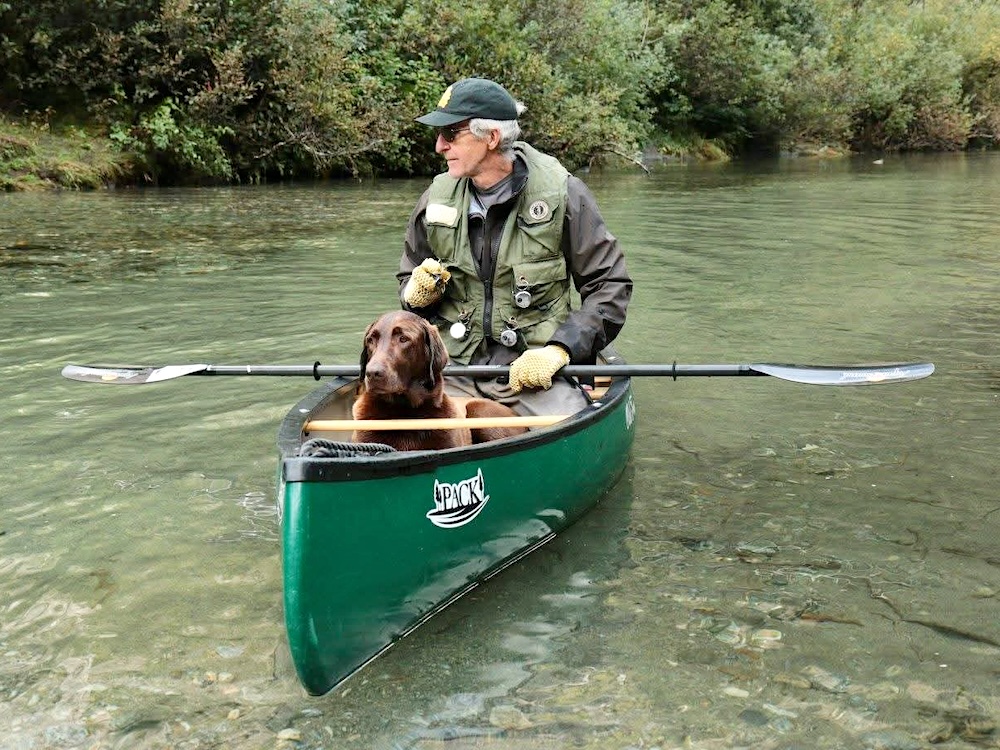
Now it’s just him, his wife Karen Hansen and their chocolate Lab, Foch.
This year he was told he might get a contract for 30 days, which will mean he will be able to inspect about 10 streams because each stream needs to be checked at least three times throughout the spawning season.
When The Tyee asked DFO why it was reducing the number of days it paid charter patrolmen to count salmon, the department said there had been “no significant changes” to stock assessment and monitoring programs “this season.”
Nelson and Hutchings said they are worried the lack of investment in stream counting could be a way for DFO to avoid its responsibility to safeguard and protect salmon.
“I think DFO would use this lack of data to be not accountable and I think DFO will be making decisions, based on no data or very little data, that affect your kids, my kids, everybody’s kids, and you and me. And I don’t think that’s OK,” Nelson said.
He added that if charter patrolmen don’t go out and count this year, “you won’t know what to expect and pretty soon you won’t have any idea of what was there in the first place.”
Salmon escapement data is also being collected by First Nations’ Guardian Watchmen programs, stewardship programs and Simon Fraser University in partnership with the Heiltsuk Nation.
In its email to The Tyee, DFO said it is working to ensure “data collected remains efficient and targeted to maintain and support all Pacific salmon fisheries in-season.”
But that usually means focusing on the big, easy-to-count streams and ignoring the smaller streams that are more heavily affected by climate change, Housty said.
A changing Mussel River
Data can help protect against shifting baselines, where one generation’s idea of abundance is reduced from the generation before them, and the generation before them.
Nelson said tourism boats used to radio him and ask how many fish were in the Mussel River. But he said they quit asking about 10 to 12 years ago because he’d tell them, every year, the returns were the worst he’d ever seen.
Tour boats, or DFO employees, will occasionally still radio him to report “a lot of fish” in a river. But they’ll be excited about 10 fish, which is not the 100,000 fish that used to swim through that spot, he said.
The Mussel River has been slowly warming as the glaciers that used to feed it vanish.
On a hot summer day the river used to be ice cold because of glacier melt, he said. Now it can warm up to 20 C, which can kill salmon eggs, he said.
As rivers warm, the amount of dissolved oxygen in the water decreases and salmon will start to “pant” by flapping their gills, Nelson said.
If enough fish suffocate in the warm water, the decomposition process will eat up the rest of the oxygen and there will be a mass die-off, he added.
“It’s quite an awful experience. Everything is dead, even down to the little tiny fry,” he said. “Even the sculpins, which make their way up the stream to feed on eggs and are really tough fish. Dead.”
Bears and wolves that normally feast on salmon avoid these die-offs, he added.
Or a river can dry up, as the Neekas did in 2022. That year, salmon counters for the Heiltsuk Nation found 65,000 dead pink salmon during a drought season.
Even when everything looks normal, a charter patrolman can spot signs of an ecosystem under stress.
Nelson said he’s seen up to 30 bears feeding from a single salmon run, which is helping build a bear-watching tourism industry.
It’s good for people to delight in seeing bears, but they should also know that bears are solitary and don’t like people, so when they gather in those numbers it’s because there are no other food sources for them, he said.
Nelson and Hutchings also worry they will be among the last charter patrolmen.
Nelson said it’s a “dead-end job” with no security, which is why there’s only one younger patrolman and he’s already looking at other careers.
Hutchings said he and his wife can earn $900 per day with their contract as charter patrolmen but have to provide their own live-aboard boat and equipment to paddle up streams.
That’s less than what chartering a boat to go sport fishing would cost, which is about $1,000 for eight hours, or what a bear-watching tour would cost, which can be around $2,500 for a day, he said.
He estimates charter patrolmen are the most cost-effective method DFO has for assessing salmon escapement numbers.
Hutchings said he’ll be turning 72 in September and has worked as a charter patrolman since he was 19.
He said the work was never about the money — he did it because he loves salmon and the lifestyle, where he could be out in the woods and count fish.
“It’s a real kick in the butt when there’s no feeling from the government, just a ‘We don’t need you anymore,’” he said.
He added he used to work with another charter patrolman who worked in Area 6 for 50 years before his position was cut.
“They never even sent him a letter saying thank you for your service — nothing,” he said.
But old habits die hard. Hutchings said that even if DFO isn’t paying him, he’ll likely still be found canoeing up salmon streams with his dog Foch, counting salmon.
“Not that we’ll hand that information over to the government,” he said.
“But we’ll have it.” ![[Tyee]](/design-article.thetyee.ca/ui/img/yellowblob.png)
Read more: Indigenous, Environment


Tyee Commenting Guidelines
Please note that email notifications for replies are not currently working due to a software issue which may be resolved in a future update.
Comments that violate guidelines risk being deleted, and violations may result in a temporary or permanent user ban. Maintain the spirit of good conversation to stay in the discussion and be patient with moderators. Comments are reviewed regularly but not in real time.
Do:
Do not: