


 SHARE:
Are men sometimes a bit boring?
Before online commenters jump in with both feet, let me clarify. I’m not talking about all men. I’m referring to a fair number who think that everyone, women especially, ought to find their arcane interest in things like British train stations or the Swedish banking system irresistible.
There is a certain segment of the male population that never learned to read social cues. And they don’t realize they’re boring everyone to absolute tears.
Sometimes, these men are artists.
I must admit that I’ve never found the creative work of the Vancouver School photo conceptualists all that interesting. Technically, the work is accomplished, but I rarely have an emotional reaction to it.
An exhibition of Vancouver School photographer Jeff Wall’s work, recently opened at the West Vancouver Art Museum, resurfaced the idea that sometimes men aren’t nearly as interesting as they think they are.
Called Jeff Wall: Inside, the title of the show might imply a collection of images drawn from colonoscopy or other invasive medical procedures. Perhaps a new direction for the artist! Alas it’s the usual. The gallery is filled with wall-mounted light boxes containing elaborately staged large-scale images. Their mini narratives often contain moments caught in time, as though they were suspended in amber.
Inside is drawn from the previous three decades of Wall’s work. Given the constraints of the gallery (it’s not a large space), the show is on the smaller side, consisting of a dozen images. Many of these are art-directed within an inch of their high-gloss lives. The experience of taking in Wall’s work is an extended series of speculations. Something along the lines of, “Well, what happens next?”
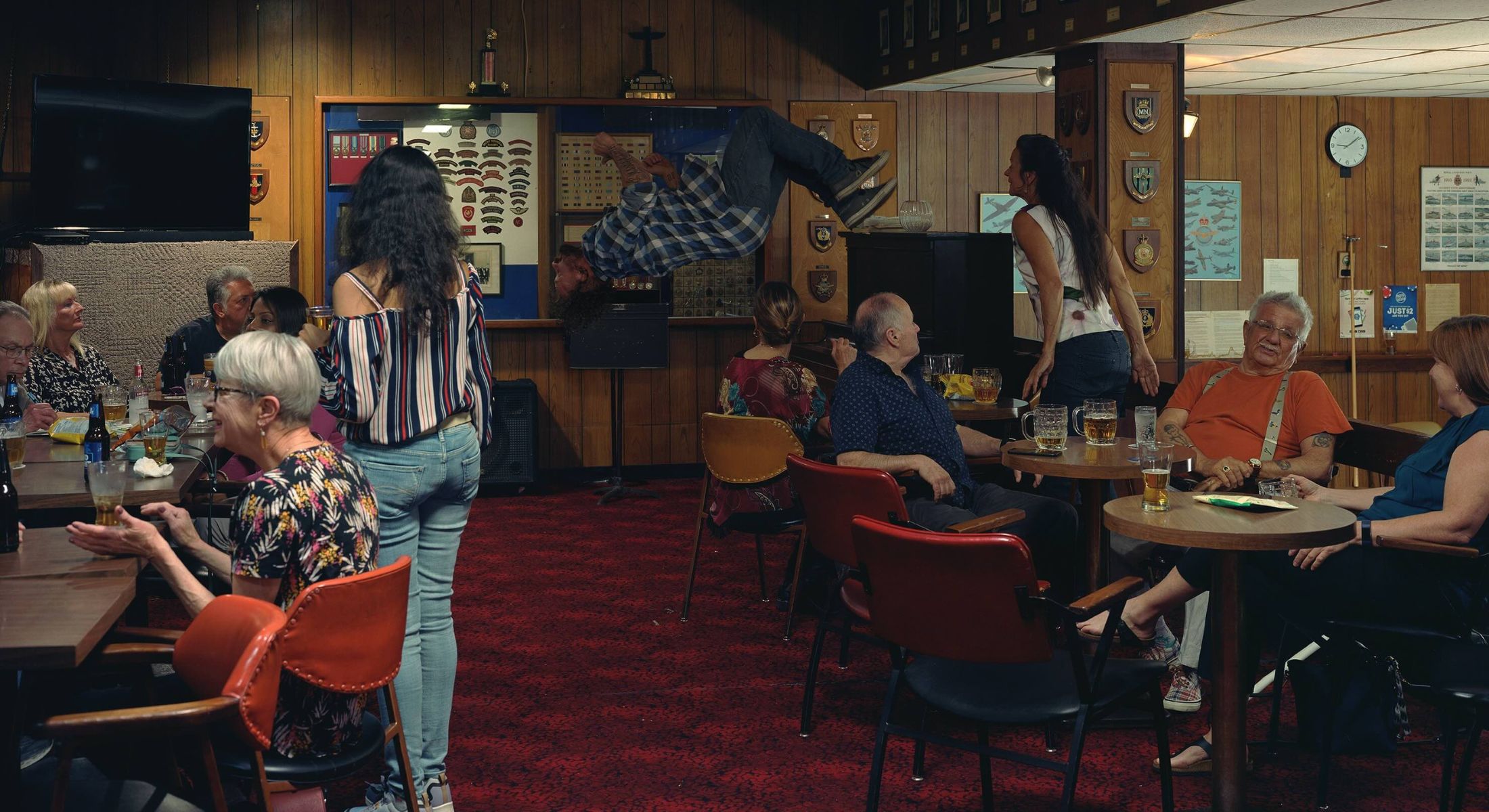
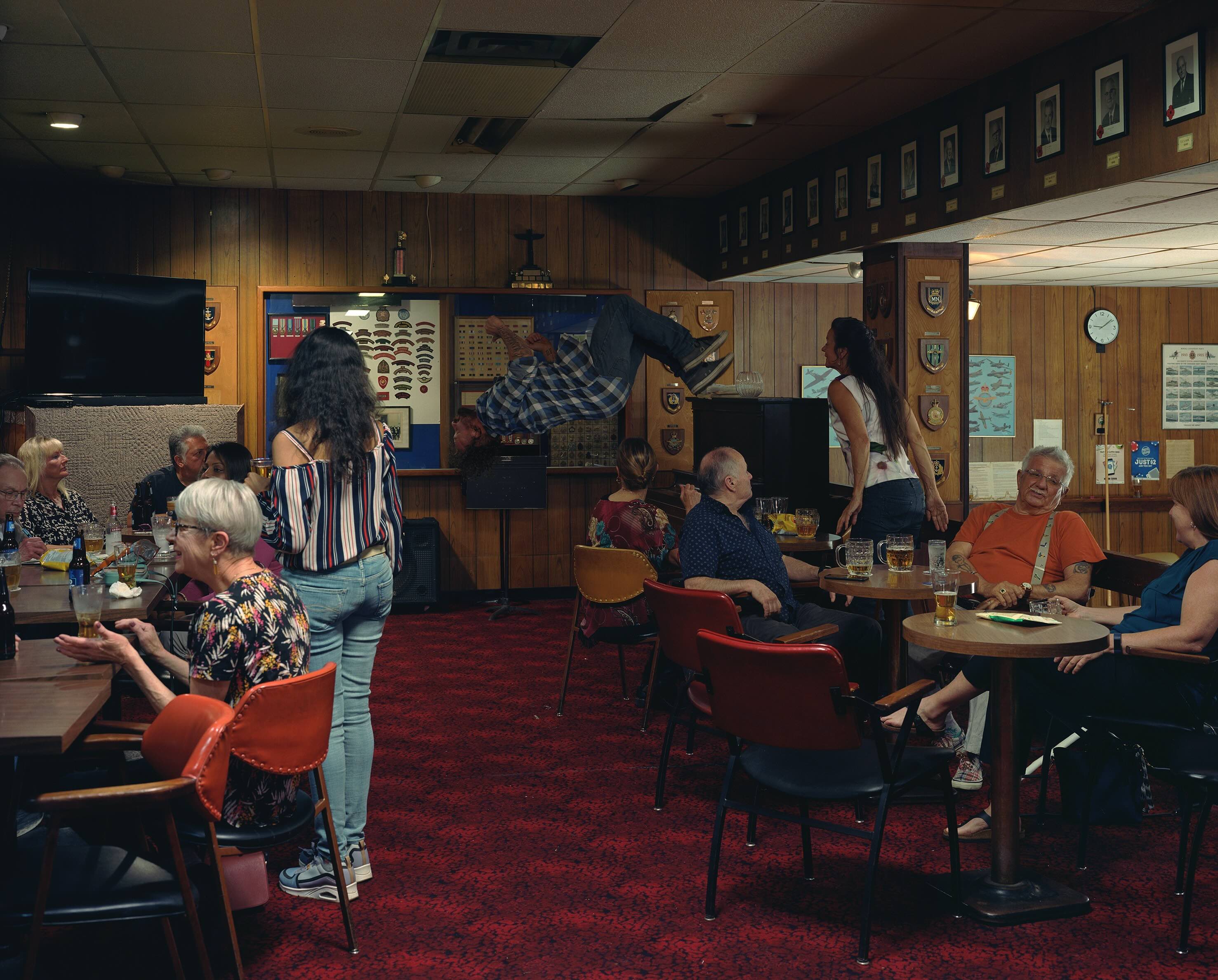
In the Legion (2022), a convergence of the mundane and the deeply odd, is a case in point. It’s a common motif in Wall’s work.
In Legion, old timers sit amidst a motley assortment of tables nursing beers, while in the centre of the frame, a man is caught in mid-backflip. None of the patrons in the place seem surprised or even much affected by this display.
The void of unanswered questions is left to be filled by viewers.
In isolation, the exchange between audience and image is interesting enough. But when the same exchange is repeated multiple times, something else starts to emerge.
I noticed it first as a kind of vague irritation. Which is an emotional reaction, I guess, but perhaps not the one that the artist intended.
Is frustration the point?
Is it simply that a certain amount of work is required on the part of the viewer to partake of these images? Or it is something else? That’s where I get stuck, because I’m not sure why this give-and-take bugs me so much.
Delving into Wall’s history might hold some answers. There is a clinical aspect, a dissection of all the many small details, that adds depth and heft. They also offer clues as to what a viewer may wish to take away with them.
A couple of the images in Jeff Wall: Inside, commissioned by international organizations and cultural centres, haven’t been seen before in Vancouver.
Informant: An occurrence not described in chapter 6, part 3 of Últimas tardes con Teresa by Juan Marsé, commissioned by the City of Barcelona, is one example. The 2023 work takes inspiration from Spanish author Juan Marsé’s 1966 novel Últimas Tardes con Teresa (which translates as Last Evenings with Teresa).
The novel is centred around the relationship between two young people from different social classes. Manolo (commonly known by his nickname Pijoparte) is a working-class dude from the lower social echelons of Barcelona. A bit of a thug with a penchant for stealing motorcycles, he sets his sights on a university student named Teresa. Blond, pretty and from a different social class entirely, Teresa comes under his thrall.
Over the span of 25 chapters, the story details their ups, downs and finally the conclusion of their relationship. The critical moment, depicted in Wall’s image, is a romantic betrayal that effectively brings the saga to its conclusion.
None of this is obvious at first glance. In Wall’s image, a young woman is depicted in a moment of decision. She is on the phone with the police. The other aspect at work, as hinted at by the title of the photograph, is whether this critical point of intersection doesn’t take place in the original novel; there is creative licence taking place. It’s oddly frustrating. But maybe that’s the point.
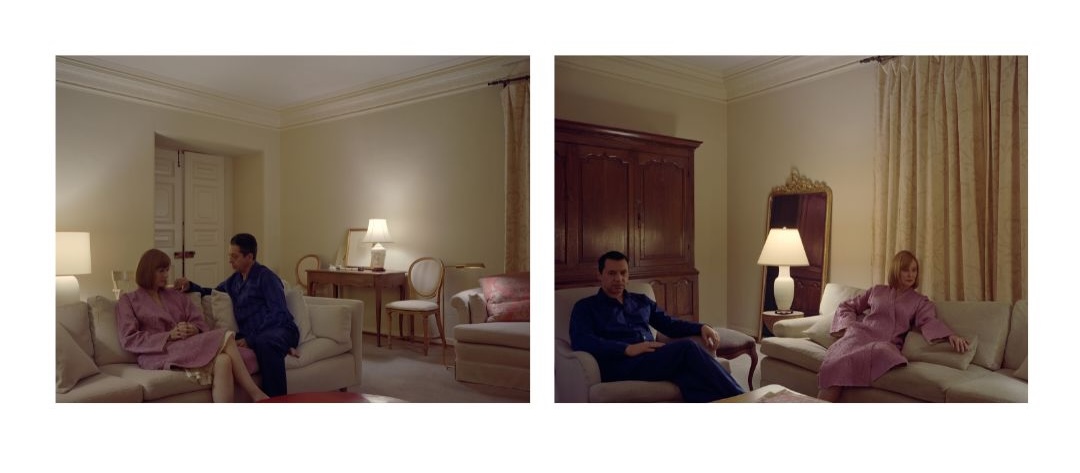
This purposeful obliqueness can work. In a pair of images aptly named Pair of Interiors, a couple is photographed in luxe apartment. He wears what appears to be a pair of dark navy pyjamas; she wears an embroidered rose-coloured housecoat. Neither seems capable of making eye contact with the other.
What’s happening here? Again, it largely depends on one’s own perspective. Anyone who has been in a long-term partnership might recognize the inimitable air of resentment, suffocation and mutual agreement to remain together, if only to continue to duke it out, that perfumes the images. It’s as pungent as a cloud of Shalimar perfume.
But other viewers might see something very different. If the result is intrigue or curiosity, there is often little payoff. There are no grand reveals or resolutions. Just a series of questions, tapering off into blankness.
The animating impulse in Wall’s work is meant to stop time. This hermetically sealed quality, almost stilted in its all-consuming attention to detail, is interesting. But it often lacks juice. It makes me long to break the glass and free the people inside.
Is insularity fascinating?
Given that many of the images in the West Vancouver show are from different periods in the artist’s career, drawing any thematic throughline or greater cohesion is impossible. One must settle for broader strokes about Wall’s oeuvre.
Whether you find Wall’s insularity fascinating or dull might depend on your tolerance for entertaining the obsessions of men, especially men of a certain vintage.
A few years ago, I watched Picture Start, a 2011 documentary about the Vancouver School. In addition to Wall, the film profiled Ian Wallace and the late Rodney Graham.
The film was very much about process, including the work that went into staging Wall’s photographs. Among Wall’s works in the film was an image of a young boy falling out of a backyard tree. Boy falls from tree was inspired by Wall’s own experience of falling from a tree and breaking his arm as a child.
The efforts involved in making the image, captured in the documentary, were exhaustive. The story of the process behind that singular work took up a fair amount of Picture Start’s running time.
In an interview about the image, Wall explained that the central drama of the fall was only one aspect. The other invisible element, and arguably more important thing at work, was the foundational force of gravity.
It is an omnipresent thing that we rarely notice unless something goes wrong, and we end up a mangled heap on the ground or worse. This is a deeply interesting idea. So why does the image itself make me want to shrug and saunter off?
In isolation, I find Wall’s images compelling. But I am less engaged when seeing them collected. Like most artists, Wall has developed a methodology, and it’s done well for him. Radical departures in execution or content are rare at a certain stage of creative careers, especially if they have netted a degree of recognition and financial reward for the artist.
In trying to pinpoint my own reaction to the work, I read a number of interviews and analyses of Wall’s work to explain to myself why I sort of like it, but it also bugs me.
It was a 1982 article in Art Forum that came the closest to hitting this binary feeling.
“In Wall, technique sometimes seems to become absolute, a total frame of mind, into which any spiritual-sexual interpretation sinks and disappears, even when it seems convincing,” writes Donald Kuspit.
“On the other hand, Wall’s work is self-legitimating to the extent that it seduces us into believing in the presence of a passion so profound that it undermines the impact of his technical brilliance.”
So, which is it? An emotional void, or an obliterating passion as grand as super nova?
It’s up to you, the beholder and your eyeballs, to decide.
‘Jeff Wall: Inside’ runs until Oct. 3 at the West Vancouver Art Museum. ![[Tyee]](/design-article.thetyee.ca/ui/img/yellowblob.png)
Read more: Art





Tyee Commenting Guidelines
Please note that email notifications for replies are not currently working due to a software issue which may be resolved in a future update.
Comments that violate guidelines risk being deleted, and violations may result in a temporary or permanent user ban. Maintain the spirit of good conversation to stay in the discussion and be patient with moderators. Comments are reviewed regularly but not in real time.
Do:
Do not: