


 SHARE:
[Editor’s note: In collaboration with CreativeMornings/Vancouver, The Tyee launched its Creative Forces series in November to showcase the people in our region who are using their creativity as a force for good. We posted a call for nominations inviting readers to nominate a ‘Creative Force’ to be profiled in The Tyee, and so far we’ve received 34 submissions from across B.C. We’re pleased to feature our first profile based on a community submission today.]
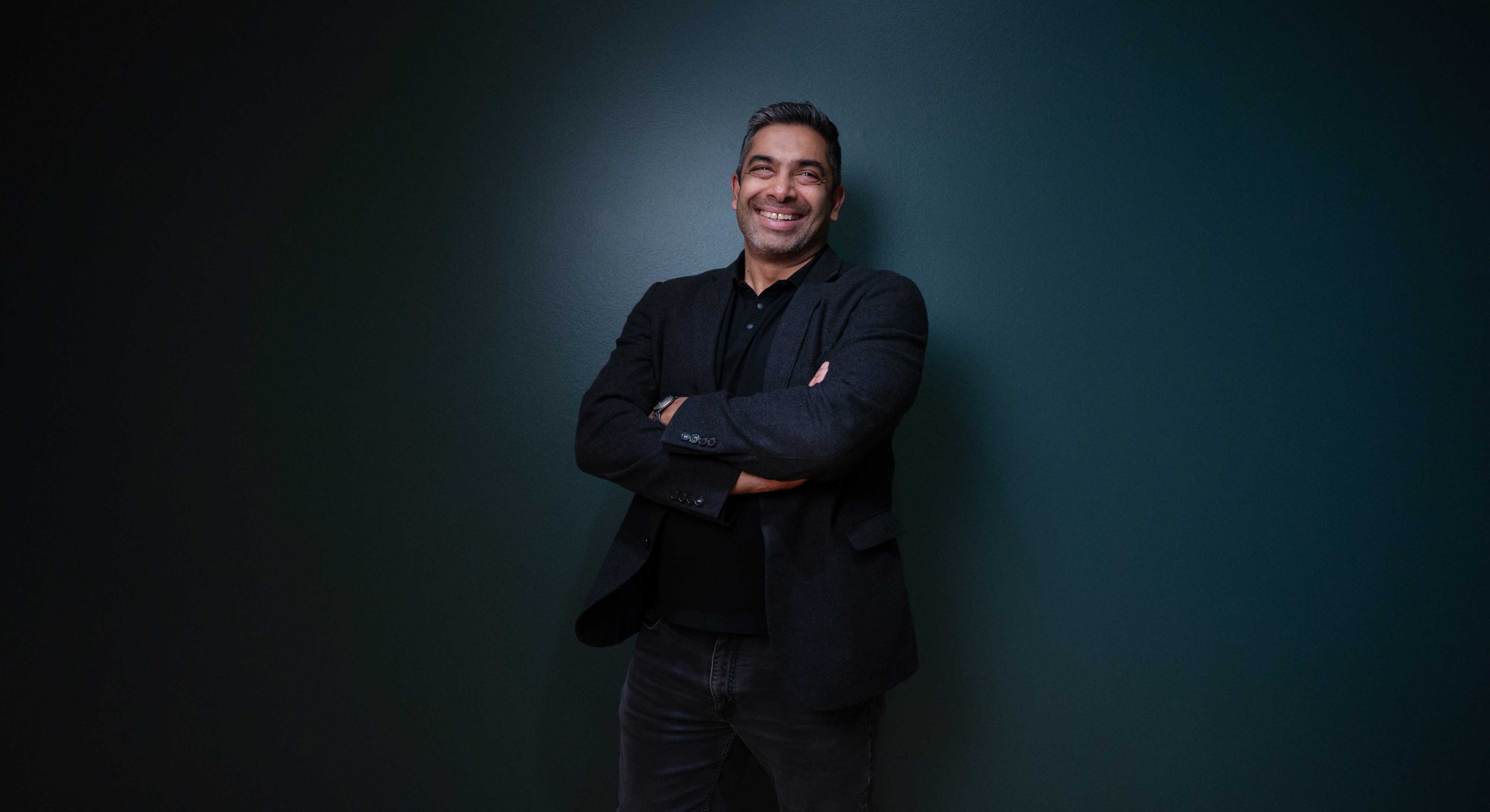
Sirish Rao is a creative force. Perhaps, in this instance, that goes without saying.
The internationally recognized cultural innovator is a recipient of the King Charles III Coronation Medal for significant contributions to Canada, a Lifetime Achievement Award from the Hari Sharma Foundation for his contributions to social and economic justice through the arts, and a member of Vancouver Magazine’s Power 50 list for 2025.
Rao is the co-founder and former artistic director of the Indian Summer Festival, one of Vancouver’s most celebrated cultural events, and the award-winning author of 20 books. He has served on the boards and councils of several cultural institutions, including the Chan Centre for the Performing Arts, Vancouver Foundation and the Vancouver International Film Festival.
Since 2023, Rao has been a member of the leadership team at the Vancouver Art Gallery, first as the director of public engagement and learning, and only two years later as the interim co-CEO, alongside Eva Respini.
In 2025, Rao and Respini took up the difficult task of steering the gallery through financial strains, spearheading the construction of a new downtown building and repositioning the gallery as a much-needed space for respite and holistic healing.
“As artist Hank Bull says, an art gallery,” Rao told the Tyee, “is a hospital for the soul.”
The recently-launched Art of Wellbeing Lab is proof that Rao means this literally.
The pilot project ensures that people of all ages can draw upon the resources of VAG and its partners to improve their overall health. Those partners include the BC Parks Foundation and their PaRx program, which enables healthcare professionals to prescribe time in nature. As part of this, some partner organizations —including the Vancouver Art Gallery — offer access to PaRx participants. The program received a 2025 Social Prescribing Changemaker Award from the Canadian Institute for Social Prescribing, or CISP.
Rao doesn’t necessarily see it as a new idea, however.
“We are now catching up with what people have known for a very long time and have practiced for a very long time,” he said. “The reason why we do this — make art — is to reach out from one human soul to another human soul, to express what we as a collective feel, to offer healing for oneself in making it or for others and seeing it. To me, that’s the core of the offering. What we’ve been able to do is formalize that.”
This interview has been edited for length and clarity.
The Tyee: Sirish, has a painting ever made you cry?
Sirish Rao: I don’t think I've ever come across a painting that made me cry. Well, no, that’s not true… my daughter painted something that was so completely free in its experimentation. You have folks like Picasso saying that you spend your life trying to paint like a child. And I think when I saw, in a way, this completely unfiltered interaction with a bunch of flowers, the oneness in this little painting created by a small person, it reminded me of the oneness we seek in all art.
This one time I went to the Smithsonian in Washington during a particularly dark time in my life. I spent the day perusing the gallery with all of this emotional detachment. And then I saw The Farewell by Bernard Perlin. Do you know that painting?
Oh yes.
And I burst into tears. It was the strangest feeling.
I’ve heard of a lot of people breaking down in front of Rothkos, which is just this mass of complex colour.
Maybe it’s that Rothko red. The Farewell is very red.
Funny thing though, Harrison, is that I come much more from the literary world. Things that made me cry often have words. Even though I’m very much in the visual arts world now, and I’ve always loved it, my first love was always poetry. So if I cry, it’s usually because of a poem, or the lyrics of a song. I’m easy to get with words.
I brought this up not to demonstrate my deep appreciation of art, but because it was one of the most cathartic cries I’ve ever had, and I think it goes to your vision of what art can do. A lot of people think about art as something you simply appreciate, or consume, or collect, but you have championed art as a healing force.
I came from a post-colonial environment, where art was very much around me, but what was held up as the art to aspire to, the art I should know, was Shakespeare and Wordsworth and the art of Britain. It was held up as the highest of all forms. Yet I grew up with another language in me. I grew up with stories of the Mahabharata, and all these performances and expressions that were not considered of value. That was, of course, very much a construct. These were hugely rich traditions that have been there for centuries.
But I saw how much shame was involved in speaking your own language, in performing your own art forms. I was part of that generation that grew up feeling ashamed, and then wanted to find a place for what we wanted to say on our own terms.
When I came to Vancouver as an adult, I found that was happening here as well. There were stories that were untold, deliberately silenced or simply not valued. So the first part for me where art can heal is when you have full and free expression. When your exuberance is not problematic. When it is wholehearted. There’s a kind of healing in that, and I think it has to do with how free and how normalized your expression is.
Not simply as an abstraction, but healing in a medicinal sense, correct? As I understand it, this is the vision behind the recently launched Art of Wellbeing Lab. Can you tell me more about that?
I really got interested in this idea of art and science, or art and medicine really being the same thing when I met Dr. Harold Varmus. He was the person who discovered the proto-oncogene. His work really resulted in helping us understand cancer and gene aberration.
I met him at the Jaipur Literature Festival, and got talking to him and realized he had a son who was a jazz trumpeter, and that they both were searching for discovery in dissonance. And I thought, this is fascinating. This is a completely different kind of inquiry. And I proposed that they would do a performance together: him giving a lecture on gene structure while a jazz sextet accompanied, and they were essentially saying the same thing. We presented that show — it was called Genes and Jazz — at the Playhouse here quite a few years ago. It was completely baffling to everybody.
But it led me down this path of inquiry, such that when COVID hit and we realized that people were turning to art for solace and comfort, that it’s not just something latent.
Art is good for you. It was accompanied by empirical data and research that came in on museums, on music. The scientific community was beginning to understand that only about 20 per cent of someone’s health outcomes are determined by what they can do inside the formal system.
Eighty per cent of it, in Canada, for example, is determined by your social environment. This is socioeconomic. It’s linguistic. It’s what access to art you have. Access to self-expression, access to your cultural heritage, access to joy is part of healing.
And you really can get a prescription to visit?
We were really lucky to meet with Dr. Melissa Lem, who is the president of the Canadian Association of Physicians for the Environment and one of the co-founders of PaRx, an initiative of BC Parks Foundation. Healthcare professionals can prescribe time in nature, which may include visits to parks and other accessible green spaces and cultural landscapes. Now we’ve signed up to this so that doctors — and there’s 20,000 healthcare providers registered nationally — can write a prescription.
Ask your doctor if the Vancouver Art Gallery is right for you. That’s fascinating. But what does a prescription actually get you?
Anyone who comes to the Vancouver Art Gallery with that prescription will get a free visit, not only for themselves, but also a friend or a guest, so they’re not alone. Because that’s the other thing. We know that visits to galleries and museums can be isolating for some folks, and so we wanted to make sure that people can come with somebody else.
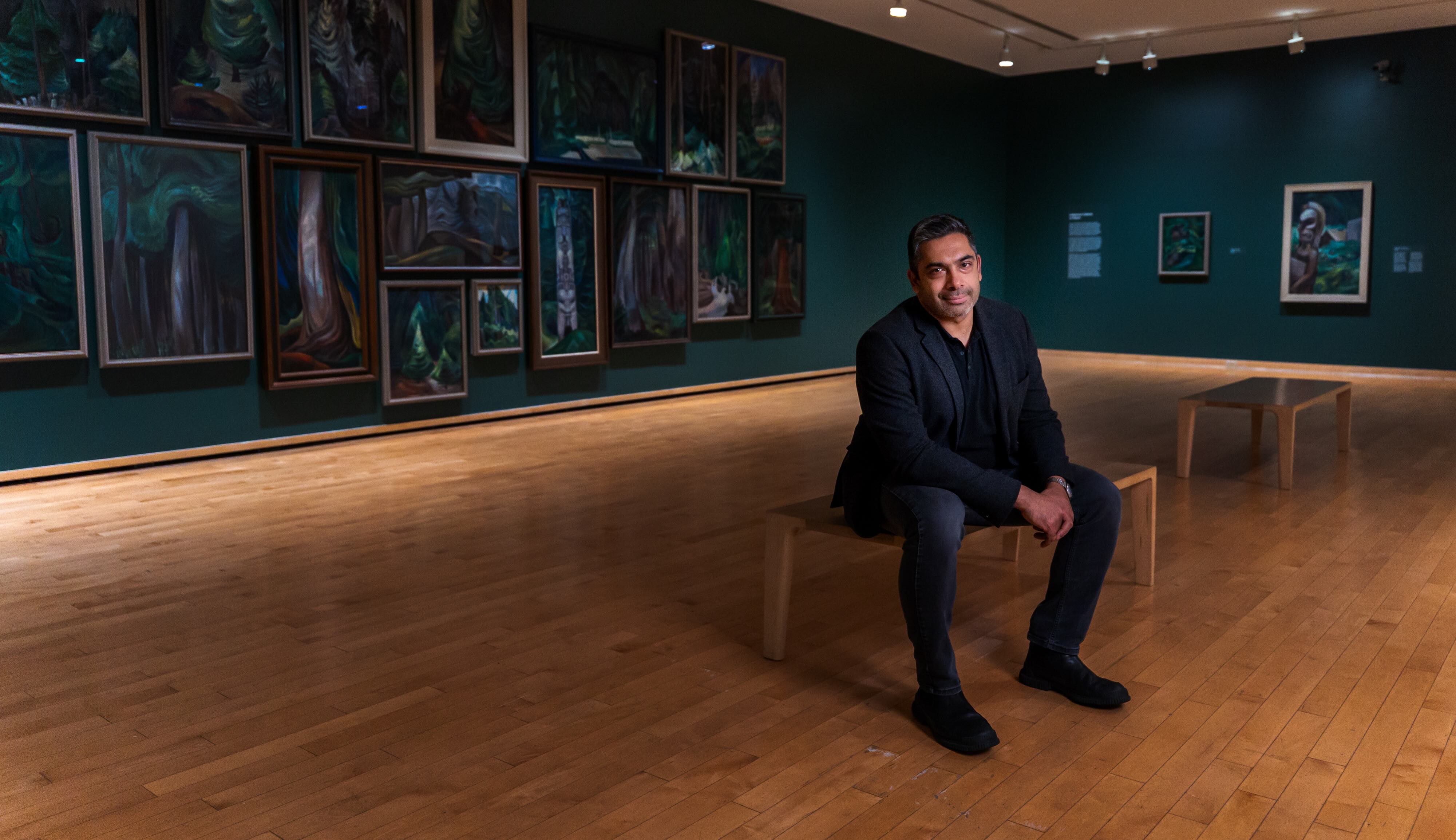
Currently, they’re prescribed to go to the Emily Carr room on the top, which is an entire wall curated by Dr. Richard Hill. It’s just a tangled mass of forest. It’s not a landscape. It’s portraits of trees. It’s a kind of intimacy with every single tree and its character all hung together. So it’s an urban forest bathing experience.
We love an urban forest bathing experience.
Medical research shows that it’s not just being in nature, but even looking at images of nature can be beneficial for your well-being. So that’s really what we’re offering. It’s the most B.C. thing possible. You come to the Vancouver Art Gallery, you see Emily Carr, and from there, you can go to a provincial park. So it’s a connection of art and nature that is very unique to this place.
Before we started this program, we checked in with Elder Willard “Buddy” Joseph of Squamish Nation, who is the elder-in-residence of the Vancouver Art Gallery. And he said, well, obviously, art is healing. Why else would you do it? And obviously, there’s no distinction between art and nature. How ridiculous.
You said once: How art meets people is important. I can see that, not only in the Art of Wellbeing Lab, but in the way my kids are welcomed when we visit, and they get that little package of activities and art supplies, so they can sketch what they see, or interact with the displays in childlike ways. Often museums and galleries are stiff, stodgy spaces. It’s different when you get a bag of crayons at the door.
I do think that in so many ways, the presence of children does soften and does also make you understand why you would be in a place like that. And as art education disappears from classrooms, it’s so important to have places that encourage critical thinking and invite young people to look at art and have valid and loud opinions about it.
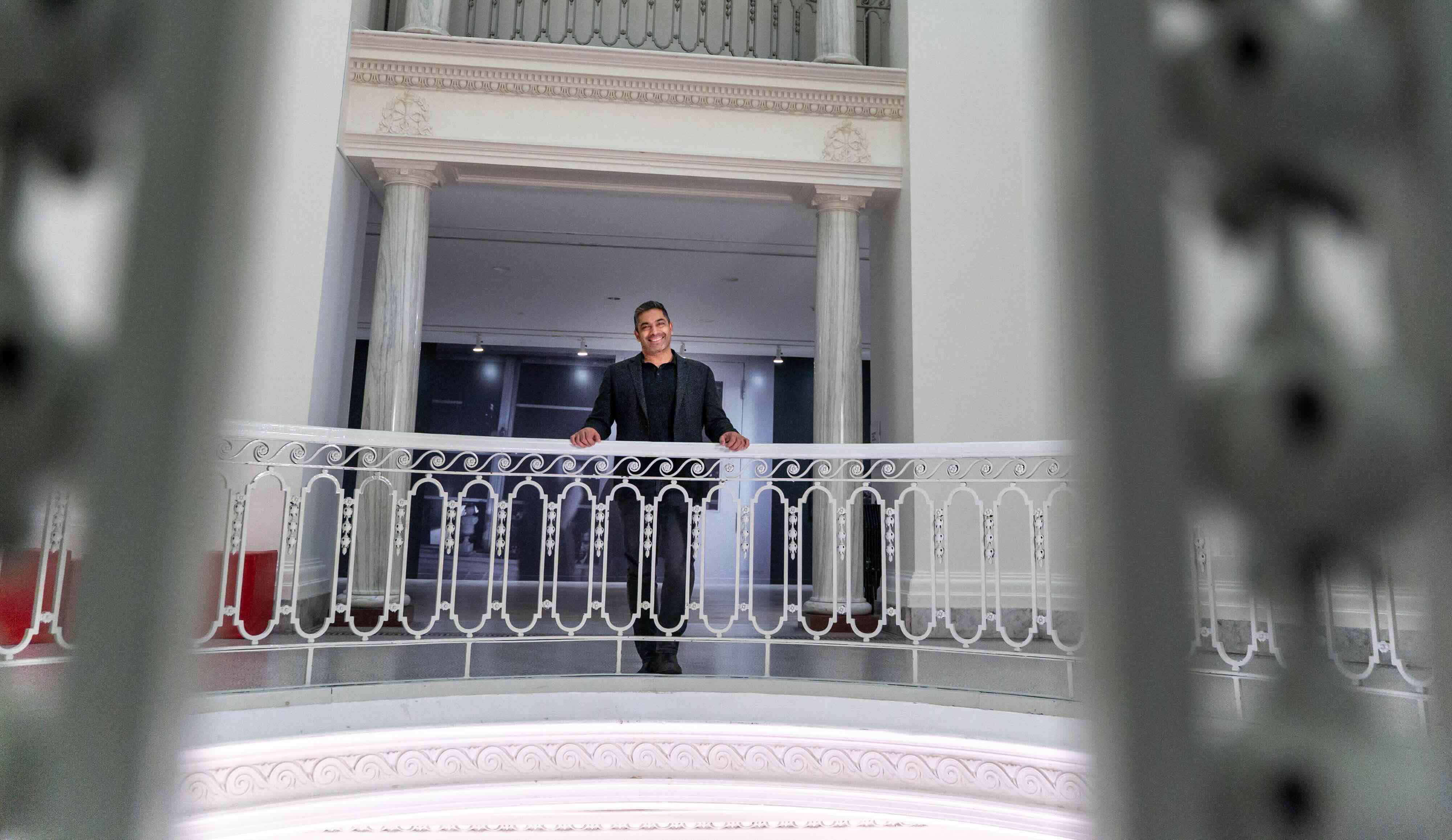
But I would say that it also takes special conditions. I think that we are questioning the role of museums and art galleries, increasingly, moving from the idea of the temple or the fortress to the public square.
My co-CEO here, Eva Respini, was the photography curator at MoMA for 15 years. You need a partner on the curatorial side who has that same belief. There’s often a standoff in institutions like this, between the territorial [mindset] and public engagement — that is, trying to smuggle people in. But we don’t have that [conflict], because we feel the same way about the encounter with art.
That’s why, I gather, you both feel we need a new building. For a while, I assumed it was more display space for the 13,000 objects in the permanent collection. But what you’re talking about is a Vancouver Art Gallery that can do more for the community, a building with a lecture hall and classrooms that can be more of a gathering place.
Absolutely. Having more physical space is only one part of the equation, to counter what one could describe as hoarding. Because if you have so many amazing works of art and people never get to see them, what’s the point? So having more square footage really allows us to [showcase] what I believe is the repository of our cultural memory as a province. If we can put as much on display as possible with more space, then we are giving people access to their common cultural heritage.
So that’s the one side. The other, of course, is a porous building. We see a future where it’s a multi-art space. It’s not only for one kind of expression. And then we ask: how can a museum be a place of healing? How can it be a place of belonging?
And those questions can be answered not only architecturally, but in the notion of what is the museum of the future, the 21st-century museum, that doesn’t have to inherit or carry the baggage forward of the 20th-century museum?
I know that you’ve had to make some hard choices this year in order to make the art gallery financially sustainable. That’s important work. But it also strikes me as not the sort of work that a champion of the arts would prefer to be doing? Does the emphasis on return on investment and the fiscal side of artistic curation ever frustrate you?
It’s difficult work, for sure. But I started by being a writer myself. I and a group of friends founded a publishing house. We made books by hand. These were labours of love. But we also had to run it like a business. I’m very attuned to the fact that we’re an arts organization, but unlike, say, in Europe, where the state 100-per-cent supports museums like ours to be free to the public, we’re not supported that way.
And in the U.S., for example, you have a model where a philanthropist might underwrite everything, even create an endowment and say, okay, my name’s on the building, but you can do what you like. In Canada we have a hybrid model which, in some ways, offers many legs to stand on, but in other ways means we’re constantly having to work with several different models.
So charging admission is absolutely critical. There’s no way we would keep our doors open if we didn't. Yet you need to keep finding ways to make access. We have our free First Friday nights. That’s supported by BMO, and the lineup’s always around the block. People want to be here. It’s always free for youth and kids 18 and under. Always. And that’s made possible by a donor.
I very firmly believe that we have to find the value for culture in society. Make sure that nobody expects artists to do things for free, arts workers to do things for free, or for art to be free, unless it’s supported to be free. It’s a balance.
On the one hand, it’s not exactly what I set out to do, but it’s always part of running an institution. You have to ensure that you survive and thrive and give artists the promise that they deserve, of showing their work very well, of creating a great art experience and living for tomorrow. ![[Tyee]](/design-article.thetyee.ca/ui/img/yellowblob.png)
Read more: Health, Art, Media, Environment

Notice about commenting changes
The Tyee’s commenting system will be moving to a new platform on Nov. 12. If you’re already a Tyee commenter you must register with the new system on or after Nov. 12 with your preferred username.More information can be found here.