


 SHARE:
We’re in the full flush of spring. Here on the east coast of Vancouver Island, signs of renewal abound, including winged arrivals from Espírito Santo, Brazil — the ravenous and ravishing purple martins.
I, too, am feeling revived. This year, in addition to the usual milestone — a birthday, my 59th — spring brings something new: the first anniversary of having survived a major health crisis that nearly cost me my life. Short of a swift helping hand, I wouldn’t be here today. I think the new me has become better at finding joy in and connection to the burgeoning life around me: the unfurling leaves, the riot of blooms, the return of migratory birds — especially the purple martins.
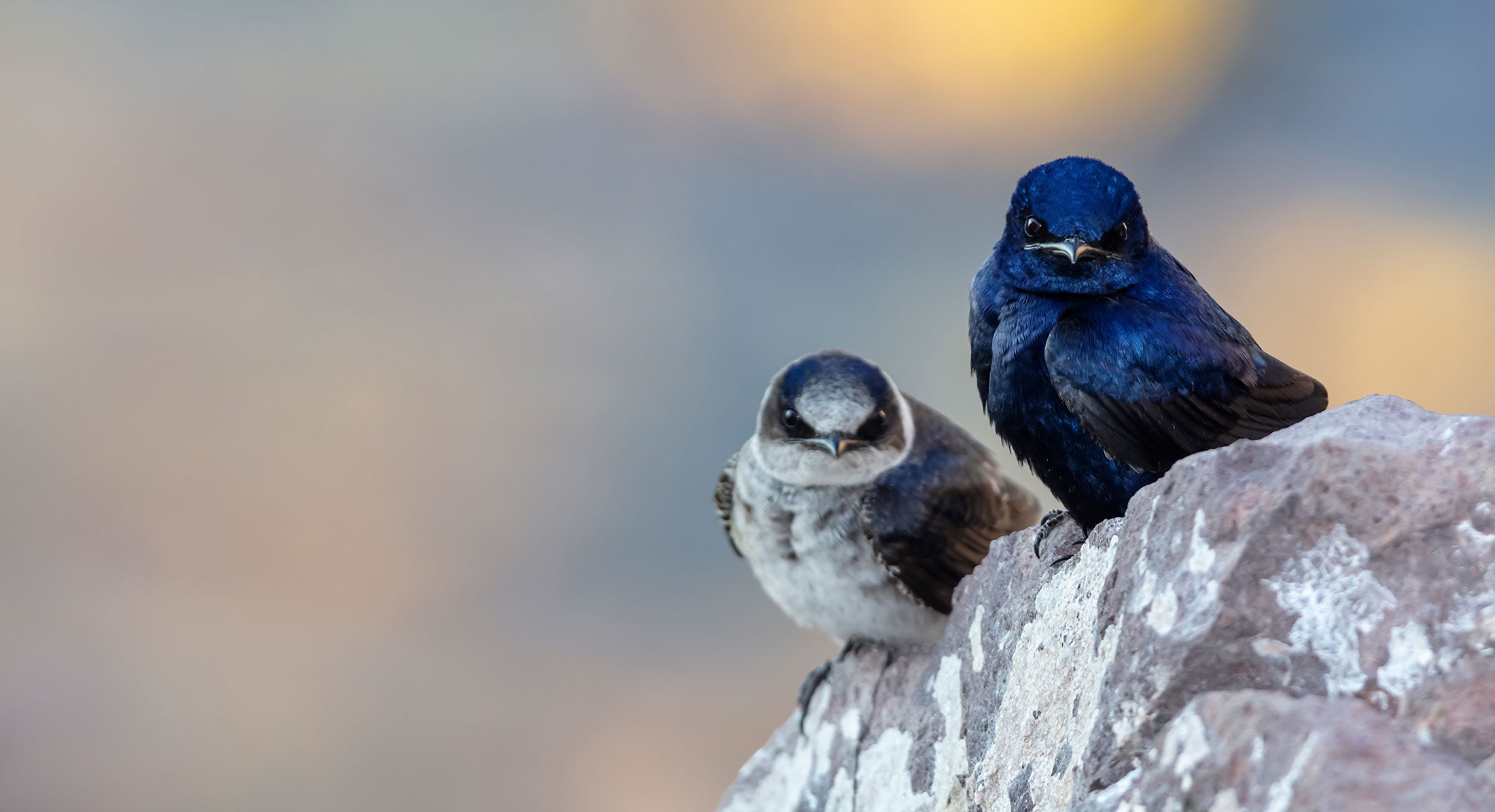
While the females of this species are mostly shades of gray, the males are a resplendent, iridescent purple-black. North America’s largest swallows, their acrobatic aerial feats as they pursue insects, and each other, command attention. Their complex vocalizations — urgent proclamations of metallic clicks and chirps reminiscent of R2-D2 — delight me every time.
Clearly, I’m not alone in my appreciation. Six new nest boxes have gone up at the end of the pier overlooking our small town’s marina, thanks to the local Rotary Club and municipality. Checking on them has become a highlight of my family’s evening strolls, which can include sightings of river otters, seals and bald eagles vying for castoffs from fishers cleaning their catches. Over the years, I’ve noticed these shoebox-sized homes in several locations here on the island and wondered about the people who built them and the birds who use them. This year, the year of no more excuses, I decided it was time to follow my interest.
I soon discovered that purple martins inspire deep and lasting devotion, and that this connection is older and more widespread than I could have imagined. Across North America, wherever purple martins are found, people are moved to care for them. But there are many species of birds, and other wild creatures, that could use a helping hand. What is it about these birds?
For many purple martin people, the answer lies in an intimate, vital and ongoing relationship with something wild willing to meet us across the interspecies divide.
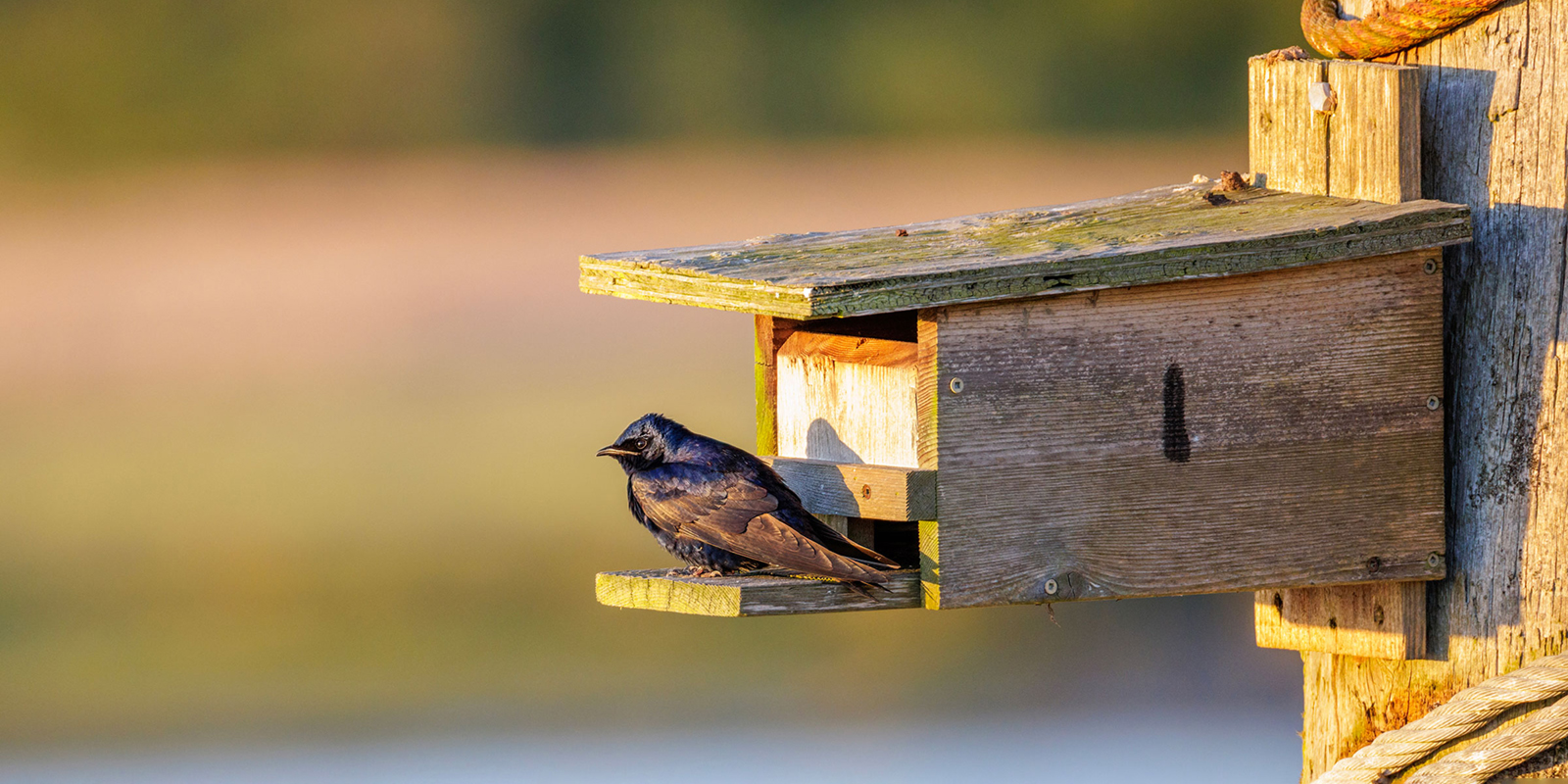
Like all purple martins, the western subspecies (Progne subis arboricola) that nests in my neighborhood depends on a wide variety of flying insects to sustain itself and its chicks, including wasps and winged ants, bees, flies, beetles, moths, butterflies and dragonflies.
Vancouver Island sits at the northern extent of their breeding range, which reaches all the way down to Southern California. They arrive here after a nearly 13,000-kilometre round trip to their wintering grounds along the southeast coast of Brazil, a feat that scientists only learned about in 2023.
When it comes to choosing a home, western purple martins, like their cousins in the central and eastern part of the continent, prefer a turnkey residence. Their natural nesting sites — abandoned woodpecker cavities, snags in mature trees — have dwindled as development and logging have claimed more and more habitat. But thanks to the efforts of local individuals and organizations, nest boxes like the ones on our pier helped save this species from vanishing here in British Columbia back in the 1980s, when only five known nesting pairs remained.
Today, there are an estimated 1,200 in the province, and as many as 247,800 individual western purple martins throughout their range, though the population is decreasing.
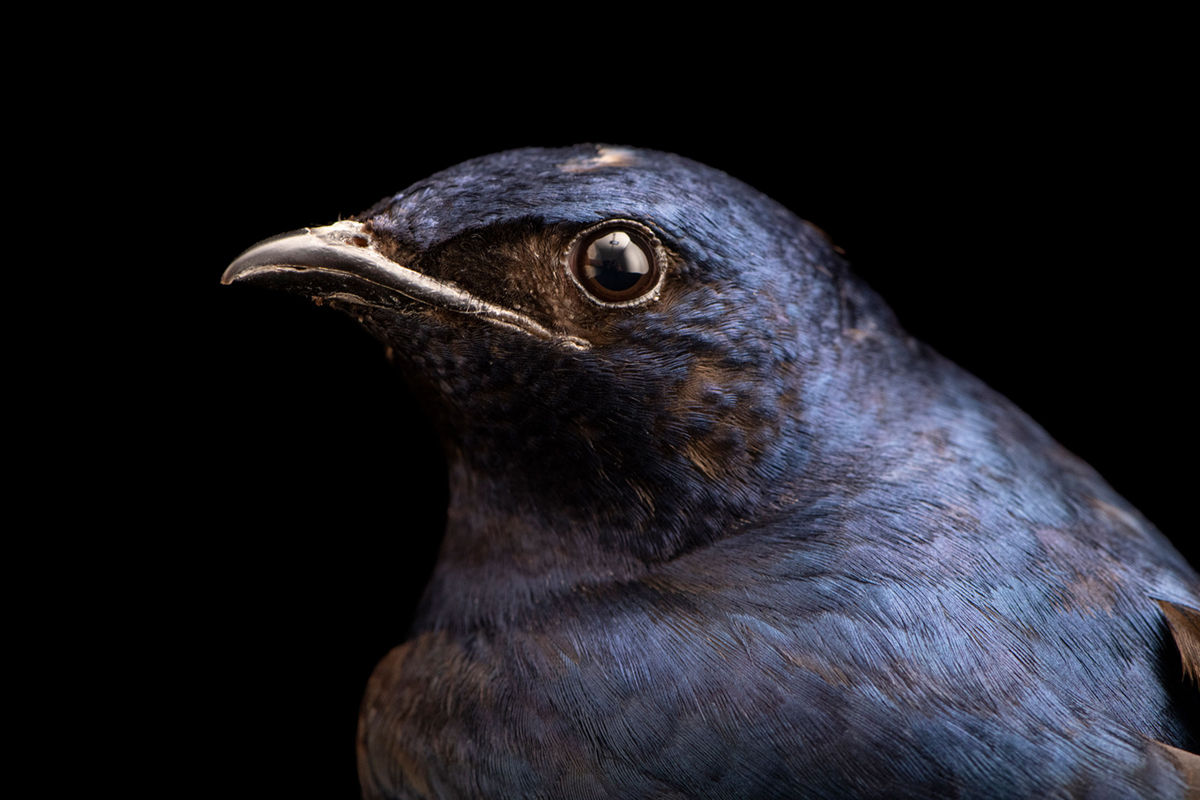
Another subspecies, the desert purple martin, still nests in cavities bored by other birds in the saguaro and cardon cacti of Arizona and northern Mexico. Relatively little is known about this subspecies, although their numbers — perhaps 6,000 — are also thought to be falling.
Still, taken together, the western and desert subspecies make up only 2.9 per cent of the overall purple martin population. The far more numerous and widespread eastern subspecies is found across most of the eastern half of the United States and southern Canada and consists of about 8.7 million individuals. These purple martins also once nested in cavities created by other creatures and natural processes, but as people destroyed their native habitat, they became almost exclusively reliant on nest boxes built and maintained by people, known as purple martin “landlords.”
The long bond between purple martins and humans
The practice goes back centuries, at least. During the 1700s, in what is now Mississippi and Alabama, ornithologists reported seeing hollowed out calabash gourds hung up in Choctaw and Chickasaw settlements. These Indigenous peoples attracted purple martins to reduce insect damage to crops and to act as sentries. Purple martins will mob predators such as hawks, crows, dogs, raccoons and people they don’t recognize who get too close to their nests and adjacent human habitation. The tradition spread to settlers, and by 1831 John James Audubon reported that “almost every country tavern has a martin box on the upper part of its signboard, and I have observed that the handsomer the box, the better does the inn generally prove to be.” Today, there are an estimated one million purple martin nest boxes in North America.
Joe Siegrist — a naturalist, field biologist, and president and CEO of the non-profit Purple Martin Conservation Association in Erie, Pennsylvania — tells me that without their landlords, purple martins wouldn’t exist. “There’s this direct emotional connection that forms between these people and these birds. There are a lot of conservation efforts in the world, but this may be the most direct.”
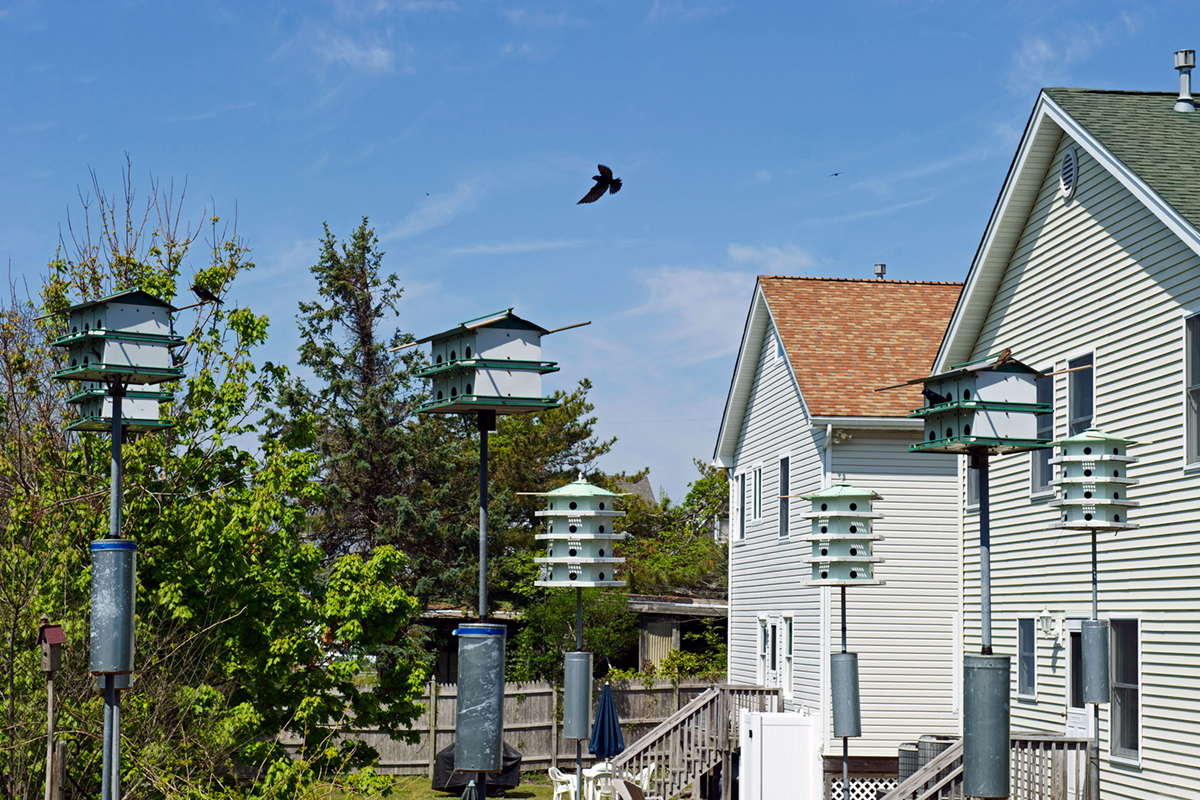
Although there are other examples of wild animals benefiting from human efforts to improve their breeding success — such as building blue bird boxes and osprey nesting platforms, or acting as eider keepers — eastern purple martins have become wholly dependent on humans for reproductive success. As we remake the world to suit our purposes, wildlife winners and losers emerge. Winners include species that can still make a living around the margins of our enormous footprint, or are useful in some way, or delight us.
Purple martins check all the boxes. They’re loyal, with a strong sense of site fidelity. They return to the same place year after year with the expectation that their nest boxes will be there, unoccupied by aggressive, invasive competitors such as starlings and house sparrows, and that they will be close to the people with whom they’ve become comfortable.
“If you put a purple martin house out in the middle of nowhere, and that same exact purple martin house in a backyard, they’re going to choose the one that’s in the backyard,” Siegrist says. “They actually will choose the location that’s closer to human activity.” As long as those homes are on the edge of open spaces such as fields, meadows, or bodies of water that provide access to flying insect habitats.
The overall history of settler-bird relations in North America is far less cozy. The plume trade, bounty hunting on a wide variety of species deemed inconvenient to progress and wanton habitat destruction wreaked unimaginable damage to both birds and ecosystems.
Yet, despite the fact that we’ve mostly destroyed their natural habitat, through natural selection purple martins have come to associate people with nesting opportunities, and relative protection from predators.
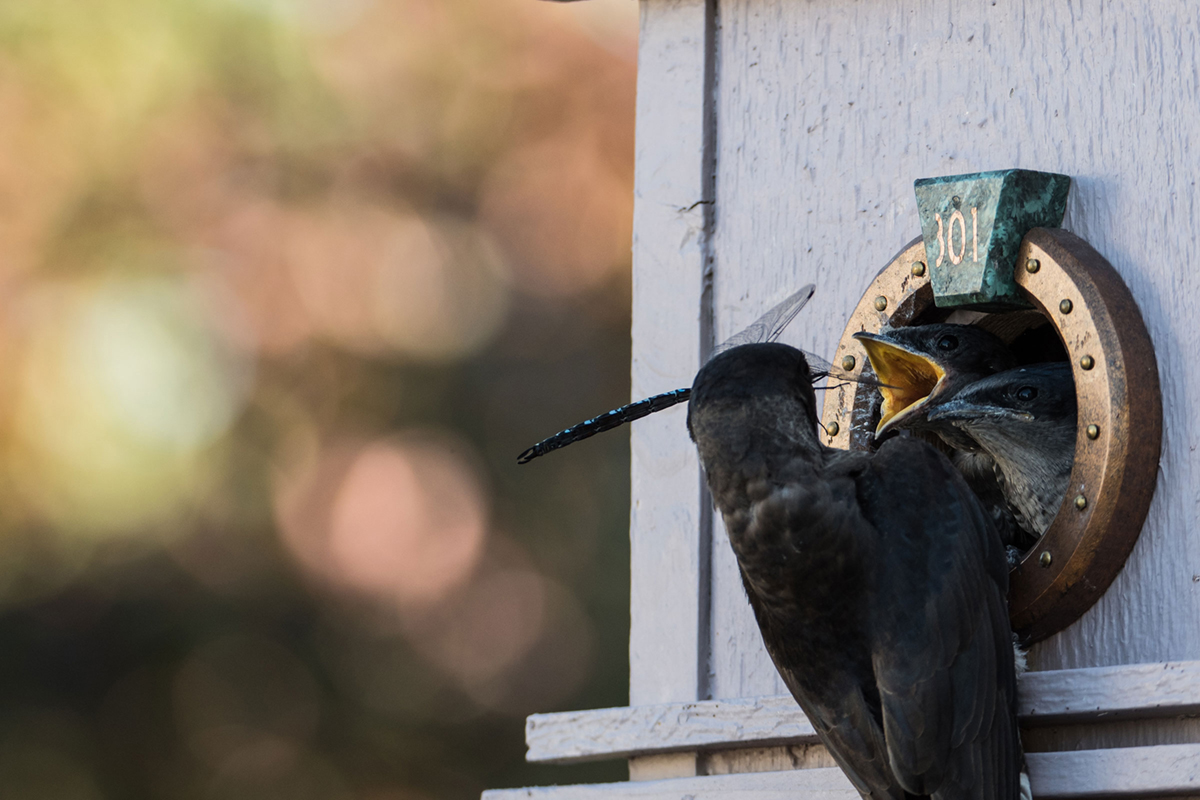
Today, eastern purple martins prefer to nest about nine metres to 30 metres from human housing. Landlords build, install and clean nest boxes; evict predators and competitors; track and report arrivals and departures; and generally commit for the long term. They undertake regular nest checks to assess the health of the parents, eggs and chicks. (Purple martins are highly tolerant of their landlords’ presence and touch.)
Why do landlords take up and continue this work? Mostly for pleasure, they say. It gives them something to look forward to over the winter. And when the purple martins return in the spring, they bring joy.
The crises facing purple martins
That feeling resonates with me. As the birds make rapid-fire calls just overhead and then launch into mesmerizing, swift aerobatic maneuvers high in the sky, I have to remind myself to watch my step along the boardwalk. The fact that purple martins are both cherished and provided for comes as no surprise.
With such effort, their future should be assured. And yet it turns out they are facing long-term, gradual decline — their numbers have dropped by an estimated 25 per cent since 1966, the year I was born. Habitat loss, invasive species (such as European starlings), pesticide and insecticide use and climate change have all contributed to the decline of the birds, with some of these factors further impacting their prey.
Concurrent with the global collapse in insect life, known as the insect apocalypse, about a third of all birds that rely on insects for food — nearly 160 million — have vanished from North American skies over the past 50 years. Still harder hit have been migratory birds — approximately 2.5 billion have been lost. Purple martins are migratory insectivores.
The other crisis facing purple martins, one all too familiar to humans, is a looming lack of housing. The current cohort of landlords is aging. Many of these purple martin caretakers took up the practice at a young age, alongside their parents or grandparents, or as scouts.
One study, already over a decade old, found that nearly 90 per cent of landlords in Texas and Oklahoma were aged 50 or older, with most in their 70s. Some move, or become physically unable to continue caring for the birds.
They are aware that younger generations are not able to support the purple martin housing market because they can’t afford to live where their parents or grandparents did. Fewer and fewer people are stepping up to take their place as landlords.
For some, this makes facing their own mortality even more poignant. Just as their own lives are drawing to a close, they must face the fact that the wild birds they love may go uncared for.
Wild animals with human affinities
Wild animals with this close affinity to humans — called synanthropes — include raccoons, pigeons, bats, crows, silverfish and purple martins. But unlike purple martins, those other synanthropic species are generally unintended beneficiaries of our lifestyles.
Given this, it may appear that purple martins are unique in their dependence on humans. Research suggests, however, that this dynamic may be becoming increasingly common. Humans now control so many aspects of the environment that most threatened and endangered species already — or will soon — depend on our conservation actions. They, too, are vulnerable to our willingness and ability to continue caring for them. In this sense, researchers suggest, purple martins represent a core dilemma in modern conservation.
Part of the Purple Martin Conservation Association’s mission is to attract new and younger landlords, and Siegrist advocates for putting up nest boxes in more sustainable locations, such as schools, public parks and marinas. He wants to foster a new kind of “landlord” relationship that doesn’t require homeownership. This encourages community adoption of this practice and provides both shared responsibility and continuity.
Short of becoming a landlord, what else can a person do to help purple martins? Ensure they have something to eat. People can replace lawns with native plants and reduce pesticide use. These efforts are not acts of sentimentality or tokenism. In addition to benefitting insects, birds and general environmental health, they can also bring a sense of connection.
And so I’ve cleared all the grass from our tiny front yard and bought seeds for a native pollinator garden. I’ve volunteered to help maintain my community’s growing purple martin colony. Next year, when spring again unfurls in our small corner of the world, the flowers, insects and nest boxes will be ready for arrivals from Espírito Santo.
In the face of staggering global biodiversity loss, I know this might not seem like much. But it’s a mindset, a way of being present and aware of my place in the natural world that these birds — and their people — have helped reawaken in me.
This article first appeared in biographic and is republished here with permission. ![[Tyee]](/design-article.thetyee.ca/ui/img/yellowblob.png)
Read more: Environment










Tyee Commenting Guidelines
Please note that email notifications for replies are not currently working due to a software issue which may be resolved in a future update.
Comments that violate guidelines risk being deleted, and violations may result in a temporary or permanent user ban. Maintain the spirit of good conversation to stay in the discussion and be patient with moderators. Comments are reviewed regularly but not in real time.
Do:
Do not: