



 SHARE:
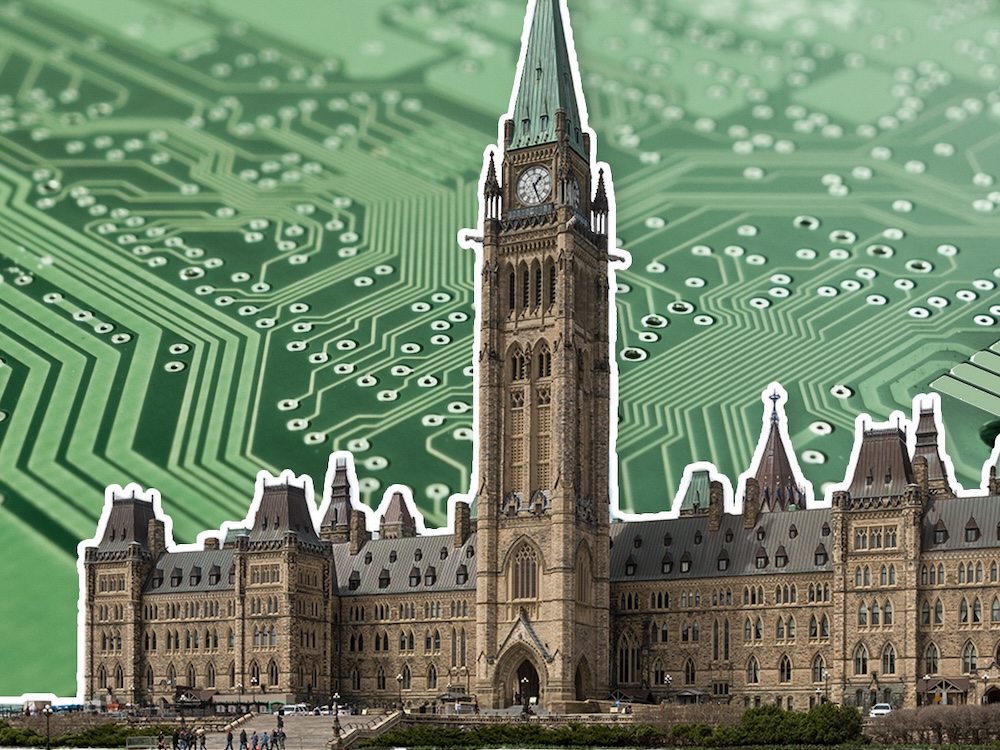
Voting for fellow community members to represent our interests in Parliament is a very human activity here in Canada. So is consenting to have that elected Parliament legislate on our behalf. Human, too, is having something to say publicly about proposed legislation.
These are, in fact, fundamental rights in one of the oldest continuing democracies in the world.
We should therefore be wary of degrading gimmicks such as the recording of made-up votes by a phoney member of Parliament. Although that is not discouraging a group of wealthy tech bros from trying.
Shortly after last year's election, the advocacy group Build Canada created what it calls the world's "first AI member of Parliament." The "Builder MP" project uses OpenAI’s GPT-5 to review every proposed piece of legislation introduced in Parliament, summarize it, analyze it against a specific set of criteria consistent with Build Canada's economic freedom-focused policy agenda, and assign it a vote (yes, no or abstain).
The AI MP also proposes “question period”-style questions for some bills. Sometimes, it suggests potential improvements to a bill.
OpenAI is the Sam Altman-led company that Canada's privacy commissioner recently said violated federal and provincial privacy laws in training its ChatGPT tool.
This is also the company being sued by families in Tumbler Ridge, B.C., for failing to alert authorities it had knowledge of a planned mass shooting before it took place. After months of waiting, the Liberal government chose not to include a mandatory reporting requirement in its recently announced legislation on online harms, disappointing B.C. Premier David Eby.
Shades of ‘Big Tech authoritarianism’
At the time of the AI MP launch, Build Canada CEO Lucy Hargreaves sought to frame the tool the same way the tech industry usually frames AI use — as an inevitability. "This project is about showing that the same technologies transforming industries can also modernize our public life.... AI will reshape how societies function, including how democracies govern themselves," she wrote.
Such framing foreshadows a very real potential danger consistent with the rise of what Azadeh Akbari, professor of critical data and technology studies at Goethe University, refers to as “Big Tech authoritarianism”: the offloading of political rights, civic responsibility and democratic accountability from citizens and their elected leaders to private interests and their programmable machines.
Presently, real democracies are experimenting with integrating AI machines into their public institutions and political decision-making bodies. Albania has appointed an AI cabinet minister. The prime minister of Sweden regularly consults AI for a second opinion. The United Kingdom is using AI to advise on local planning decisions. The European Union is assessing the laws of prospective member countries for compatibility with the union through AI.
In Canada, public submissions to Parliament as part of the policy consultation on a national AI strategy were reviewed and summarized by AI, a role normally reserved for non-partisan public servants. Canada's AI minister, Evan Solomon, admitted to turning to AI to receive a briefing on a bill, a process that reportedly proved badly flawed.
Since the new Liberal government came to power, the AI MP has reviewed and opined on about 200 bills. The results have been underwhelming.
For example, on Bill C-253, “An Act to develop a national framework for a guaranteed livable basic income,” the AI MP gets a basic fact wrong. Whereas the actual bill proposes "a national framework for the implementation of a guaranteed livable basic income program throughout Canada for any person over the age of 17," the AI MP claims the bill proposes a basic income be delivered to "all people in Canada aged 17 and over." Misidentifying the age of applicability is a significant, and, if it were to be implemented, costly, mistake.
There is also a curious inconsistency in the AI MP's voting choices on typically non-contentious, recognition and designation bills such as the "Ukrainian Heritage Month Act." While abstaining on this bill, along with acts recognizing Arab, Caribbean and Somalian heritage months, the AI MP voted no to bills designating a month for recognition of Albanian heritage, Hellenic heritage and national immigration. The wording of each of these bills is limited and remarkably alike. The analysis the AI MP provides in support of its votes is so similar that there is no justification for the different decisions.
Such inconsistency raises questions about the overall accuracy and analytical heft of the AI MP's review of more significant, denser bills.
Also, the AI MP's proposed "question period" questions are not always reflective of, or compatible with, the frame of the position taken on a bill. For example, while the AI MP recommends voting yes on a private member's bill proposing a U.S.-style "castle law," its questions are worded as if opposed.
A robot programmed for ‘economic freedom’
More importantly, Build Canada's AI MP is seeking to influence public opinion to align with the group's political agenda, to the point of near absurdity.
Consider, while supporting several tough-on-crime bills including the government's Bill C-14, which deals with bail and sentencing reform, as well as the "castle law" private member's bill, the AI MP abstains on proposed legislation to toughen sentences for domestic violence because it does not "promote economic freedom" and is instead "expanding state control." In its opposition to the Gatineau Park act, a bill intended to preserve public access to, and protection of, the park, the AI MP proposes to "implement dynamic pricing to fully fund upkeep." Suggesting revisions to bills that would directly benefit Build Canada's members is a not-infrequent occurrence.
On several bills concerning First Nations treaties, Indigenous rights and recognition, and residential school denialism, the AI MP abstains or votes no, on the latter because the proposed legislation is "risking a chilling effect on discourse." It does vote yes on the First Nations Clean Water Act, but the Assembly of First Nations has criticized the bill for weakened language on rights compared with previous bills.
On major government bills, Build Canada's AI MP has voted yes, including to the One Canadian Economy Act focusing on major projects, Bill C-5. This bill repeals carbon pricing and provides tax cuts. The AI also voted yes to the government's two major budget bills. Unsurprisingly, it opposed the new digital harms bill and most climate-concerned bills including those dealing with renewable energy, climate finance and ocean pollution.
The AI MP also voted no to the groceries benefit. More surprisingly, it opposed bills C-2 and C-12, the laws dealing with border issues and immigration, albeit less out of concern for human rights and democratic erosion but rather due to "red tape, regulatory uncertainty, and costs for exporters, financial firms, and employers relying on immigration."
Some votes lack both sensibility and sensitivity. A private member's bill on extending employment insurance benefits and bereavement leave periods to parents who suffer the death of a child received unanimous support among MPs at second reading, but the AI MP voted no because the bill is "not a large-scale prosperity reform" nor a "lower cost change."
Build Canada's AI MP also voted no to bills that would create a national framework on attention deficit hyperactivity disorder and a national strategy for children and youth. And a bill in support of homeless Canadians is opposed because, "while it may advance human-rights considerations, it does not enhance growth, productivity, or competitiveness."
Notably, the AI MP voted against all routine treasury bills that ensure the government has enough funds to operate. A Build Canada government would therefore appear to be one that regularly loses confidence and throws the country into frequent elections.
While Build Canada may smugly note its AI MP “won’t knock on doors,” human MPs will. When they do, those representing the Liberal government should expect tough questions from citizens on its alignment with a self-interested broligarchy.
What does ‘build Canada’ really mean?
"Build Canada" is a mostly innocuous, potentially positive phrase that could be associated with any number of policies, projects or objectives, from strengthening access to health care to constructing a high-speed rail line to creating a more just society. The Mark Carney government regularly leverages the term in its communications to Canadians.
Yet the phrase has also come to be associated with an accelerationist movement intent on ushering in new technologies, often with little regard for democratic norms, human rights, social justice or the natural environment.
In 2023, U.S. software engineer and venture capitalist Marc Andreessen penned "The Techno-Optimist Manifesto," championing unbridled technological advancement and its wide benefits to society. The 5,000-word manifesto — which praises the late Italian futurist and fascist Filippo Tommaso Marinetti — ends with the words "It’s time to build."
As activists from Build Canada gain place and prominence within this country's public policy decision-making apparatus — along with legitimacy from the prime minister — it is imperative that Canadians better understand what the group's proposed policies are, whom they would benefit and why they are necessary.
We can, should and do seek to build Canada, but this work cannot be left to a few wealthy tech bros, their self-serving policy proposals and their allies in government. Building Canada involves all of us.
This completes the series ‘The PM and the Broligarchs’ by Christopher Holcroft. Find all three stories here. ![[Tyee]](/design-article.thetyee.ca/ui/img/yellowblob.png)
Read more: Federal Politics, Science + Tech










Tyee Commenting Guidelines
Please note that email notifications for replies are not currently working due to a software issue which may be resolved in a future update.
Comments that violate guidelines risk being deleted, and violations may result in a temporary or permanent user ban. Maintain the spirit of good conversation to stay in the discussion and be patient with moderators. Comments are reviewed regularly but not in real time.
Do:
Do not: