





 SHARE:
Artificial intelligence makes it temptingly easy for students these days. Essays can be ordered up in seconds. Yet AI makes young people uneasy as they hear talk of jobs being swept away by robots. One question that students have always asked about school — “Why are we doing this?” — has become a lot harder to answer.
We speak from experience, as high school students enrolled in a University of British Columbia study that invited us to name our doomscrolling anxieties. The three of us discovered we share a concern about how AI is changing learning in the classroom and beyond. The same UBC project invited us to interview someone who is tackling our issue head-on — and we found him at Sir Charles Tupper Secondary in Vancouver.
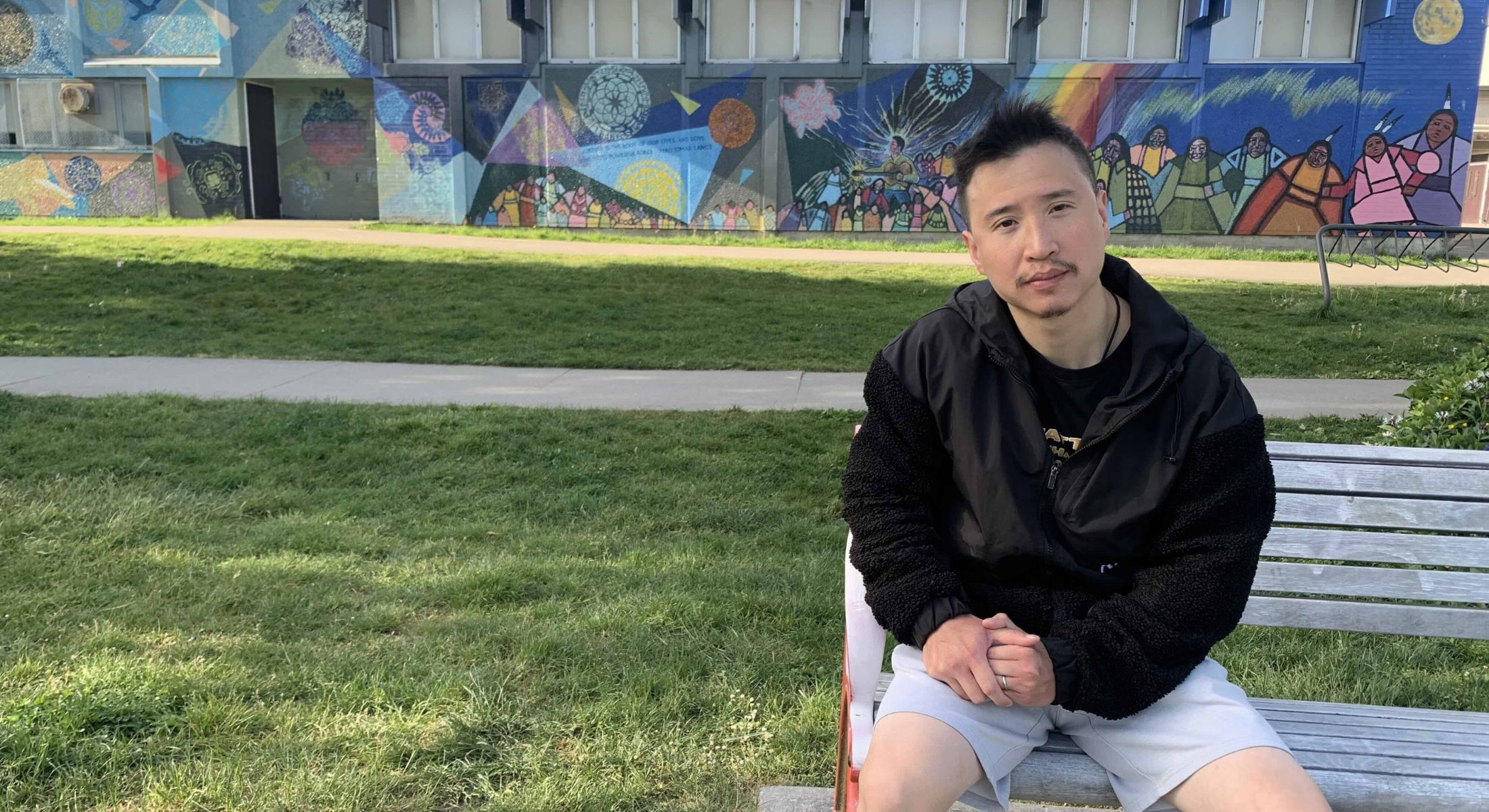
In the spring term of 2025, Tupper Secondary School English teacher Steven Hsu launched a class dubbed Applications of AI 12. The Vancouver School Board-approved course aims to prepare students for the looming AI reality by teaching them to use AI responsibly and effectively, sift out AI hallucinations and hold a fighting chance in an AI-dominated job market. As part of the course, students can try to apply the technology to solving real-world problems.
Hsu cautions that he’s not trying to “spread the gospel of AI.” In fact, he admits the new tech frightens him some. But he believes that its spread is inevitable and so the education gap surrounding responsible AI use must be filled. The gap is wide, according to a study from Cornell University, which found that 92 per cent of university undergraduate students used AI to boost their productivity at school, but only 36 per cent received formal instruction on how to use the technology.
We asked a student who had taken Hsu’s course what they thought of it. Catriona, as we’ll call them, said that they already knew some about AI before taking the class, but wanted to go deeper. “I didn’t personally use AI, and I still don’t.”
They said taking the AI class helped further illustrate the problems with the technology. “Just seeing how often AI gets things wrong or how often there’s AI hallucinations and all that. I’ve just always found it easier to do it myself instead of having AI do it and then cross-referencing and checking everything.”
Nevertheless, they said taking the AI class will still likely help them in a future AI-dominated job market. They see their parents’ workplaces “really pushing for AI usage, to the point where they’re like, ‘You have to use AI for this project,’ just to increase productivity.”
“There are ways that AI can be used for harm, but also for good,” Catriona added. “I feel both are very important. AI is obviously going to be such a big thing, so educating yourself on it is important even if you yourself don't use it.”
In February, during an early morning study block, we held a wide-ranging Zoom conversation with Hsu. In the background, Canada’s men’s hockey team played in the Olympic finals as Hsu talked about why he invented his course, what he hopes students will learn from it, how they applied their knowledge to solving real problems, and more.
Here is our conversation, edited for length and readability.
What led you to propose the Applications of AI class at Tupper? Was there any specific catalyst?
When ChatGPT first came out at the end of 2022, I guess you can call me an early adopter. I played around with it, just out of curiosity. And even within the first couple of months, I realized just how powerful this new technology can be. I realized that this thing is here to stay, whether I like it or not.
So, as a teacher, as a responsible adult, as a responsible citizen, I wanted to learn it. That evolved into, ‘Hey, we have to teach kids how to use this because it’s going to be a big part of the future.’
When seeking approval for this class from the school board, did it ever cross your mind that AI should be kept out of schools instead of letting students use it?
For a while now VSB students have had access to AI through the internet. I think the school board is taking a very measured approach. I think there’s a healthy amount of caution.
I didn’t want to be viewed as someone who is trying to spread the gospel of AI, trying to promote it. For me, I’m coming from a place of necessity. My whole approach since the beginning — and I think that’s perhaps why I didn’t get as much pushback — was, ‘hey, we need to learn this,’ but we need to do it the right way as opposed to having students explore it on their own, using AI through Snapchat, WhatsApp or Instagram.
So I think from the get-go, the decision makers at the top, while they were concerned, they also understood where I was coming from.
If this class hadn’t existed and students hadn't been able to learn how to use AI in a classroom setting, what problems do you think they might face?
A big threat that AI poses for the average person is misinformation. Inaccurate facts, what’s been called AI hallucinations. From time to time, AI still hallucinates, although to a much lesser extent.
And not just students but anyone may be tempted to use AI in unethical ways, or ways that can infringe on copyright or privacy. This was a big concern for me before teaching the course. There was a part of me that was like, ‘Oh, what if a kid goes and takes what we learned in class and makes a deepfake or something like that?’ But that didn’t happen.
Without the ethical instruction though, two things pose risks to kids using AI on their own: mistaking false information the AI gives you for truth, or just abusing or misusing the AI.
How did you teach students about possible AI hallucinations and misinformation?
In a math class the teacher gets you to show your work, right? The teacher wants to see a step-by-step process, right? So, what I really wanted on every assignment was to see their prompts.
Some of the earliest assignments were based on subject content that the students or their own family members were familiar with. So, say you are a student with a family member who owns a restaurant. The student would ask ChatGPT or ask Perplexity, which was another approved language learning model that we had access to, ‘How do you open up a restaurant in Vancouver? What are the certificates and licenses that you need?’ So you needed to know the background knowledge in order to catch AI hallucinations.
We tried to do something like that with most of the assignments: personalize it for students in the sense that whatever questions you’re asking AI, it's a bit of an extension of your own knowledge base, as opposed to, if you were to ask me about quantum physics, I wouldn’t know the first thing about it, so there was no way I could catch AI, right?
Can you tell us more about how the course was structured, and about the day-to-day for students in the class?
We started off very, very basic with how to effectively prompt AI for answers. And even before that, we had the ethics stuff. So after the prompting, we started doing more complex projects, projects like where you design a plan for a passion project, based on subject-area knowledge.
Also, we started doing some generative images and generative audio. And then it culminated in what I called a community capstone project. The aim was to have students share what they learned and use their skills to benefit family members, their neighbouring community or their school community.
The student would approach a family member, a coach or a teacher, and say, ‘How can I use AI to help you to make your lives easier?’ That’s why the course was called Applications of AI — because it’s about applying AI tools that have been vetted by the VSB, to help people. That was the big project but all the skills that the students learned throughout the semester built up to it.
Have your students told you that taking the course has created a lasting difference?
I’ve had pretty much nothing but the most positive feedback about the course, and a lot of the students have actually gone on to explore AI on their own. Some of them are actually thinking about doing a little bit of content creation with AI because it makes content creation a lot easier, whether that’s making YouTube videos or starting an Instagram.
There are also students starting to think about what courses they want to take in university. Some of them started thinking, ‘Oh, should I be pivoting my initial post-secondary choices? What kinds of courses would make me AI-proof?’ That wasn’t my intent, but it’s always good to think about.
So if you are, for example, going into business, how much of marketing and copywriting do you need? If you were getting into marketing or if you were getting into accounting, AI’s gotten very good at a lot of that. I’m not saying that they’ll replace accountants. I’m not saying they’ll replace marketers, but the course got them really thinking about, ‘What are some things I can do as a potential marketer or as a potential accountant that can offset what the AI can do? How can I future-proof myself?’
And that’s something all of us should be thinking about. Even me as a teacher now in my 40s. I’m not sure teachers are going to be replaced, but how can I future-proof myself to make sure that I develop skills that can supersede the AI?
Since teaching the course, what outcomes have you seen?
Students pop by from time to time and they’ll say, ‘Hey, I use AI to…’ Obviously, they’re not using AI to do their assignments. I’d like to think that I taught them to be more ethical than that. But from what they tell me, they’re integrating it into everyday life.
If they need to do research, if they need some help outlining certain things, it’s become a part of what we call a regular workflow. AI is a big part of their day in the sense that they use it to help them with little things. Not just as replacement for thinking.
Some of these students use AI as a “person” to bounce ideas off of or to compare/analyze things to help with small decisions such as price comparisons or reviews of restaurants or smartphones. They might use it to get ideas about specific careers or small businesses that they might be interested in starting when they get older.
And just in general, there’s obviously a big proliferation of AI. As an English teacher, I definitely see that we’re always trying to catch AI-written essays and things like that. But it’s becoming increasingly difficult. And at the same time, I think, as an English teacher, as any subject-area teacher, you have to shift. You have to expect that there will be AI in the work.
So how do we teach students to use AI but still assess them? How do we target the skills that AI can’t do? And I think that’s the biggest thing. AI has definitely become more commonplace and more widespread. But how can we actually assess learning, when we have access to AI?
The leading scholars and minds in AI have consistently said that creativity and discerning “taste” are going to be the “premium” human skills moving forward, so all of my English assignments focus on personal reflection, expression and selecting appropriate supporting quotes or evidence. These are things that AI struggles with and will likely continue to grapple with, and they are skills that I intend to foster in all of my classrooms.
Are you planning on teaching the course again?
It really depends on enrollment. I’m hopeful I will run again. It’s course-planning season, so we’ll see how the numbers go. Again, my argument since the beginning has always been that we need to learn this. It doesn't matter if you like it or not.
I know there are a lot of issues with AI. I know about the environmental concerns with AI. The immense amount of energy used. We’re going to need a lot more of what they call ‘compute.’ We’re going to need a lot more electricity. It’s just changing the world in ways that we might not necessarily like.
But I think it’s a tide that’s very difficult to stop because governments and these gigantic tech companies are pushing for AI. And I think at this point, we have to adapt. My whole my philosophy is, how do we adapt? Adaptation, that’s the key word. I think as humans, we need to reconcile with the fact that we’re never going back to an AI-less world. And that’s my rationale.
Every time, I’m going to argue for AI education — not necessarily because I like AI, not necessarily because I think it’s the best invention since the wheel or fire or the internet. I don’t think like that. Actually, I’m quite afraid of it. But I think if you’re afraid of something, you have to face it and you have to learn it. That would be what I'd say to everyone who is hesitant about AI.
This story is part of a series by secondary school students, ‘Reporting on Better Futures.’ ![[Tyee]](/design-article.thetyee.ca/ui/img/yellowblob.png)
Read more: Education, Science + Tech






Tyee Commenting Guidelines
Please note that email notifications for replies are not currently working due to a software issue which may be resolved in a future update.
Comments that violate guidelines risk being deleted, and violations may result in a temporary or permanent user ban. Maintain the spirit of good conversation to stay in the discussion and be patient with moderators. Comments are reviewed regularly but not in real time.
Do:
Do not: