


 SHARE:
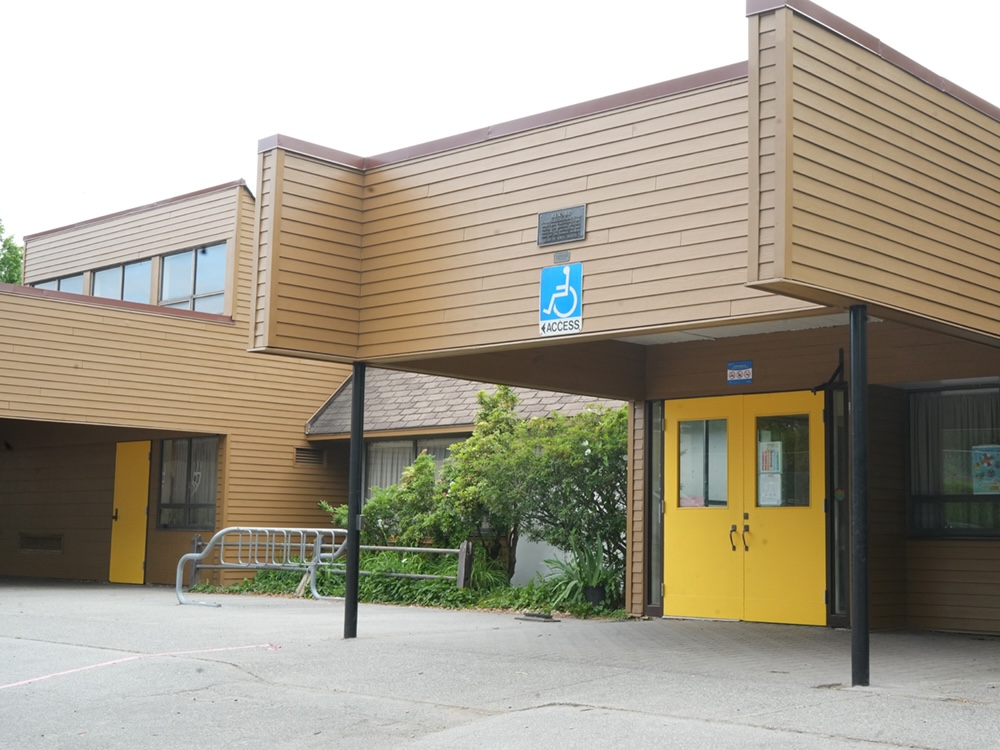
British Columbia’s 60 public school districts must submit balanced budgets for the next school year to the Education Ministry by the end of June.
For school districts facing deficits thanks to provincial funding not keeping up with increasing costs, aging school infrastructure and growing student needs, budget season is the time to make strategic and inevitably unpopular cuts to services and supports.
Online surveys are one of the methods districts can use to gather feedback about parents' and staff members' budget priorities.
These surveys are part of a school district’s "mandate to serve the public and to represent the public in school matters," says Jason Ellis, an associate professor of educational studies at the University of British Columbia.
There are two benefits for districts who run them, Ellis added: "It enables the district to get a sense of what the local priorities are for the spending that it has some discretion over. And… give the public a sense of what the competing priorities are within a limited budget model."
But surveys don’t always go smoothly.
Take for example the 2021 Greater Victoria School District budget survey, where parents were asked to rank their top three investment goals.
One of the options? Indigenous students’ personal and academic success. Many parents interpreted that as pitting the rights of Indigenous students against the rights of non-Indigenous students to access education that met their needs and reflected their culture.
The district ultimately canned the question.
This year marks a decade since the Surrey School District began asking parents to fill out an online budget survey to provide their feedback. Prior to that, offline surveys had been conducted by the district since the late 1990s.
Although the survey itself has not changed in years, it’s also the first year a parent reached out to The Tyee to complain about one of Surrey’s survey questions.
The parent, who declined to be interviewed citing their children’s privacy, noted the survey asks respondents to rank supports of students with disabilities and diverse abilities against other district budget priorities such as having certified teachers in every classroom and making available counselling and mental health supports for students.
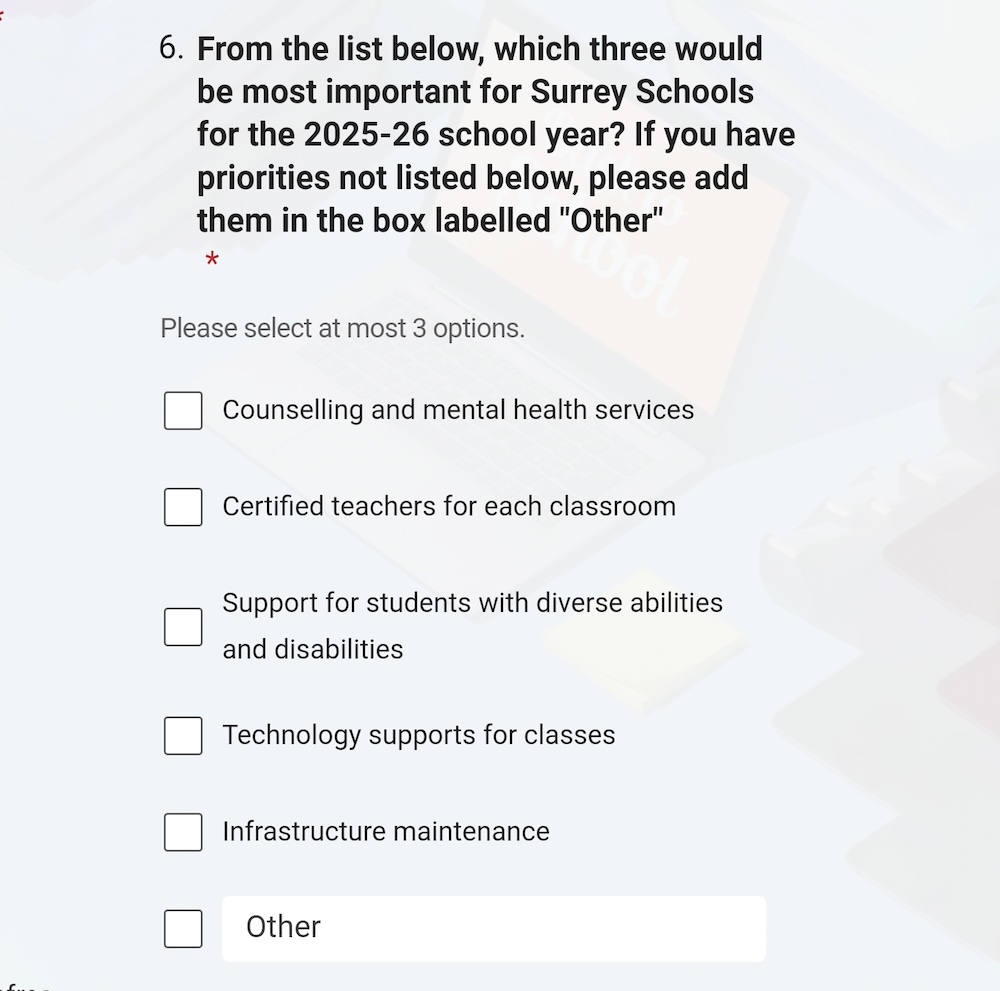
BCEdAccess, a grassroots organization advocating for equitable education access for kids with disabilities or diverse abilities, says questions like this are not uncommon in B.C. districts’ budget surveys.
"Ranking spending decisions for children with disabilities and diverse abilities against infrastructure maintenance in a public voting system is offensive and should not be socially acceptable," wrote Kim Block, chair of BCEdAccess’ board of directors, in a statement emailed to The Tyee.
"These kinds of financial decisions should never be put to a vote by the majority of people who have no experience or awareness of the systemic challenges disability communities face."
Why Surrey surveys parents
Surrey Trustee Terry Allen remembers what public budget consultations were like before the district implemented the online survey.
"We used to have actual board meetings where people came to make their pitch," said Allen, who has spent 23 years on the Surrey school board.
But the board found that most of the people who attended meetings were trying to sell a new product to save the district money, or were already involved with the education system through their school’s Parent Advisory Council.
"So we moved to the survey model and to be honest with you, we were very satisfied," Allen said.
Surrey’s survey, which closed April 7, had received about 8,800 responses when Allen spoke to The Tyee in late March. It was translated into six different languages to accommodate the diversity of languages spoken in the city, he said.
The largest district in the province with over 83,000 students, Surrey School District is facing a $16 million deficit this year, amounting to what Allen calls "a shitty budget" due to the required cuts.

Survey results, in addition to feedback from other stakeholders such as employee unions and students, help trustees deliberate on proposed cuts and even reconsider them based on the feedback they receive, Allen says.
The question about support for students with disabilities is important, Allen said, because the district spends $55 million on top of the per-student provincial funding they receive for supporting students designated as having "special needs."
"So you think about how we have to wrestle with, 'Do we continue to carry on at that level?'" Allen asked, adding the alternative is only providing the support the provincial funding covers for students with disabilities and diverse abilities.
"And if the survey comes back overwhelmingly that that’s a priority, then that makes a difference. It has to make a difference."
'Children’s human rights are not optional': Block
The current funding formula sees districts receive money for supports for every student diagnosed with a disability covered under three different provincial funding categories.
The money doesn’t go towards an individual child. Instead, it is pooled to cover supports district-wide.
Surrey is not alone in asking parents how much they prioritize spending money on classroom supports for students with disabilities.
The Vancouver School Board, whose survey ended in March, also had a question asking parents to indicate how much of a priority improving school accessibility for students and staff with disabilities is to them.
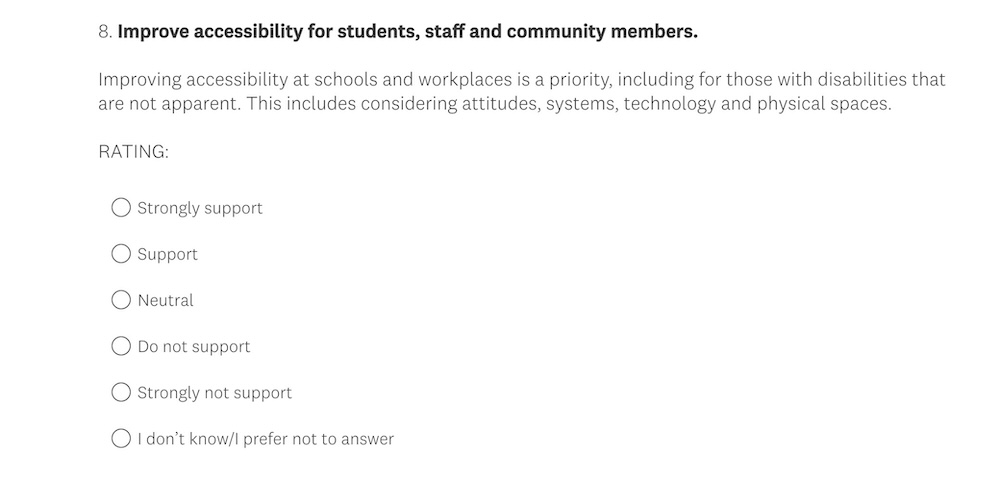
In an emailed statement to The Tyee, a district spokesperson wrote that the question is important because Vancouver, like Surrey, spends more on accessibility than the province provides funding for.
"The survey did not seek a ranking of any one area over another, but to reaffirm some priority areas that surfaced over time, including this school year," the emailed statement read, adding the district is accepting written submissions on the budget until April 15.
A public delegation meeting on the topic is scheduled for April 23.
But Block from BCEdAcccess doesn’t think funding for students with disabilities should even be put to a question.
"People in positions of power should always be a safeguard to make space in financial decision making for those who struggle the most with unmet needs due to the failings in our system," she wrote in her emailed statement to The Tyee.
"Children’s human rights are not optional. They will always need advocacy. It’s automatic. This is a public school."
Referencing the "chronic underfunding" of school districts in B.C., "inclusive education is often the first place to not only get cut, but also to have the impacts of underfunding reach them," said Anne Whitmore, president of Surrey’s District Parent Advisory Council.
Provincial policy dictates students with disabilities or diverse abilities are entitled to "equitable access" to education achievement and the "pursuit of excellence."
"Why should it be even a question of whether that would be a priority or not?" Whitmore asked, adding parents and caregivers of kids who need in-class support tell the Council they aren’t getting the same level of in-school support they once did.
How districts achieve this equitable access for students is not spelled out in policy, says UBC’s Ellis.
"That’s why you can get a question like, 'should we do this or that?' with money that could be used for special education," he said.
"I see where the parents are coming from. But also, these are the decisions we are making. It’s better not to disguise them as something else, or not talk about them at all."
Allen says the district is open to changing how the questions are worded in next year’s survey.
"We’re not opposed to rejigging any of this," he said. "We want it to work. It’s critical, actually."
*Story updated on April 9, 2025 at 5:45 p.m. to correct that Surrey’s survey was translated into six different languages, not 20. ![[Tyee]](/design-article.thetyee.ca/ui/img/yellowblob.png)
Read more: Education












Tyee Commenting Guidelines
Comments that violate guidelines risk being deleted, and violations may result in a temporary or permanent user ban. Maintain the spirit of good conversation to stay in the discussion and be patient with moderators. Comments are reviewed regularly but not in real time.
Do:
Do not: