


 SHARE:

“Everything’s a fight. It’s never gone smoothly.’
The frustration in Jason Maschke’s voice matches that of many other injured workers interviewed by The Tyee who feel stymied by their dealings with the Workers’ Compensation Board, the provincial Crown corporation that does business as WorkSafeBC.
Maschke is a 50-year-old Port Moody father of four and police officer with post-traumatic stress disorder and other mental health diagnoses. His experience with WCB leaves him asking, “Who’s the client? The injured worker or the employer? It’s the employer.”
Other injured workers in B.C. who spoke with The Tyee shared the view that WorkSafeBC is more interested in saving money so it can minimize costs for employers than it is in helping them recover.
The perception remains despite discussion in recent years about retooling WCB to better meet the needs of injured workers and a series of reports, including a landmark one from labour lawyer Janet Patterson released five years ago that included 102 recommendations advising the government on how to repair the system.
While WCB boasts of returning surplus funds to employers, many workers continue to describe their frustrations navigating a bureaucratic and legalistic claims process and the difficulties they have getting their needs met.
“I’m always telling people to just keep pushing for what you need,” said Andrea Hilder, a 50-year-old education assistant from Tsawwassen who for more than five years has been dealing with a head injury from a classroom accident. “Their first answer is always ‘no.’ I’ve had to fight for everything.”
‘I have regrets’
“Right now I have regrets,” said Solange Gham, a 42-year-old who worked in an administrative position with a Victoria construction company after what she describes as workplace bullying led to mental health issues and a WCB claim. “It’s just made my situation worse. I feel like the process is the punishment, you know.”
There’s Tammy Baines, a 57-year-old in Vancouver whose 35 years of work responding to calls as a 911 operator led to a chronic PTSD diagnosis. The condition has not been improving and dealing with WCB has aggravated it, she said. “It actually has gotten worse. I think, no, I know, it’s because of the stress.”
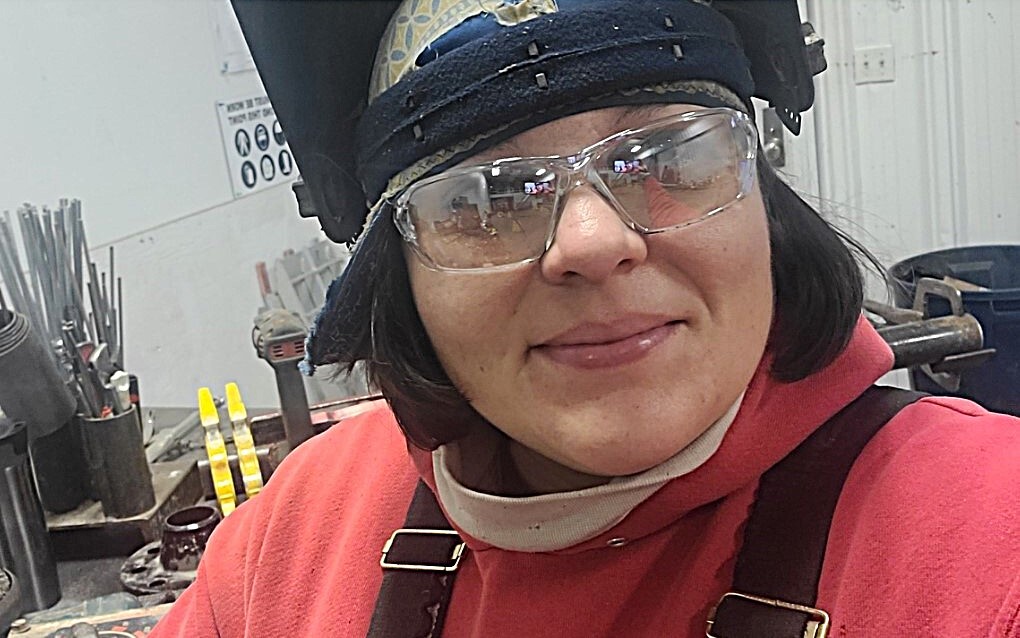
Casey Lynn Brouse, 40, is a welder based in Fort St. John who is certain the mental health issues she suffers from are linked to exposure to fumes and chemicals from her 21 years working on oil and gas facilities. She has found herself in “limbo” as she navigates WCB’s bureaucracy. “We’re just everyday working people and we don’t know these laws and these systems,” she said. “They’re basically leaving you for the welfare system. Or you get no choice but to go back to work.”
As a Métis person, she said, she feels compelled to let other Indigenous people know how difficult the agency is to deal with. “You’re not going to get help.”
Jeff Schlechtleitner, a 61-year-old gas fitter from Langley, was working in Surrey five years ago when he was injured moving something heavy. “They paid me for six months, then said, ‘You should be better by now,’ and I wasn’t,” he said. “I hurt every day.”
It’s been years since he’s received payment, and he’s ended up living in a motorhome, he said. “WorkSafe is not there to save me; it’s there to save the employer from what they do to me.”
Nobody from WCB was available for an interview.
“WorkSafeBC is committed to supporting injured workers on their road to recovery,” a spokesperson said in an emailed response to detailed questions. Supports are tailored to an individual injured worker’s needs and can include wage-loss benefits, health-care benefits, physiotherapy and vocational rehabilitation, they said.
“We recognize that workplace injuries can carry significant physical and emotional impacts. The period following an injury can be marked by pain, uncertainty about recovery and concern over future employment. Our staff understand these challenges and are dedicated to providing responsive, transparent and individualized support throughout the claims and recovery process.”
WCB’s priority is to make sure both the worker and the employer have the necessary services to support recovery and a safe, sustained return to work whenever there is a work-related injury or illness, they said.
Complicated experiences
WCB covers 2.7 million British Columbians working for some 281,000 employers. In 2024 it received reports of more than 142,000 injuries. More than 88 per cent of the claims that went through the adjudication process were allowed.
Each injured worker The Tyee spoke with had a story that was long and detailed. The stories were often complicated, with many workers citing legislation and WCB policy as they described why they believe they’ve been mistreated.
While the details vary widely, some of the common themes include: frustrations with case managers; disagreements with return-to-work plans; getting deemed “unco-operative” for reasons beyond the worker’s control; being considered to have plateaued in their healing; getting steered into retraining when they’re not ready or in a field they feel is unsuitable; having WCB officials override the opinions of outside health-care professionals who have treated the worker; and sharing private medical information with employers.
Gham, whose payments were cut off in March and who has been struggling to survive, has an appeal in with the Workers’ Compensation Appeal Tribunal. She has also filed a complaint with the BC Human Rights Tribunal as she had reason to believe the treatment in her workplace was rooted in racism. Her feeling of belonging has been shaken, she said.
“My mental health claim was terminated against medical advice, based not on my psychiatrist’s ongoing treatment, but on assessments by individuals who have never even met me,” she wrote. “My wage-loss and medication coverage were cut off. I’ve been urged to quit, to accept long-term disability and to simply move on, as if I hadn’t already lost so much.”
For police officers, it’s supposed to be presumed that PTSD can be attributed to what they’ve experienced at work, but Port Moody officer Maschke said that wasn’t what happened to his claim, despite his detailing for WCB 27 traumatic incidents he’d experienced. “There’s no presumptive at all. They try to disprove you.”
As a first responder, he thought he could rely on help when he needed it, but he was disappointed. “They are there to save money,” he said. “If they think it’s going to be long term, you are in for a war.... You’re putting your trust in someone else, then you’re being let down.”

Baines, who was the chief dispatcher for the Vancouver police in her most recent job, said there have been expectations to participate in retraining even as she struggles with chronic PTSD. “If you don’t do them, you don’t get paid.”
WCB treats injured workers as numbers, not whole people, she said. “How about just being in reality? The reality is some of us, myself included, can’t go back to school and learn something because we don’t retain anything.”
According to WCB’s spokesperson, it makes decisions about claims and vocational rehabilitation based on the best available evidence. “These decisions are based on reports from the worker, the employer, medical reports from the injured worker’s doctor and all other relevant medical information.”
When medically appropriate, returning to work can be a “critical component of healing, contributing to both the physical and psychological well-being of injured workers, and helping restore a sense of normalcy and purpose,” they said.
Injured workers who disagree with a claim decision have several avenues open to them to appeal, they added. There’s also independent assistance available through the Workers’ Advisers Office, they said.
$570 million in surplus funds
WCB is funded by premiums paid by employers and investment income. In what is sometimes referred to as the “historic compromise,” which goes back more than a century, both employees and employers give up the right to sue in exchange for a predictable no-fault method of determining how much support an injured worker is entitled to.
In mid-July the Crown corporation announced that it would be able to hold rates steady for the ninth year in a row and that strong investment returns made it possible to set fees at a rate lower than what it costs to fund the system.
“The announcement also outlines that approximately $570 million in surplus funds will be returned to B.C. employers in 2026 by keeping rates below the cost to run the system,” WCB’s statement said. “Between 2019 and 2026, $3 billion in surplus funds will have been returned to employers through reduced rates.”
A few days later the BC Federation of Labour issued a statement saying that the top priorities for using any surplus in WCB’s accident fund should be improving benefits for injured workers and making workplaces safer.
“The so-called surplus in that fund was built on the backs of injured workers,” it quoted president Sussanne Skidmore saying while tracing its origins to cuts made while the BC Liberals, including current Conservative Party of BC Leader John Rustad, were in government.
“Instead of billions of dollars in handouts to employers, the WCB should be making up for that lost ground,” she said.
The WCB directors should reverse the premium decision, she added. “If the fund really has more than the WCB needs to meet its commitments, they should invest that in making workers safer and treating injured workers more fairly.”
BC Federation of Labour secretary-treasurer Hermender Singh Kailley noted that employers pay less for WCB now than they did a decade ago. “How is it that the WCB somehow can’t afford to treat workers with psychological injuries fairly, can’t afford to restore pensions and can’t afford to put more into workplace inspections and enforcement — but can afford to keep employer premiums artificially low?”
WCB’s spokesperson said the surplus has been used to lower premiums for employers but also to enhance benefits for workers. They gave the example of $1.26 billion that was used in 2022 to cover a one-time liability cost for worker benefits related to legislative changes the government made that year.
Kevin Love is a lawyer with the Community Legal Assistance Society in Vancouver who works on workers’ compensation cases. “The challenge, of course, from the worker perspective is if the system isn’t appropriately caring for workers, that’s what we have to do before we decide there really is a surplus, is to ensure the needs of workers as envisioned in the historic compromise are being met.”
While there have been positive steps, and there are many good people trying to make the system the best it can be, there’s always more to do to, he said. Priorities include the need to implement the Patterson report, address claim suppression and better support workers with mental disorders and other conditions like chronic pain that are difficult to see.
Change is slow in part because of the large number of players involved in the system, Love said. The government sets the legislative framework, the WCB board of directors sets policy work within what the law allows, and then the law and policies are implemented by people making frontline decisions.
“Progress really requires movement on all of those fronts,” he said. “It makes it very difficult.”
‘Half-measure changes’
Meanwhile there are many injured workers struggling to navigate a system they find frustrating. Some claims go smoothly, but others can be complicated.
“Unfortunately the system is still set up in a very legalistic way that focuses on discrete decisions that drive people into endless reviews and appeals rather than a worker-centred system that looks at the worker and looks at the claim holistically and strives to get to the correct result as efficiently as possible,” said Love.
“We continue to see workers with five, six, seven, eight reviews and appeals going in all different directions and that can be very difficult for the worker to understand what’s been decided, how it all fits together and what to do next.”
Others say it can even be hard to get through to a case worker or to get a call returned, a reality that may have to do with large caseloads and understaffing.
“We’re still in the era of more for less,” said Sarah O’Leary, a lawyer who represents unions and who in the past served as a worker’s adviser and as a vice-chair of WCB’s appeals division. “I’ve been doing this for 35 years and the bureaucracy has never been worse.”
She traces many of the problems with the system to the early 2000s when the then-BC Liberal government made changes that were negative for workers. Since returning to government in 2017, the NDP has made some positive changes but hasn’t gone far enough, she said.
“They make changes that are half-measure changes,” she said. “They are good for workers. They could be better.”
O’Leary said she’s hopeful for progress under Jennifer Whiteside, a former labour leader who has been labour minister since November and who may be more committed to listening to what workers need and advocating for them.
“I think that everything the NDP has brought in has been well intentioned and meant to help workers,” said O’Leary. However, she added, “The consultation with workers and the worker community has not been robust in any regard and as a consequence of which... their changes have been watered down and in some cases of questionable assistance to the worker community.”
Hilder, the education assistant who continues to experience concussion symptoms, said she would just like to be adequately compensated for the change to her life as she’s gone from being an energetic person to someone who now requires lots of rest and recovery.
Whatever changes have been made to WCB, the system is not at all worker centred, she said. “Here I am with a brain injury having to go through all these processes just to get an answer.... It’s this added stress to my life.” ![[Tyee]](/design-article.thetyee.ca/ui/img/yellowblob.png)
Read more: Health, Rights + Justice, Labour + Industry


Tyee Commenting Guidelines
Please note that email notifications for replies are not currently working due to a software issue which may be resolved in a future update.
Comments that violate guidelines risk being deleted, and violations may result in a temporary or permanent user ban. Maintain the spirit of good conversation to stay in the discussion and be patient with moderators. Comments are reviewed regularly but not in real time.
Do:
Do not: