


 SHARE:
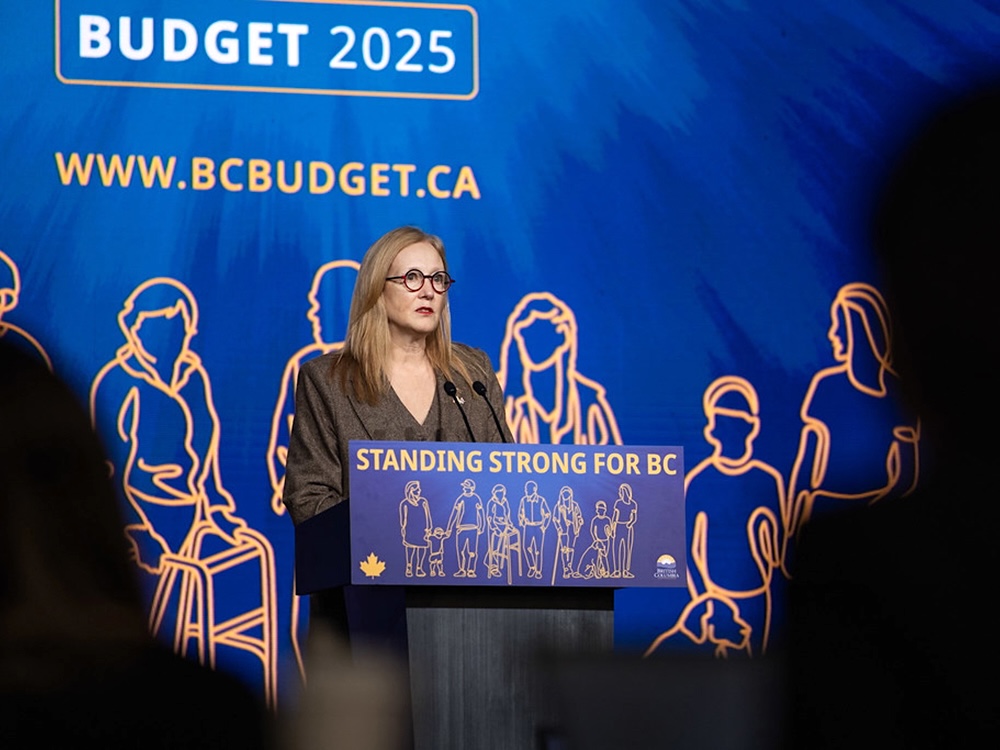
Three months into the fiscal year, the British Columbia government is forecasting a record deficit that would be even larger if lost carbon tax revenue weren’t temporarily offset by a windfall from a successful lawsuit against tobacco companies.
Finance Minister Brenda Bailey blamed the government’s deteriorating financial health on external factors.
“While the province’s diverse economy is showing some signs of weathering the economic headwinds we’re facing, our financial bottom line isn’t immune to the impacts of uncertainty being felt in the global economy,” she said Monday.
The government’s updated forecast predicts an $11.6-billion deficit for the current fiscal year, up $665 million from the February budget.
The biggest hole in the budget is due to the commitment Premier David Eby made ahead of the 2024 election to get rid of the consumer carbon tax if the federal government removed the requirement to have one.
The cut resulted in lost revenue of $2.8 billion this year, a gap that was largely balanced by $2.7 billion owed to the province as its share of the legal settlement with tobacco companies. The tobacco money will come in over 18 years, but the bulk of it has been counted as revenue in the current year.
The decision on how to book the revenue from the lawsuit was made by Finance Ministry accountants following standard accounting principles, not by politicians, Bailey said.
“This isn’t a magical number out of nowhere,” she said. “These assets are coming from the work to hold tobacco companies accountable for the harms they’ve caused Canadians and caused British Columbians.”
Still, Bailey acknowledged the help to the bottom line, saying she was “delighted” when Attorney General Niki Sharma said the tobacco settlement was coming. “These are challenging times economically. There’s no question.”
While the bump from the settlement is a one-time help, the loss of the carbon tax revenue will recur every year, adding more than $3.1 billion to the deficit in each of the next two years.
Bailey acknowledged that the reasons to cut the carbon tax were political rather than doing what was best for the province’s finances.
“That tax cut really was largely an affordability measure for British Columbians,” she said. “Much of the benefit from that tax cut is still to be felt as we head into the winter season, the first winter season people will experience without the carbon tax, and will see that reflected on their gas and fuel budgets going forward.”
The government has been working to cut spending and has found $300 million to cut this year and plans to find $600 million in each of the next two years. Though no specific numbers were provided, she said savings had been found on travel, contracts, administration and discretionary advertising.
The public service has shrunk by 850 employees, largely through attrition and retirements, she said.
Other significant changes since budget day include an added $613 million to fight wildfires, $357 million less in contributions from the federal government, $247 million less in property transfer tax revenue, $225 million less from natural resources and an additional $140 million in debt servicing costs.
It also includes $740 million the government will save on refundable tax credits and $411 million from increased corporate income tax revenue.
Overall, B.C.’s taxpayer-supported debt remains relatively affordable compared with other provinces, Bailey said, but it is on track to grow by about 50 per cent over the next two years.
“What we see happening in debt accumulation is very, very concerning to me, and that’s why we are so focused on revenue development and a careful review of government spending,” she said. “Those two things must happen.”
Conservative Party of BC finance critic Peter Milobar said slowing economic growth and caving revenues are very troubling signs.
“Most concerning of all, I think, is really the accounting we’re seeing with the tobacco settlement,” said Milobar. “The government’s desperate to paint a picture that’s better than it actually is.”
He criticized the minister’s lack of clarity on where the government is finding savings. “She is on this mythical quest to find $300 million that she can’t actually point to any specific dollar figures attached to any of the things she has said they cut back on.”
The numbers don’t look good for the coming years, Milobar added.
“The minister may feel that they dodged something today,” he said. “Maybe the goal is to try to hope and cross your fingers that the economy really takes a big upswing and you can try to pretend next year’s deficit won’t be as bad, but there will be a flow-through and a knock-on effect on this when you’re artificially presenting how bad the books actually are.”
The BC General Employees’ Union, which represents some 34,000 core government workers, currently has almost 20 per cent of its members on strike as it seeks a new agreement with the province.
BCGEU president Paul Finch said in a statement that the quarterly update shows the government can afford to invest in public service workers.
“Numbers released today by B.C.’s finance minister indicate that B.C.’s economy remains strong despite global volatility, with low unemployment numbers and a debt-to-GDP servicing ratio that remains among the best in the country,” he said.
Government workers provide key services the province depends on, said Finch. “The looming crisis faced by the province is the risk that the people who provide these services can no longer afford to stay in their jobs.”
The union has been seeking general wage increases of four per cent this year and 4.25 per cent next year but says the government’s last offer was 1.5 per cent and two per cent.
The government’s offer is “less than inflation and a continuation of the devaluing of the critical work done by people like wildfire fighters, health-care workers and correctional officers,” Finch said.
Every one per cent increase in wages across the entire public sector costs around $530 million a year.
Finance Minister Bailey said there is money put aside to cover wage increases, but it would be inappropriate to identify how much as negotiations aren’t finished.
“We believe we can find an agreement that both respects workers and respects all British Columbians and our bottom line,” she said. “We look forward to the opportunity to get back to the bargaining table to continue that work.” ![[Tyee]](/design-article.thetyee.ca/ui/img/yellowblob.png)
Read more: BC Politics








Tyee Commenting Guidelines
Please note that email notifications for replies are not currently working due to a software issue which may be resolved in a future update.
Comments that violate guidelines risk being deleted, and violations may result in a temporary or permanent user ban. Maintain the spirit of good conversation to stay in the discussion and be patient with moderators. Comments are reviewed regularly but not in real time.
Do:
Do not: