




 SHARE:
Shara Pritchard Nixon’s 99-year-old mother was stuck in Surrey Memorial Hospital’s emergency department for nearly 24 hours this July after she fell and broke her leg.
The bright lights, loud noises, police incidents and lack of privacy in the emergency department added up to “torture” for her mother, who would “scream” in pain every time her bed was moved, Pritchard Nixon said.
The majority of B.C.’s hospitals are often operating at over 100 per cent capacity, meaning full hospital wards and backed-up emergency departments.
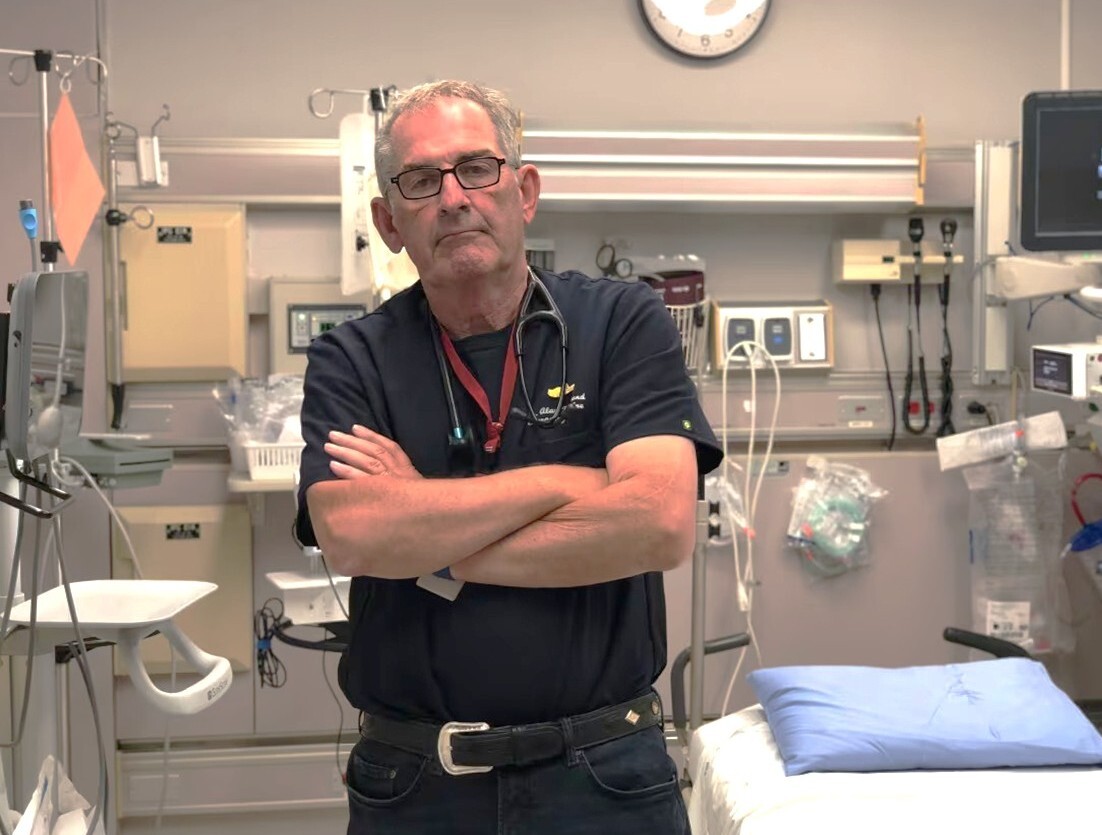
Emergency department care teams “play Jenga” with patients while they try to find space to see them and care for them, said Dr. Jeffrey Eppler, an emergency physician who has worked at Kelowna General Hospital for three decades.
He said the main challenge facing emergency departments is a phenomenon known as “boarding.”
Emergency departments are designed to admit and stabilize patients so they can be moved to a bed in a hospital ward for treatment and care. But when hospital wards are full, patients who are waiting to be moved to a ward end up being boarded in an emergency department for several days.
Boarding is a countrywide problem, said Dr. Alan Drummond, who has been working as an emergency physician for four decades and served as the public affairs co-chair of the Canadian Association of Emergency Physicians, the professional association for Canada’s emergency doctors, for 21 years.
When he was starting his career, “we never saw hallway medicine, ever,” he told The Tyee.
Today, he said, he struggles to find free space in the emergency department to see patients. He’s met them in the waiting room and the ambulance bay.
“I saw a patient three weeks ago in a toilet because it’s either that or you don’t get seen for hours and might leave without being seen,” he said.
Hallway medicine
When they’re waiting for a bed in a ward, patients often end up on stretchers in emergency department hallways.
That’s a “terrible place to receive care,” Drummond said, because of the 24-7 bright lights, lack of privacy and delays in getting food, water and medication.
Stretchers are designed to hold a person for only a couple of hours. They’re really uncomfortable to be stuck on for days on end, Drummond said.
“You can get bedsores,” he said.
Pritchard Nixon told The Tyee she was grateful her mother could get a bed when admitted to the emergency department in July but was frustrated that the bustle of the area prevented her mother from resting.
“Every time she gets settled she gets woken up. I regret calling an ambulance,” she wrote in a social media post about that night.
Pritchard Nixon was also distressed to see how many seniors were there with no one to advocate for them.
“They’re just left in the hallway crying,” she told The Tyee.
Increased risk of delirium
The busy emergency department can put patients, especially seniors, at risk of developing delirium, Eppler said.
Delirium is marked by “a sudden change in a person’s mental status leading to confusion and unusual behaviour,” according to the province.
Delirium waxes and wanes, Eppler said. Patients can suddenly be confused, experience visual or auditory hallucinations or have impaired judgment. Some patients can become withdrawn while others can be “quite agitated,” he added.
Agitated patients may have to be restrained, he said. Overall, delirium is bad for a patient and bad for their family, leads to longer hospital stays and increased mortality and “is economically bad for the system, not to mention a failure of human kindness.”
In B.C.’s largest health authority, Fraser Health, acquired delirium rates have exceeded the organization’s own targets for at least five years, according to quarterly report cards. In Delta Hospital, which operated at 128 per cent capacity last year, the rate of acquired delirium this spring was seven times the target set for the facility.
Other overcrowded hospitals, such as Abbotsford Regional Hospital, Surrey Memorial Hospital and Burnaby Hospital, also significantly exceeded their targets.
Moral injury reduces staff numbers
The chaos of emergency departments is also having a huge impact on staff.
“You go to work feeling like you’re being set up to fail every freaking day of your life,” Drummond said.
While it’s a tough job, people who work in emergency departments love working as a team to transform chaos into calm and are willing to work weekends, nights, holidays, on their wedding anniversary or on kid’s birthday to deliver that care, he said.
But it’s hard to find joy in your work when “you’re getting beaten up every day, verbally at least, because you can’t do the job you were trained to do,” he said.
Coming to work every day to an overflowing waiting room and hallways filled with patients wears you down on every level, he said.
Despite all that, Drummond said emergency nurses love what they do and many who have left would likely return to the profession if the government or health authorities could improve the flow of patients so there wasn’t crowding in emergency departments.
Patients checking themselves out early, or leaving without getting care
Surrey resident Lindsay Gill, who was introduced at the start of this series, spent four days in Surrey Memorial Hospital’s emergency department in late September.
She told The Tyee she checked herself out of the hospital because “they didn’t need me in the chaos and I was doing them a favour by leaving.”
Gill said she was able to recover at home that time.
She had a stroke 15 years ago and despite regularly needing care, she struggles to stay in hospitals longer than a couple of days because of a previous traumatic health-care experience.
After speaking to The Tyee the first time, Gill reached out to say she had fallen and hurt her ankle. She spent 19 hours in Surrey Memorial’s emergency department without food. She again left the hospital without being discharged.
A week later she developed intense bruising and blistering on her ankle, but she said she wanted to stay home to recover.
“I’m not going to the hospital, not again,” she said in a message to The Tyee. Gill has since fully recovered.
A growing number of patients are leaving the emergency department without getting care.
According to reporting by CBC, this number rose 86 per cent between 2018 and 2025 in B.C.
It’s calculated this leads to around an additional 15,000 to 20,000 excess deaths in Canada every year, Drummond said.
Some of these deaths are obvious, like a young person who dies from sepsis, he said. But many more are harder to see, like a senior who could have lived another couple of years if her pneumonia had been caught and treated.
When hospitals are running at 85 per cent capacity or lower, they’re safer for patients because there is space and capacity to deal with surges in demand, and beds available to move patients into hospital wards whenever needed, Drummond said.
But it’s rare to find a hospital with less than 85 per cent capacity, said Eppler.
Instead, the majority of hospitals run at over 100 per cent capacity.
“That translates into long wait times, where a six to 12 hours’ wait isn’t unusual,” he said. “Waiting four to eight hours for care while worried about a condition? That’s an awful situation to be in.” ![[Tyee]](/design-article.thetyee.ca/ui/img/yellowblob.png)
Read more: Health











Notice about commenting changes
The Tyee’s commenting system will be moving to a new platform on Nov. 12. If you’re already a Tyee commenter you must register with the new system on or after Nov. 12 with your preferred username.More information can be found here.