


 SHARE:
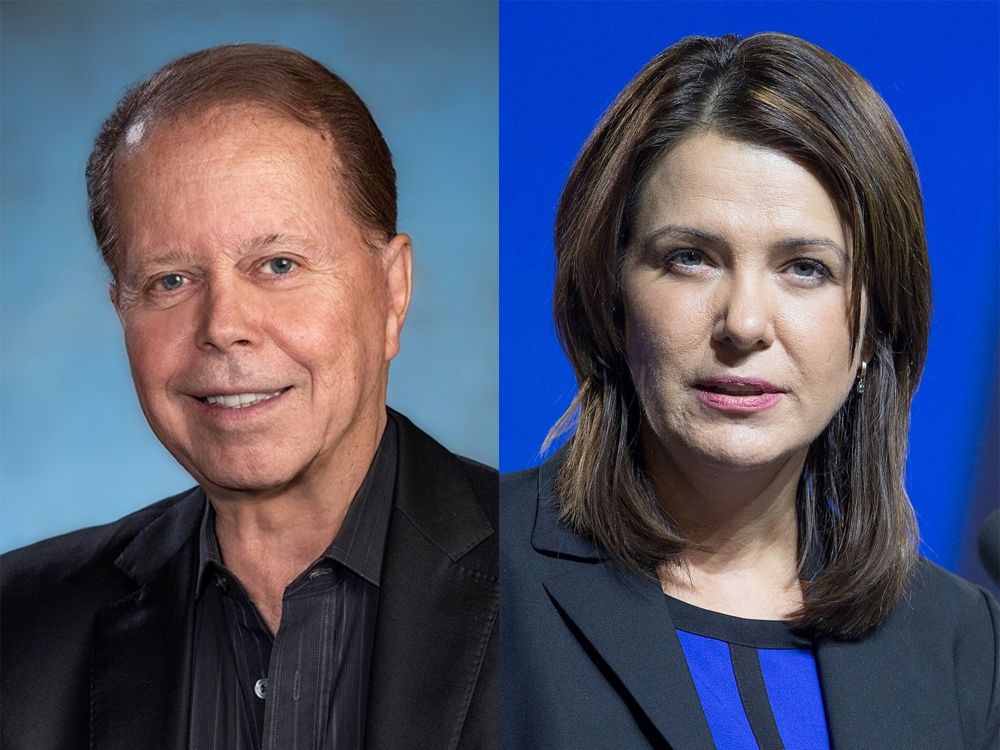
A key figure in Alberta’s separatist movement said Premier Danielle Smith indicated to him that if the province goes it alone she’d stay on as its leader. And the title she’d prefer in the role is prime minister.
Dennis Modry made the claims at a sovereignty petition signing event in Stony Plain on Jan. 22. Modry is former CEO of the Alberta Prosperity Project or APP, a group that has been mobilizing the drive for signatures.
Smith has yet to explicitly state if she is for or against Alberta separation.
The premier’s repeated advocacy for a “sovereign Alberta in a united Canada” has placed her at the centre of escalating tension over independence efforts.
Political scientist Duane Bratt sees Smith’s rhetoric as designed to appeal to the United Conservative Party, separatists and federalists. This strategy has allowed separatist leaders to publicly claim her support, while others accuse Smith of deliberately blurring her position.
“She is trying to play this middle ground,” Bratt said. “I just don’t know how long she can keep dancing.”
The citizen initiative petition for Alberta independence began collecting signatures on Jan. 3. At the Stony Plain petition signing event Modry was audio recorded telling the crowd that Smith demonstrated a willingness to lead an independent Alberta.
“I’ve asked her the question, would she be willing to govern the sovereign country of Alberta as president or prime minister? And her comments be, ‘Well, I don’t really like president, I prefer prime minister,’” Modry claimed.
In this alleged conversation, Modry described David Cameron’s resignation as prime minister following the 2016 Brexit referendum, during which the United Kingdom voted to leave the European Union.
“Cameron, who campaigned against Brexit, did the honourable thing. He resigned when Brexit was successful,” Modry said he told Smith. “And she said to me, ‘Well, I’m not going to David Cameron myself.’ So that obviously means she’d be willing to lead a sovereign country.”
In an email, Smith’s press secretary Samuel Blackett wrote that “Modry does not speak on behalf of the premier. The premier has been very clear — she supports a strong and sovereign Alberta within a united Canada.”
Modry did not acknowledge a query from The Tyee about his comment.
Smith ‘helping’ separatists, says expert
While Modry does not speak for Smith, he is no stranger to publicly interpreting Smith’s rhetoric as signalling support for separation efforts.
At an APP town hall in May 2025, Modry suggested that Smith had made a separation threat when she warned, two weeks before the federal election, that if victorious, Mark Carney and his Liberals would have to address her demands within the first six months “to avoid an unprecedented national unity crisis.”
Modry, whose comments were audio recorded, told attendees that her warning “can only mean that [Smith] is suggesting that Alberta would leave if we don’t get what we want.” The disconnect between Smith’s push for sovereignty within Canada and how her rhetoric is interpreted by separatist leaders is a deliberate strategy on Smith’s part, according to Bratt.
In July 2025, the rules Smith’s UCP government put forward for citizen initiative petitions went into effect. The number of signatures needed to put a referendum question on the ballot decreased from a threshold of 20 per cent of general election turnout to 10 per cent. As well, signature collection time increased from 90 to 120 days.
APP, whose current CEO is Mitch Sylvestre, has until May 2 to collect 177,732 signatures.
The separatist movement “is coming from an outside group… with clear ties to the UCP,” Bratt said. Smith has “made it much easier for them” by changing referendum rules, he added.
“It allows Smith to say; it’s not me who’s separating or proposing this. It is Modry. It is Sylvestre. It is [APP lawyer] Jeffrey Rath. But she’s helping them at the same time.”
But Smith’s relationship to APP goes farther back. At an event hosted by Rebel News on Aug. 25, 2022, the right-wing media company’s founder Ezra Levant asked Smith if she’s willing to say, “we want these things, or else.”
“The ‘or else’ is Dennis Modry and the Alberta Prosperity Project,” Smith replied. “Part of when I decided I wanted to run, I knew how important it was to make sure that we addressed the issues of autonomy. And I talked to Dr. Modry as one of my first steps. I said, let’s try this together. Let’s get as much autonomy as we can.”
APP has “got the power if we are not successful. And this is why I take your movement very, very seriously,” Smith added.
While Smith was vocal about her support of APP in 2022, her tone has since changed.
Bratt said that, during Smith’s UCP leadership campaign in 2022, “it was all about sovereignty.” The idea of being sovereign within a united Canada, he added “was imposed upon her by the rest of the caucus.”
“She can’t come fully on the side of separatism because the majority of Albertans aren’t,” Bratt said. “And so the rhetoric about a sovereign Alberta in a united Canada is designed to placate both wings of her party and both parts of Alberta.”
Nenshi calls for ‘absolute clarity’
Tensions over Alberta separation have only gotten stronger in the past two weeks, resulting in more calls for Smith to clearly state her position.
In a press release sent on Jan. 26, the leader of the official Opposition of Alberta, Naheed Nenshi, said the Alberta New Democrats “unequivocally denounce separatism,” asking if “the UCP say the same.”
“In times like these, we need nothing less than absolute clarity from our leaders,” Nenshi wrote. “Yet our premier is busy stoking the fires of separatism with her separatist government.”
However, the pressure on Smith has begun to spill beyond Alberta. On Jan. 29, Ontario Premier Doug Ford weighed in after confirmation that APP leaders have met with U.S. state department officials three times since April 2025, claiming that the U.S. supports Alberta separation.
“This is an opportunity for Premier Smith to stand up and say enough is enough,” Ford said. “Either you’re with Canada or you’re not with Canada.”
Also on Thursday, B.C. Premier David Eby called the APP leaders’ meetings with U.S. officials “treason,” and asked Smith to call it out as “unacceptable conduct.”
For Bratt, Smith’s reluctance to draw a firm line is rooted in political survival, shaped by a deep concern for party unity.
“She saw the party split when she was Wildrose leader, which allowed — in her view — the NDP to win in 2015,” Bratt said. “She saw the danger of the party splitting over COVID when Jason Kenney was leader. And if she took a line against separatism, that would create a separatist party that would morph out of the UCP.”
“So she’s worried about the separatists within her party.”
Bratt compared how Smith has approached mitigating these tensions to former Alberta premier Jason Kenney’s 2019-20 Fair Deal Panel, which sought to consult Albertans on provincial autonomy.
“There was a spike in separatism when Justin Trudeau got re-elected. Kenney is not a separatist,” Bratt explained. “But he knew that there was a venting, so he created this panel to vent.”
Smith took a similar approach as chair of the 2025 Alberta Next Panel. The panel sought feedback on issues of autonomy, including an Alberta Pension Plan, constitutional changes and immigration policy.
“A provincial referendum on some of these ideas is coming in 2026 but what’s on that ballot will be informed by your feedback,” according to the Alberta Next Panel website.
Smith has “taken it much further than Jason Kenney did,” Bratt said. He added that, while the number of separatists within the UCP is unknown, “the answer is not zero.”
“So how does she respond? That’s why she is using that ambiguous language. But over time, it loses its power, and you’re going to have to pick a side.”
US meetings with separatists confirmed
Smith’s balancing act has only become harder to sustain now that the separation debate has ventured below the border.
On Jan. 22, U.S. Treasury Secretary Scott Bessent said Alberta’s oil reserves make the province “a natural partner for the U.S.” He proceeded to comment on the separation efforts within the province, acknowledging the possibility of a referendum.
“People are talking. People want sovereignty. They want what the U.S. has got.”
In her response to Bessent’s comments, Smith pushed back on the idea that Alberta separatists want to join the U.S. However, she “didn’t say, stay out our affairs,” Bratt pointed out.
In Stony Plain, the same day Bessent made his comments, Modry told the crowd that meetings with U.S. administration have shown that “they are solidly in favour of Alberta sovereignty and solidly not in favour of Alberta becoming the 51st state.”
He further claimed that the U.S. would provide a line of credit “that could be conceivably drawn on during that transition process from a province to a country.” A White House official has since confirmed to Financial Times that “no such support, or any other commitments, was conveyed.”
For Bratt, the intersection of Smith’s ambiguous stance and growing international attention allows for conditions that are more difficult to control.
“I believe we’re going to see a lot more American intervention. There’s lots of different ways that they can do this beyond the rhetoric coming out of the Trump administration,” Bratt said. “[U.S. President] Donald Trump hasn’t said anything, but he will.”
Bratt also pointed to the misinformation campaigns during Brexit, saying that Albertans will also see misinformation online.
“How much of that is Russian bots? How much of that is American bots? We know that there was misinformation in the Brexit referendum. This is going to be so much worse.”
However, the central issue within the issue of separation remains unanswered. Bratt said that, if there is a referendum question on separation, he “would think that the premier would be under an obligation” to say how she’s voting.
“What way are you voting, premier? Is that a yes, or is that a no?” ![[Tyee]](/design-article.thetyee.ca/ui/img/yellowblob.png)
Read more: Alberta








Notice about commenting changes
The Tyee’s commenting system will be moving to a new platform on Nov. 12. If you’re already a Tyee commenter you must register with the new system on or after Nov. 12 with your preferred username.More information can be found here.