


 SHARE:
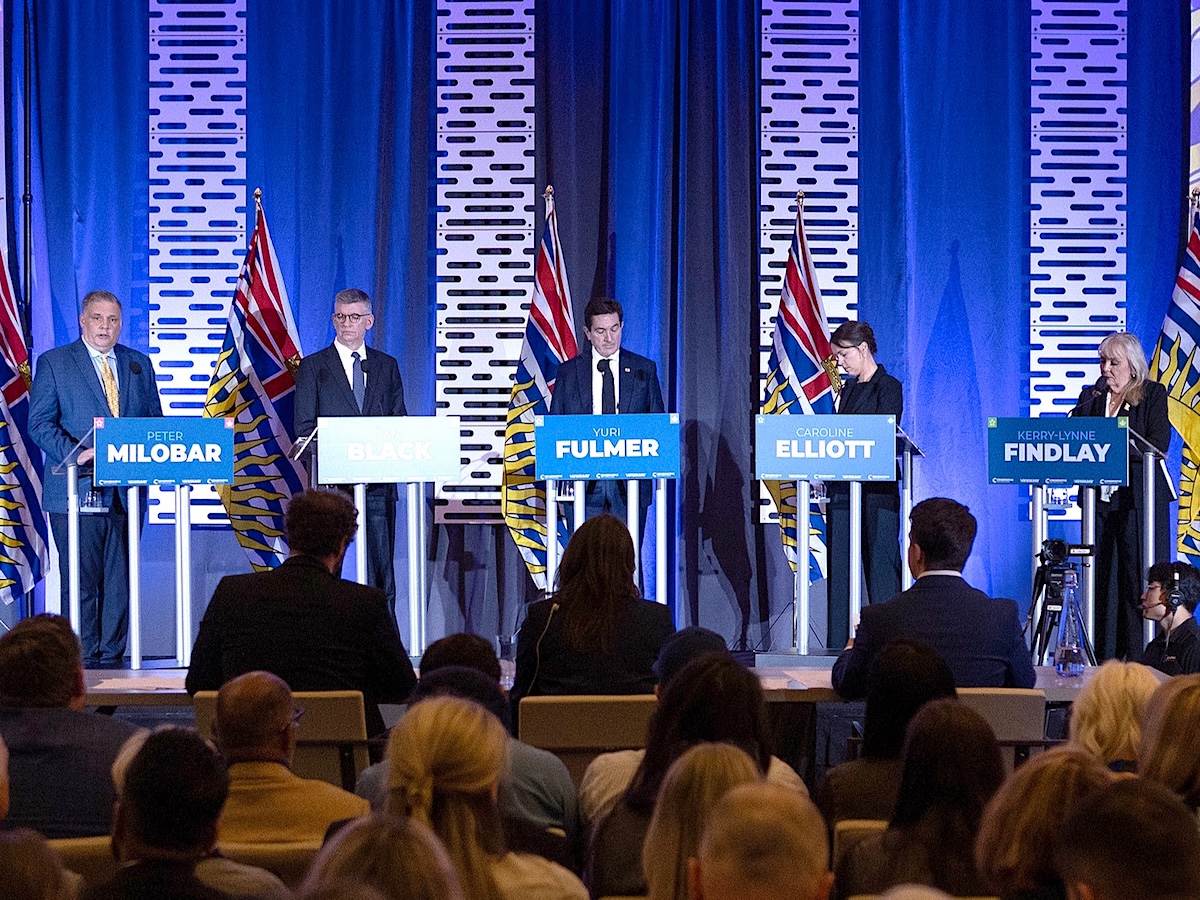
Conservative Party of BC leadership candidates have used the first two debates with all five hopefuls to make a pitch for what sets them apart.
In Kerry-Lynne Findlay’s case, it’s her experience governing as a Conservative. As national revenue minister in then-prime minister Stephen Harper’s cabinet, she says, she helped lower taxes and bring the federal budget back into surplus.
For Iain Black, it’s his background in both business and government. He has held senior roles in several companies and founded others, and he sat in former premier Gordon Campbell’s BC Liberal cabinet. He’s released the most detailed policy plan, including a 20 per cent income tax cut.
Yuri Fulmer, an entrepreneur who is chancellor of Capilano University, sells himself as the only one able to unite the province’s right, having struck a deal with Dallas Brodie that would see OneBC candidates running unopposed by Conservatives in five yet-to-be-determined constituencies in exchange for not contesting the other 88.
As the only contestant with a seat in the legislature and never having lost an election at either the municipal or provincial level, Peter Milobar presents himself as best able to win and to form government. Before becoming an MLA in 2017, he was mayor of Kamloops for three terms.
Caroline Elliott is an academic and former BC United party vice-president who was key to negotiating a deal that folded the BC United campaign ahead of the 2024 election and cleared the path for the Conservative breakthrough. She says she’s the only one who can be trusted to repeal the Declaration on the Rights of Indigenous Peoples Act, or DRIPA.
While all five candidates are promising to repeal DRIPA, a position consistent with the Conservative platform in the 2024 election, Elliott said she had been publicly opposing it while others in the race (like Milobar) were voting for it or making land acknowledgments (like Fulmer).
“If you weren’t willing to call it out when it was politically hard,” she said in one debate, “I can guarantee you won’t be there when it counts.”
Others agreed there will be protest. “It will be noisy no matter who repeals DRIPA,” observed Milobar. “If we’re not prepared to have a little bit of turbulence on this, what’s the point of having this conversation?”
There’s consensus on other topics as well. With some quibbling on details, all support lower taxes, smaller government, less regulation and growing the economy.
Both Fulmer and Milobar questioned the size of Black’s proposed 20 per cent income tax cut, with Milobar pointing out it would add billions to the province’s already large deficit.
And while various candidates questioned the wisdom of Fulmer’s deal with OneBC, suggesting it would unnecessarily concede seats long before the next election and institutionalize a divide on the right, Fulmer argued it’s a pragmatic response to the reality that OneBC has a real base and a real following.
The leadership contest follows a fractious time for the B.C. Conservatives. Having rapidly grown from virtually nothing to almost winning government under former leader John Rustad, divisions led to six MLAs either quitting or getting kicked out of the caucus before Rustad was himself forced to resign as leader.
The contest to replace him is a chance for the membership to consider what kind of party they want, whether it should focus on social conservative values, attempt to create a tent big enough to form government or land somewhere in the middle.
The second event with all of the candidates, which opened with a land acknowledgment, was styled as a conversation rather than a debate.
The previous debate, hosted by the Canada Strong and Free Network, had a format that included candidates questioning and challenging each other directly, leading to more sniping.
In particular, Elliott, Fulmer and Findlay took shots at one another, generally aiming to expose one candidate or another as insufficiently (or not genuinely) socially conservative.
More than once, Elliott was criticized for calling former MLA Laurie Throness’s views on SOGI 123 — the Education Ministry’s resources on sexual orientation and gender identity — and the federal ban on conversion therapy “abhorrent,” a line of attack she deflected as having come from NDP press releases. The Fulmer campaign has posted the 2020 clip.
Elliott went after Fulmer for scrubbing land acknowledgments from his website and Findlay for whipping Conservative MPs to support a motion that referred to Canada as a genocidal state in relation to residential school abuse.
Fulmer has confirmed he made land acknowledgments but said it was standard in the environment the BC Liberal government of the day created.
Findlay insisted she was not the party whip at the time of the motion, challenging Elliott to “look it up.” She said her own support was based on the limited information available immediately after the discovery of 215 possible graves at the site of the former Kamloops Indian Residential School. Since then, she said, she has been “seeking the truth.”
At one point Black offered a reminder that the real enemy is the NDP and that while he appreciated the spirit of the exchange, the attacks could be damaging to the party. “If we get too far down this path we’re going to be offering up news clips that are going to bite us in the backside in the months to come.”
Milobar took aim at Black for resigning as an MLA before his term was done and forcing a byelection, but the pair stayed largely on the sidelines when it got snippy.
That may be wise strategy in a race likely to be decided based on which candidate can pick up support in later rounds.
The leadership contest uses a ranked ballot, which means eligible members can rank the candidates. There is also a point system in which each of the province’s constituencies is given a maximum of 100 points.
If nobody receives enough votes to take more than half the points on the first count, the candidate with the fewest points is dropped. Their supporters’ second choices are distributed to the remaining candidates. That continues until someone wins.
The format favours candidates who are the “least objectionable” to the people voting, says Mainstreet Research CEO Quito Maggi. “The one who can appeal most broadly across most of the ideological spectrum within a membership is the one that can win.”
When the deadline for signing up new members eligible to vote passed on April 18, the party said the membership had swollen to 42,000 people.
There is one more debate scheduled for May 9. Voting opens on May 23, and the winner will be announced on May 30 at an event in Vancouver. ![[Tyee]](/design-article.thetyee.ca/ui/img/yellowblob.png)
Read more: BC Politics


Tyee Commenting Guidelines
Please note that email notifications for replies are not currently working due to a software issue which may be resolved in a future update.
Comments that violate guidelines risk being deleted, and violations may result in a temporary or permanent user ban. Maintain the spirit of good conversation to stay in the discussion and be patient with moderators. Comments are reviewed regularly but not in real time.
Do:
Do not: