


 SHARE:
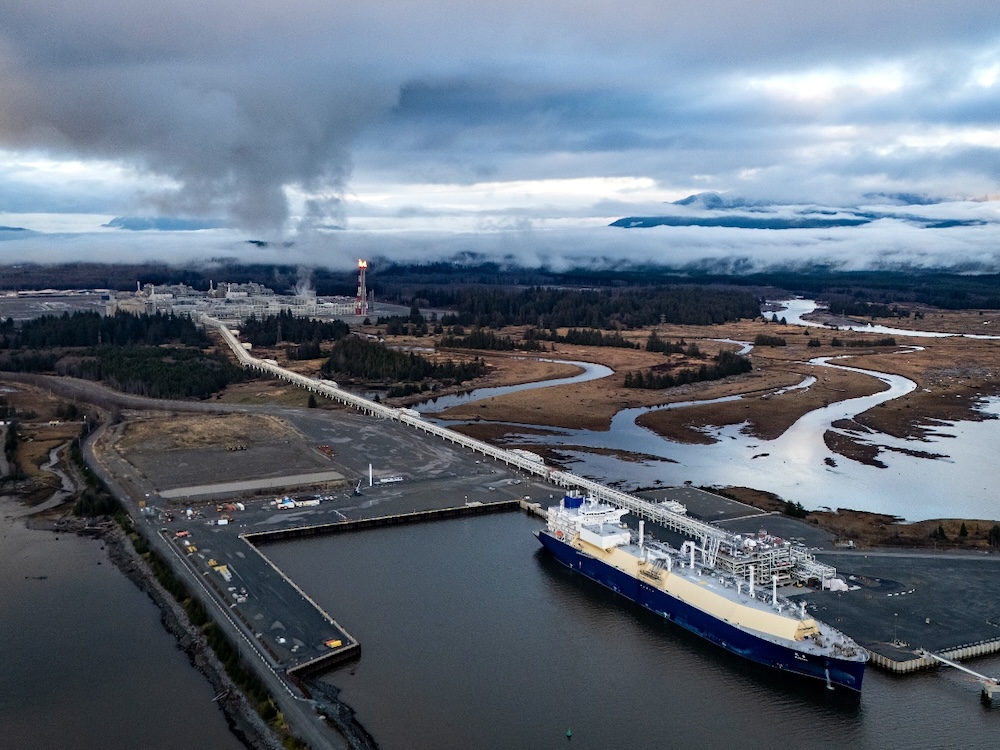
Once a middling player in Canada’s fossil fuel industry, B.C. has become a major fracking hub in the last two decades.
If the province’s planned LNG boom appears, gas extraction will surge higher. According to the province, its new fuel business comes with green credentials, delivering “some of the lowest-emission LNG in the world.”
The have-it-both-ways policy approach is familiar: its proponents argue that ramped-up fossil fuel extraction can coincide with climate leadership. It’s a message regularly echoed by provincial and federal governments in Canada and beyond.
But is it legal?
Experts warn that a growing body of international and domestic law is raising new legal stakes for major fossil fuel companies and the governments that permit their activities, particularly those like B.C. that are ramping up new fossil fuel industries as the harmful impacts of climate change compound.
“They're opening themselves up to liability, as well as violating the rights of Canadians by continuing to do this,” said Andrew Gage, a staff lawyer with West Coast Environmental Law, which recently published a report outlining the legal landmines B.C. could face as it fashions itself into a major global LNG supplier.
In the last decade, a growing body of international and domestic case law points to the legal stakes of climate change and governments’ obligations to prevent it. The decisions have begun to challenge long-held norms of climate change accounting established by the United Nations Framework Convention on Climate Change, which limits countries’ sphere of climate responsibility to the emissions produced within their own borders. Increasingly, courts are giving shape to the legal obligations of countries when the fossil fuels they produce are burned elsewhere.
Perhaps surprisingly, given its interest in further expanding its fossil fuel business, Canada voted in support of more-expansive climate accountability last month, when it joined 140 countries in voting for a successful motion at the UN General Assembly. The motion adopted a legal opinion from the International Court of Justice that determined that the continued expansion and subsidization of fossil fuels could constitute an “internationally wrongful act” with legal and financial ramifications.
The motion opens up new pathways for climate-affected countries to seek damages from major fossil fuel exporters.
“When we say existential threat, we speak not in metaphor, we speak from lived experience,” said Fiji’s permanent UN representative, Filipo Tarakinikini, after the vote passed on May 20. “This is an affirmation of survival.”
Despite recent strides, it remains unclear whether legal actions will have a meaningful impact on governments intent on expanding fossil fuel production. Court rulings are by design incremental, sometimes taking years or even decades to reach groundbreaking conclusions. But Julien Beaulieu, a Canadian lawyer and postgraduate researcher at the London School of Economics and Political Science, noted that Canada’s current policy environment — heavy on climate policy rollbacks and renewed efforts to expedite fossil fuel projects — could lead frustrated citizens to turn to the courts.
“When there's less ambition, or when there's deregulation, then that's where litigation kicks up,” he said. “It’s what you do when there’s nothing else.”
Global climate litigation grows
Around the world, climate change litigation is in a growth spurt, increasing over the last two decades from just a few cases filed in the early 2000s to more than 3,000 cases filed by 2025. In the last decade, 276 cases reached high courts around the world. Although 80 per cent involve government defendants, a recent London School of Economics report says climate litigation is most successful in high courts when suits directly target fossil fuel companies.
Though climate litigation isn’t always successful, increasing numbers of wins are causing ripple effects. Financial markets now consider climate litigation to pose a relevant financial risk, and groups like the World Economic Forum warn that climate litigation could begin to have substantial material effects for companies, noting that “evidence is mounting that the courts are beginning to listen in some jurisdictions.”
Canada’s own legal landscape for nation-level climate litigation is more muted, said Beaulieu.
“There are less cases here and less diversity of cases here than in other jurisdictions,” he said. “Much has not been tested yet.”
But that could soon change, some experts say, in part thanks to Mathur. v. Ontario, a landmark 2024 ruling that established climate change impacts could violate Canadians’ human rights under Section 7 of the Charter of Rights and Freedoms.
The ruling was a watershed moment, adding legal ground under two ongoing climate litigation cases, which further link climate impacts to Charter rights.
In La Rose v. Canada, 15 children and youths have argued that Canada’s climate targets are insufficient to meet its responsibilities to address global emissions.
Meanwhile, in Misdzi Yikh v. Canada, two Hereditary Chiefs of the Wet’suwet’en Nation brought a case arguing that Canada’s actions on climate change have failed to meet the country’s climate commitments.
The federal government attempted to strike down both cases before they could be heard on procedural grounds, and the plaintiffs in both cases have resubmitted their claims to narrow the focus of their challenge. La Rose v. Canada will be heard in the fall, and Misdzi Yikh v. Canada is awaiting a ruling deciding whether their amended claim will go to trial.
Richard Overstall, co-counsel for the plaintiffs in the Misdzi Yikh v. Canada case, said the overwhelming evidence of climate change outlined through the UN Intergovernmental Panel on Climate Change will supply cases like his with ample grounds.
"Once you've got a legal hook to hang your hat on, then all the science on the UN panel is hard for anyone to counter," he told The Tyee.
So far, much of Canada’s climate litigation has relied on the “hook” of government inaction, probing whether the government has done enough to address climate change. But West Coast Environmental Law’s recent report points to the untapped potential of a different approach — namely, the potential rights violations of government actions to expand fossil fuel production.
Uncharted legal ground
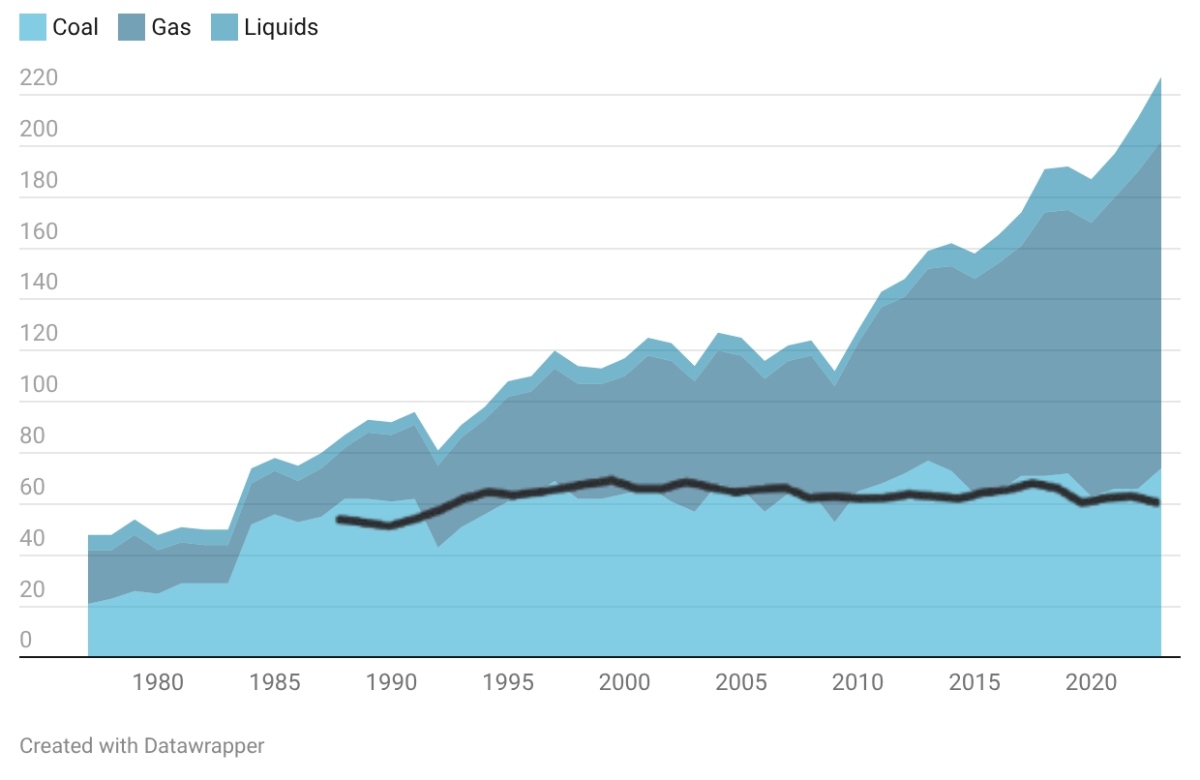
Within British Columbia, the province has maintained a relatively steady line on its emissions across the last few decades. The lack of reductions leaves the province far behind on progress towards its commitment to cut emissions by 40 per cent by 2030.
The government has now indicated it will likely miss that target. But West Coast Environmental Law’s report notes that this is the tip of a much larger emissions iceberg: B.C.’s exported emissions through fossil fuels are 2.7 times higher than those burned within its borders.
Though private companies extract and ship B.C.’s gas, the province is the ultimate owner of the resource. It benefits when it leases the rights to companies to use the resource through royalties and taxes. As both “salesperson” and owner, Gage said, B.C. could hold legal liability for its carbon-producing products.
“I think there definitely is a case to be had there,” he said.
In a response to The Tyee about West Coast Environmental Law’s report, the Ministry of Attorney General said it appreciates the organization’s “work in preparing this report.”
“B.C. takes climate action issues very seriously and will be taking the time needed to carefully review the publication and its recommendations,” it added.
Last week, the environmental law charity Ecojustice warned the federal government of similar extraction-focused liabilities linked to its ongoing subsidies for fossil fuel companies, suggesting that the increased oil and gas production that government policies facilitate could constitute Charter-linked human rights violations.
Canada and its provinces may be readying themselves to offer sizable subsidies for fossil fuel projects. That could include financing and acting as a proponent for a potential oil pipeline between Alberta and B.C.’s coast, and helping secure a final investment decision on the second phase of LNG Canada, a project to double the facility’s production. Last week, the environmental group Environmental Defence reported that Canada spent $10.2 billion on various forms of fossil fuel subsidies in 2025.
The Tyee’s request for comment from the federal government on Ecojustice’s letter was directed to Natural Resources Canada, which did not respond by press time.
Whether focused on subsidies or fossil fuel permitting, extraction-focused cases would need to establish a key piece of untrodden legal ground in Canada: that fossil fuel extraction leads to climate change.
It’s a seemingly obvious link, but one Canadian courts have yet to declare. Litigating will involve challenging one of governments’ favourite claims about Canada’s energy: Canada and B.C. frequently argue that their requirements for carbon capture technology or electrifying LNG production make their fossil fuel products outliers, noting that exporting fossil fuels to other regions could reduce overall emissions by displacing oil and gas supplied by competitors. This “substitution” argument suggests Canada can extract oil and gas while reducing global emissions.
The logic hasn’t fared well in courts around the world where the argument has been tried.
“It’s been rejected in a lot of cases,” said Beaulieu. High courts in the United Kingdom and in Europe have established that carbon extracted generally means carbon is burned, and that governments must curb production even if their fossil fuels are marginally less damaging.
“This is an obligation of conduct,” he said. “You should not drive at 200 kilometres [per hour] on the highway. Who cares if there’s someone in front of you or not?”
Beaulieu argues that the UN’s recent adoption of the International Court of Justice’s advisory opinion on climate change could add further legal weight to those obligations, though the ways Canada chooses to adopt its recommendations remain unclear.
“This is a concrete legal signal,” he said. “The risk is there.” ![[Tyee]](/design-article.thetyee.ca/ui/img/yellowblob.png)
Read more: Energy, Rights + Justice, Environment


Tyee Commenting Guidelines
Please note that email notifications for replies are not currently working due to a software issue which may be resolved in a future update.
Comments that violate guidelines risk being deleted, and violations may result in a temporary or permanent user ban. Maintain the spirit of good conversation to stay in the discussion and be patient with moderators. Comments are reviewed regularly but not in real time.
Do:
Do not: