


 SHARE:
Anna started coughing in March 2025 and never stopped.
The cough regularly punctuates her speech and gets worse when she moves around. “My chest hurts, and it's hard to breathe sometimes,” she told The Tyee.
After rounds of tests, Anna was diagnosed with a severe respiratory illness. The Tyee has agreed to use a pseudonym for Anna to protect her privacy.
As a non-smoker, Anna’s symptoms were unexpected. She examined her life for changes and found nothing. Except, that is, for the new industry next door.
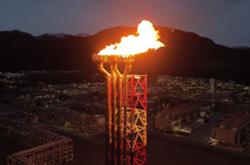
Outside Anna’s house in Kitimat, B.C., LNG Canada’s flare stacks frequently light up the night sky. Anna wondered if its pollutants could be to blame for her illness.
Anecdotal reports of coughs, low-grade headaches and other respiratory issues have begun to grow among residents of Kitimat, where Canada’s first major LNG facility ramped up its flaring activities last spring.
So far, no studies have analyzed the facility’s impacts on health in the community, and there are no proven links between residents’ symptoms and the company’s operations.
Still, their co-occurrence with the facility’s startup has Anna and others wondering what they’re breathing.
The Tyee has spoken with three Kitimat residents who have developed symptoms including ongoing respiratory issues and severe bouts of pneumonia since LNG Canada began startup. Each resident reported having conversations online and in person with other residents experiencing similar concerns.
According to a recent op-ed published by the Kitimat-Terrace Clean Air Coalition, some residents are “making active plans to relocate.”
“It’s reasonable to be concerned,” said Christopher Carlsten of the University of British Columbia’s air pollution exposure lab, who told The Tyee that anecdotal evidence and clusters of symptoms like this “warrant further investigation,” particularly because the company’s flaring activities are known to release toxins. It remains unclear, he added, whether there’s a causal link between individual symptoms and its operations.
B.C.’s Ministry of Health did not respond to The Tyee’s question asking whether it was investigating reports of respiratory issues in the Kitimat airshed. A spokesperson noted in an email that the province considers human health impacts during the project’s environmental assessment phase.
Major data gaps in monitoring and regulation
Since LNG Canada began operations in spring last year, the facility’s flaring activity has not gone as planned.
As The Tyee has reported previously, flaring at the facility has consistently exceeded B.C.’s regulatory limits and has frequently coincided with outages of the plant’s acid gas incinerator, which was designed to destroy particularly harmful emissions.
Flaring has also been accompanied by periodic bursts of black smoke — a sign that some unburned gas and its associated pollutants have entered the airshed.
Last month the World Bank Group estimated that LNG Canada had the second-highest flaring volumes out of 146 LNG plants worldwide.
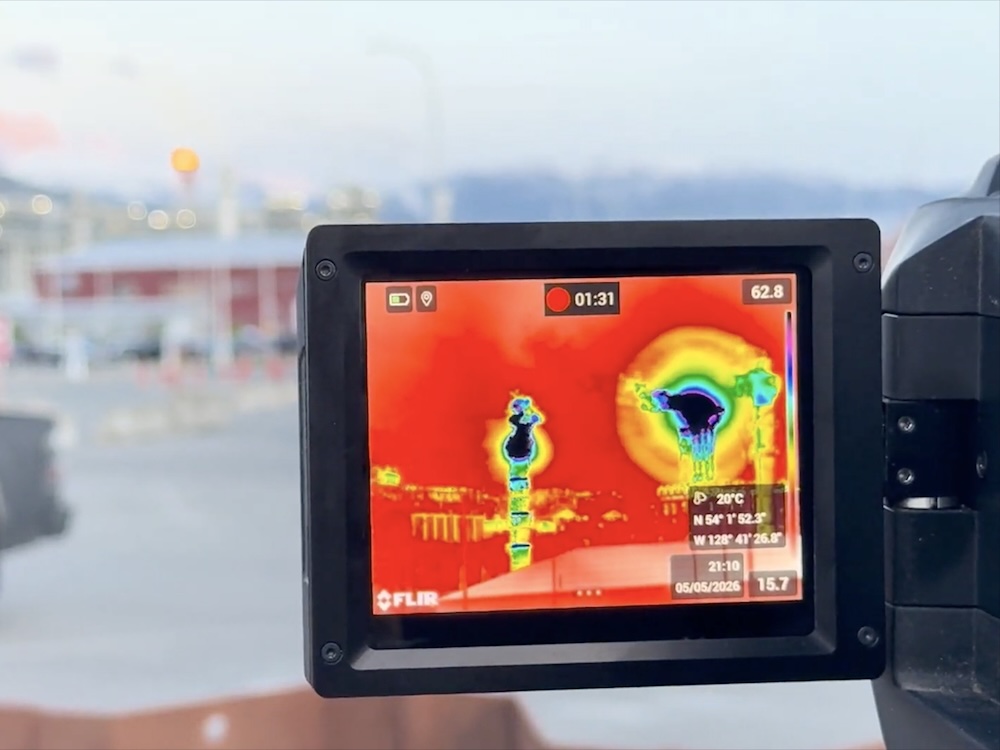
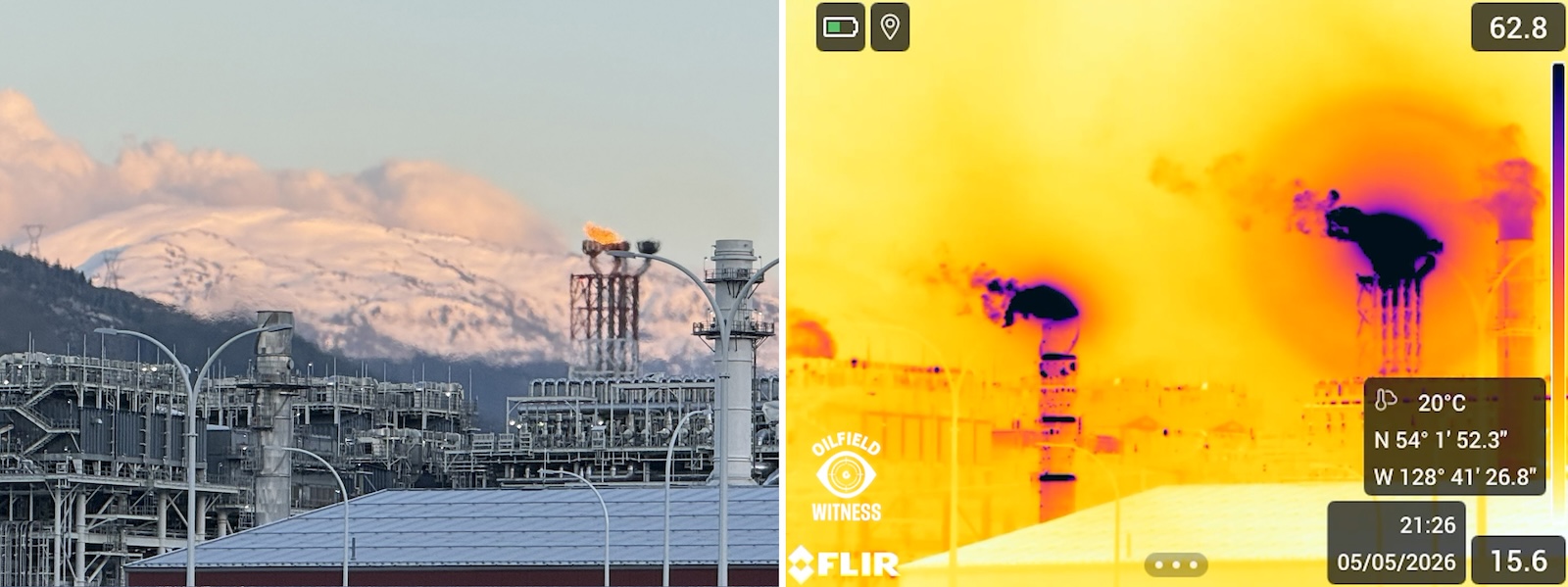
And recent optical gas imaging at the facility captured by Tim Doty, a former employee of Texas’s environmental agency who now works with the advocacy group Oilfield Witness, shows plumes of unburned pollutants streaming from the facility and its exhaust stacks, indicating there are more emissions at the facility than meets the eye.
“It was a huge emitter, in my opinion,” Doty said in an interview with The Tyee.
But according to the company, LNG Canada’s flaring and operational issues have had little impact on the region’s air quality.
“We are not seeing an increase in pollutants in the Kitimat airshed,” Teresa Waddington, LNG Canada’s vice-president of corporate relations, told Kitimat district council during a recent presentation.
In an email to The Tyee, BC’s energy regulator agreed, noting that though the facility’s flaring volumes breach regulatory guidelines, they “have not had a measurable impact on local air quality.”
“We understand that residents and others need and deserve confidence that we are ensuring LNG facilities are operating safely,” added the regulator. “We are committed to providing that assurance through rigorous oversight, transparency and a continued focus on protecting communities and the environment.”
But a Tyee investigation into Kitimat’s air monitoring system indicates gaps in tracking the dispersion of potential pollutants LNG Canada knows it will produce.
That includes many of the chemicals and compounds associated with unburned or partially burned gas, which can release volatile organic compounds, including the known carcinogen benzene, into the airshed. These unburned pollutants can escape when the flare stack isn’t burning all the gas that’s sent to the flame, or when the facility vents or leaks unburned gas.
Kitimat has no air quality monitors designed to clearly identify LNG Canada’s production of volatile organic compounds, including benzene.
Instead, it has one monitoring station that detects a category of emissions described as “hydrocarbons.” A Tyee investigation identified elevated levels of these emissions at the one station that monitors them.
While hydrocarbon levels are an imperfect proxy for LNG Canada’s unburned pollutants — they can pick up other emissions unrelated to the facility’s operations — spikes in Kitimat’s monitoring data over the last year warrant a closer look, says Greg Evans, an engineering professor specializing in air pollution and human health at the University of Toronto.
“These maximum values are higher than typical values,” he told The Tyee over email, noting that further analysis would be required to link the events to the facility’s emissions.
The Tyee also analyzed a subset of Kitimat’s hydrocarbon readings known as “non-methane hydrocarbons,” which can include a range of compounds, including the carcinogen benzene and the neurotoxin toluene. The monitoring station is located in a residential area called Riverlodge, which is about three kilometres away from LNG Canada’s facility.
The Tyee compared Kitimat’s continuous non-methane hydrocarbon readings with non-methane hydrocarbon readings taken from the 37 monitoring stations in Alberta that record them, including a station located near the oilsands and at various petrochemical facilities. The analysis found that Kitimat’s annual average hourly readings were higher than those of all 37 monitoring stations.
How LNG Canada pollutes
Riverlodge is one of five trailer-like air monitoring stations scattered across Kitimat and filled with various instruments to document pollutants in the region’s airshed.
“In general, monitors are great,” said Tracey Holloway, an atmospheric scientist at the University of Wisconsin-Madison and lead of the Holloway Group studying air pollution and public health. Holloway said Kitimat’s variant of monitors that continually record measurements is “the gold standard.”
But monitors do have limitations. They have to be in the right place at the right time, for example. Depending on things like wind direction and the kind of pollutant in question, one monitor might pick up contaminants while another nearby might detect none.
And Kitimat’s air monitors were not built with LNG Canada’s pollutants in mind. Rather, they were first established to monitor pollutants from the Rio Tinto aluminum smelter, which sits along LNG Canada’s fenceline.
Monitors need to analyze the right pollutants for the industry at hand, and LNG Canada’s pollutants are complex.
To transform the natural gas received from its pipeline into a highly purified form of supercooled, liquid gas, LNG facilities strip out impurities — things like hydrogen sulphide, benzene and mercury — that prevent it from liquefying properly. Once purified, that methane gas is cooled to -160 C, turning it into a liquid. LNG Canada uses its own supply of gas to power the turbines, compressors and incinerators that do the stripping and liquefying.
In theory, burning gas in a flare, or to power a turbine, comes with a clear benefit: fully combusted gas is less harmful than uncombusted gas in the airshed.
For example, when burned, the methane in natural gas is transformed into carbon dioxide, a less powerful greenhouse gas. While combusting natural gas does also create nitrogen dioxide, a pollutant that can damage airways and trigger respiratory issues, it’s still considerably less harmful than some of the other compounds lurking inside uncombusted gas.
The problem is, each compound and chemical in the gas requires different temperatures and conditions to burn properly. Without those conditions, they can escape the burning process unburned or partially burned.
“As you have less-complete combustion, then you have a more wide range of volatile organic compounds,” Faisal Irshad Khan, a petroleum engineer at Texas A&M University, told The Tyee. Gas compounds can also morph and transform in the process of being incompletely burned or burned under certain conditions, or when burned alongside other volatile compounds, he added.
“Potentially more toxic gases get formed,” Khan said. The dangerous gas hydrogen sulphide, for example, can create sulphur trioxide, another harmful gas, under certain temperatures and levels of oxygenation.
Unburned gas has several escape routes in a facility like LNG Canada’s.
It can get through flare stacks if the burning conditions aren’t right, sometimes exhibiting plumes of black smoke known as “black carbon,” as LNG Canada has frequently done.
Unburned gas can also leave the facility through vents designed to release it. The regulator limits venting to 25 tonnes per year, roughly the carbon dioxide equivalent of 163 cars per year. The BC Energy Regulator did not directly respond to The Tyee's question about how much gas LNG Canada has vented in the past year. Instead, it linked to data that did not provide a total volume of vented gas.
Gas can also escape unburned from leaks in the facility, or when gas-burning machines such as turbines aren’t running properly.
What LNG Canada monitors
B.C. has no regulations requiring LNG Canada to monitor and control for markers of unburned gas in the airshed.
Instead, the facility’s pollution rules are mostly designed to capture pollutants produced when gas is fully combusted — specifically, the pollutants nitrogen dioxide and sulphur dioxide. Both compounds have remained below B.C.’s air quality objectives since LNG Canada began its operations.
LNG Canada is also required to monitor and control for a class of particulates called PM2.5, which, according to Evans, is a poor metric to analyze unburned particles of fossil fuels. PM2.5 includes a broad category of airborne particles from wildfire smoke to pollen, meaning the finer, more specific category of black carbon would likely show up as only a small subset of the total.
That leaves the large category of potential pollutants linked to unburned or partially burned gas largely unmonitored.
For example, there are no air pollution monitors capable of analyzing black carbon independent of the larger category of PM2.5.
“That would probably be the pollutant that I would measure if I were interested in emissions from flaring,” Evans told The Tyee.
Black carbon is toxic to breathe, and its extra-fine particles can travel deep into the lungs, potentially creating a pathway for other volatile organic compounds to enter the body. Because it absorbs sunlight, black carbon is a stronger global warming agent than carbon dioxide.
This spring, the BC Energy Regulator issued an order to LNG Canada to reduce instances of black smoke production and to submit a report to the regulator this August on its root causes.
LNG Canada also has no means of monitoring specific concentrations of LNG-linked volatile organic compounds in Kitimat’s airshed, including the carcinogen benzene, which is known to exist in LNG Canada’s gas supply.
Volatile organic compounds were identified as one of seven “substances of interest” linked to LNG Canada’s operations during its environmental assessment process over a decade ago. But the company determined that modelling “indicates the VOC concentrations are well below any level of concern.”
LNG Canada is required to monitor markers of unburned pollutants at its flare and exhaust stacks — a method known as “stack testing.” There, it tracks emission levels of volatile organic compounds such as benzene, toluene and hydrogen sulphide. The company is required to report on its stack testing every quarter, but it does not disclose its reports publicly. The company has no permitted emission thresholds of volatile organic compounds that it must meet.
In a recent presentation to Kitimat council in May, Waddington cited that stack testing when she claimed that LNG Canada emits “slightly less than half” the volume of benzene, toluene, ethylbenzene and xylene emissions of “the average Canadian gas station.”
The Tyee asked LNG Canada for information on how that statistic was identified, and whether it reflects an average or a single point in time. The company did not respond.
The picture painted by total hydrocarbons
In the absence of more-targeted monitoring tools, hydrocarbon measurements from Kitimat’s Riverlodge monitoring station offer indications about unburned or partially burned gas from LNG Canada’s operations in the airshed, albeit with some shortcomings.
“It’s a very general measurement,” Mike Brauer, a professor in the school of population and public health at the University of British Columbia, told The Tyee. Hydrocarbons can derive from hundreds of compounds, not all of them fossil fuel related, Brauer added.
Ambient hydrocarbons are generally made up mostly of methane — one of the key markers of natural gas — but methane and other hydrocarbon components can also derive from vegetation such as algae and trees, or from vehicle traffic.
Because their readings are less specialized, hydrocarbon monitors tend to be cheaper than systems that target compounds such as benzene. Lacking that specificity, hydrocarbon readings can mean different things depending on the makeup of more-noxious and less-noxious gases and compounds they contain.
Despite their limitations, hydrocarbons and the subset of non-methane hydrocarbons within them have been used as a proxy for measuring pollutant levels from fossil fuel operations and air quality risks in the United States, Taiwan and beyond. Studies have also revealed links between non-methane hydrocarbon exposure and various illnesses, including asthma, stroke and some cancers.
The Tyee’s research identified 322 hours over the last year when hydrocarbon levels were deemed “elevated” compared with thresholds described in a report from the Government of Alberta analyzing levels of the pollutant in the oilsands. Given the range of contributors to hydrocarbon levels, any threshold for the pollutant would ideally attend to the unique factors at a given point in time and place, meaning Alberta’s levels serve as an imperfect point of comparison.
Last September, Kitimat’s Riverlodge station reported a reading 14 times higher than that elevated threshold. Ambient hydrocarbons at that level can cause acute symptoms of slurred speech, vomiting, drowsiness and nausea.
Other spikes include a one-hour period in January when hydrocarbons were nine times higher than the threshold described by Alberta and a five-hour period in May with levels eight times higher than the threshold.
Determining the source of spikes in hydrocarbon levels requires some detective work. Brauer said that would ideally include comparing measurements with levels recorded at other monitors in the airshed, or against baseline data from before the facility began operations. That’s not an option for Kitimat: its one Riverlodge station remains the only site where ambient hydrocarbons are measured, and the monitor was installed after LNG Canada’s operations began.
But other patterns and trends can help researchers narrow down the source of elevated hydrocarbon levels or spikes like those in Kitimat, including trends in the time of day, time of year, wind direction and wind speed recorded at the time when pollutants are elevated. Each influence has confounding factors, meaning experts generally look for multiple patterns and trends to avoid misattribution.
In an email to The Tyee, a spokesperson for LNG Canada noted that “wind direction and emissions analysis” determined that the highest spike of total hydrocarbons in September “was located northwest of the monitoring station and was not related to LNG Canada operations.” It did not comment on the source of other exceedances.
“LNG Canada reviews elevated ambient monitoring readings on a case-by-case basis and reports findings to the BC Energy Regulator as required, including the elevated total hydrocarbon reading recorded at Riverlodge in September,” the spokesperson added.
An emphasis on monitoring combusted emissions isn’t uncommon, Brauer told The Tyee, in part because it’s easier to identify a causal link between combustion-linked pollutants and the activity that created them — for example, burning fossil fuels. Identifying the source of unburned emissions can be murkier.
However, some jurisdictions have made efforts to track the specific pollutants linked to unburned emissions related to LNG production. The city of Darwin, Australia, tracks pollutants such as benzene, toluene and xylene at various sites around the nearby Ichthys LNG facility.
There are signs that Kitimat’s airshed could have pre-existing problems.
According to a 2025 presentation from the Northern Health Authority, Kitimat’s asthma rates were 75 per cent higher than the provincewide average and 156 per cent higher than the average across the Northern Health region. The cause of these levels remains unclear, but the health authority’s presentation pointed to several sources including woodsmoke, marine transportation and industry. The town’s aluminum smelter is a substantial contributor to sulphur dioxide emissions.
Kitimat council votes against health assessment
A year after her symptoms started, Anna isn’t sure what to do next.
“I don't want to move away from my family,” she said. But she worries about her symptoms worsening.
“My fear is, am I damaged to the point where this is now going to be the rest of my life?” she asked.
Anna is among a growing movement calling for an independent health impact analysis of LNG in the community.
Morris Amos, a Kitimat resident and member of the Beaver Clan of the Haisla First Nation, agrees.
“We need more studies and more information,” he said, noting a growing divide between LNG Canada, politicians and local residents.
“It's an age-old corporate tactic that I've seen over the years, where they say, ‘Thank you for your comments, but you can't prove it,’” he said.
Last month, Kitimat council voted against calling for an independent health assessment on LNG and fracking in the province in a 4-2 decision. Last week, the Town of Smithers voted against a similar motion in a 4-3 vote. Councils in Dawson Creek, Terrace and Squamish have all voted in favour of the assessment.
The District of Kitimat didn't respond to The Tyee's request for comment.
During the council meeting leading up to the vote, Kitimat’s mayor, Phil Germuth, said he was confident that Kitimat’s air quality remained clean, adding that the airshed is “extremely highly monitored.” ![[Tyee]](/design-article.thetyee.ca/ui/img/yellowblob.png)
Read more: Energy, Health, Environment






Tyee Commenting Guidelines
Please note that email notifications for replies are not currently working due to a software issue which may be resolved in a future update.
Comments that violate guidelines risk being deleted, and violations may result in a temporary or permanent user ban. Maintain the spirit of good conversation to stay in the discussion and be patient with moderators. Comments are reviewed regularly but not in real time.
Do:
Do not: