


 SHARE:
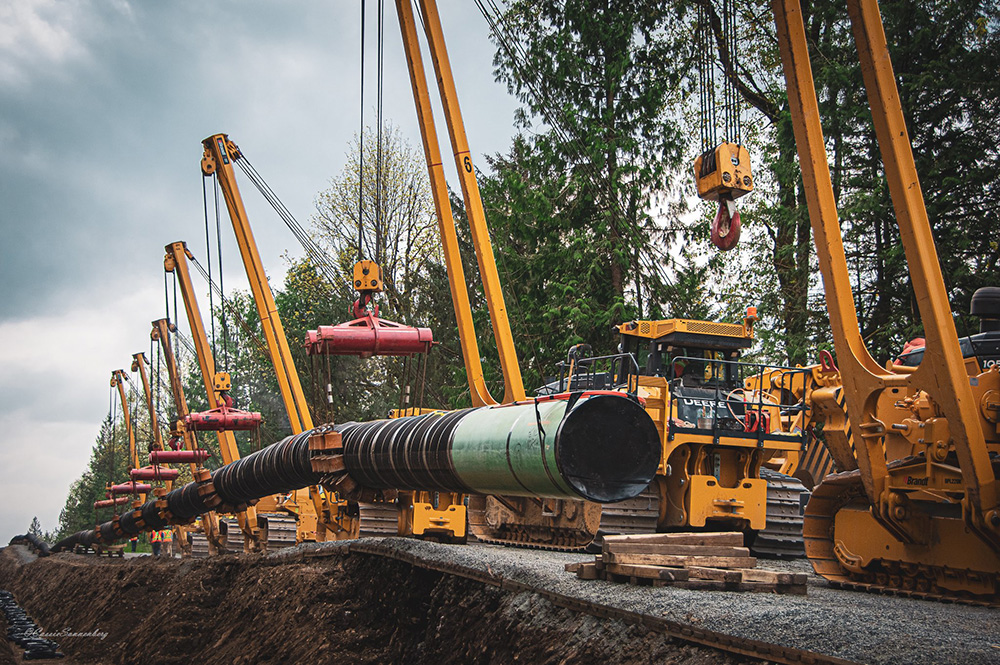
After months of closed-door negotiations, Trans Mountain Corp. has agreed to lower its fees for companies shipping oil through its new pipeline.
Under the new settlement agreement, which must still be approved by Canada’s energy regulator, oil companies with long-term contracts would pay about 10 per cent less to use the pipeline.
Even before the discount, their fees covered less than half the cost to build the $34.4-billion pipeline, meaning the government already pays more to ship each barrel of oil on the publicly owned pipeline than contracted oil companies.
The new settlement would deepen that public funding.
If approved by the regulator, the new tolling system concludes a years-long, often contentious debate over how the pipeline’s massive construction cost will be shared.
Trans Mountain has not publicly acknowledged that its settlement results in lower tolls. In a statement, the company’s CEO, Mark Maki, described the settlement as a “balanced agreement.”
The Canadian government continues to promote the pipeline as a financial success.
“The Trans Mountain pipeline is a money-maker,” said Canada’s energy minister, Tim Hodgson, in a recent interview with CBC’s Power & Politics, adding that the pipeline is “one of the best assets this country has.”
“It’s generating oodles of cash.”
But a previous Tyee investigation found problems with that claim. Trans Mountain is technically owned by a shell company called TMP Finance, which holds billions in debt on its books. If Trans Mountain Corp. reported the scale and cost of the pipeline’s debts in its finances, it would be reporting monthly losses instead of profits.
The new settlement compounds that financial quagmire, said Eugene Kung, a staff lawyer with West Coast Environmental Law.
An analysis commissioned by the Tsleil-Waututh Nation estimates the settlement would cut tolls by about $1 per barrel. The companies had previously requested tolls be cut by about $2.19 per barrel.
Kung co-authored a regulatory submission on behalf of Tsleil-Waututh Nation that estimated the proposed settlement would result in an additional $2.5-billion loss for Trans Mountain by the end of oil companies’ contracts, potentially totalling a $22.5-billion loss overall in the same period.
In Trans Mountain’s evidence submitted with the settlement application, economist John Reed argued the company’s settlement with oil companies “maintains the financial viability of the pipeline,” though he acknowledged the settlement’s expected earnings are “below what might be considered a competitive return” if the company was charging shippers for the full cost of building the pipeline. Reed added that Trans Mountain could make higher returns if the pipeline continues to be used by oil companies after the 15- and 20-year contracts expire.
Trans Mountain did not return The Tyee’s request for comment.
Trans Mountain’s battle with disgruntled shippers
In 2012, when Trans Mountain’s expansion project, or TMX, was still privately owned by Kinder Morgan, the company signed agreements with a group of oil companies committing to use the pipeline monthly for up to 20 years. By signing on ahead of time, companies’ contracts would guarantee a cheaper rate compared with companies shipping oil on the line without an agreement.
Etched in companies’ contracts was a clause that put companies on the hook for roughly one-quarter of any future cost overruns associated with building the pipeline.
At that point, the pipeline was estimated to cost $7.4 billion. Kinder Morgan was confident it could pay off the cost of building the pipeline during the lifetime of those contracts with ample profit to spare.
Construction costs exploded in the next decade, jumping to $34.4 billion by the time the project was complete. Companies decried the cost overruns and their contractual obligation to cover their previously agreed-to share, suggesting during a regulatory hearing that the higher tolls to follow could put them at a strategic disadvantage.
“Trans Mountain expansion project is not the lower cost option to provide market access,” oil company Canadian Natural Resources Ltd. said in its submission to the energy regulator last year.
For months, companies made their case for a lowered toll, with Trans Mountain countering by saying that the agreement established in 2012 came as a “package deal” the company relied on to make its decisions and investments in the first place, and that the contracted shippers’ requested $2.19-per-barrel discount wouldn’t generate sufficient returns.
Trans Mountain argued that if the lowered toll were approved, below-market return could poison the well for future projects that may include public investment because companies could expect the regulator to force below-market tolls, potentially spurring investors to be leery of such investments. They warned that uncertainty could drive up borrowing costs.
“If the Canada Energy Regulator is perceived as applying arbitrary or ownership-dependent financial rules, it could negatively impact Canada's reputation as a stable and predictable investment destination,” Trans Mountain added.
Hearings continued until last October, when Trans Mountain and its contracted shipping companies withdrew from the regulatory hearing to undertake closed-door negotiations.
The proposed settlement announced last month is the result.
The reduced rate comes with other concessions. Besides the lower fees for contracted shippers, the settlement also provides a lower floor for fees applied to shipments from companies without long-term contracts. The ceiling for those fees remains the same.
The agreement also includes a seven-month delay on the collection of a 2.5 per cent cost “escalator” intended to help compensate for the cost of inflation. The escalator will also now fall to two per cent in 2034.
The new agreement includes a change in the amount of room in the pipeline that is available to short-term, uncontracted shippers. Previously, those shippers had been afforded 20 per cent of the line’s capacity. Now Trans Mountain has increased the share of contracted space, meaning uncontracted shippers will have 10 per cent of the line available to them. Unlike in the previous agreement, contracted shippers will no longer receive half of the revenue gleaned by those uncontracted shippers, but Trans Mountain will now apply some of those revenues to compensate companies for penalties charged to ships that exceed their loading times at the Westridge Marine Terminal. Those fees had been a previous point of contention for oil companies.
Several major oil companies have written to the regulator in support of the settlement. One company, Marathon Petroleum, informed the regulator it will not sign on.
A public company in a private negotiation
Both Trans Mountain’s first tolling agreement in 2012 and its recently announced discount on those tolls are known as “negotiated settlements,” and they’re a relatively new phenomenon in the world of utility regulation.
Negotiated settlements started to emerge in the 2000s, said Garret Fellows, program director of the Canadian Northern Corridor research program at the University of Calgary’s school of public policy.
Pipelines and other utilities like it are known as natural monopolies, meaning their business models work in the absence of competition. To avoid the prospect that pipeline companies or their shippers might take advantage of such a situation for their own benefit, regulators have historically required that utility rates follow a “cost of service” model, in which users of the utility pay what a regulator determines to be a fair share of the costs of building and operating it.
But that model has less wiggle room for accommodations between the parties. Negotiated settlements, on the other hand, “allowed for a little bit more creativity, but it made the process less transparent,” Fellows said.
Generally, the logic of negotiated settlements rests on the fact that both participants — the utility and the user, in this case Trans Mountain and its oil company shippers — are operating as market actors. It assumes those actors wouldn’t take risks that the market, and their financiers, wouldn’t agree to sign off on.
But in their earlier submissions, Trans Mountain’s shippers argued the Canadian government’s pipeline purchase brought non-market logic into the picture and changed the terms of that negotiation.
“The Government of Canada must consider broad social and political interests that are not the responsibility of investor-owned companies,” Canadian Natural Resources said in a regulatory submission from 2025, before the company re-entered into closed-door negotiations with Trans Mountain.
Canadian Natural Resources and other contracted shippers had made their final commitment to continue their contracts to the line in 2017, a year before Canada bought the pipeline from Kinder Morgan. The publicly owned company incurred billions more in costs before the line was complete.
“Obviously, shippers would not have agreed to Trans Mountain flowing through these costs if they knew the Government of Canada would own Trans Mountain,” Canadian Natural Resources said.
In Trans Mountain’s recent settlement application, Reed, the company’s expert adviser, argued the settlement generates sufficient revenues and implied that Trans Mountain’s position as a market actor proves the settlement is a competitive one and “should be presumed to be just and reasonable and not unjustly discriminatory.”
West Coast Environmental Law’s Kung argues otherwise.
“That assumption that the company is operating on a commercial basis just doesn't hold up,” he said, noting that the government has been willing to shoulder costs that a private actor likely wouldn’t have, “essentially baking in another subsidy in the form of a lower-than-commercial toll.”
In an email, a spokesperson for the energy regulator said that it assesses whether tolls proposed through negotiated settlements are “just, reasonable and not unjustly discriminatory.”
As the country weighs the prospect of another publicly funded pipeline to B.C.’s West Coast, Kung noted the public could again own a pipeline that companies will not want to pay for.
“Trans Mountain is a red flag,” he said. “It's not a blueprint.” ![[Tyee]](/design-article.thetyee.ca/ui/img/yellowblob.png)
Read more: Energy, Labour + Industry










Tyee Commenting Guidelines
Please note that email notifications for replies are not currently working due to a software issue which may be resolved in a future update.
Comments that violate guidelines risk being deleted, and violations may result in a temporary or permanent user ban. Maintain the spirit of good conversation to stay in the discussion and be patient with moderators. Comments are reviewed regularly but not in real time.
Do:
Do not: