


 SHARE:
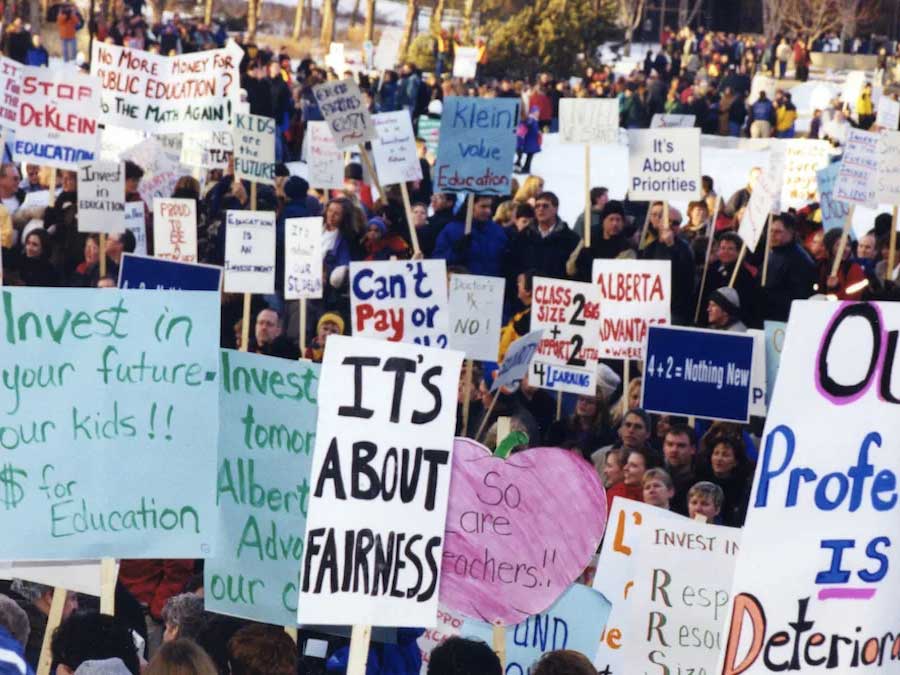
With Labour Day behind us and another school year about to commence, Alberta news coverage will be “laser focused,” as our government likes to say, on the looming labour dispute between the Alberta Teachers’ Association and the Teachers Employer Bargaining Association.
The potential inconvenience to parents caused by a strike or lockout in Alberta’s public, Catholic and francophone school systems just as the school year is starting is enough to make this a major story by any journalistic yardstick.
Perhaps the dynamic duo of Education Minister Demetrios Nicolaides and Finance Minister Nate Horner will actually say they’re laser focused on resolving the impasse between fed-up teachers and TEBA. One can hope.
They should be, after all. They’re the ones who have been stubbornly insisting behind the scenes that there will be no pay increase for teachers larger than the 12 per cent over four years that is clearly unacceptable to rank-and-file teachers. In May, 62 per cent of teachers rejected a mediator’s recommendation, and in June, 94.5 per cent of the nearly 39,000 teachers who took part in a strike vote supported strike action. So the union can now strike after giving 72 hours’ notice. This should have concentrated some minds at the top on the direction this was moving.
Indeed, had there not in fact been a secret government mandate given to the TEBA, most likely the employers would have shown a little movement on wages — if not enough to satisfy every teacher, enough to get a deal most of them could live with. We’ll never know for sure, of course, because the thing about secret mandates is that they’re secret.
To crank things up a little more, CTV reported Sunday that TEBA has asked the Alberta Labour Relations Board for approval to lock out the teachers.
But that doesn’t necessarily mean the government, which as noted is pulling TEBA’s strings, would be so foolish as to order a lockout.
Such applications by employers are routine when a union is in a legal position to strike. Without a lockout notice, there are plenty of ways a union could make life difficult for the employer without actually throwing up a picket line. And a TEBA spokesperson did tell CTV that the employers would only lock teachers out in response to unspecified union tactics.
Still, at this hour, a work stoppage for one reason or the other is definitely possible, and possibly likely, although it’s always worth remembering that, as in politics, a week is a long time in labour relations.
Nicolaides and Horner have not exactly covered themselves in glory with their attacks on the ATA for having the temerity to try to bargain collectively instead of taking their medicine like good little children.
The ministers’ ludicrous effort to pin the blame for the strike on the teachers by accusing the ATA of trying to divert resources from classrooms to their pockets after years of mostly zeroes when it came to pay increases may fool some Albertans, but it doesn’t seem to be fooling enough.
So, at this point, about the only thing Nicolaides and Horner could do to make the situation worse and make themselves look more foolish would be to lock the teachers out.
Well, never say never. As former ATA president Larry Booi, who led the teachers strike in 2002, told me Sunday, “if teachers walk out, no matter how justified they may be, they will take heat. But if the government locks them out, they will get the blame. Locking out teachers would be an act of political hari-kari.”
Casting his mind back to 2002 when more than 20,000 teachers then working for 22 school districts hit the bricks, Mr. Booi said Feb. 4 was chosen for the walkout to begin to ensure students wouldn’t waste a year.
“There was a great deal of concern in the public that teachers would go out just before the diploma exams in late January in order to cause maximum disruption,” he recalled. “But no one on our executive council was comfortable with that approach. It would have created enormous problems for Grade 12 students, and I think it would have been viewed extremely negatively by the public.”
“When we announced that we would not disrupt diploma exams but would go out shortly after they were completed, there was a lot of relief in the public,” he said. “I think that was one of the reasons why we ended up having a good deal of public support after the strike — because we were seen as trying to be fair and reasonable during an exceptionally disruptive and difficult time.”
The Progressive Conservative government of then-premier Ralph Klein passed legislation ordering an end to the strike on Feb. 21, 2002. ![[Tyee]](/design-article.thetyee.ca/ui/img/yellowblob.png)
Read more: Alberta







Tyee Commenting Guidelines
Please note that email notifications for replies are not currently working due to a software issue which may be resolved in a future update.
Comments that violate guidelines risk being deleted, and violations may result in a temporary or permanent user ban. Maintain the spirit of good conversation to stay in the discussion and be patient with moderators. Comments are reviewed regularly but not in real time.
Do:
Do not: