
 SHARE:
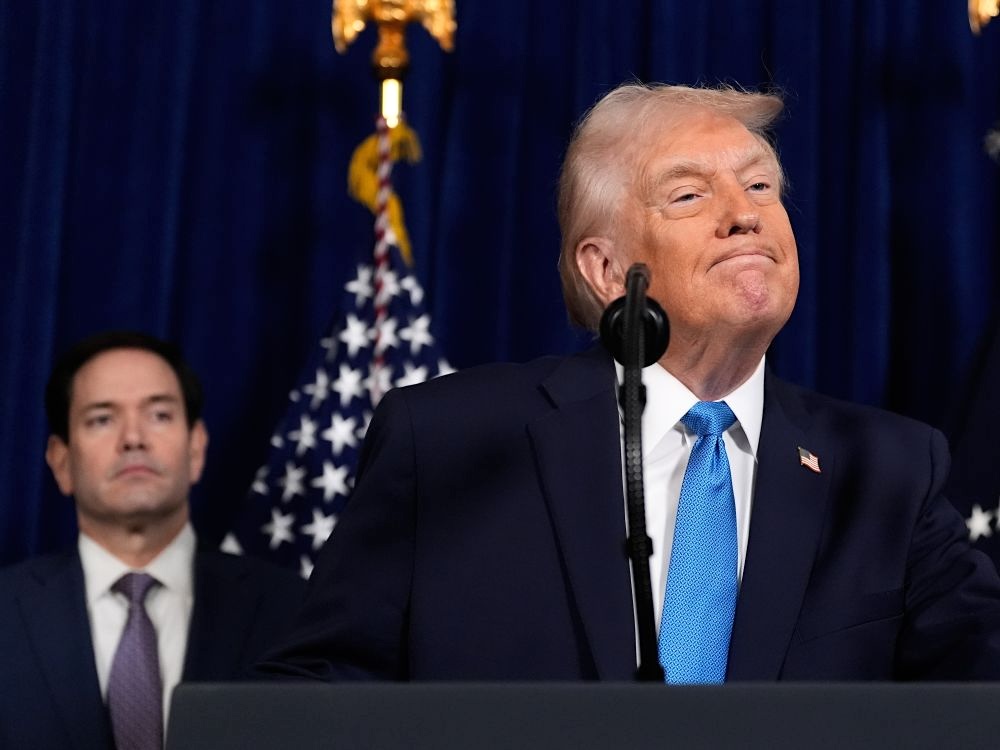
So, the president who falls asleep in cabinet meetings has now invaded a sovereign nation and abducted its leader and his wife to face “justice” in the United States.
That makes it official. America has its first rogue president, Donald J. Trump. As a result, the United States and the rest of the globe are suddenly in a precarious place. The rule of law is at risk of being replaced by an old and ugly idea: might is right.
In that throwback world, the fates of the United States’ closer neighbours would be far more at risk — Canada, right next door, included. As Trump has noted in his musings about harming our economy until we are ripe for annexation, we are a nation with resources the United States covets and a far smaller population and military.
And yet Prime Minister Mark Carney’s first statement about the violent Maduro extraction mentioned nothing about its patent illegality.
It fell to his foreign minister, Anita Anand, to vaguely post on social media: “In keeping with our long-standing commitment to upholding the rule of law and democracy, Canada calls on all parties to respect international law.”
At least NDP interim leader Don Davies was full-throated in his condemnation of the “totally illegal” U.S. operation.
But Conservative Leader Pierre Poilievre has joined with others cheering Trump on. Why? Spin and optics.
The leader who was deposed by U.S. military force is no doubt a vile dictator, credibly accused of everything from dealing drugs to murder to stealing Venezuela’s 2024 election. Hence, getting rid of Nicolás Maduro in this way was not only justified but downright admirable, right?
Absolutely not.
This is not the first time Trump has appealed to the authoritarian logic that some people are so bad that they deserve whatever they get — including summary execution. No due process required.
Case in point. When the U.S. military began blowing up alleged drug boats in the Caribbean, Trump justified the killings by accusing their crews of being “narco-terrorists.” Bad guys bringing cocaine and fentanyl into the United States to kill Americans. The president called those drugs “weapons of mass destruction,” the same, bogus rallying cry that led the United States into its calamitous invasion of Iraq.
As of Dec. 25, 115 people on those boats have been killed by U.S. forces, including two who survived the initial attack and were murdered waving for help as they clung to wreckage.
The Trump administration has produced no credible evidence that they know who or what was on these doomed vessels or where they were headed.
Nor has Trump provided any legal justification for his lethal action.
Accordingly, that action has been widely denounced as illegal — not self-defence, as Trump claims. More like murder on the high seas.
And that is one of the reasons that no one should be patting Donald Trump on the back after his attack on Venezuela.
Instead, they should be taking note of the fact that Trump is fighting lawlessness with lawlessness of his own — based on a clear violation of his oath of office, in which he pledged as president to uphold the U.S. Constitution.
Towards ‘a world of violence, chaos and instability’
As the New York Times put it, by bombing Venezuela and abducting its leader and his wife, Trump is “pushing our country toward an international crisis without valid reasons. If Mr. Trump wants to argue otherwise, the Constitution spells out what he must do: Go to Congress. Without congressional approval, his actions violate U.S. law.”
Trump never sought such approval, suggesting that Congress might “leak” the details of the Venezuelan mission.
And it’s not only the highest U.S. law that Trump is breaking. The secretary-general of the United Nations, António Guterres, has described Trump’s attack on Venezuela as a “dangerous precedent.”
A statement from the UN said that “the secretary general continues to emphasize the importance of full respect — by all — of international law, including the UN Charter.” That charter calls for respecting every country’s sovereignty.
Trump’s attack on Venezuela has been widely denounced by those world leaders who understand the harrowing new order it signals. From South America, the criticism is particularly vehement.
This is how Luiz Inácio Lula da Silva, president of Brazil, put it: “Attacking countries in flagrant violation of international law is the first step toward a world of violence, chaos and instability.”
Colombian President Gustavo Petro described the U.S. military action as an “assault on the sovereignty of Latin America.”
Norway’s foreign minister, Espen Barth Eide, said, “The American intervention in Venezuela is not in accordance with international law.”
This throws into sharp contrast Canada’s more muted and weak-kneed response. Not only did Carney not criticize the U.S. attack on Venezuela, despite the obvious violation of international law and all that could mean. He welcomed the removal of Maduro as an opportunity for Venezuela to achieve democracy after decades of repressive dictatorship that began with Hugo Chávez.
Carney called for that march toward freedom to be led by Venezuelans. Sadly, that won’t be happening. In using military force to bring about regime change in Venezuela, Trump made a stunning announcement. The president said that the United States would “run” Venezuela for an unspecified time, because he didn’t want another Maduro in charge.
And not only would the United States rule the country for the time being, but Trump announced that U.S. oil companies would be returning to Venezuela to take charge of the country’s vast oil reserves, the largest in the world.
Oil as plunder
So why did the United States really attack Venezuela? Was it to take out a vicious dictator, or just to steal his country’s oil? One thing seems to make the answer obvious.
Trump got Maduro. But he left the rest of his regime in place, including his vice-president, Delcy Rodríguez. She has since been sworn in as president. All of these people were key players in the same looting and destruction of Venezuela that Maduro presided over. And it’s not as if Trump didn’t have a better option.
But when asked if María Corina Machado, who won the Nobel Peace Prize in 2025, could play a part in post-Maduro Venezuela, Trump said she was unfit to run the county.
He claimed she lacked support and respect among the electorate. Nonsense. Machado had been barred by the government from contesting the 2024 election precisely because she was the leading candidate at the time.
Trump’s misadventure in Venezuela should never have happened. For one thing, even if it were true that the president was out to rid the world of a bad actor, the United States’ record on regime change should have given him pause.
After 20 years of attempted nation building in Afghanistan, the Taliban took over the country and the United States left in disgrace. The Americans also unseated a dictator in Libya, only to leave that country in chaos.
As the New York Times wrote, “the United States has sporadically destabilized Latin American countries, including Chile, Cuba, Guatemala and Nicaragua, by trying to oust a government through force.”
But the assault on Venezuela is far more dangerous. And it’s not just because it is likely doomed to failure. Venezuela’s new president has already pledged to protect the country’s oil resources and rejected Trump’s insolent plan to “run” the country until he is satisfied that it will be a good and reliable neighbour ready to share its oil.
The real danger is that Trump has now provided the model for any other powerful, ruthless country in the world to take what it wants by force.
How can Trump now continue to denounce Russia for pushing for regime change in Ukraine, when he has used force to do the same thing in Venezuela? And if the Chinese should now decide to annex Taiwan militarily, how can the United States credibly denounce them?
Thanks to Donald Trump, we are all swimming with the sharks now. ![[Tyee]](/design-article.thetyee.ca/ui/img/yellowblob.png)
Read more: Politics






Notice about commenting changes
The Tyee’s commenting system will be moving to a new platform on Nov. 12. If you’re already a Tyee commenter you must register with the new system on or after Nov. 12 with your preferred username.More information can be found here.