


 SHARE:
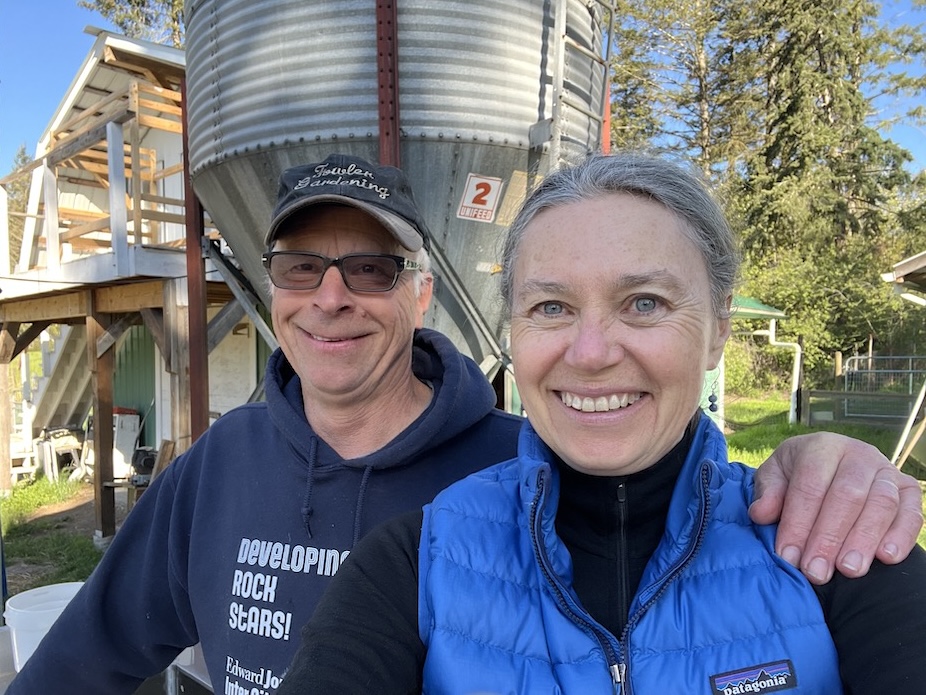
Each day begins with a boisterous chorus of birdsongs at Rosebank Farms. At sunrise you’ll find Andrea Gunner, who owns and operates the farm with her husband, Steve, doing morning chores on their nine acres of rolling pastures and woodlands. If she takes a phone call, the birds are so loud that Gunner is often asked if she is in an aviary.
There was a time when mornings were far quieter.
Nestled above the North Okanagan’s Armstrong valley, the farm sits on a slope once known as Drought Hill. When the Gunners purchased the farm in 1992, they knew the pastures were weedy and rock strewn.
They went ahead and invested all they had to start a pasture-raised poultry operation, a production type well suited to their thin soils and hilly land. It seemed an ideal place to raise their growing family. But that first week on the farm, Gunner turned on the sprinkler to irrigate the pasture and the shallow well ran dry within 10 minutes.
Next, chicks from their first batch of hatchlings began to mysteriously die.
The Gunners, whose farm sits in a rain shadow microclimate, soon discovered their groundwater was contaminated with nitrates at levels high enough to kill the baby birds. They drilled a deeper well only to yield a trickle of water, a quarter of a gallon a minute.
Seeking an alternative source of water became the Gunners’ quest. Keeping their farm depended on finding one. They hung in, trucking in water some years even though the cost whittled as much as six per cent off their gross income.
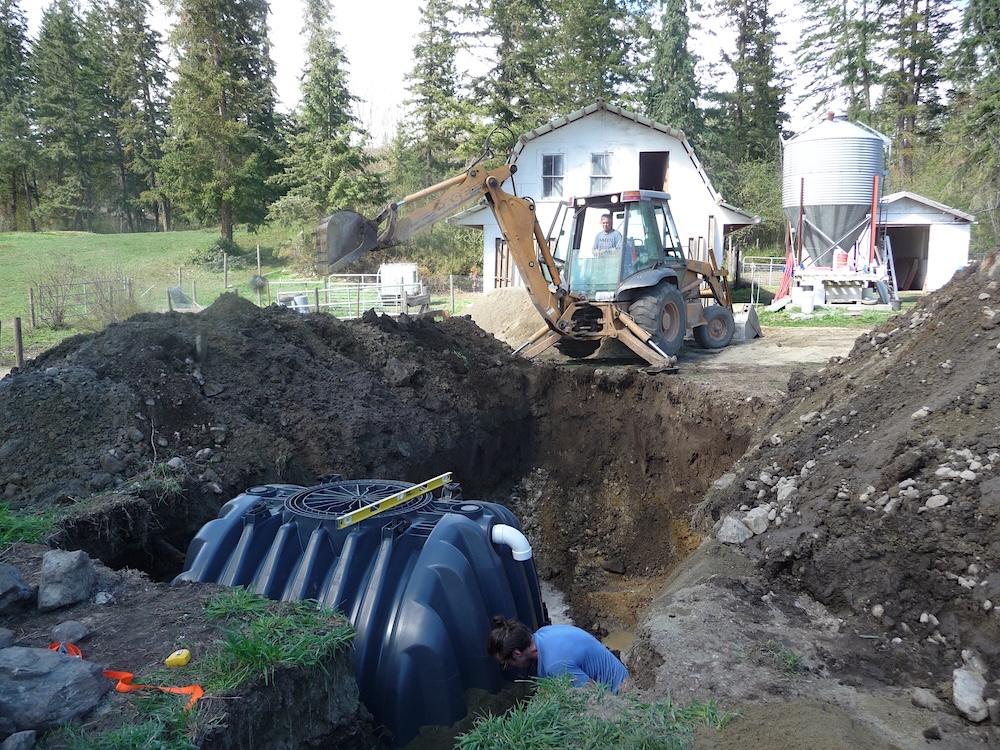
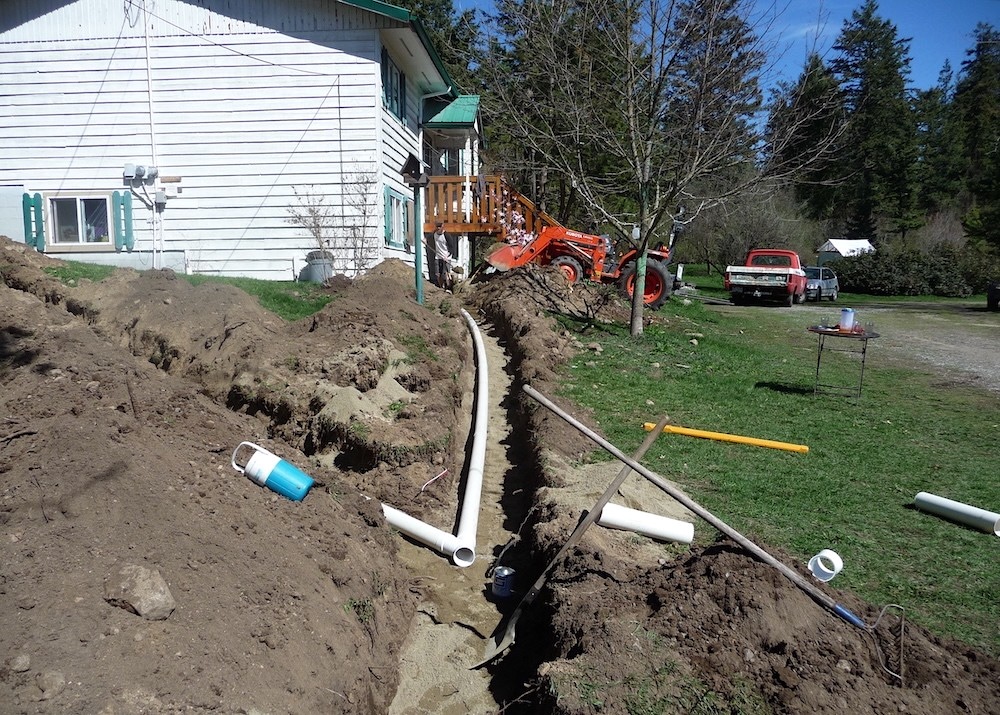
Two years ago, the Gunners put the finishing touches on their solution, an elaborate water catchment system. Today, the roof of every building at Rosebank Farms is made of metal so each drop of moisture — rain, snowmelt and condensation — rolls smoothly into screened eavestroughs and travels down a network of pipes leading to underground storage tanks.
One cistern holds potable water processed through the farm’s water treatment equipment. Six more have a combined capacity of over 10,000 gallons, roughly the volume of a small backyard swimming pool. A final three underground tanks are filled with water at the far end of their property in case of fires. A complicated set of valves and switches manages water flows and ensures that if a leak starts in one tank, all the stored water will not be lost.
Rosebank Farms not only is home to flocks of chirping birds, but has become a model for human resilience in the face of climate change.
Ground zero for BC drought
In a province that generally is getting hotter and drier, the Okanagan region has experienced drought conditions in four of the past five years, and forecasters predict this year will be more of the same. At the beginning of April, Okanagan snowpacks were at 58 per cent of normal, a concerning shortfall going into summer.
Conditions will only get worse. Modelling of precipitation and temperature patterns in the Okanagan projects warmer winter temperatures that will decrease precipitation falling as snow by 25 per cent over the coming decades. Less snow means earlier peak stream flows and less water available in summer.
Summers are changing too, trending towards less precipitation and more days with temperatures above 30 C.
“We're seeing certainly more severe droughts, and we're certainly seeing them more widespread across the country,” says Trevor Hadwen, an agroclimate specialist at Agriculture and Agri-Food Canada. Over the 25 years Hadwen has been monitoring drought, he's seen the issue grow from a prairie problem to a challenge across the country.
In the Pacific Northwest, Vancouver Island, too, is likely staring down drought conditions this summer, along with large parts of Washington state and Oregon.
Forecasts for the Yukon and Northwest Territories also predict above-seasonal temperatures.
Hadwen is part of a small team responsible for monitoring drought conditions across the country. The portal where they share updates, the Canadian Drought Monitor, is one of the top 10 most visited federal government websites. Hadwen is not surprised by its popularity. Drought has quickly become a top concern not just for farmers but for municipal utilities, wildfire responders and many others across Canada.
A costly but necessary investment
Against the wider weather swings caused by climate change, the Gunners’ water catchment system acts as a buffer. It collects and stores precipitation throughout the year, capturing the bounty from intense rainfalls to furnish water independent from groundwater sources.
The Gunners invested $90,000 for their 10 tanks, filters, pipes, eavestroughing, materials and installation. Because of the nitrate contamination in their groundwater, which they still rely on periodically, they needed to invest another $60,000 in water treatment equipment.
Including the potable water tank, the catchment system gives the Gunners just under 12,000 gallons of water storage capacity for farm use, which they draw on sparingly. Another 5,000 gallons of water are available for emergency use in case of a fire. They no longer irrigate their pastures and instead rely on fall precipitation to reseed. They use drip lines to irrigate their vegetable garden and a fine mist fogging nozzle to keep their poultry flocks cool on hot days.
They also use water to keep their flocks hydrated, to sanitize poultry feeding equipment and for household purposes. Typically, stored water gets the farm through until midsummer, then they draw water from their well and filter it until the fall rains begin.
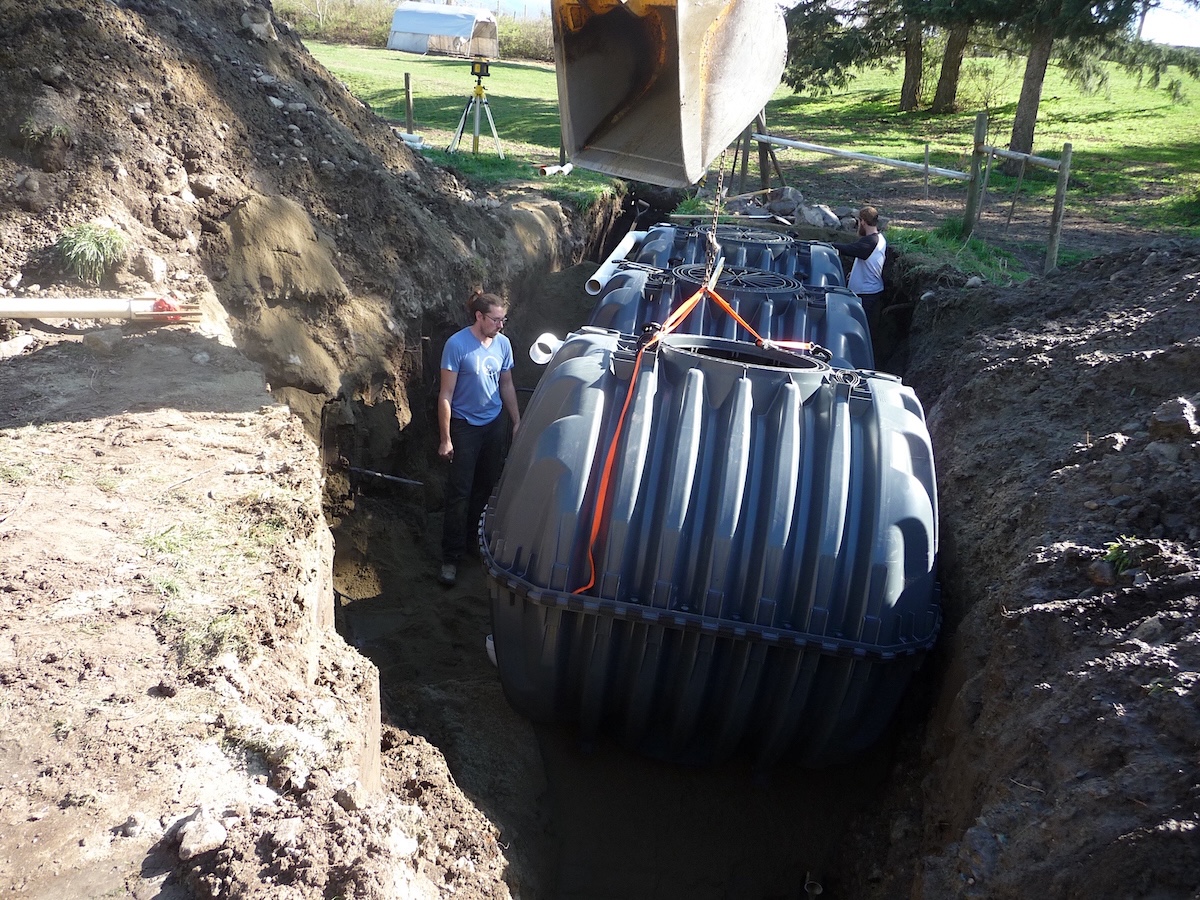
For a small farm, this self-reliance was a costly but necessary upfront investment.
Whether the Gunners’ children take over the farm or they decide to sell the property, the farm, which is worth about $1 million today, would be worth far less without a viable water supply.
Still, these kinds of investments can be a challenge. In 2024, when the Gunners made the latest expansion of their system, the farm qualified for a $30,000 grant from a new, government-funded Agriculture Water Infrastructure Program designed to help farmers offset the costs of new equipment.
The program has since changed to focus on large grants for farmers investing over $200,000 in new water infrastructure. Smaller grants are still available for farms with an Environmental Farm Plan.
Beyond the financial hurdles, if farmers are looking for government grants for a groundwater project, they need a provincial water licence. And green lights aren’t always quick. Rosebank Farms received approval for its wells in 2024 after a two-and-a-half-year wait. Lengthy approval times are common and can be another barrier to investing in improved infrastructure. The backlog started in 2022 when new regulatory requirements came into full effect.
Finding water in a drying world
In Cache Creek, a town about 200 kilometres west of Armstrong, known for its desert-like landscape and rolling tumbleweeds, Horsting’s Farm Market is a few years into using a drip-line irrigation system and has seen major benefits. For decades, the farm relied on irrigation reels with overhead spray guns to water its 65 acres of mixed vegetables and 20 acres of fruit and berries.
A lot of water was lost in the windy and hot conditions of a Cache Creek summer. As the spray guns shot moisture into the air, 65 per cent of it was lost to evaporation before it ever reached the crop. Switching to the new drip-line system allowed Horsting’s to use irrigation valves air-tagged to each crop that make it easy to direct water with almost no evaporation. The drip lines made it possible to add a new “fertigation” system, too, which delivers custom fertilizer mixes to each crop along the drip line when and where it’s needed.
“It's saving us a lot of money, saving a lot of water, and we're getting better crops because we're watering when we're supposed to, we're feeding where we need to feed,” says Marc Shane, owner-operator at Horsting’s Farm Market.
Thanks to the drip lines and fertigation system, Shane estimates he’s cut water use by more than 60 per cent while boosting yields by 20 per cent. Water worries did not drive the change. Shane says the Bonaparte River, from which the operation draws irrigation water, flows fast and clear all summer long. He was motivated to switch by the efficiency of drip irrigation and recommends similar farms consider it too.
Through his work at Agriculture and Agri-Food Canada, Hadwen sees many ways farmers across the country are adapting to drought. From selecting drought-tolerant crop varieties and using practices that help soil retain moisture to investing in more water-efficient irrigation, Canadian producers are changing how they farm.
He recommends the public take notice and change their water use habits too.
“It may seem insignificant from an individual point of view,” Hadwen says, “but when you're talking about millions of people reducing that amount of water, it does add up, and it does allow farmers to utilize a little bit more moisture to benefit the crops and to benefit the economy as well.”
At Rosebank Farms, the Gunners’ water catchment system has caught the attention of neighbouring farms, with some installing water storage systems on their own properties. It’s a step Gunner believes everyone in drought-prone areas should take to adapt to climate change and leave more groundwater for wildlife and ecosystems.
Water collection is practical, but it can also inspire awe and hope. “It's amazing how much precipitation you can capture, even from condensation in the morning, from the dew,” says Gunner. “We can hear it running down the downspouts. We can go and open the tank and watch the water flood in.”
This article runs in a section of The Tyee called ‘What Works: The Business of a Healthy Bioregion,’ where you’ll find profiles of people creating the low-carbon, regenerative economy we need from Alaska to central California. Find out more about this project and its funders, Magic Canoe and the Salmon Nation Trust. ![[Tyee]](/design-article.thetyee.ca/ui/img/yellowblob.png)
Read more: Environment








Tyee Commenting Guidelines
Please note that email notifications for replies are not currently working due to a software issue which may be resolved in a future update.
Comments that violate guidelines risk being deleted, and violations may result in a temporary or permanent user ban. Maintain the spirit of good conversation to stay in the discussion and be patient with moderators. Comments are reviewed regularly but not in real time.
Do:
Do not: