


 SHARE:
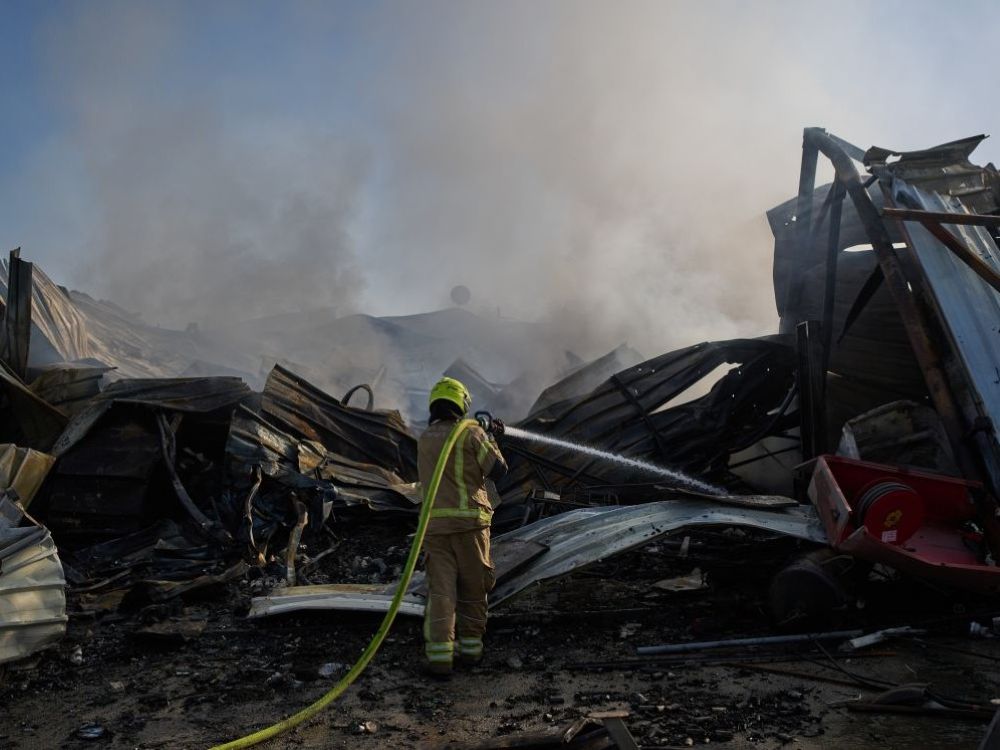
As retired U.S. Army general Mark Hertling recently observed, Donald Trump’s attack on Iran, with Israeli support, seems to have been designed as a marketing project, not a carefully planned and resourced military campaign.
As a predictable result, the U.S. and Israel find themselves unable to suppress all Iranian missiles and drones. Those that get through are doing damage not only to Israel but to the oil-rich Gulf states that provide bases and support for the U.S.
Far worse than that, Iran has effectively closed the Strait of Hormuz. According to military analyst Phillips O’Brien, only three per cent of normal tanker traffic exited the strait by the end of the first week of March, and those have been Iranian or Chinese vessels. The U.S. Navy has declined to escort shipping through the strait. Trump has had the gall to invite NATO governments to provide a service his own navy can’t handle. A much longer war now looms.
It really began, of course, as soon as Trump took office in 2025 when he declared an emergency that permitted him to impose tariffs on America’s trading partners — which include almost every country on the planet. He went on to threaten Greenland with annexation, Canada with statehood and Panama with repossession of the Canal Zone.
Trump has since made it clear that the U.S. has no allies; it has client states and real or potential adversaries.
By attacking Iran but losing control of the Strait of Hormuz, Trump has inadvertently turned a regional conflict into a global war — with the U.S. and Israel on one side and everyone else on the other. That’s because so many nations depend, directly or indirectly, on exports from the Persian Gulf.
Those exports include more than crude oil. Qatar, for example, is the largest producer of helium outside the U.S., supplying about 36 per cent of the world market in 2024. Those exports go through the Strait of Hormuz.
Helium’s not just for birthday party balloons. It’s necessary for magnetic resonance imaging scanners, semiconductors, aerospace systems and many kinds of scientific equipment. The business website GoldInvest, citing Germany’s Federal Institute for Geosciences and Natural Resources, says a third of Qatar’s helium goes to the European Union, with 31 per cent going to Southeast Asia and 29 per cent to China.
With Qatari helium shut down indefinitely, prices are rising. Reuters recently reported that a 60-to-90-day halt in supply could see the price rise beyond $2,000 per thousand cubic feet, with other reports warning of a 40 per cent to 6o per cent increase. Existing supplies, stored in special containers, have a “shelf life” of 45 days before the contents evaporate.
Reduced fertilizer supplies pose a food-security threat for India, Southeast Asia and West and North Africa. According to Deutsche Welle:
Gulf nations account for 20 per cent of global traded volumes of key fertilizers such as ammonia, phosphates and sulfur, data from the maritime intelligence company Signal Group show.Nearly half the world’s traded urea — the most widely used nitrogen fertilizer — comes from the Gulf region, with Qatar accounting for one-tenth of the global supply, according to Bloomberg Intelligence.
When QatarEnergy last week halted production after Iranian strikes on Ras Laffan, the world’s biggest LNG and fertilizer hub, hundreds of thousands of tons of key fertilizer nutrients and precursors were sidelined.
The DW report went on to say that a “30-day closure of the strait could be enough to trigger shortages and yield risks for nitrogen-dependent crops like corn, wheat and rice.”
With the planting season about to start, Kenya is just one African nation worried about this year’s crops and prices.
Meanwhile, oil production and shipment have fallen sharply. MoneyControl.com recently reported that “Gulf countries’ output of oil and oil products has plunged from 30 million barrels per day last year, excluding Oman, to 10 million currently, according to the International Energy Agency. It said the amount passing through the Strait of Hormuz had fallen to less than 10 per cent of pre-war levels.”
Hobbling big Asian economies
Last month, before the war started on Feb. 28, Zero Carbon Analytics warned that “China, India, Japan and South Korea account for 75 per cent of oil and 59 per cent of LNG flows through the strait. Of these, Japan and South Korea are the most vulnerable to supply shocks, sourcing 87 per cent and 81 per cent of their energy from fossil fuel imports.”
From Sri Lanka to the Philippines, governments are rationing gas and oil, shortening the work and school week, and urging their civil servants to wear short-sleeved shirt and no neckties instead of turning on the air conditioning.
So, some of the world’s most advanced industrial nations are likely to be hobbled by the amount and price of the oil and gas they can obtain while the Strait of Hormuz is closed. African farmers’ crops will not be productive enough to meet the demand for them, so prices will rise and the poor will go malnourished — aggravating a global health problem that began a year ago, just after Trump regained power.
The children of the poor suffer most from this problem. A study published in 2019 found that “undernutrition contributes to nearly 50 per cent of all annual deaths in children under five years.” Such children fall ill more easily and die more often from diseases like diarrhea, pneumonia and measles.
Combine those future deaths with those already caused around the world by Trump’s shutdown of the U.S. Agency for International Development. According to a December article from the Center for Global Development, 1,597,890 people died last year as a result of Trump’s cuts to U.S. health and humanitarian spending, largely through USAID.
The countries that suffer those deaths will know American policy caused them, just as they will know why their fertilizer hasn’t arrived, why gasoline and diesel are so expensive and why their hospitals’ MRIs are out of action. They will understand that they have been attacked just as surely as if Tomahawk missiles had struck their own schools and ports.
Giving Trump the silent treatment
The countries that suffer collateral damage from Trump’s war on Iran are unlikely to pull their ambassadors out of Washington or expel their U.S. ambassadors. But they will decline to help the U.S., and they will look for more reliable trade and security partners. China will surely make more trade deals henceforth than Trump ever will.
And who will benefit from Trump’s war? Russia is already selling more oil thanks to Trump’s “temporary” lifting of sanctions. Alberta Premier Danielle Smith will demand still more pipeline projects while the price of bitumen is still high. Other oil producers outside the Persian Gulf will crank up production as fast as possible. B.C.’s exports of LNG to Japan, South Korea and China will boom, for a while.
But a few countries may watch the events of Trump’s war and draw a different conclusion: that it’s utter folly to pin their survival on fossil fuels. Without much fuss they will speed up their energy transition to renewables: sun, wind, geothermal — even nuclear, despite the long-term drawbacks of nuclear waste.
When Trump’s war against Iran is over, and Trump himself is out of power, the fragility of Persian Gulf supply chains will remain. The question then will be whether Canada chooses to create new supply chains or plans ahead to prosper in a world free of fossil fuels. ![[Tyee]](/design-article.thetyee.ca/ui/img/yellowblob.png)







Tyee Commenting Guidelines
Please note that email notifications for replies are not currently working due to a software issue which may be resolved in a future update.
Comments that violate guidelines risk being deleted, and violations may result in a temporary or permanent user ban. Maintain the spirit of good conversation to stay in the discussion and be patient with moderators. Comments are reviewed regularly but not in real time.
Do:
Do not: