


 SHARE:
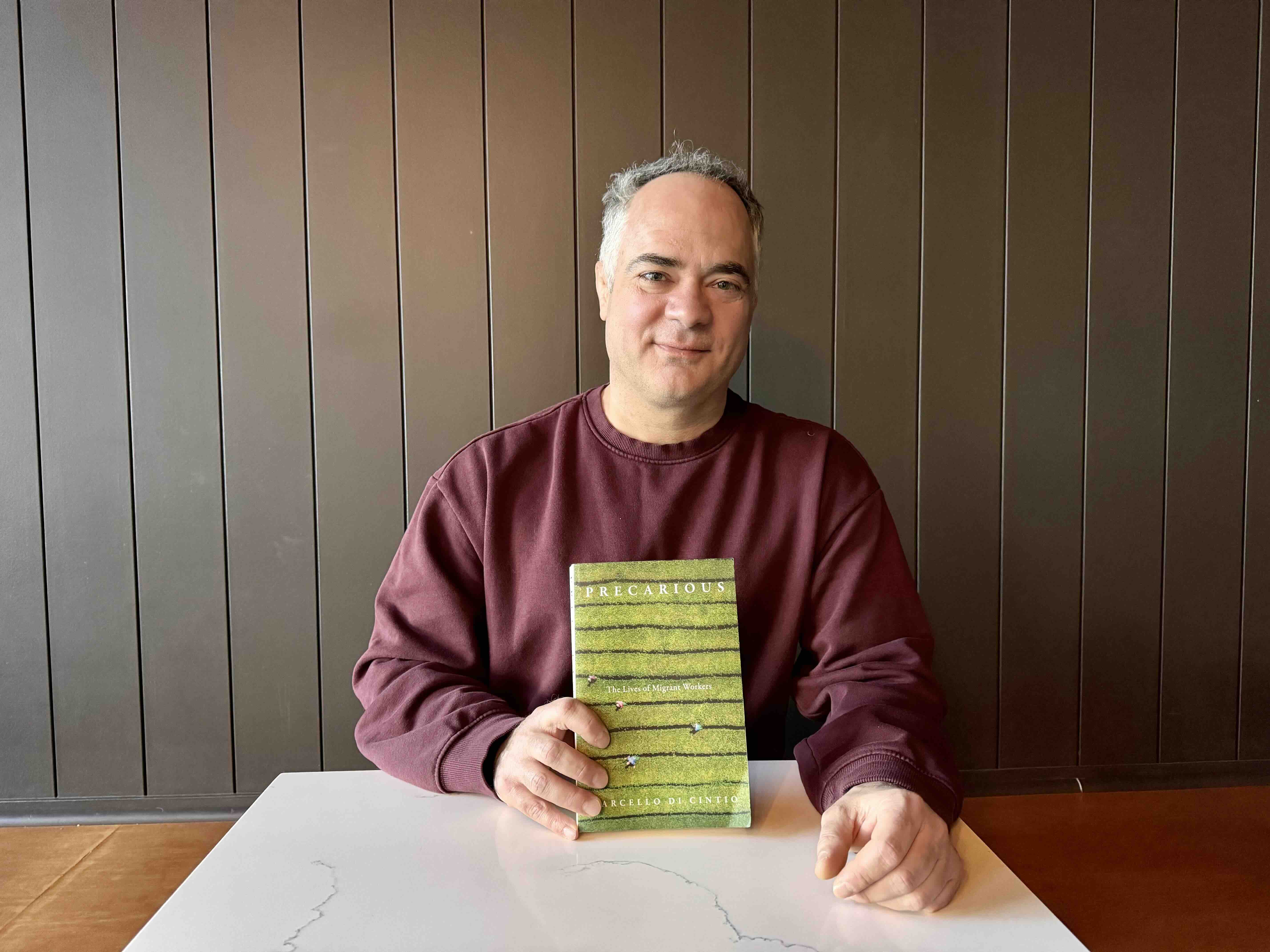
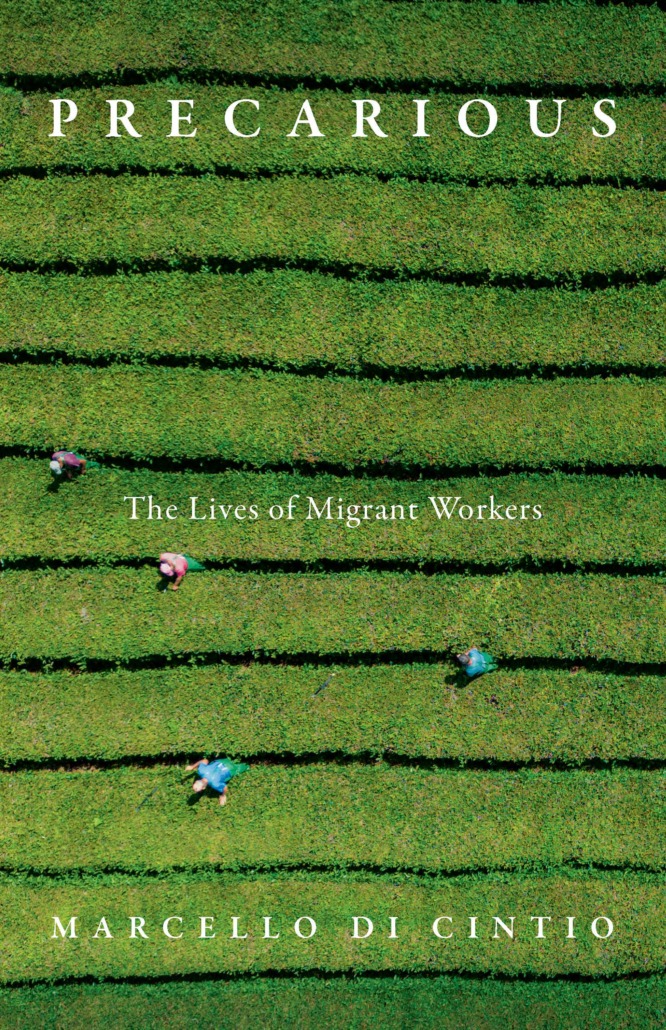
Precarious: The Lives of Migrant Workers
Marcello Di Cintio
Biblioasis (2025)
Canada is a country of immigrants. Some might say it’s a land of opportunity for anyone willing to work hard. Generations of European newcomers fled war, poverty or both, toiled to earn their kin a spot in the higher rungs of Canadian society — and succeeded. Immigrants from Scotland, Ireland, Greece and Italy laid the foundations to some of our country’s largest family fortunes.
However, the conditions that secured Canada’s reputation as a welcoming country where anyone, regardless of their background, can access a high standard of living and have a shot at economic success, have slowly shifted over the last 50 years.
Unlike their predecessors, a small share of newcomers arrive in Canada today as landed immigrants, or those allowed to stay and work in whichever field they find suitable. Instead, our country has come to rely on the labour of temporary migrants, largely from the Global South, to sustain an economic system where the interests of capital precede the rights and dignity of racialized workers.
Migrant workers today aren’t entitled to work and stay for as long as they like. Few can bring their families along and start a new life — but the promise of a better future remains alive.
In Precarious: The Lives of Migrant Workers, Calgary-based author Marcello Di Cintio recounts the stories temporary migrants shared with him, guiding readers into the cruel underbelly of a country that can be hardly recognized as our own.
“Nearly every worker I spoke to had been done wrong,” he writes. “The abuse nearly always came at the hands of my fellow citizens.”
An author with faint ties to the migrant worker community, Di Cintio is clearly an outsider, a position that enables him to ask the questions lurking in the minds of readers and dispel our often misguided assumptions.
“Is our country worth it?” he ponders, acknowledging that exploitation is baked into this country’s immigration system while temporary migrants continue to flock to Canada.
In his book, Di Cintio confronts answers as complex as the lives of the workers.
The choices available to temporary migrants are as precarious as their status in Canada, Ella Haley, a retired farmer from Ontario, tells Di Cintio. She highlights Canada’s complicity in perpetuating an unjust economic system.
Migrant workers accept our country’s conditions “because their economies are lousy,” she says. “The corn economy in Mexico fell apart with NAFTA, and they rely on the corn economy. A lot of them lost farms.”
Canada might be offering temporary migrants an abysmal deal, but for workers confined to poverty and abuse abroad, this country may be perceived to be a lesser evil that offers an opportunity to get ahead.
Di Cintio writes of fathers from South America and the Caribbean who leave their children behind to toil on a Canadian farm so that the meagre income they earn here buys their families a more stable future. Filipino mothers selflessly care for our elderly in Canada while their own children grow lonely abroad. In India, parents spend their life savings to give their children access to a better education in Canada, a shot at earning a higher income and enjoying a better life.
It can be easy to dismiss the circumstances that force migrant workers to leave everything to toil for us; they might seem to be outside of our control. But as the stories gathered by Di Cintio show, Canadians aren’t passive observers.
“Our actions impose a vulnerability and precarity on [migrant workers] before they even reach our borders,” he writes. “These workers are not our guests. They are our hostages.”
I sat down with Di Cintio at a Calgary café to talk about the importance of sharing the stories of one Canada’s most vulnerable groups. The conversation has been edited for length and clarity.
The Tyee: Unlike your book, the immigration discourse in Canada tends to focus on the economic value of migrants. What do Canadians miss out on when we frame their worth solely on how their work helps prop up our country’s economy?
Marcello Di Cintio: We talk a lot about multiculturalism in the context of regular immigration. If you want to immigrate, we want you to bring your culture, music and food, but if you're coming to work, then just shut up and work.
But there are cultural things happening with the workers that we have no idea about.
For example, in the Medicine Hat area, Big Marble Farms hires mostly Thai workers. They have a soccer league where the greenhouses play each other every year. While the men play, the women watch and drink and sell ice cream — it’s super fun.
They also have birthday parties with these lavish meals in their bunk houses, or set up tables and blankets between the greenhouses and have these giant Thai dinners. Yet, all we know about them is that they pick cucumbers, and that’s what we care about.
Did this knowledge gap spark your interest in the lives of migrant workers?
In the beginning, my editor and I went in thinking that this book was going to be a series of profiles about these workers, their lives, their backstories — what was their life like in the Philippines and Mexico?
But then I realized that you can’t understand their lives without understanding the system that they’re here under, and you can’t understand that system without understanding its history. When you follow that thread, you learn a lot about Canada.
So the book is as much about Canada as it is about workers like Celesté and Griselda and Sara, and the portrait that it paints is extremely unflattering. We don’t want to think about Canada as a place where injustice is inherent and baked in, but we’re part of a system that allows governments to use shitty recruiters to take advantage of workers.
It’s like every villain is enabled by the system, both in Canada and abroad.
There’s no reason why we should bring workers into conditions that we would never agree with ourselves.
We should aim to be the people who we say that we are, and we can’t correct our mistakes unless we know what they are. That’s why it’s important that people know these stories. Stories are far more compelling than statistics are. You can talk about this percentage of workers who experienced exploitation, but data just slip away — personal stories are what hit people.
We often hear stories that frame immigrants, migrants as resilient people whose hard work is eventually rewarded, either in Canada or abroad. You didn’t choose to follow such a narrative — why?
Resilience is a concept that infuriates me; it gilds suffering with nobility, distracting from what’s causing suffering.
I was impressed and inspired by the workers I met, who had the courage to stand up at great personal risk, and the book is full of those people. They fought for their own rights and continue to fight for the rights of everyone else, but we can’t expect everyone to come up and step forward, because the risks are too high.
I think the average Canadian believes that migrant workers are just the Mexican or Jamaican guys working in a greenhouse, not the construction worker, not the manager at the Cannabis shop, not the dishwasher.
There’s a lot of misconceptions of what it means to be a migrant worker, Canadians need to listen to their stories, and acknowledge who migrant workers are.
Your work on this book was well underway in 2023, when Tomoya Obokata, the United Nations’ special rapporteur on contemporary forms of slavery, characterized Canada’s temporary foreign worker program as “a breeding ground for contemporary forms of slavery.” While you write that Obokata’s conclusion didn’t catch you by surprise, were you expecting the milquetoast reaction of Canadians?
In a committee meeting, Marc Miller, then minister of immigration, pointed out the problems they needed to solve, but they didn’t solve any of them. The solutions that came forward were to target employers. Not a single initiative was to make the lives of workers better. It’s like politicians wanted to stop employers from exploiting the system, not from exploiting the workers.
LMIA [Labour Market Impact Assessment] rules changed to make sure Canadians aren’t available for those jobs, but no one is making sure that the bunk houses for migrant workers are safe, or that bad employers are punished.
But maybe things are changing. The other week, two people were sentenced to jail for abusing TFWs [temporary foreign workers] in Calgary. I did five years of work on this book, and I never heard of anyone being jailed. ![[Tyee]](/design-article.thetyee.ca/ui/img/yellowblob.png)
Read more: Books, Rights + Justice, Labour + Industry, Alberta












Notice about commenting changes
The Tyee’s commenting system will be moving to a new platform on Nov. 12. If you’re already a Tyee commenter you must register with the new system on or after Nov. 12 with your preferred username.More information can be found here.