


 SHARE:
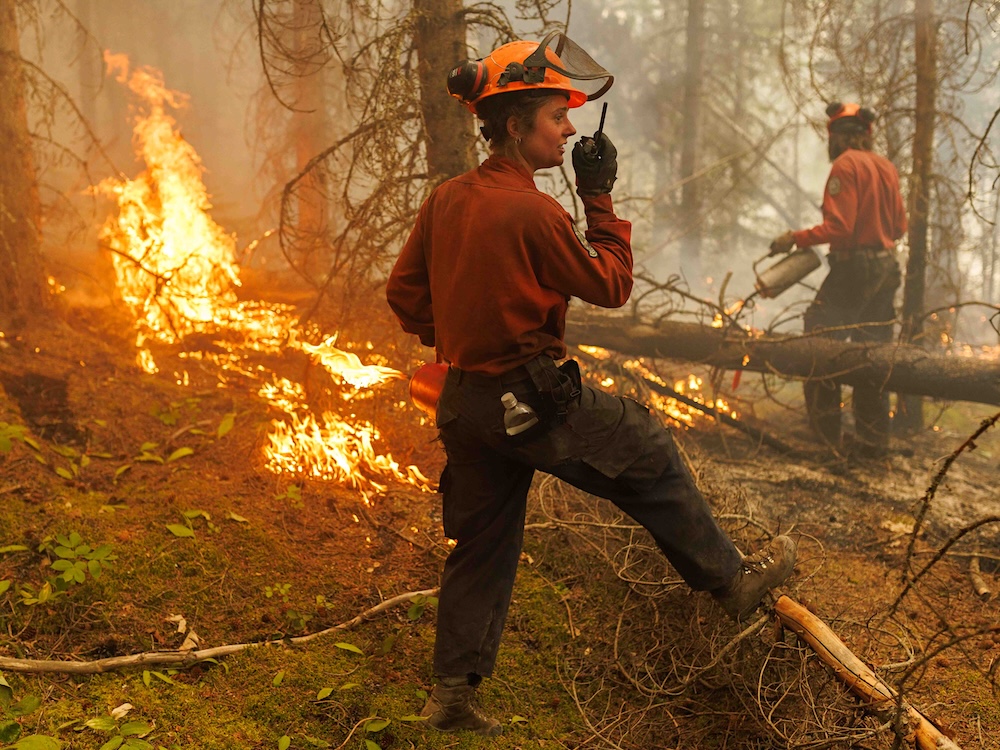
- Wild Fire: Dispatches from a Country Ablaze
- HarperCollins (2026)
Jesse Winter is a reporter and photojournalist who loves being out in the field, experiencing news events at maximum intensity. (I once heard him answer the question “What have you been up to?” with “Oh, you know, comforting the afflicted and afflicting the comfortable.”)
He’s been writing about and photographing B.C. wildfires since 2018, at one point taking the initial wildfire training so he could get closer to both fires and the BC Wildfire Service workers who fight them.
It was both a good and a terrible time to develop an expertise on wildfire reporting. Western Canadians have always lived with forest fires, but over the past decade fires have become more frequent, more intense giants that create their own weather and overwhelm understanding. Fort McMurray in 2016 marked a turning point in driving home to Canadians that we are living in a new reality — a desperate scramble to evacuate through flames, a part of your town burned down.
After Fort McMurray, there was the destruction of Lytton in 2023, then the conflagration of Jasper in 2024. And in 2023, two B.C. wildfire fighters died in incidents just weeks apart.
In his new book Wild Fire: Dispatches from a Country Ablaze, Winter has captured his own experience covering wildfires and the perspectives of the red-shirted corps who work these fires. It’s journalistic work that takes time and care, because the cone of silence and secrecy that pervades most Canadian public agencies is very much in place when it comes to wildfire fighters.
Along with a stark warning about labour conditions and the tiny size of Canadian wildfire resources compared with those of other countries, Winter’s book includes incredibly dramatic scenes of some of the most controversial wildfire responses in the past three years, including the Adams Lake wildfire in B.C.’s Shuswap region in 2023, the evacuation of Yellowknife in 2023 and the Jasper fire in 2024.
This interview has been edited for length and clarity.
The Tyee: Your book has a really strong focus on labour issues inside BC Wildlife Service and other wildfire services as well across Canada. Why was that important to explore?
Jesse Winter: When I was able to access these spaces, when you spend all day with a crew, they talk. I wasn’t doing formal interviews but just getting to know them and understand their frustrations and the realities of their workplace.
I started to hear over and over concerns about high levels of turnover, high levels of burnout. There's this sort of downward pressure that crew leaders and crew supervisors are juggling — it’s harder for them to do their job if they are in charge of a crew that’s 30 or 40 per cent rookies.
What I started to see, particularly in 2023, was the ways in which all of this sort of downward pressure on crews was making things unsafe.
Firefighters often talk about safety as sort of a Swiss cheese model. Like someone’s inexperience could be a hole in the system, broken equipment could be a hole in the system, but as long as those holes never line up, as long as the safety layers are thick enough, then crews are protected.
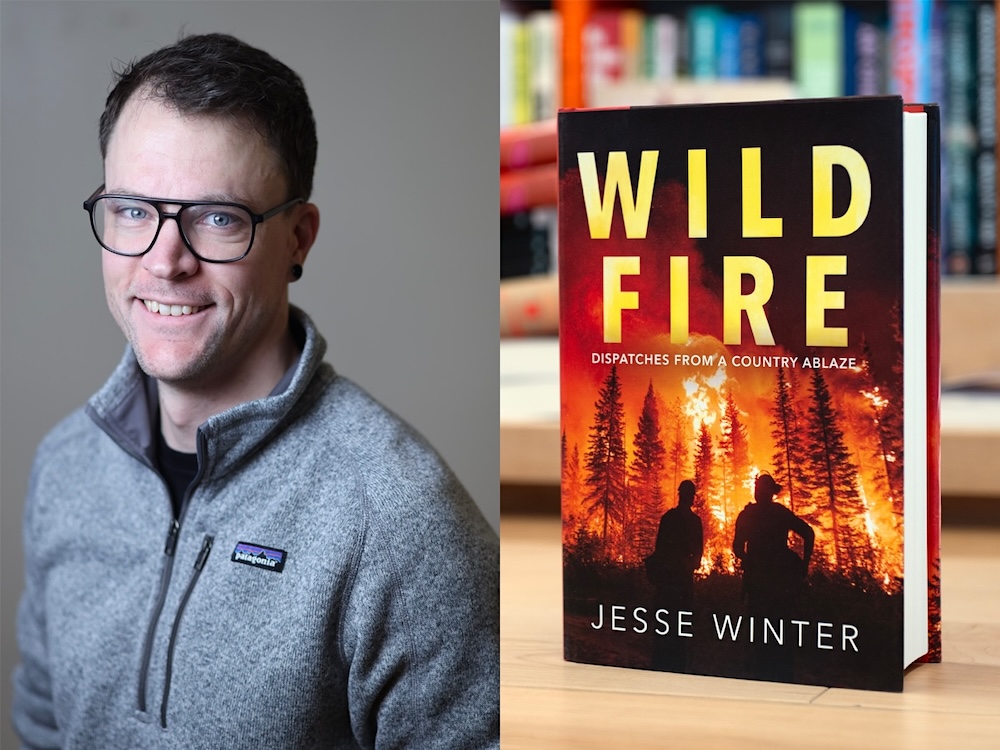
What's been happening more and more is that things like turnover and burnout, and bigger, longer fire seasons, all of those things are starting to create a scenario where it’s more likely that these holes will start to align, and when that happens, things like firefighters getting killed by falling trees, car crashes, ATV rollovers — these are the outcomes of the system struggling to operate in an environment that it wasn't designed for.
We saw the deaths of 19-year-old Devyn Gale and 25-year-old Zak Muise in 2023, which was shocking to me because we have heard of firefighters dying in other places, but it's really unusual for B.C. Was that a wake-up call, that it is really that dangerous?
For me it was a huge wake-up call. For firefighters? I don't think so.
There were a lot of people saying inside the system that they expected this, but people have been feeling for years that if things didn’t change, someone was going to die.
There are firefighters now, I know, who are choosing to leave the service because they don't want to be around when an entire crew gets burned over.
If you look at some of the safety changes that have been made in places like Australia or California, particularly in California and the U.S., a lot of systemic change happens after a mass casualty event, like the Granite Mountain Hotshots, for example. An entire hotshot crew got wiped out, and a lot of the changes that were brought in after that were things that happened as a result of those kinds of fatalities.
There are definitely folks in the fire service here who are afraid — not just in B.C., but across Canada — that systemic change won’t happen until we see a mass casualty incident like that, and they don’t want to be around for it.
One of the early chapters of the book deals with the 2023 Adams Lake fire. That was a really contentious fire response — local residents were really upset and BC Wildfire Service got a lot of criticism, especially related to a backburn they attempted. You really dug into exactly what happened. Can you talk about why it was important to break that down hour by hour in the book?
That planned ignition is probably one of the most, if not the most, contentious planned ignitions in B.C. wildfire history.
The more I dug into it, the more I started to realize that the reason it was so contentious is because there was so little information available about what happened. I think there’s this tendency amongst the bureaucracy, like they worry so much that the public won’t understand, that they have this default is to say as little as possible.
That was an ignition that was very visible to the community. People had a sense that they were watching it unfold in real time and that they witnessed it escaping, even though the public communications around it in the days and weeks afterwards insisted that that wasn’t true.
It turns out that what actually happened is more complex and nuanced — because of course these things are — but I think it was really important to try to have as clear and as factual a breakdown of exactly what happened and who knew what when and why did it happen, because that community is still deeply traumatized.
I don’t think you can move forward until there’s an understanding and agreement about what took place. I mean, at the end of the day, this is a democracy. We live in a democracy. Governments are accountable, and it’s important that this stuff be on the record.
Let's talk about communication and how it often breaks down when communities are threatened by wildfire. You talk about this with Jasper, where people like you were trying to show what had happened there.
I do think this question of communication is really critical. It touches a bunch of different things, including public safety as the primary one, and I think we’ve seen examples across Western Canada where evacuation orders are called late, people don’t seem to get — even when the fire services are trying really hard to get the message themselves out — people still somehow are surprised by fire and caught off guard and forced to evacuate through flames and that kind of stuff.
I think one of the biggest problems we have in this country is this increasing tendency amongst the government to control the information and control the narrative around these incidents so heavily that it’s breeding mistrust, it's breeding frustration amongst journalists, it's breeding a sense from the community that they’re not being told the truth.
The idea that it is the government, and only the government, who gets to decide when you find out that your house was lost, how you find out whether there’s media around for you to talk to, if you want to talk to them about the fact that your house was lost, government wants to control the entire thing.
And in Jasper, I was very alarmed to see what I think might be a first in Canada: the public was allowed back into the town, but journalists were not allowed. This went on for weeks afterwards. There was one press availability with the premier in the days after the fire, and so one pool video camera, one pool press photographer were in the town for a couple of hours, and that was it.
I’ve spoken to people from Fort McMurray, I’ve spoken to people from other communities, I’ve spoken to reporters who covered other fires, and they always tell me that one of the most important things is that people want to make sense of these disasters after they happen. For some people that means being able to tell their stories, to share their grief, to have to be seen and to have us all recognize what has happened.
Obviously, that’s not everybody, and we have to be sensitive and careful as journalists, but this idea that we don't get to look at the disaster until the government decides it’s OK for us to look at the disaster is really problematic from a democracy perspective.
I think the way that fires are behaving today is really different than it was in the past. I never used to imagine my hometown being engulfed by flames, because it’s surrounded on three sides by interface, but I do imagine it all the time now. I feel like people still don't have an understanding, though — either they think of it as being overly scary, or they don't realize how fast the fires can move if it’s a really crazy confluence of factors, like what happened in Jasper with the fire-caused high winds.
I think your book helps in providing that step-by-step information to let people imagine it. Do you think that more needs to be done on that front?
Yeah, 100 per cent. I think there needs to be more journalism around this. I think there needs to be more coverage. I think the more that storytellers and journalists, in particular, should get access to these spaces. That’s how I started understanding this stuff. It’s not possible to learn it or to truly understand it sitting in a classroom or sitting at your desk in a major city; you’ve got to see it up close, and that means understanding the scale of the truly devastating fires like Jasper, like West Kelowna, like Adams Lake.
But it also means understanding that not all fires are like that. For example, if a fire starts outside of town somewhere in the Lower Mainland, or in most parts of B.C., even though parts of the central Interior are still at pretty high risk right now, for the next couple of weeks, at least, we should be OK. So the fire starts, you don't need to panic — maybe it gets a modified response, maybe it gets a full-on response, but there’s a difference between that and a fire starting on a 35-degree day with 20 per cent relative humidity and 30 kilometre-per-hour winds, right?
Those are entirely different circumstances, and we need to understand it, and that means more storytelling around it, more journalism around it.
Quick plug for Kevin Eastwood and the wildfire documentary that he made for the Knowledge Network, also in 2023, which is really good. It was done in collaboration with the wildfire service, so they didn’t have an opportunity to ask some of the same accountability questions — but all of it is helpful.
You had some pretty stark numbers when you compare with other jurisdictions, showing just how small Canadian wildfire services are. For instance, you say that there are a total of 6,000 firefighters available in Canada. California, with a similar population to Canada, has more than 27,000 firefighters. You’ve also looked at Australia’s model, which relies on trained community volunteers. Do you have any hope that the message is getting through to decision-makers?
It's definitely getting through to decision-makers in the operational space. None of this is news to the BC Wildfire Service. Where I don't think the message is yet getting through is to their bosses and their political masters. I think if you look at the discourse in the last couple of years from politicians around what is needed, we’re hearing things like: “We need a federal national wildland firefighting force, we need more water bombers.”
You’re not going to solve this problem by just buying more water bombers. It's one piece of a much broader systemic problem that is based on 100 years of forest management practices, 100 years of aggressively suppressing nearly all wildfires, of not seeing wildfire as a natural, vital part of the landscape, and instead trying to put it all out.
Firefighters will often talk, and fire ecologists talk, about the wildfire debt that we’ve created. What we see now with these huge fires is that they are unsuppressible. There is no amount of water bombers, no number of firefighters that would have stopped the Jasper fire, or the Adams Lake fire, or the West Kelowna fire.
These are fires that are beyond resources, and the only way to manage them is to basically get back to a place where we can learn to live alongside wildfire more effectively, respecting it, understanding it and not just innately fearing it all the time.
I see the connection between labour issues on the ground and these broader questions. Because the longer that we just keep expecting firefighters to be able to show up and save the day, the worse the labour conditions are going to get. ![[Tyee]](/design-article.thetyee.ca/ui/img/yellowblob.png)
Read more: Books, Labour + Industry, Media, Environment


Tyee Commenting Guidelines
Please note that email notifications for replies are not currently working due to a software issue which may be resolved in a future update.
Comments that violate guidelines risk being deleted, and violations may result in a temporary or permanent user ban. Maintain the spirit of good conversation to stay in the discussion and be patient with moderators. Comments are reviewed regularly but not in real time.
Do:
Do not: