

 SHARE:
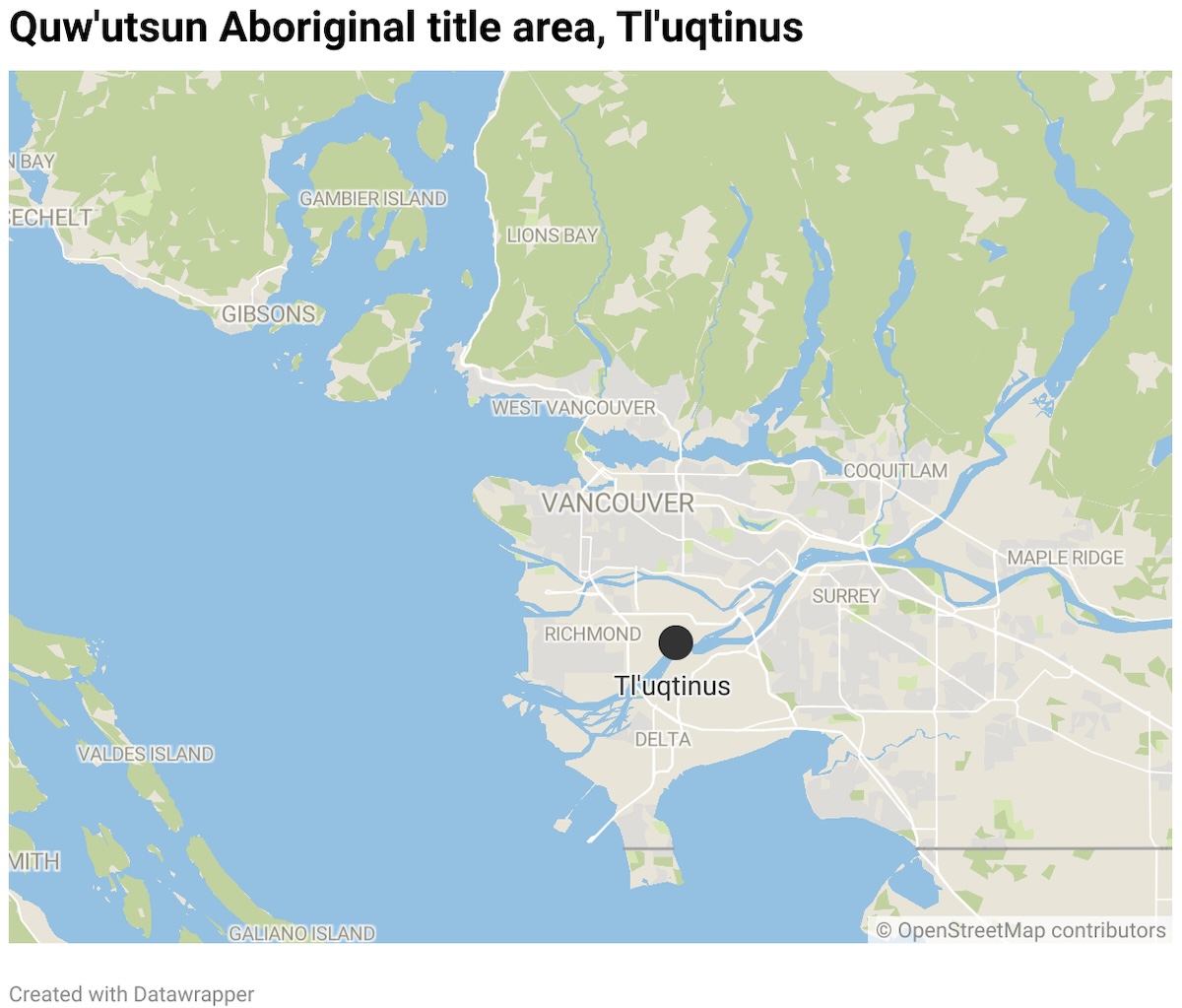
Today, a tract of land on the southeastern shore of Richmond’s Lulu Island includes a dirt-coloured grid of distribution centres for companies like Wayfair, Amazon and Ikea. Elsewhere, thousands of trucks, boats and cars dot the landscape like metallic bugs.
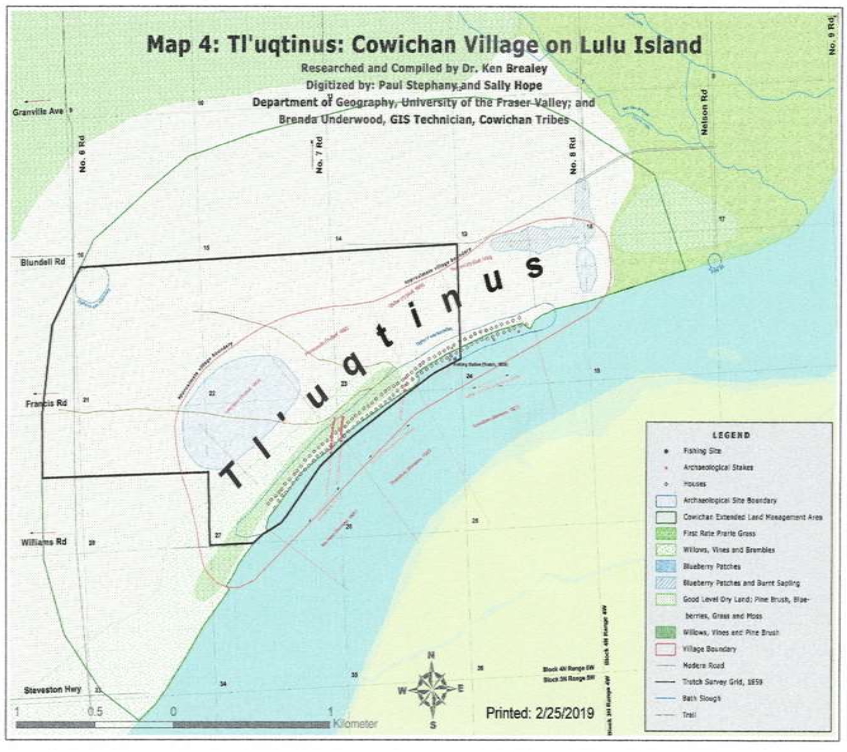
But less than 200 years ago, it was a buzzing village belonging to the Quwʼutsun Nation, who spent their summers there before travelling, en masse, in cedar canoes to their other territory on southern Vancouver Island and parts of the southern Gulf Islands for the rest of the year.
In its Aug. 7 decision on the Cowichan Tribes v. Canada case, B.C.’s Supreme Court recognized the nation’s title to this 780-acre tract of land known as Tl’uqtinus (“long chest”), named after what was once a sloping beach that hugged the river’s shore.
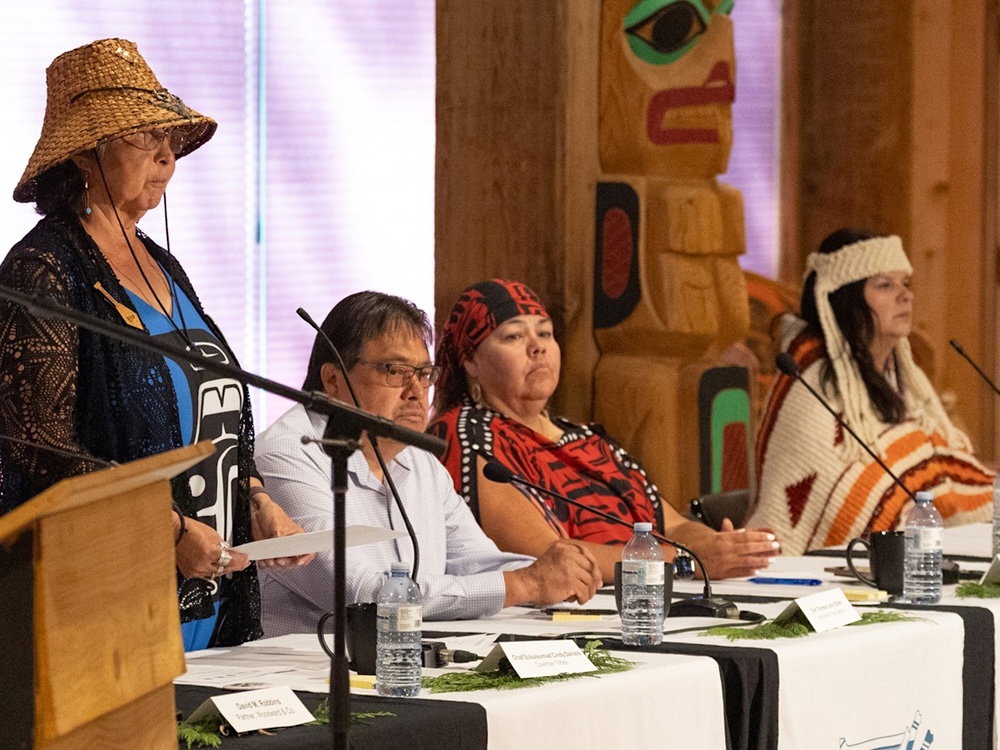
“This ruling is a recognition of our truth, of our oral history, and it is a validation of our pain,” said Chief Laxele’wuts’aat, Shana Thomas, of Lyackson First Nation, one of the five Quwʼutsun nations, at a press conference last Monday morning. “It’s our resilience that led us to today.”
For the first time in Canada’s history, the decision recognized Aboriginal title over private land and land underwater.
Canada’s first title declaration case was decided over a decade ago, when the Supreme Court of Canada recognized the Tŝilhqot’in Nation’s title to over 1,750 square kilometres of their territory in B.C.’s Interior.
With its precedent-setting decision on private or fee simple land title, this ruling creates a “second pillar” in Aboriginal law, David Robbins, lead counsel for the Quwʼutsun Nation, told The Tyee.
It appears B.C. is determined to knock that new pillar down. On Aug. 11, the province’s attorney general, Niki Sharma, announced that the province would appeal the ruling.
The nation’s case was also opposed by the Musqueam and Tsawwassen First Nations, who argued against Quwʼutsun Nation’s claim to exclusive occupation of the territory and fishing rights in the region.
“We are particularly disheartened the court didn’t recognize the importance of oral history and traditional governance protocols which guide intercommunity relationships since time immemorial,” said yəχʷyaχʷələq, Chief Wayne Sparrow, of the Musqueam Indian Band, in a statement.
The decision renders fee simple, Crown grant land held by the province, federal government and City of Richmond “defective and invalid.” In its arguments, the nation didn’t seek to invalidate the private property owners’ rights to their land, and the judge’s ruling agreed. That means private ownership still stands, but it exists alongside Aboriginal title.
The ruling compels the province to enter into negotiations with the nation about the privately owned lands. It also grants the nation Aboriginal food fishing rights to the southern arm of the Fraser River.
“Tl’uqtinus has always been ours,” said Chief Tholmen, John Elliott, of Stz’uminus First Nation, one of the five Quwʼutsun nations, at the press conference.
“We just have the opportunity to work and build a relationship with the people around us in Richmond and the surrounding areas, knowing we can work together to make sure and understand that the Quwʼutsun Nation people are coming home.”
A storm of opposition has grown since Supreme Court Justice Barbara Young’s decision last week. “This ruling is wrong — and it MUST be overturned ASAP,” the Conservative Party of BC wrote in an email sent to supporters the weekend following the decision.
The Conservative Party of BC did not respond to The Tyee’s questions about whether it accepted the legitimacy of B.C.’s courts. The Musqueam and Tsawwassen First Nations, Government of Canada, B.C.’s attorney general and the City of Richmond also did not respond to the Tyee’s requests for comment.
How did we get here?
On the witness stand, Luschiim, Arvid Patrick Charlie, an Elder and member of Cowichan Tribes, described the slow curve of Tl'uqtinus’s long beach, and the yearly trip his grandparents took to get there, stopping to harvest food along the way at “jump-off points” including Hwune'nuts, or Fulford Harbour, on Saltspring Island.
Once at Tl'uqtinus, Charlie said his family harvested sockeye, pink salmon and blueberries, drying and smoking much of it for use throughout the year.
“Tl'uqtinus is very important to us,” Charlie said during his oral testimony. “It's our home. That's where we harvested many things.”
Along with seven oral history accounts from Quwʼutsun Elders, the trial drew on historical accounts from 1790 to the early 1900s, including an early Hudson’s Bay Co. expedition that named what’s now known as the Fraser River the “Coweechin,” and a sketch from 1827 that referred to Tl'uqtinus as a “Cowitchen” village. In 1824, the Hudson’s Bay Co. reported that the village had a total of 108 longhouses.
Records also show what happened next.
Signs of a coming gold rush boom triggered the province’s predecessor, the Colony of British Columbia, to get serious about its project of surveying and parcelling out the land, relegating First Nations to small parcels that included their dwellings and any cultivated crops.
“All other land is to be regarded as waste, and applicable to the purposes of colonization,” Archibald Barclay, the Hudson’s Bay Co. secretary in London, wrote to then-Vancouver Island governor and soon-to-be governor of British Columbia James Douglas in 1849. Douglas assured the Quwʼutsun Nation that Queen Victoria required him to treat the Quwʼutsun with “justice and humanity.”
Under those terms, Tl'uqtinus, with its clear signals of occupancy, should have been made a reserve, said Justice Young in her ruling.
But that never happened, because Port Moody’s namesake, Col. Richard Moody, took much of the land for himself. As the chief commissioner for lands and works for the Colony of British Columbia, and lieutenant-governor of the colony from 1859 to 1864, Moody was tasked with establishing reserves.
Instead, he bought large swaths of Tl’uqtinus through Crown grants, attempting to hide his identity through a go-between land agent.
“I find it is likely that he used a land agent to conceal his acquisition,” Justice Young wrote in her ruling.
During the trial, the provincial and federal governments argued that Moody “paid full price” for the land, noting that it was not illegal for government agents to do so.
Justice Young, however, found that Moody’s conduct was “dishonourable.”
“No Indian reserve would be established at Tl’uqtinus in subsequent years,” she wrote, adding that “the remainder of the Cowichan Title Lands would be sold — mostly to high-placed officials — in the following years.”
Those sales, including to the Vancouver Port Authority, the City of Richmond, the province and around 120 parcels of private land, were made in error, the judge found.
“All of the Cowichan Title Lands were sold to settlers with no regard for the Cowichan’s interest,” she said.
As early as 1878, officials reported on the quagmire Moody’s failure created.
“The ancient fishing ground on the Lower Fraser of the Cowichan nation, where 700 to 1,000 Indians have been accustomed to assemble to catch fish for their winter food, has been sold and now belongs to a white non-resident,” wrote Joint Indian Reserve Commissioner Gilbert Sproat in a letter to Moody.
“What can be done in such a matter?”
Until this month, nothing was done. Now, according to Justice Young, a century-long injustice has been set straight.
Government, opposition pushback
The province’s response to Justice Young’s decision was swift.
“The ruling could have significant unintended consequences for fee simple private property rights in B.C. that must be reconsidered,” Niki Sharma said in Monday’s announcement.
Sharma also announced that the province would apply for a stay to pause the implementation of Young’s ruling.
B.C., Canada and the City of Richmond argued during the trial that it was too late to undo history. The provincial government, for example, argued that private property offers its holders “exclusive” occupation to the land, and that Aboriginal title should be suspended “so long as those incompatible interests exist.” The City of Richmond argued that Aboriginal title should be considered “extinguished” on private land and warned that economic havoc could follow if the two titles were to coexist.
Drawing on the Constitution and recent case law clarifying the nature of Aboriginal title, Justice Young found those arguments didn’t hold up.
“The question is not whether Aboriginal title can exist over fee simple lands, but whether fee simple interests can exist on Aboriginal title lands,” said Young in her ruling. “In my view, the law has evolved, and the answer to that question is ‘yes.’”
In an interview with The Tyee, Quwʼutsun’s lead counsel, David Rosenberg, said that the ruling addresses a long-standing gap in Canada’s legal landscape and calls for the Crown to negotiate a resolution with the Quwʼutsun Nation.
“I'm not saying that as a result of this, people are going to lose their property,” he said. “I'm saying the opposite.”
“As a result of this, the Crown is going to have to resolve something that's left outstanding by its own fault,” he said. “We have to deal with it and get on with it.”
“Certainty is always better than having this cloud on the horizon.”
Negotiations
In her announcement, Sharma said this case illustrates why the province prefers to resolve land claims through “reconciliation” and negotiation.
But the Quwʼutsun Nation say they tried that route to no avail.
“We initially tried to move this work forward through the treaty process, but there was no openness to discussing our Tl’uqtinus village lands and our Aboriginal right to fish in the Fraser River at that table,” said Chief Sulsulxumaat, Cindy Daniels, of Cowichan Tribes during the press conference.
B.C.’s claimed preference for negotiation is disingenuous, said Merle Alexander, a Hereditary Chief of the Kitasoo Xai'xais First Nation and a lawyer practising Indigenous resource law.
“I think it’s a lie that they prefer it,” he said, adding that the courts identified Aboriginal title decades ago, and the province knows nations across the province have robust claims.
“There [could] be all these Aboriginal title tables right now where they are choosing their preferred option and negotiating,” he said. “But that's not happening.”
Instead, Alexander said, the government has backed away from its commitments to reconciliation, including the Declaration on the Rights of Indigenous Peoples Act, which became law in B.C. in 2019 and mandates that the province bring its laws into alignment with the United Nations Declaration on the Rights of Indigenous Peoples.
Two of the province’s recent pieces of legislation, bills 14 and 15, for example, meant to facilitate the fast-tracking of major infrastructure projects, were carried out without First Nations involvement and faced swift and decisive opposition from First Nations.
“Regressive political periods and like regressive political decisions often create very strong Aboriginal case law,” Alexander added.
“I think it’s a wake-up call for [B.C. Premier David] Eby that things are going to backfire if you’re going to be adversarial.”
Speaking at the nation’s press conference, Chief Laxele’wuts’aat said the court’s decision was critical.
“As a result of this litigation, the truth is public knowledge, and our oral history is now understood.” ![[Tyee]](/design-article.thetyee.ca/ui/img/yellowblob.png)
Read more: Indigenous, Rights + Justice, BC Politics


Tyee Commenting Guidelines
Please note that email notifications for replies are not currently working due to a software issue which may be resolved in a future update.
Comments that violate guidelines risk being deleted, and violations may result in a temporary or permanent user ban. Maintain the spirit of good conversation to stay in the discussion and be patient with moderators. Comments are reviewed regularly but not in real time.
Do:
Do not: