


 SHARE:
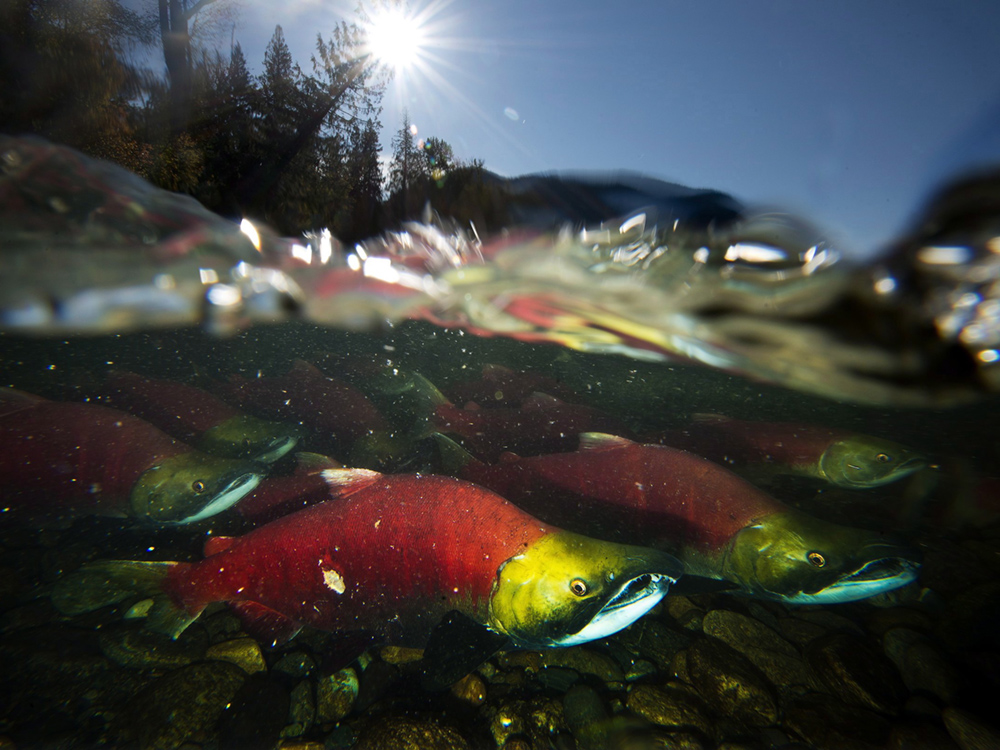
Good vibes abound on the Fraser River right now as the Canada-U.S. Pacific Salmon Commission predicts the largest sockeye return since 2018 — but not everyone is singing a happy tune.
Even as recreational and First Nations fishers pull sockeye from the river, commercial harvesters and their allies have continued to criticize the amount of fish B.C.’s salmon industry is allowed to catch.
That debate, which has now led to the resignation of a longtime Canadian representative to a cross-border salmon commission, turns on questions about whether Canada’s fishing policies may be too risk-averse — and whether an overabundance of returning fish could be bad for future salmon populations.
Last week, Michael Griswold resigned his seat on the Pacific Salmon Commission in protest over what he says is a misguided and overly cautious management plan that could doom B.C.’s commercial salmon industry. A former commercial fisher, Griswold served for 40 years on the commission, which oversees the treaty that regulates how Canada and the United States jointly manage their shared salmon populations.
While sockeye are returning in numbers not seen for decades, commercial harvesters have been disappointed by the amount they are allowed to catch. In a scathing resignation letter posted to the Facebook page for the BC Salmon Gillnetters Association, Griswold wrote that the federal government’s management plan was “unnecessarily restrictive” on the amount of fish allocated to commercial harvesters.
His complaint is one of many from B.C.’s struggling salmon industry. Officials with the BC Seafood Alliance have noted that quotas were set months ago and were based upon a much smaller predicted return of salmon. They and Griswold say the allocations should be adjusted given the number of fish that have materialized.
Griswold also took issue with the lack of input commercial fishermen had in crafting this year’s management approach, saying a management board composed of government and First Nations representatives had veto power over its decisions.
In an interview with The Tyee, Griswold suggested fisheries managers were being too cautious, given the number of salmon trying to spawn, the circumstances underlying this year’s strong sockeye return, and the dire state of British Columbia’s commercial industry.
“One of my frustrations was that we tend to focus on the worst-case-possible scenario in order to be risk-averse,” he said.
But Fisheries and Oceans Canada and Stó:lō Tribal Council president and Tribal Chief Tyrone McNeil both signalled to The Tyee that it was important to be cautious, despite the great year for salmon returns.
In a statement to The Tyee, a spokesperson for Fisheries and Oceans Canada, commonly referred to as DFO, wrote that allowable catch quotas can be adjusted, but that they are based not just on the total number of returning salmon.
“Fisheries are managed to bycatch limits and some co-migrating stocks of concern are constraining fishing opportunity,” the statement said.
McNeil told The Tyee that while this year’s returns have been a positive sign for the future, there isn’t yet enough evidence to allow mass harvesting of salmon by commercial fishers.
Griswold, on the other hand, said the government’s response to this year’s returns has given him a “sense of foreboding.”
“I don’t think the commercial industry can withstand a year like this ever again. Because here we have all the hallmarks of what should be a successful harvest year and we didn’t get access. We know what it’s going to be like when it’s a bad year there, but if there’s no future, why invest in this industry?” Griswold told The Tyee.
Griswold said that if Canada’s fishing industry disappears, salmon will continue to be commercially harvested — but by U.S. operators.
The science of escapement
Griswold told The Tyee that some of the factors underlying this year’s strong return — cooler temperatures in the Pacific Ocean and the removal of fish farms from the sockeye migration route — suggest future returns may also prove bountiful if managed properly.
But he said an overly cautious approach can have significant negative consequences for Canada’s salmon industry.
Too many salmon returning upriver, he said, could have ecological consequences.
Over-escapement, Griswold acknowledged, is a “commonly abused” term.
Commercial harvesters have long claimed that not fishing poses a risk to future salmon populations.
“But that doesn’t mean there isn’t validity to some of it,” he said. During his time on the Pacific Salmon Commission, he said, the organization was presented with reports suggesting that overly dense spawning grounds, with “too many fish and not enough water,” led to significant mortality rates on the Stuart River one year.
“I’m arguing for measured escapement policy,” he said.
The published science on over-escapement is relatively limited.
A 2004 study for the Pacific Fisheries Resource Conservation Council found evidence that suggests that a surplus of spawning fish leads to relatively inefficient populations of egg-layers — but not overall drops in future years.
The researchers questioned the logic that modern-day fishing restrictions harm populations.
“It is difficult to see how statements like this could be generally true, considering how much larger both salmon runs and escapements would have been before development of commercial fishing,” they wrote. And they found no new evidence to suggest that a particularly large spawning year directly contributes to stocks collapsing in return years.
At the same time, the study found that the efficiency of salmon stocks does decrease as spawning populations grow, with each individual egg having a smaller chance of hatching.
While that doesn’t mean there are fewer overall fish hatching, the decrease in efficiency can be seen as wastage by salmon-hungry humans.
William Cheung, the director of the Institute for the Oceans and Fisheries, said there is reason to be cautious about predicting success for future salmon returns.
“It’s obviously good news that we are seeing more salmon than forecast returning to our rivers; however, this needs to be looking into the context of the longer-term trends of Pacific salmon,” he said.
Climate change has warmed waters, increased droughts and resulted in extreme events that have negatively affected populations. He said that makes it particularly important to ensure 2025’s returning population bolsters future generations of sockeye.
“It is important to make sure that this year's good salmon can contribute to the longer-term sustainability of the salmon population,” he told The Tyee.
“Previous studies and commissions have shown the challenges that Pacific salmon are facing are complex.”
‘An over-allotment for decades’
Responding to commercial harvesters who take issue with their allotment this year, McNeil of the Stó:lō Tribal Council points to the history of fisheries management in Canada.
“They’ve received an over-allotment for decades and that’s partially why we’re in this dilemma,” McNeil told The Tyee.
McNeil sees reason to hope that this year’s strong return won’t be an anomaly. Like Griswold, he thinks the closure of fish farms off the Vancouver Island coast has aided this year’s returns and bodes well for the future. But he says it is still worth being wary about allowing too many salmon to be caught.
“We have to take the precautionary principle.”
Although the returning numbers speak well for several B.C. salmon runs, McNeil is concerned that fish destined for still-struggling spawning grounds would be caught and affected by large-scale commercial harvesting. Although fisheries officials have a process to attempt to monitor the destination of salmon being caught along the river to ensure that salmon headed to certain vulnerable spawning grounds are allowed to migrate, McNeil is doubtful about the effectiveness of that oversight.
“We’d be happy when we get back to a day where First Nations are getting what we need for fish, the rec fishery is out there, the commercial are out there too,” he said. “But right now it’s still too early.”
As for the threat of over-escapement, McNeil said he doesn’t buy the argument.
“Say that early fish that go up there, they dig their bed, they lay their eggs, the male comes along and does what he needs to.... Yes, they’re potentially killing the earlier-spawned eggs, but they’re laying new spawn on top of it.”
McNeil said action could be justified if one could be certain twice as many fish were spawning as could reproduce. But current spawning predictions are too uncertain to not err on the side of caution and overabundance, he said.
Though Griswold and McNeil differ on the approach fisheries managers should take this year, they do agree that co-operation is the key for the long-term success of salmon — and that the DFO could better facilitate that.
Griswold believes allocations should be set through negotiations between government, First Nations and commercial parties, as is done in Washington state. McNeil agrees commercial input and participation is needed, but that those discussions need to be facilitated, not obstructed, by the DFO.
Last year, McNeil spoke at a press event in Vancouver alongside representatives from the recreational and commercial fisheries. He reminisced about growing up fishing on the Fraser — and fighting over salmon.
“For the last number of years, we haven’t been fighting because there hasn’t been enough for you... there’s only been us out there,” McNeil remembers saying.
This year, there’s enough salmon to stoke more than a few disagreements. But McNeil hopes the bumper salmon run will also provide a reason to push forward.
In the meantime, McNeil is getting ready for a weekend on the river. After years of fisheries closures, he said this year’s run caught him by surprise — and allowed him to reconnect with a piece of life that had been missing.
“I get reminded of the medicine that is to live literally on the banks of the river, catching fish every day, processing every day. It’s just medicine to us and it felt so good. I was on top of the world for two weeks.”
If you have any information for this story, or information for another story, please contact Tyler Olsen in confidence via email. ![[Tyee]](/design-article.thetyee.ca/ui/img/yellowblob.png)
Read more: Environment










Tyee Commenting Guidelines
Please note that email notifications for replies are not currently working due to a software issue which may be resolved in a future update.
Comments that violate guidelines risk being deleted, and violations may result in a temporary or permanent user ban. Maintain the spirit of good conversation to stay in the discussion and be patient with moderators. Comments are reviewed regularly but not in real time.
Do:
Do not: