

 SHARE:
[Editor’s note: This story contains references to residential school abuse and sexual assault. An Indian Residential Schools Help Line (1-866-925-4419) is available 24 hours a day for anyone seeking emotional support as a result of their residential school experience.]
When RCMP Const. Calvin Swustus got the call to travel to B.C.’s Lower Mainland for a week of training in 1995, he knew he was being asked to join some sort of specialized task force, but that’s about it.
“When I arrived, I looked around and realized that all the First Nations police members were there,” Swustus recalled in a recent interview with the Investigative Journalism Foundation, or IJF. “After the first day we realized that, ‘Oh, we're going to be taking on investigating residential school crimes against our people.’”
The mission hit close to home for Swustus, a member of the Cowichan Tribes who was then 17 years into his career with the Vancouver Island RCMP. As a teenager, he’d lost friends to suicide stemming from the trauma they’d experienced at the Kuper Island Indian Residential School.
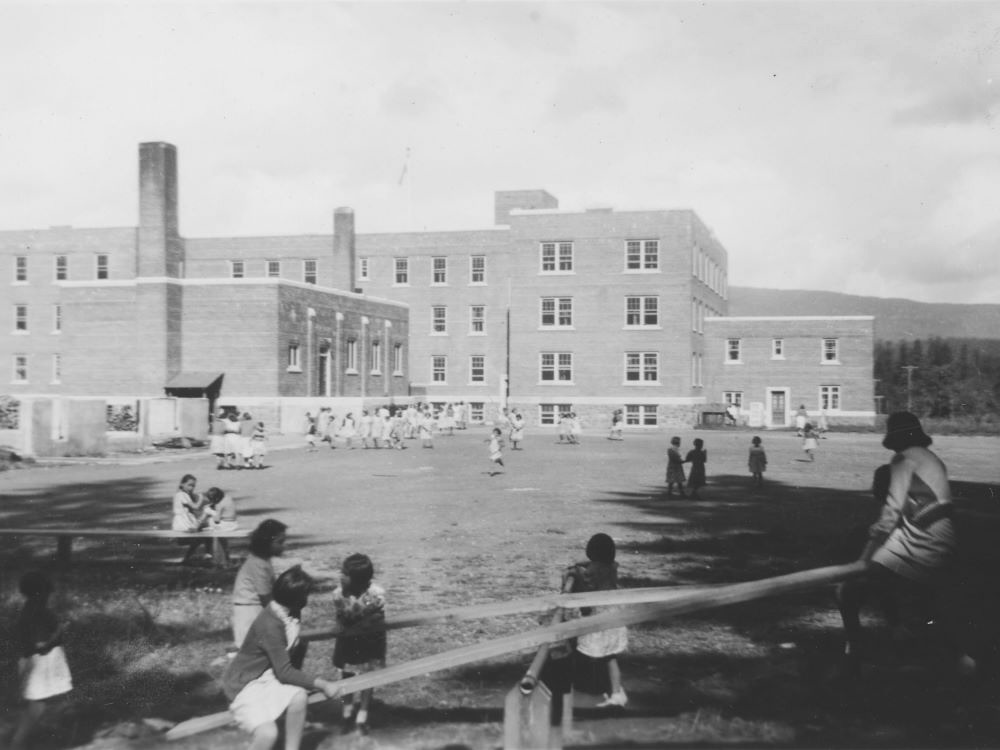
Now, he was being inducted into the RCMP Native Indian Residential School Task Force, a team assembled with the ambitious goal of investigating every single allegation of sexual assault and violence at 15 residential schools in B.C. No criminal investigation into these abuses had been attempted at this scale or scope before, and to this day, no other jurisdiction in Canada has tried to match it.
Three decades later, the IJF is finally able to tell the full, inside story.
The task force’s 2003 final report has been made public for the first time thanks to the IJF’s Open by Default database. It breaks down both the successes and failures of the task force, also known as Project E-NIRS, detailing the prosecutions that resulted from its work and the numerous barriers that stood in its way.
The final report of the task force tells the story of a specialized police unit with noble intentions, led by dedicated and skilled police officers, which was nonetheless dogged by chronic underfunding, obstruction by government and churches, morale problems, careless work by some officers and unending difficulties gathering evidence that could stand up in court.
Swustus said he was overcome with emotion to read the report for the first time. His job had been to interview survivors and file reports on abuse by clergy and staff members, but he’d never known how those reports were used.
“I'm very overwhelmed by the outcome, because some of the names on the list of people being charged, I remember reading their names in statements from the survivors,” he said.
“I feel good that something came out of the investigations. I feel good that some people were arrested, charged and convicted.”
Charges against 14 men have been linked to the task force’s work, although the report makes it clear four of those men were charged before the team was formed. Charges against another two men used some evidence collected by the task force, but the bulk of the work had been done earlier.
Still, the task force’s legacy is more than just the criminal cases for the RCMP’s major crime units. Staff Sgt. Ron Palta wasn’t on the team, but he’s seen how its work informed the complicated investigations he’s overseen related to missing and murdered Indigenous women and girls.
He described it as an important step toward building trust between Indigenous communities and the Mounties, especially considering their role as truant officers for residential schools. The protocol developed by the task force to ensure the investigations were “victim-driven” also laid the groundwork for what’s now known as trauma-informed policing.
“It certainly didn't become commonplace in the RCMP to be talking about reconciliation until much later,” Palta said. “In terms of a formal practice and a recognition of a way to proceed, you recognize that E-NIRS was ahead of their time.”
Though they have questions about whether the task force achieved all it could, some who were abused at the schools ask why the model wasn’t replicated in other provinces.
“I had never heard of this,” Lejac residential school survivor Marian Duncan said of the task force. “I wonder if they’d do that today?”
‘The Ark of the Covenant’
The task force was originally expected to last just two years, lead investigator Cpl. Michael Wayne Pacholuk wrote in his introduction to the final report.
“Instead, this investigation mushroomed into one of the largest and most difficult sexual assault investigations in B.C. history, and one that placed the RCMP squarely in the middle of numerous competing interests,” he explained.
The team would go on to collect more than 4,000 tips, including complaints against 129 people and 974 separate allegations of criminal misconduct.
“The investigation finally came to an end eight years after it began, consuming thousands of hours of investigative time and well over a million dollars in salaries and other expenses. Numerous obstacles were placed in its path,” Pacholuk wrote. “Despite all the effort and resources expended on this file, relatively few criminal prosecutions resulted.”
The report wasn’t made public at the time it was completed because there were still prosecutions underway, according to Dawn Roberts, director of communications for the BC RCMP, also known as E Division.
The report and hundreds of boxes of evidence then languished for years in E Division’s holdings while they were subject to disclosure requirements related to the Truth and Reconciliation Commission and various inquiries.
“It's like the Ark of the Covenant,” she joked.
Roberts had just started working for the RCMP when she was assigned as the media strategist for the task force. She said it was a disappointment when the task force wrapped up its work in 2003 without much media fanfare and she’s pleased the final report is finally coming to light.
“I think they were quiet heroes,” she said. “They worked so hard, our core investigators. They dealt with some really traumatizing information and stories. They persevered. They allowed victims to speak their truth.”
‘I felt traumatized just to listen to the stories’
It all began with a plea from the Nuu-chah-nulth Tribal Council on Vancouver Island in 1994. More than 100 community members had come forward to report abuse during their time at Alberni Indian Residential School, and the council asked local Mounties to take these allegations seriously.
But the detachment in the small city of Port Alberni, B.C., didn’t have nearly enough officers to tackle an investigation of this size, according to Pacholuk’s report.
And so the task force was born, originally composed of four members of E Division’s major crimes division and 15 regional investigators who had experience with sexual assault cases and working in First Nations communities.
The five days of training that Swustus attended in Richmond, B.C., included the history of the residential school system as well as the unique protocol developed by the task force, which made it clear the victims would drive every step of the process. It was up to survivors to come forward with their stories, and to decide whether to proceed to a criminal prosecution.
Charlene Belleau, a former Chief of the Esk’etemc First Nation and a survivor herself, helped facilitate this training through the Provincial Residential School Project, now known as the Indian Residential School Survivors Society.
“I just wanted them to know that there are many victims and these are the kinds of things they went through, so that there's not a lot of shock and hurt caused by the investigators when they went out, and so they were fully aware of what they were going into,” she told the IJF.
Once the five days were up, the investigators returned to their communities and began interviewing the survivors who’d come forward.
For Swustus, that was a long and difficult process.
“I felt traumatized just to listen to the stories,” he said.
He found strength through the cultural teachings of his grandfather, who’d helped him work through his grief and anger after the suicides of his friends many years earlier. But the pain he heard in those interviews lingered.
“As a policeman you can sit down and interview hundreds of victims all the time, but when it's all on them, that kind of abuse, what's going to happen to them after they leave?” he said. “You open up that wound, and I always just hope that they're going to be OK.”
Not everyone on the task force was so thoughtful about their work.
“Unfortunately, some parts of the investigation left much to be desired,” Pacholuk wrote. Some of the statements gathered by the Mounties were sloppy, and members made faulty assumptions based on little evidence or even rumour.
“In some cases, suspects were erroneously written off as dead based upon the complainant's belief or opinion, rather than through investigation. This proved to be embarrassing when a more thorough investigation conducted years later revealed that these individuals were in fact still alive,” the report says.
‘A tough slog’
From the beginning, strained budgets and staffing were major issues for the team.
“The single most significant problem faced by the task force was inadequate staffing, much of which was caused by factors beyond anyone's control,” Pacholuk wrote. “Unfortunately, the task force began to shrink in size almost as soon as it started.”
Government cost-cutting from 1995 to 1998 led to major increases in workload for team members, and by the summer of 1999 the task force was down to just three officers. It wasn’t until 2000 that the task force resumed full operations — although workload and staffing would continue to be an issue.
Throughout its existence, the task force had difficulties attracting qualified investigators. The report describes officers becoming discouraged by the “never-ending job” of compiling upsetting statements from victims trying to corroborate claims of sexual assault that happened decades earlier.
“Many members interested in a transfer to E Division Major Crime withdrew their applications when told they would be assigned to this file,” Pacholuk wrote.
Palta said it’s not surprising to hear the team was demoralized. That’s typical of historical sexual assault investigations, which can be the most difficult to resolve through charges.
“It's not that they're shy of the work, but you just know it's going to be a tough slog,” he said.
Trouble from above
Another major obstacle was the refusal of federal government bodies and many churches to open their archives. The national headquarters of the Department of Indian Affairs, which had recently gathered 20,000 documents related to residential schools across the country, denied all access to its holdings, as did the Oblates and the Sisters of St. Anne, Catholic religious orders that operated residential schools in B.C.
“It had become abundantly clear by September 1997 that none of the outstanding complaints could be successfully prosecuted without further corroboration, and that the only way to get this corroboration would be through a search warrant,” the report says.
Const. Stephen Thatcher, a former lawyer, was brought on to do the paperwork necessary to force these bodies to open their books. In the summer of 1998 alone, Thatcher drafted 44 applications for search warrants, and through his work, the task force was able to identify numerous suspects who’d been known only by a first name or nickname.
Frequently, however, these suspects were long dead. That meant, no matter how thorough the investigative work, there could be no charges or resolution for the victims.
Even if the suspects were still alive, getting enough evidence to satisfy Crown counsel was a challenge. In B.C., unlike in many other provinces, police cannot lay charges directly and must convince prosecutors to approve them.
To get that approval, investigators had to corroborate the claims against each suspect with complaints from multiple victims.
The investigation into Keavin Amyot offers a particularly poignant example. By the time he was accused of sexual assault by a survivor of St. Mary’s Indian Residential School in 1997, Amyot already had multiple convictions for sexual assault against children.
The task force report says Amyot refused to provide a statement to investigators but did admit to being a “monster” and a pedophile.
“A report to Crown counsel was submitted soon afterwards but charges were not approved due to a lack of corroboration,” Pacholuk wrote. He called this “a very common situation that kept occurring over and over.”
Charges were recommended again after a second victim came forward in 2002, but Amyot died before they could be approved.
Meanwhile, just as the task force was gathering evidence, many residential school survivors were also filing lawsuits over the abuse they’d suffered.
This added a whole new wrinkle to the process. Survivors and the federal government both wanted the police investigation files to bolster their cases and petitioned courts for access.
Normally, the RCMP and the Department of Justice fight on the same side, but the task force worried that disclosing these files to anyone would jeopardize the investigations. Then-Chief Supt. Gary Bass refused to co-operate with the requests for access, convincing a judge to give the team more time.
For survivor advocate Belleau, that was a unique display of leadership that proved the Mounties were ready to defy tradition in this case.
“People normally just toe the line, but there's some that didn't and were willing to do things differently,” Belleau said. “That's the kind of commitment you need at those levels for the kind of things that we did.”
‘This process gave those victims a choice’
That type of leadership helps explain why B.C. was the only province that had a task force on this scale, in Belleau’s thinking.
Palta and Roberts of the RCMP said B.C. Mounties came into this investigation with a leg-up in experience with large-scale investigations that covered multiple jurisdictions. That includes cases like the 1985 Air India bombing, as well as the 1970s probe of serial child murders committed by Clifford Olson.
Robin Percival, a spokesperson for the national headquarters of the RCMP, wrote in an email that the work of the B.C. task force “should not be interpreted as a reflection of actions taken — or not taken — by other divisions.” She said other provinces investigating residential school abuses “would respond to these complex and sensitive issues in ways that aligned with their operational realities and community needs.”
In the end, Belleau said she and other survivors felt some disappointment in the relatively low number of convictions and short jail times that resulted from the task force’s work, but it still marked a crucial step toward reconciliation.
“The important part of it all was that this process gave those victims a choice,” she said.
Swustus retired from the RCMP in 2000 and is now an elected councillor with the Cowichan Tribes.
With the clarity of hindsight, it’s impossible not to think about what he could have done differently during his time on the task force.
“You always look back and say, ‘Could I have done better? Did I miss any questions? Should I have asked one or 100 more questions?’ All those things play a mind game on you,” he said.
“I'm just very proud to be one of those members on the list that were part of the task force. It’s something I'll remember forever.”
With files from Ninah Hermiston. ![[Tyee]](/design-article.thetyee.ca/ui/img/yellowblob.png)
Read more: Indigenous, Rights + Justice









Tyee Commenting Guidelines
Please note that email notifications for replies are not currently working due to a software issue which may be resolved in a future update.
Comments that violate guidelines risk being deleted, and violations may result in a temporary or permanent user ban. Maintain the spirit of good conversation to stay in the discussion and be patient with moderators. Comments are reviewed regularly but not in real time.
Do:
Do not: