


 SHARE:
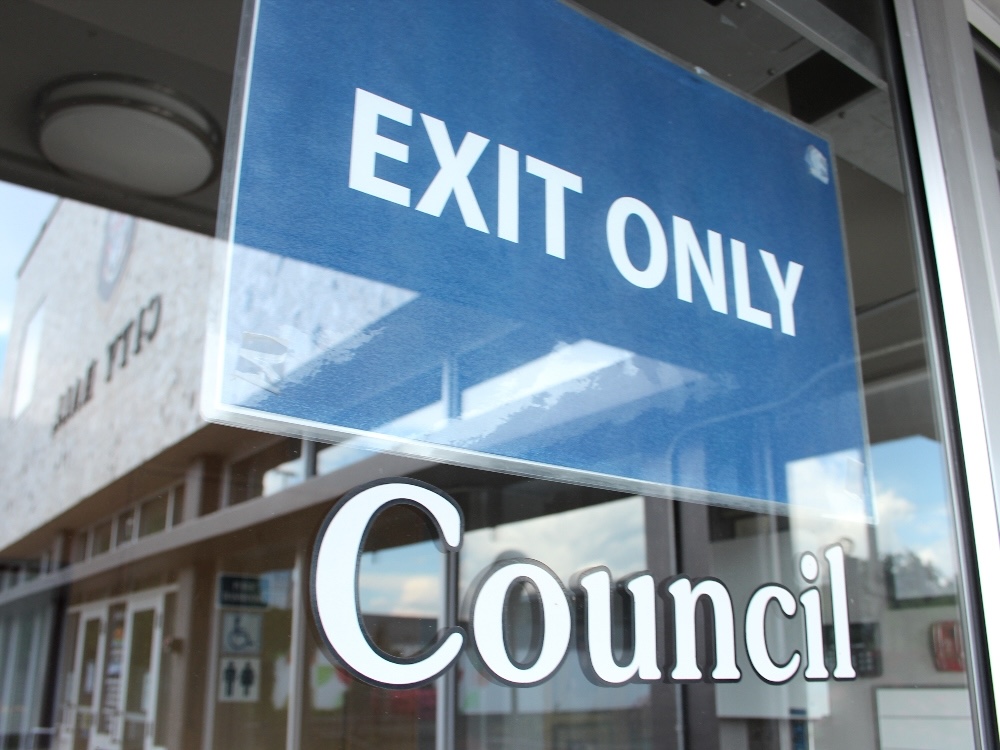
[Editor’s note: On Wednesday, we profiled Reid Hamer-Jackson, the embattled mayor of Kamloops. We examined the multitude of controversies since his 2022 election. Today, we consider potential remedies for municipalities with dysfunctional councils.]
There is no return policy on a mayor.
But some former local politicians think there should be.
With dysfunctional councils sparking discussions about how the provincial government might increase the oversight of local politicians, B.C.’s Municipal Affairs Ministry has said it will look to increase oversight of mayors and councillors.
Provincewide codes of conduct, third-party enforcement of complaints and clear consequences are all on the table. But some current and former mayors think the province should consider another step: giving voters the chance to throw elected officials out of office.
“There should be a mechanism whereby the people — knowing that they’ve made a decision and that decision has resulted in a dysfunctional situation — [can] go back and say, ‘Hey, we need to correct this,’” said Terry Lake, a former Kamloops mayor who himself was once subjected to an attempted recall at the provincial level while he was a member of the legislature.
At the federal and provincial levels, politicians who can’t get things done or break rules can be thrown out of office before their usual expiry date.
Premiers and prime ministers unable to muster a majority of elected representatives must either call a new election or resign. And in Alberta and British Columbia, voters can petition to recall an MLA. The threshold is very high, however — in B.C., a byelection can be triggered if 40 per cent of electors sign a petition. In Alberta, half of electors must sign up to recall an MLA.
Lake says he hasn’t historically been a fan of recall. He himself was the subject of a failed recall campaign launched in 2011 after his BC Liberal Party brought in the harmonized sales tax.
But the current situation in Kamloops, in which Mayor Reid Hamer-Jackson has been found to have repeatedly breached the city’s code of conduct, has prompted him to consider how voters might oust a mayor.
Mayoral terms are now four years rather than the three they were prior to 2014. This fact has extended the pain when a municipality ends up with a council or politician that can’t get things done, he said. At the same time, Lake and others say recall should be a last resort.
“The bar has to be high,” he said. “You can’t have people just not liking someone and, you know, succeeding in a recall just because they got, you know, 1,000 other people to sign a petition.”
‘It’s supposed to be a public service’
Former Abbotsford mayor Henry Braun has also landed on recall as a potential solution to address politicians who have lost the respect of their colleagues or constituents.
Last year Braun was recruited by the provincial government to work as a special adviser in Kamloops to try to help its council resolve a series of issues linked to Hamer-Jackson that had sparked lawsuits, legal wrangling and a deluge of negative headlines.
Braun eventually delivered a report that identified Hamer-Jackson’s behaviour as the main reason for the discord.
Although Braun recommended the mayor modify his behaviour, the report has had little impact and Hamer-Jackson continues to feud with his council.
In turn, council has moved his office to the city hall’s basement, stripped him of his role as Kamloops’ spokesperson and docked his pay for repeated breaches of its code of conduct.
Braun said recall would ensure that decisions to remove mayors and councillors should fall to the citizens themselves.
“Local government is the closest to the people and it’s supposed to be a public service,” he said.
“I firmly believe that the people who elected the mayor and council should be the ones who fire them — not the province.”
Can elections solve problems? Look to Harrison Hot Springs
One recent municipality has demonstrated that elections can solve problems.
Through late 2022, all of 2023 and into 2025, Harrison Hot Springs was home to one of B.C.’s biggest problem councils from the last two years.
Harrison’s newly elected mayor, Ed Wood, had alleged that his foes had orchestrated a “coup” against him, declared the presence of a “mole” sowing discord and overseen an exodus of employees.
As strife continued last year and council meetings broke down, Wood and John Allen, his lone ally on council, resigned their respective seats, then ran for each other’s previous positions.
Voters rejected them in the subsequent byelections. Both received less than one-fifth of all ballots cast.
Since the elections, the village government has operated normally. Its members have been collaborative.
That election, however, was triggered by the politicians at the centre of controversy, not the electors. Rarely do mayors who want to retain their position in government voluntarily expose themselves to the risk of losing their jobs.
‘An option in the most dire cases’
Clearwater Mayor Merlin Blackwell, who has watched the Kamloops chaos from his small community just to the north, sees recall as something that might be of use in the worst-case scenarios.
“I think recall legislation should be an option in the most dire cases, but I would still like to see it used when other things have been exhausted,” he said.
Blackwell and others have warned that recall legislation could be “weaponized” in highly charged political environments. That should require a high bar, they say.
But because voting habits are so different at the provincial and municipal levels, that threshold might need to be different for recall to be useful at a local level — in 2022, fewer than 30 per cent of Kamloops residents bothered to vote.
Blackwell suggested that it might be worth putting other limits upon recall campaigns.
“I don’t think a recall campaign should necessarily go ahead if it’s just a minor behavioural issue,” he said. “If it’s a criminal issue, if it’s a fraud issue. It should be a fairly significant thing for recall to happen, not just, ‘I don’t like them.’”
He also suggested the province might consider creating an ombudsperson-like position that could provide oversight and, if necessary, demand a new election in cases where councils don’t seem to be functioning.
How recall could be weaponized
Recall legislation has its doubters.
Allison Habkirk, a former Central Saanich mayor who now regularly consults and advises on municipal governance matters, says broader changes are needed to address the root of the problems bedevilling local councils.
“Could recall be an answer? Maybe. But it comes with some real challenges too,” Habkirk said, pointing to the cost of both recall campaigns and subsequent byelections.
Habkirk worried that recall legislation could leave communities even worse off.
“You could see how recall could be weaponized and kind of taken over by a group of really strident people of one ideology or another, and it actually might be worse,” Habkirk said.
B.C. Municipal Affairs Minister Christine Boyle told The Tyee that recall isn’t at the centre of the provincial discussions about increasing oversight of municipal councils. She pointed to the fact that recall legislation exists at the provincial level, but hasn’t been employed successfully.
“We’re looking at a range of options, and that one isn’t currently on the table,” she said. “But I really welcome hearing from folks who have experience in local government on what their suggestions are that would make a difference.”
At the centre of many provincial discussions is the creation of enforceable codes of conduct.
In 2022, the province required municipal councils and boards to create such codes, which lay out broad-based behavioural rules for local politicians.
But the form of each code can vary across municipalities, and it is up to each council (or board) to enforce them. That leaves them subject to political machinations and, often, with limited credibility. Those found to breach their municipal code of conduct can label findings as politically motivated.
Boyle, who previously sat on Vancouver council, told The Tyee the province “will continue over the coming months to talk in more detail about that possibility of a mandatory code of conduct and other feedback and recommendations that come out of local government.”
Societal factors and social media
Legislative changes, however, can go only so far.
There is no firm data on council misdeeds, or the lack thereof.
Certainly councillors and mayors didn’t just start behaving poorly over the last four years. Boyle notes that “the vast majority of local governments around the province are functioning well.”
There have always been local politicians who were unable to get along with one another and behaved unprofessionally.
In 2003, for example, one argument at a closed-door White Rock meeting grew so heated that it allegedly ended with one councillor jabbing another with a pen. (The alleged assailant, Margaret Woods, said she had merely delivered an open-handed slap to her foe. Criminal charges were filed but then dropped. Woods ran for mayor in a subsequent election but lost.)
The growth of social media, and video recording of meetings, has made it easier for people around the province to learn about far-flung, spectacularly dysfunctional municipal councils, and for distant reporters to cover them.
“There probably is more [conflict], but I think that the publicity around it is probably out of proportion compared to how much it has increased,” Habkirk said.
New codes of conduct and more litigation also seem to be providing more exposure to dysfunction.
But Habkirk, who has operated in the local politics sphere for decades, does think dialogue is breaking down more frequently. And the root causes may be global and societal in scope.
For Habkirk and others, the poor behaviour has a lot to do with breakdowns in civility in the broader political sphere.
Habkirk pointed to aggressive rhetoric by U.S. President Donald Trump and Conservative Party of Canada Leader Pierre Poilievre.
“I think the sort of tolerance for the way he speaks, the way Poilievre speaks, it’s become normalized, so somehow people think it’s OK.”
A shift in tone, civility
Historically, local government has been seen as relatively non-partisan. That, combined with rules that incentivize more teamwork and discourage formal oppositional debate have reduced strife. But Habkirk sees it breaking down, with real consequences.
“I think this sort of shift in tone and civility has had an impact, particularly in smaller communities,” Habkirk said. “You have mayors that come in and think they’re going to ride roughshod, rule the roost and make things happen.”
The ties that bind communities have frayed in ways that are hard to fix.
Lake points to the struggles of Kamloops’ local media as one factor there. Since 2014, the city’s daily newspaper and its award-winning newspaper, which published three times a week, have both closed. The city’s news radio station has also laid off reporters and moved to a new music format. Kamloops still has a relatively vibrant online media sphere, but it reaches only so far.
“People are sort of in their own bubbles so you don’t hear the same sort of news and have the same views to discuss at coffee shop and watering holes,” he said. “I think that has affected politics everywhere... everyone’s got their own discourse.”
Braun has a similar sense. And he said people seem to have grown less tolerant of people who make different decisions or believe other things. And he said politicians have a role in that.
“I’ve told my MPs and MLAs here over the years, ‘You guys have got to be nicer to each other in the house question period. It’s a gong show. I would never let my kids watch that,’” he said.
“Until we start changing some of that — which means we have to change ourselves — I see it getting worse before it gets better.” ![[Tyee]](/design-article.thetyee.ca/ui/img/yellowblob.png)
Read more: Municipal Politics





Tyee Commenting Guidelines
Please note that email notifications for replies are not currently working due to a software issue which may be resolved in a future update.
Comments that violate guidelines risk being deleted, and violations may result in a temporary or permanent user ban. Maintain the spirit of good conversation to stay in the discussion and be patient with moderators. Comments are reviewed regularly but not in real time.
Do:
Do not: