


 SHARE:
Artificial intelligence is, suddenly, everywhere.
Its everyday uses include personalizing your Netflix recommendations, filtering your social media feeds and enabling the facial recognition that opens your smartphone.
As companies expand AI’s presence in our daily lives, the need for infrastructure supporting the technology also grows.
B.C. recently saw its first AI data centres open in Prince George and Kamloops, and more are on the way. AI centres have been touted as a way to grow the economy while ensuring data sovereignty by storing information within our borders.
“AI is everywhere. It’s changing how we work. It’s changing how we learn. It’s changing how we do business,” said Port Moody-Burquitlam MLA Rick Glumac, who this summer became B.C.’s minister of state for artificial intelligence and new technologies. The position comes with a mandate to expand B.C.’s AI sector.
“There’s a lot of good work ahead,” Glumac, who comes from a tech background, told The Tyee.
But there’s a hitch. AI is just one of various potential boom industries vying for a piece of B.C.’s limited electricity supply.
AI data centres are energy intensive, requiring immense amounts of electricity for power and cooling. B.C.’s hydroelectric grid, which is fed almost entirely by renewable sources, offers a clean — but limited — energy source that’s attractive to businesses seeking to market themselves as environmentally conscious.
As the province looks to green the existing economy, transition to electric vehicles and expand industries like LNG using cleaner energy, AI is fast becoming one more customer seeking a piece of the power pie.
Companies eye significant chunk of power supply
B.C. is the first province in Canada to create a cabinet position dedicated to AI. But the province isn’t alone in signalling its interest in the industry.
The federal government created its own minister of artificial intelligence and digital innovation following the spring election, tapping former broadcaster Evan Solomon for the position.
Last month, Canada launched an AI Strategy Task Force, which promised to position the country at the forefront of the artificial intelligence “revolution.”
It is seeking public input throughout October on a broad range of AI-related activities, including infrastructure and security. Digital sovereignty — the ownership and control of Canada’s information storage and data infrastructure — has been identified as a national security concern.
B.C.’s parallel cabinet position “gives us the opportunity to really put a focus on this and to partner with the federal government,” Glumac told The Tyee.
In an email, B.C.’s Ministry of Energy and Climate Solutions said the province groups data centres into three categories: conventional data centres, cryptocurrency mining and AI data centres.
It added that there are currently 12 “notable” conventional data centres in the province and three more requesting a power connection. If approved, the combined operations would draw nearly 40 megawatts of power — a small slice of the province’s 12,000-megawatt power supply.
AI data centres, however, can each draw more than 100 megawatts of power.
Two of Canada’s largest telecommunications companies recently announced plans to open AI data centres in B.C.
In May, Bell Canada said it would open an AI “data centre supercluster” that is expected to use upwards of 500 megawatts, or about five per cent of the province’s current power supply.
Its first AI data centre, a seven-megawatt facility in Kamloops, opened in June. A second seven-megawatt facility is slated to open in Merritt by the end of next year.
The company is planning two additional 26-megawatt data centres in the near future, one in partnership with Thompson Rivers University and the other with the Upper Nicola Band. It says another two data centres with a combined capacity of more than 400 megawatts are in “advanced planning stages.”
Bell declined to provide detailed timelines, confirming in an email only that its Kamloops site is currently operational. “We remain on track and more sites will open in the coming months,” a spokesperson wrote.
The company also faces competition.
In April, Telus announced two Canadian data centres, one in B.C., touting the operations as “fully owned, operated and secured on Canadian soil by a Canadian company” — a nod to national concerns over data sovereignty.
The Kamloops operation will be “powered by 99 per cent renewable energy,” Telus said, but how much power it will draw is unclear. The company didn’t respond to The Tyee’s questions about capacity or when it might come online.
Asked about how these data centres will fit into B.C.’s power grid, Glumac said that “BC Hydro is monitoring this very closely and planning accordingly.” The industry is evolving quickly, he added, and he wouldn’t rule out the possibility that the province would need to regulate expansion as it did with cryptocurrency mining.
“We want to make sure that clean energy supports not just data centres but supports the people in British Columbia and supports economic opportunities and job opportunities,” Glumac said. “It’s very important to monitor that and to balance all of that, and BC Hydro is doing that.”
BC Hydro directed The Tyee’s questions to B.C.’s Energy Ministry, which also provided an emailed statement.
“BC Hydro continues to look at how the growth in the industry could impact future demand, and will adjust its forecasts and planning accordingly,” a ministry spokesperson wrote, adding that the province is committed to “balancing energy demand with economic priorities.”
“We recognize that the AI industry is evolving rapidly, and we are closely monitoring how advancements in AI infrastructure may impact future energy needs.”
BC previously put the brakes on crypto connections
B.C.’s power grid has attracted other large data centres in the past, many seeking to market their operations as environmentally sustainable.
That forced the province to put the brakes on new cryptocurrency operations in recent years.
In December 2022, B.C. announced a moratorium on new electricity connections for cryptocurrency operations, citing “massive amounts” of energy use and unprecedented interest from the industry. At the time, the province was home to six cryptocurrency mining operations and seven more were in advanced planning stages.
While those operations were allowed to continue, B.C.’s Energy Ministry placed a pause on 21 additional projects that were requesting a combined 1,403 megawatts, or more than 10 per cent of the province’s total power supply. Last year, the ministry tabled legislation aimed at regulating the “unchecked growth” of the cryptocurrency industry.
“We’re working with BC Hydro to ensure we have the electricity we need to build a clean economy and power our future, and that includes regulating electricity service for energy-intensive cryptocurrency miners that create very few local jobs,” former energy minister Josie Osborne said in a statement at the time.
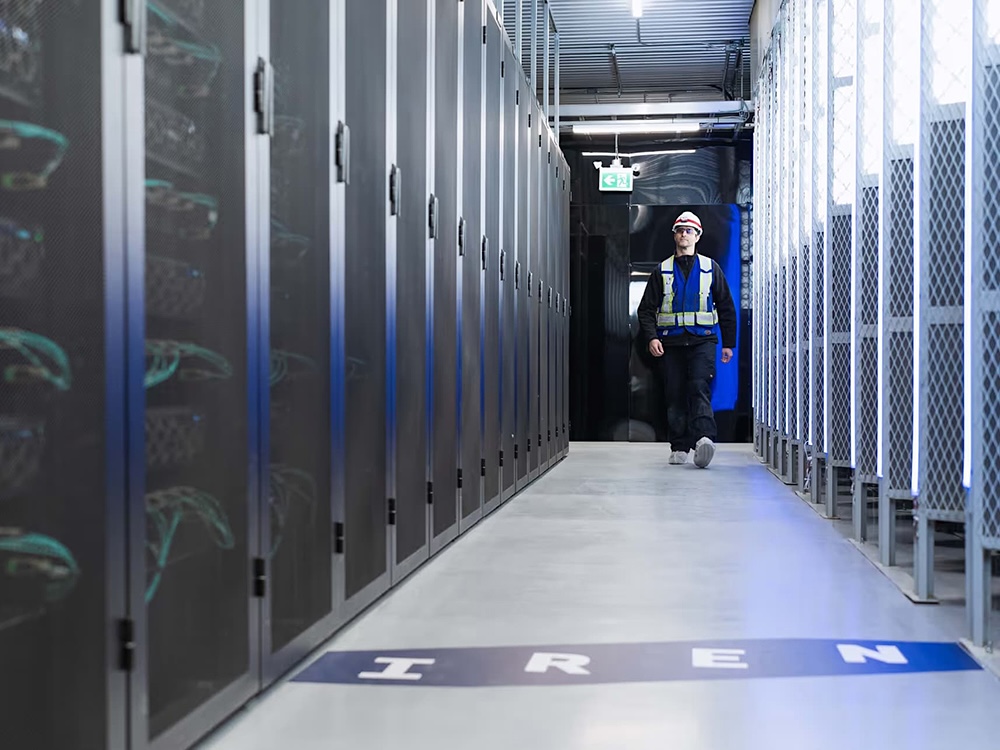
The moratorium on new cryptocurrency operations remains in place, Iren chief commercial officer Kent Draper told The Tyee.
The Australian company, which rebranded last year from Iris Energy, is B.C.’s biggest miner of bitcoin, a type of digital currency. With operations in Prince George, Mackenzie and Canal Flats, the company has promoted itself as an environmentally responsible operation capitalizing on B.C.’s excess power supply. Its facilities draw up to 160 megawatts of power combined.
Draper confirmed Iren cannot expand its bitcoin operations under B.C.’s new rules. But it has already begun to diversify into AI data storage.
“We are interested in further expansion within B.C. and AI data centres are a use case that is allowed,” Draper said in an interview with The Tyee.
The move isn’t a “pivot,” Draper emphasized, but an extension of its existing operations. Both bitcoin and AI data centres “handle very power-dense computing applications,” he said, meaning that the transition can happen with a few simple upgrades.
“In that sense, AI is actually very similar to bitcoin mining,” Draper said. “The data centres that we’re using for AI are the very same ones that we’ve been using for bitcoin mining.”
Iren’s Prince George facility, which has a 50-megawatt power capacity, began offering AI data storage last year. The company announced in September that it would double its AI storage. Work is currently underway to upgrade the Mackenzie and Canal Flats facilities for AI expansions.
The market has responded favourably. Iren’s stock has skyrocketed, doubling over the past month alone.
In B.C., Draper said, the expansion would triple Iren’s workforce of 60 people. Retrofits will add about 100 short-term construction jobs, he said.
While the company’s overall power allocation won’t change, AI’s need for a reliable power source means that Iren is also adding a backup power supply. The diesel generators will be used “very sparingly,” Draper said.
“We’re talking a few hours a year, in most instances,” he added. “The environmental and sustainable elements of this are still highly important to us.”
Planning now could avoid backtracking later
BC Hydro has also sought backup power sources.
Last year, the province imported a quarter of its electricity needs, most of it from the United States and Alberta, where it was generated using fossil fuels. In both 2024 and earlier this year, BC Hydro put out calls for power in an effort to make up the shortfall with clean, locally produced power.
Kate Harland is the research lead for clean growth at the Canadian Climate Institute. In an interview with The Tyee, she said that now is the time for governments to plan for the expected spike in energy demand from AI data centres.
“There is a lot of interest right now across Canada in having AI-enabled data centres,” Harland said. But she added that there’s likely to be a “tipping point” where AI’s benefits might not outweigh its demands on the power grid.
“If suddenly data centres are 20 per cent or 30 per cent of your total electricity demand, then you get into a new territory of questions,” she said.
While provinces such as B.C. and Quebec have traditionally taken a “first come, first served” approach to industrial power requests, some jurisdictions are implementing new rules to ensure limited power supply is allocated fairly and for the greatest overall benefit, Harland said.
Last year, Quebec began requiring any projects requesting more than five megawatts of power to get ministerial approval. The approval considers factors such as economic impact, social impact and power requirements.
In 2023, Quebec’s government also signed an agreement with Microsoft as it launched four new data centres in the province. The tech giant agreed to reduce its energy consumption by 30 per cent during times of peak power use.
Harland said the pressure to meet power demand could be approached as an opportunity to build out renewables and increase supply. If data centres become more efficient over time, that would free up renewable power for domestic uses like electric vehicles and heat pumps, she said.
AI is also credited with identifying efficiencies, including in power use, which could help to offset its draw on the grid, Harland said. (Glumac also pointed to a recent study indicating that it could drive $200 billion in productivity improvements nationally.)
The technology’s practical uses tend to set it apart from cryptocurrency in the discussion about which industries get priority to grid access, Harland said.
The potential for data sovereignty is another argument in its favour.
But Harland emphasized that now is the time for governments to be proactive in forming AI policies.
“How you integrate AI data centres and any of these large industrial loads can have consequences for affordability on electricity, it can have consequences for your emissions,” she said.
It’s important that industry is “paying their fair share” and taking on any risk from fluctuations in power demand, she added.
“Maybe we can see it as a way to start building out the system that we want to have,” she said. ![[Tyee]](/design-article.thetyee.ca/ui/img/yellowblob.png)
Read more: Energy, Science + Tech, Environment











Tyee Commenting Guidelines
Please note that email notifications for replies are not currently working due to a software issue which may be resolved in a future update.
Comments that violate guidelines risk being deleted, and violations may result in a temporary or permanent user ban. Maintain the spirit of good conversation to stay in the discussion and be patient with moderators. Comments are reviewed regularly but not in real time.
Do:
Do not: