


 SHARE:
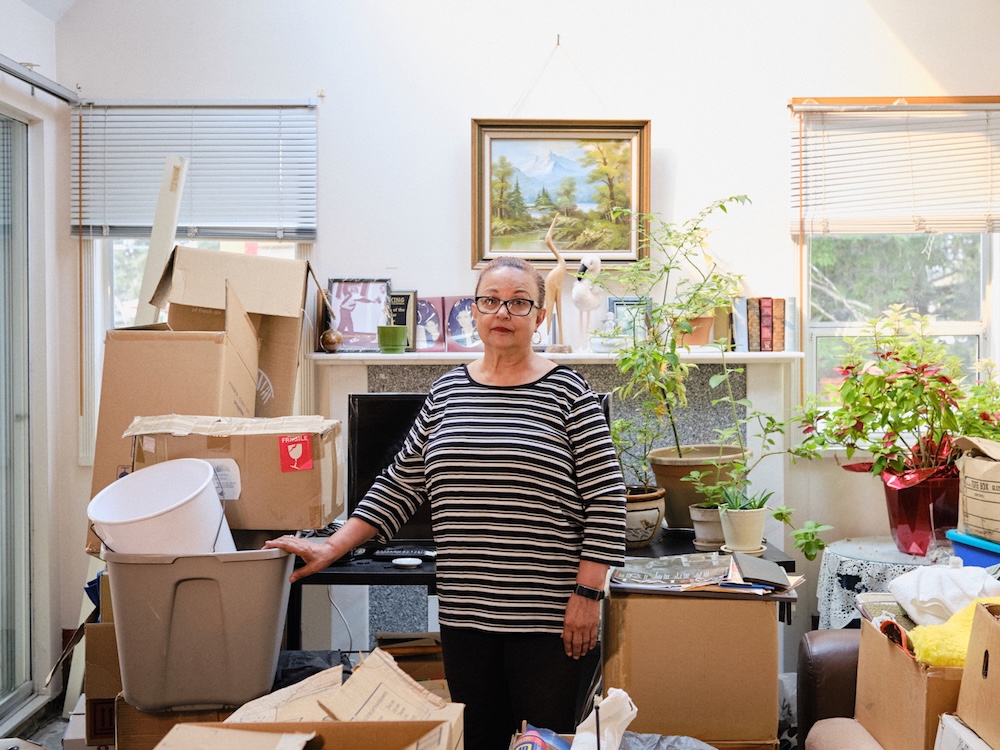
For two years, Janet Fraser and her partner Jerry — who’s deaf, chronically ill and battling Stage 4 cancer — have lived among their moving boxes. Despite a recent B.C. Supreme Court win, they remain on the brink of eviction and homelessness.
Fraser’s case raises serious housing justice issues in the province, as vulnerable renters, often facing well-resourced landlords and their lawyers, try to fight multiple eviction attempts.
Getting rid of long-term tenants, whose rent increases have generally been limited to the rate of inflation, allows landlords to increase rents dramatically when a new tenant moves in.
Each year the Residential Tenancy Branch, which arbitrates disputes between landlords and tenants, receives 20,000 applications for dispute resolution. In a 2022 staff hiring announcement, the branch said its staff had seen a 21 per cent increase in cases between 2018 and 2022.
Fraser’s case provides insight into a system that critics say can be arbitrary, unfair and biased toward landlords.
On Aug. 28, the B.C. Supreme Court overturned the Residential Tenancy Branch’s decision to allow a B.C. landlord — a numbered company — to evict Fraser. The judicial review found the RTB’s decision to be patently unreasonable and ordered the RTB to hold another hearing “before a different decision-maker.”
This decision comes after nearly two years of continuous legal battles that Fraser says have taken a significant toll on her health and consumed huge amounts of time.
“It’s been so rough, the stress and the sleepless nights were unbearable at times,” Fraser said. “I don’t know how I would have gotten through it without all the support I had.”
Fraser, 74, is a Guyanese immigrant who arrived in B.C. in 1975. Until this past May, she worked the night shift as a supervisor at Starlight, a Gateway casino in New Westminster. But Fraser, who came to Canada in search of a better life and worked hard to earn one, is now spending her senior years fighting to keep a roof over her and her partner’s heads.
Tenants get eviction notices
In June 2023, a company registered as 1392383 B.C. Ltd. bought Fraser’s eight-unit building, located in the family-friendly Richardson neighbourhood of Delta, B.C. That October, she received an eviction notice because the owner said it wanted to convert her rental unit into a living space for a building caretaker. That’s one of the grounds for eviction allowed under the Residential Tenancy Act.
Fraser, who has lived in the unit for the past 25 years, pays $768.75 a month in rent after two decades of rent increases limited by provincial legislation. While annual rent increases for existing tenancies are limited in B.C. — usually allowed to rise by only around two or three per cent a year — when a tenant moves out, landlords can increase the rent by an unlimited amount. Fraser believes she pays the lowest rent in the building, and it’s far below the Delta average of $1,779 for a two-bedroom.
The Tyee has contacted the owner of 1392383 B.C. Ltd. multiple times for comment and has sent him all the allegations made by Fraser and her advocates. In response, Harpreet Khela has declined to comment, saying the matter is before the courts.
The new landlord served three other building residents with eviction notices in the same month, all stating family members would move into the apartments. That’s another grounds for eviction under the act.
Residents who received the notices were all paying below market rent, according to Paul Lagace, a legal advocate who represented them in their RTB hearings.
Fraser was panicked, but she didn’t know where to turn for help.
Online, she found a posting for a protest by the Association of Community Organizations for Reform Now, or ACORN, outside the Delta constituency office of MLA Ravi Kahlon, then the province’s housing minister. Fraser was a constituent in Kahlon’s riding, so his office was nearby.
“I work until 4 a.m. so I never leave my house in the daytime, but I was grasping at straws,” said Fraser.
The protest organizers directed Fraser to Murray Martin, a community activist and ACORN member who often volunteers his time to help tenants navigate evictions. Martin directed Fraser to the Elizabeth Fry Society of Greater Vancouver, a non-profit organization that supports women, girls and children at risk.
But Fraser’s case couldn’t be supported by the organization as she was working at the time and her income was over their qualifying criteria. She received the same response at several other organizations.
With social service organizations overstretched, Martin decided to help Fraser dispute her eviction at the RTB.
“Since then, Murray’s been by my side all the way,” she said.
Fraser attempted to negotiate the rent with Khela, a part-owner of the company that owns the building. She offered to pay $1,200, but she said he declined and told her that he could easily get $1,500 to $2,000 over her current rent for the unit if she moves out.
“If we could find Janet and Jerry humane, affordable housing, they would have moved there. We never stopped looking throughout the legal proceedings,” Martin said.
He repeatedly contacted Kahlon’s office for support or alternatives, but to no avail. Despite promising more options for low- and middle-income renters, the BC NDP minister refused to meet with them.
After a flood, a request to vacate the apartment
Before the dispute resolution hearing, in January 2024, a massive leak began in Fraser’s ceiling that flooded the apartment and destroyed her floors.
“The water reached my hips,” she said.
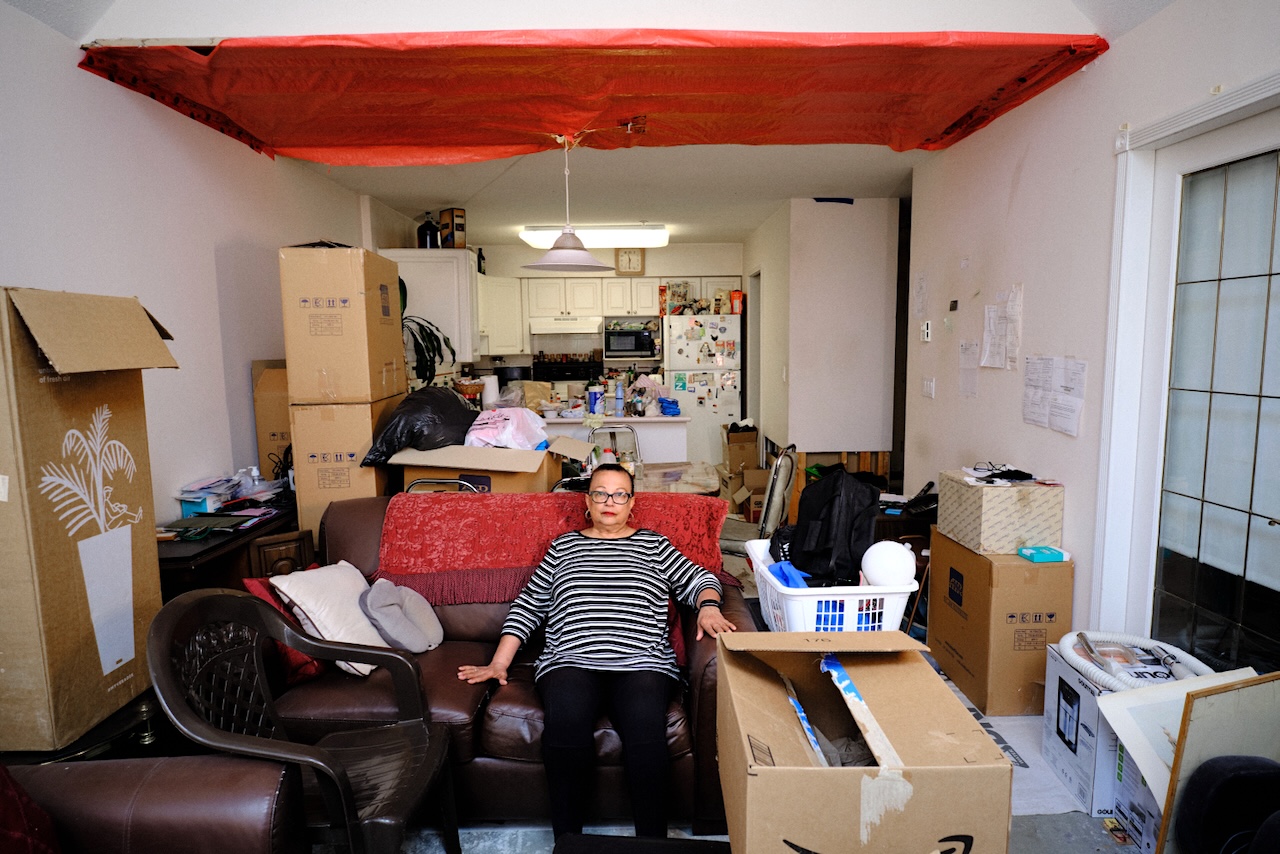
In the aftermath, Fraser repeatedly requested that the building’s management company rip out her moulding carpet, but it wasn’t done for six weeks. A large tarp now covers the unfixed hole in Fraser’s ceiling, and new flooring is yet to be installed.
The situation affected Fraser’s health, and her blood pressure reached new highs. Her doctor all but ordered her to go on stress leave.
“My load was already heavy before the eviction and the leak,” Fraser told The Tyee. “At that point, my partner Jerry had chemo every week and needed a lot of support. So every day, I would wake up in the morning, attend to his needs, take him to chemo and doctor’s appointments, then try to sleep a couple hours before going to work.
“Suddenly, on top of all that, I also had to deal with the damage in the apartment and the eviction paperwork. It was a nightmare, and it only got worse from there.”
Shortly after the leak, Fraser received an email from the property management company, Canreal, asking her to vacate the unit so they could fix the ceiling. They claimed that the repairs would take three to four months and that the insurance company would fix the damage only if all the units were ready to be repaired, so they needed her to leave in order to get the process started. The email made no mention of alternative accommodation or a timeline for Fraser and her partner’s return to the unit.
The next month, Fraser’s first eviction notice was dismissed at the RTB hearing. A missing digit from the owner’s company name on the notice rendered it invalid.
But as the hearing concluded, Martin and Fraser said Khela asked if his company could evict Fraser for two reasons simultaneously. The question further raised Martin’s suspicions of an ulterior motive behind the eviction.
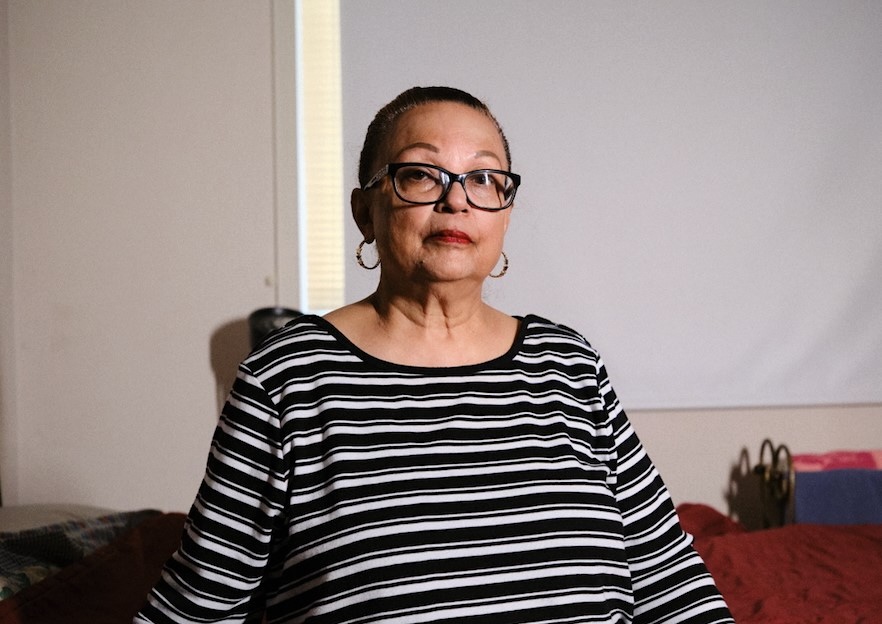
Three days later, an RTB email informed Fraser that an eviction action against her was initiated and then withdrawn.
Lagace, a legal advocate at the Prince Rupert Unemployed Action Centre who later took on Fraser’s case, told The Tyee he’d learned that “the landlord had applied for an order of possession for renovation at the RTB, but was denied due to their inability to prove that the renovations necessitated ending Fraser’s tenancy.”
Another eviction notice, more RTB hearings
Then came the second eviction notice, on Feb. 29, 2024, once again citing the need to use the unit for a caretaker’s residence.
Contradicting Canreal’s communication with Fraser saying the unit needed to be vacant for several month for repairs, the notice stated the caretaker would move in the day after Fraser’s departure. According to the eviction notice, the unit required only a coat of paint and routine cleaning to be ready for his arrival.
The message appeared to contradict Canreal’s earlier email to Fraser, which had said the repairs would take months and were so extensive she would have to vacate her home.
With Martin’s and Lagace’s help, Fraser disputed the second notice at the RTB. Once the hearing was scheduled, Martin mailed the package of documents needed for the hearing to the landlord’s office. But the package wasn’t claimed, so Martin mailed a second package that included the original documents in addition to new evidence. According to Canada Post records, the second package was picked up and signed for.
At the April 19 hearing, however, the landlord was a no-show. The RTB arbitrator, recorded as V. Hedrich on the decision document, reviewed the necessary documentation and confirmed that the landlord was notified of the hearing. She then cancelled Fraser’s eviction notice and granted her a monetary order to recover the $100 filing fee from the landlord.
Instead of her money, Fraser received notice of the landlord’s request for a rehearing, where the owner claimed to have never been notified of the April 19 dispute hearing.
The arbitrator nearly denied the request, as she had previously confirmed their receipt of a notice. The landlord’s lawyer argued that the arbitrator miswrote the file number on the monetary order given to Fraser, so they couldn’t find the case in question at the RTB. Martin wasn’t convinced; case files can be found by cross-referencing the names of the parties involved.
But the arbitrator granted the rehearing based on her mistake and they were to reconvene on June 13, 2024. At the hearing, Martin wasn’t allowed to question the grounds on which the rehearing request was approved. In her later decision, the arbitrator indicated that the landlord was “successful in obtaining [a] Review Hearing” but didn’t include specifics.
“We had done everything right. It felt like Janet was being punished for a technical mistake that wasn’t even hers,” Martin said.
Although the onus is on the landlord to prove good faith in a disputed no-fault eviction, Fraser and Martin arrived at the June 13 hearing with mounting evidence of bad faith.
The building had four other empty units, and it was unclear why the caretaker specifically needed to move into Fraser’s apartment. Khela claimed that he would knock down the wall between two of the vacant units and move into them with his wife, but they hadn’t acquired the necessary permits for this renovation. Another unit was allegedly reserved for his parents, Kundan and Kamaljit Khela, both investors in major real estate and construction companies.
Martin questioned why Harpreet Khela, a man who ranked first among Century 21 agents in Canada and owns the Khela Real Estate Group, would relocate to those units.
“Why does a businessman with a family background in real estate who owns development land and multiple single-family homes move his family into this regular, old building?”
At the hearing, Khela was pressed on the fate of the fourth unit but gave no clear response.
He also didn’t present a clear reason for why the proposed caretaker had to move into Fraser’s apartment. Khela argued that it was the only one with a street view that would allow the caretaker to monitor the unhoused population and ensure that they didn’t disturb the residents.
But Fraser said homeless people had never disturbed tenants during the 25 years she had lived at the building.
Fraser also showed the arbitrator that two of the eviction notices served to her neighbours named Harman Basutta as the landlord. (The Tyee has also viewed the eviction notices.) Basutta’s name isn’t listed on the numbered company’s corporate registry. The Tyee sent Basutta a request for comment by email but did not receive a response.
The landlord's case hinged on a contract with the alleged caretaker and Khela’s sworn testimony, which the RTB arbitrator didn’t examine or question.
Fraser was shocked to learn, a few days later on June 18, that the arbitrator had dismissed her application and granted the landlord an order of possession. The arbitrator accepted many of the landlord’s claims at face value, without interrogating them against the evidence presented by Fraser’s team.
Legal advocate Lagace, who has been involved in over 300 RTB dispute hearings, says he has never seen a case with such abundance of evidence get dismissed. “There was an unexplainable but incredibly apparent bias.”
New evidence
Despite the disappointment, Fraser still had fight left in her. She went hunting for new evidence. A few days after the June 18 decision, she acquired pictures of the wall between the two units that Khela claimed to be moving into with his wife. It was restored from the water damage and fully sealed, which contradicted the landlord’s earlier testimony that all the units had to be fixed at once. She used the photograph to obtain a rehearing on the grounds of “false information or fraud.”
Among the evidence barred by the arbitrator was the sworn testimony of a friend of Fraser’s who contacted the alleged caretaker contracted by the landlord. According to that testimony, the man, a caretaker in another building, denied signing the agreement and stated he had no intention of leaving his current home or job.
Within the arbitrator’s restrictions, Lagace reiterated that the landlord didn’t have the permits necessary to demolish the wall. He also questioned why one of the vacant damaged units couldn’t be made livable for the caretaker or for relocating Fraser and her partner.
His arguments were to no avail. The arbitrator wasn’t convinced that the landlord had no intention of knocking down the wall. On Aug. 27, 2024, Fraser learned that the arbitrator upheld the June 18 decision, finding no evidence of fraud. She had to leave her home a month later, on Sept. 30, 2024.
Last month, The Tyee spoke to the new tenants who now live in one of the units Khela told the arbitrator he and his wife planned to move into. The wall between them remains intact.
The problem with the RTB
Fraser’s experience raises concerns about systemic issues at the RTB. Each dispute is handled by a single arbitrator with full authority over the outcome. Arbitrators aren’t bound by previous RTB decisions or required to base rulings on precedent.
“Even if one of the dispute’s parties cites a previous RTB decision, it still doesn’t obligate the arbitrator to consider it,” said Robert Patterson, a lawyer and tenant advocate at the Tenant Resource and Advisory Centre, or TRAC.
This not only produces inconsistent decisions but also allows for potential bias. Legal training isn’t a requirement for arbitrators, and it's unclear whether the RTB has oversight mechanisms for individual hearings.
According to a spokesperson at the B.C. Ministry of Housing and Municipal Affairs, “the RTB provides ongoing education and training to statutory decision-makers to ensure administrative fairness. Training on procedural fairness and the principles of natural justice are a standard for all RTB decision-makers.”
Patterson highlighted another issue.
“Most arbitrators only review the evidence presented during the hearing,” he said. “This is compounded by arbitrators often enforcing the one-hour hearing limit, which leaves tenants with limited time if a landlord or their counsel speak at length.”
As a result, arbitrators are often releasing decisions based on incomplete evidence.
The only way to challenge an arbitrator’s decision is through judicial review at the B.C. Supreme Court. But this can be an onerous process, especially for low-income renters.
In response, the Housing Ministry spokesperson told The Tyee that “RTB managers also regularly review routine decisions and hearing practices to identify opportunities for improvement and reinforce neutrality.”
Fraser was not ready to give up.
“I was exhausted but not yet ready to give up my home, especially when the alternative was living in our car,” Fraser told The Tyee.
Looking for a lawyer
Fraser decided to seek a judicial review of the RTB decision at the B.C. Supreme Court. But the endeavour was beyond her current team’s expertise, so the search for a lawyer was on.
Access to justice is notoriously difficult for low-income people who can’t afford to hire legal representation. Legal aid organizations in B.C. are almost always operating at full capacity.
“It’s never slow in the tenancy law world,” said Lagace. “Every lawyer I know at legal aid clinics such as TRAC or Sources Community Law Clinic are up to their ears in cases.”
According to Patterson, TRAC receives at least 500 calls each month, many of which are seeking legal representation.
Lawyers say underfunding is the root cause of the limited access to legal aid. In February 2024, the Canadian Bar Association’s B.C. branch expressed “deep disappointment” over the provincial budget lacking “appropriate provisions for legal aid to help the most vulnerable in our province.” A 2019 Professional Employees Association report found that lawyers at Legal Aid BC, a Crown corporation, were paid more than 30 per cent less than Crown prosecutors and significantly less than comparable staff lawyer positions within government.
These issues mean that lawyers providing legal aid services are often overworked and underpaid.
Martin saw this reality in action as he attempted to find Fraser a lawyer.
“When I finally connected with a lawyer at the Community Legal Assistance Society (CLAS), she was working until 11 p.m. every night and had no capacity for a new, complex case,” he said. “If she had unlimited hours, I know she would have loved to help Janet.”
Martin reckoned that Fraser might receive more sympathy and support if she were to seek out a lawyer herself, so he suggested that she start contacting legal aid organizations.
Fraser was set to go back to work in September.
“We were quickly running out of money and staying home was no longer an option,” she said.
So, soon after the Aug. 27 decision, she found herself visiting and contacting legal aid clinics by day and working at the casino all night.
“I’ve lost count of the number of times I lined up outside the Sources community clinic before I could get a lawyer,” Fraser said.
Finally, Sources helped find her a lawyer and she was represented by David Eupen.
Along with her lawyer, Fraser spent months going to court dates at B.C. Supreme Court in New Westminster, waiting for her case to be heard.
Eventually, they secured a full-day hearing on March 14, initially set in Chilliwack but then moved to Coquitlam. One hearing, however, wasn’t enough to present all the bad-faith evidence, so they were scheduled for another full-day hearing on June 10.
At the June 10 hearing, Fraser said, the landlord’s lawyer offered Fraser a $5,000 settlement. When she refused, Khela offered to pay the difference between her new rent and the $1,200 she was willing to pay in rent for a year — if she agreed to move out of his building. Fraser still declined.
The judge initially had sympathy for both sides. Parting with her home of 25 years isn’t easy for Fraser, and the landlord bought an aging apartment building that came with a lot of problems. But on Aug. 28, Justice Sandra Sukstorf ultimately found that arbitrator Hedrich failed “to consider relevant and directly conflicting evidence.”
Sukstorf also noted problems with the eviction notices for family use given to three other tenants. B.C.’s Residential Tenancy Act allows only individual landlords or a family corporation to give “personal occupancy notice” for themselves or close family members.
But, Sukstorf wrote in her judgment, “the Landlord in this case was a numbered company, and two of the notices named individuals who were not on the corporate registry.”
In Fraser’s case, Sukstorf said, the RTB arbitrator had failed to consider whether the landlord had an ulterior motive.
“In sum, the arbitrator’s failure to address core contradictions in the evidence, to consider reasonable alternatives, to grapple with the Landlord’s own admissions regarding timelines and permitting, and to assess the possibility of mixed motives is not a minor defect but a fundamental shortcoming,” the justice wrote. “This deprived the parties and this Court of the transparency required to meaningfully understand the basis for the arbitrator’s findings.
Sukstorf granted Fraser a new hearing at the RTB.
This isn’t the first time one of arbitrator V. Hedrich’s decisions has been overturned. On Jan. 30, 2024, Justice Karrie Anne Wolfe set aside another for patent unreasonableness, citing a failure to properly assess the landlord’s eviction evidence.
Fraser’s landlord is now appealing the Supreme Court decision at the B.C. Court of Appeal. Unsure of their fate, Fraser chooses to keep much of her and her partner’s belongings in the boxes.
“I just want to put my feet up,” she said with a heavy sigh.
Even if the appeal fails, nothing prevents the landlord from serving Fraser another eviction notice soon after.
“There is no penalty for acting in bad faith and no record of it,” Patterson said. “Advocates have been asking for a landlord registry for years; it would help keep track of serial offenders.”
It’s apparent that Fraser hates complaining.
“If I take things one at a time, they’re not so bad,” she told The Tyee during a visit to the small home she shares with Jerry.
But the past two years have clearly taken their toll on her. Her doctor advised her to retire due to worsening blood pressure. She has trouble sleeping and concentration issues. Her claustrophobia, which she had managed before this ordeal, has intensified to the extent that she often has to run to the balcony to avoid fainting or hyperventilating.
“I have never experienced stress quite like this before,” Fraser said. ![[Tyee]](/design-article.thetyee.ca/ui/img/yellowblob.png)
Read more: Rights + Justice, Housing












Tyee Commenting Guidelines
Please note that email notifications for replies are not currently working due to a software issue which may be resolved in a future update.
Comments that violate guidelines risk being deleted, and violations may result in a temporary or permanent user ban. Maintain the spirit of good conversation to stay in the discussion and be patient with moderators. Comments are reviewed regularly but not in real time.
Do:
Do not: