


 SHARE:
In a perfect world under the City of Burnaby’s Tenant Assistance Policy, a developer will financially support the tenants it’s evicting from the apartment building it wants to redevelop.
The policy states that the developer will cover the evicted renters’ moving expenses, give them “top-ups” to cover the higher rent for their new homes and offer them the right to return to the newly developed building after completion.
This occurred last year at 6521 Telford Ave. in Burnaby’s Metrotown neighbourhood when the tenants of the old apartment building that was redeveloped moved into the new apartment building developed by Intracorp Homes.
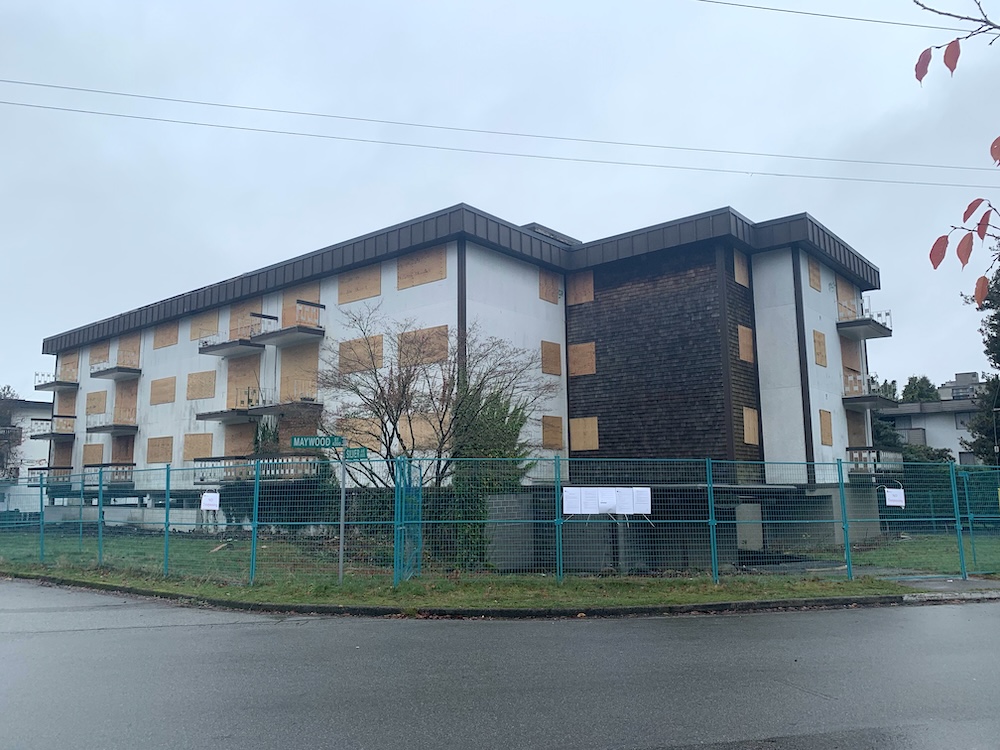
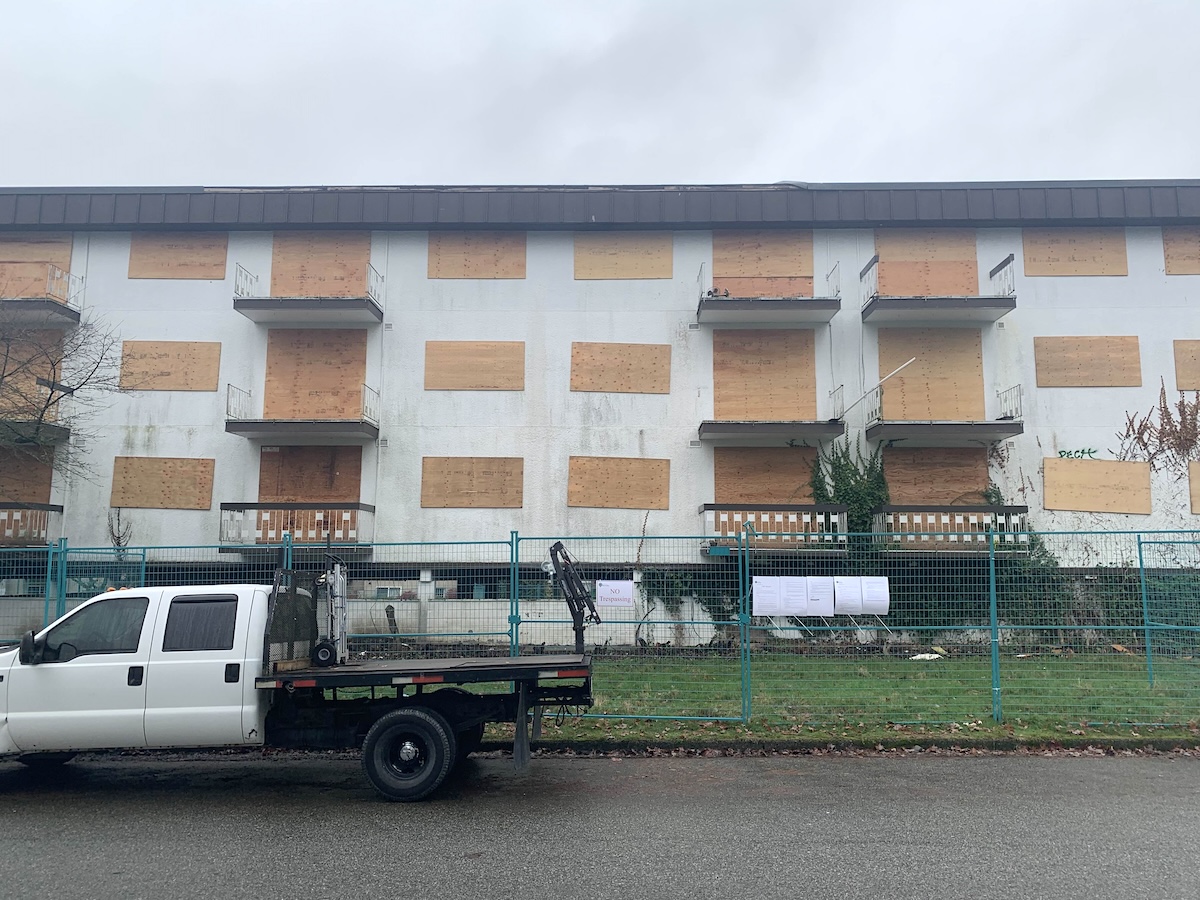
The protections that were enacted for the former Telford renters are shining examples of the Tenant Assistance Policy, or TAP, at work. But things were very different for the residents of Madeira Manor, an apartment building a block away at 6677 Silver Ave. (formerly 4330 Maywood St.).
Constructed in 1966, Madeira Manor is a 27-unit apartment building like many others in an area of Burnaby infamously known as “Demoviction Central.”
Burnaby-based Kirpal Properties bought the property in 2017 in a deal that closed in 2018 for $13.5 million, submitted a rezoning application, then issued four-month eviction notices to tenants in March 2022, according to tenants Lili Wong and Marcella Zimmer. They began living at Madeira Manor in May 2013 and September 2014, respectively, and were eligible for the TAP.
In a letter dated March 10, 2023, addressed to the approximately half-dozen tenants of Madeira Manor covered by the TAP and shared with The Tyee, the City of Burnaby Renters Office disclosed that Kirpal had informed the office it was “unable to pay rent top-ups” for April, which were due March 15.
To ensure developers meet their TAP obligations, Burnaby requires developers to provide a security bond.
The city said it would be cashing the bond and using it to pay the upcoming rent top-ups.
This was first reported by the Burnaby Now in May 2023, a few months after which real estate news site Storeys reported that 6677 Silver Ave., the site of Madeira Manor, had been listed for sale for $19.8 million, a decision that ultimately prolonged the saga and stress for Wong and Zimmer and exposed a flaw in Burnaby’s TAP.
Many municipalities are in the process of establishing tenant protections like Burnaby’s, but those policies have yet to be truly stress tested because the real estate market was strong.
We’re now in a different world, one where developer insolvencies are a regular occurrence. The story of Madeira Manor serves as an example of what can happen if tenant protection policies do not properly account for such scenarios, because not only did a developer default on its tenant obligations, but it happened twice at the same building.
‘I hope this brings some comfort to each of you’
In a letter dated June 11, 2024, the renters office informed tenants that Madeira Manor had been acquired by developer Thind Properties and that Thind was required to take over the TAP obligations, including replenishing the TAP bond.
In a June 12 email, Thind introduced its in-house tenant relocation co-ordinator and said rent top-ups would “continue seamlessly” and be issued on the 15th of each month.
“I hope this brings some comfort to each of you on the future of 6677 Silver Ave. and your soon-to-be future home,” the email concludes.
Thind also invited the tenants to a Zoom meeting on June 24. It outlined what had happened to date and its TAP obligations, according to presentation slides for the meeting.
Thind also provided a timeline, saying it planned to start excavation in the first three months of 2025 and have the new building ready for occupancy by the summer of 2027.
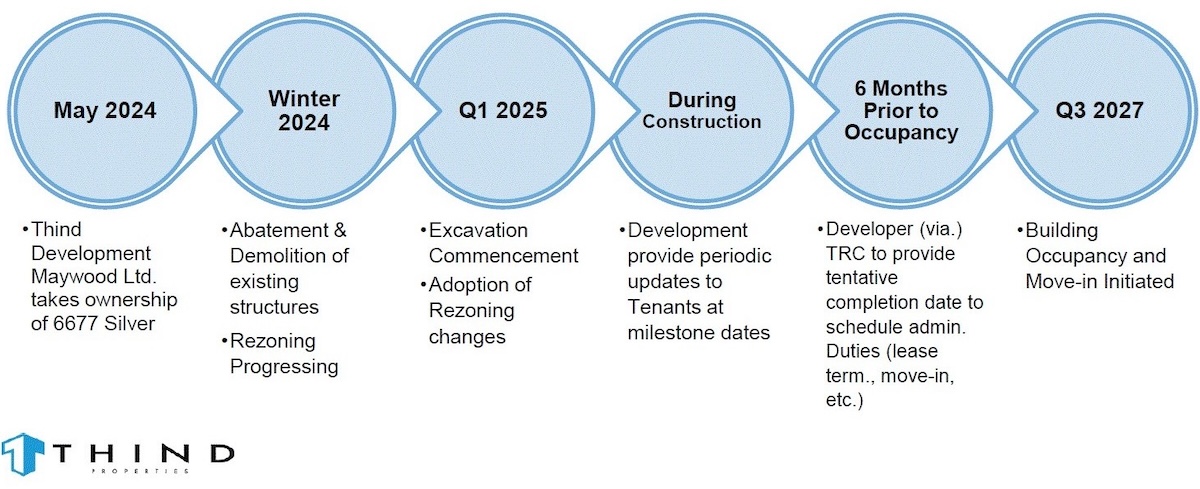
That “comfort” and timeline, however, were short-lived. Since April 2023, the city had been issuing the rent top-ups on time and on schedule using the bond money posted by Kirpal.
The first top-up Thind was responsible for was due on July 15, 2024, in time for tenants to pay rent on Aug. 1.
This first payment, however, was late. Tenants had to chase it down. “Hi the EFT is being processed right now you will receive it today,” said Thind’s tenant relocation co-ordinator in an email response to Wong that she shared with The Tyee. “Sorry it was missed by our controller.”
After payments were again late the following month, Wong followed up with the tenant relocation co-ordinator, who replied, “We don’t intend to send the payments out late and don’t want this to be continued as we know this can cause a significant impact to each individual.”
Thind goes under
In the months that followed, the renters experienced déjà vu. In an email dated Sept. 27, 2024, the renters office informed tenants that Thind had “notified the city that they are unable to pay rent top-ups for October” and the city would once again be using the TAP bond to make top-up payments.
The city also said it had issued Thind a default notice and placed its rezoning application “in abeyance,” which means it suspended it.
“I still think we will be stressed out each month,” Zimmer replied in an email, saying she feared the city would stop the payments and the new apartment might never be built. “I also believe that I will be frustrated every month wondering if my money will be there.”
Zimmer’s fears would prove to be prescient.
In November 2024, Storeys revealed that receivership applications had been filed against Thind’s District Northwest, Minoru Square and Highline Metrotown projects, with over $300 million owed to Toronto-based lender KingSett Capital.
Court documents from those proceedings revealed that Thind had defaulted on the mortgages in May and September.
KingSett would later place Thind’s Eclipse Brentwood project under creditor protection, while a different lender initiated foreclosure against Madeira Manor in December 2024.
The city steps in
After notifying tenants that Thind wouldn’t be able to pay rent top-ups, the renters office presented tenants with options in October 2024. The city told tenants that two housing projects developed by the non-profit Catalyst Community Developments Society on city-owned land were prioritizing TAP tenant applications as a condition of the land lease signed with the city.
Those two projects are located at 6889 Royal Oak Ave. and 7392 16th Ave., which are a short drive away from Madeira Manor but not in the Metrotown neighbourhood where Wong and Zimmer wanted to stay. Tenants were offered the opportunity to apply for the rental units before applications opened to the general public. The buildings were expected to open on Feb. 1 and March 1 this year, respectively, with rents expected to be $1,724 and $1,790 for one-bedroom units, according to letters the city provided Wong and Zimmer.
When they were evicted from Madeira Manor in 2022, Wong’s rent was $945 per month while Zimmer’s was $949 per month, both for one-bedroom units. They are now living elsewhere in Burnaby, where they are receiving rent top-ups of over $1,000 because their new monthly rents are more than double their previous rents.
The city also allowed the tenants to choose whether they wanted to continue receiving monthly top-ups or instead receive a one-time lump sum that in effect buys them out of the TAP. Although some did, Wong and Zimmer did not take the buyout and chose not to move for the second time in three years.
The city informed the tenants of the Madeira Manor foreclosure in January, then said in March that tenants would be responsible for paying their rent in full, without top-ups from the city, starting in February 2027 because the bond money is set to run out.
Recognizing that tenants might not be able to afford their rent without top-ups, the city hired Sommerville Community Relations in August to help tenants find affordable housing, giving them a deadline of Nov. 15 to opt in to the assistance.
A fatal flaw
Burnaby’s TAP was intended to counteract the costs that tenants incur when they are displaced from their homes as a result of real estate development — and it is indeed one of the strongest pieces of renter protection policy in B.C. But the policy was based on a flawed assumption.
When a developer provides a bond to secure its TAP obligations, the city calculates the bond amount using a formula that accounts for projected rent top-ups, but only for a period of 36 months. In a statement provided to The Tyee, the city said it uses 36 months because that is the “typical construction time frame.”
That premise, however, assumes a booming real estate market, which has been the norm in Metro Vancouver for a long time. The last few years have been the opposite. The condo market has dried up as costs have escalated, reducing the margin of error for developers to the point that one wrong move could be fatal to a project — as evident by the surge of insolvencies in recent years.
The worst part, however, is that there’s no end in sight, and Burnaby director of community planning Johannes Schumann and Coun. Alison Gu both said as much in emails to former Madeira Manor resident Zimmer this July.
Schumann said: “Planning Staff do not have confidence that the court ordered sale of the property will result in a rezoning application in the near term.” Gu said: “I recognize that this may be stressful to hear, but I do not believe that your site will be ready for redevelopment within the next three years, nor do I believe that the bond will be topped up in a timely manner.”
This means that it’s also uncertain whether the TAP’s promise that tenants will have the right to return to the new building will ever be fulfilled.
“Why wouldn’t they make the bond big enough?” asked Murray Martin, co-chair of the Burnaby chapter of ACORN, a national association focused on tenant rights. “To me, the answer to that is they were never thinking of this issue from the tenant point of view. They were always thinking about it from the corporate point of view. They were thinking, ‘How much could this corporation put into a bond? We don’t want to burden them.’ They weren’t thinking about ‘What if this corporation went bankrupt?’”
Martin served on the Mayor’s Task Force on Community Housing that helped create the TAP and recalls bringing up the possibility of developers becoming insolvent and being dismissed by others in the room.
He has also been following the Madeira Manor case and believes tenants like Wong and Zimmer are now “paying the price” for the city’s flawed design of the TAP.
What happens now?
In May 2023, Wong asked the Burnaby Now, “What happens if the city cashes in the bond, and they run out of money?”
She and Zimmer do not know what they’ll do next. They are frustrated with the options they’ve been given: apply for BC Housing and move again — losing access to rent top-ups, according to an FAQ the city provided to Zimmer — or stay put and pay double their rent starting in February 2027.
“This whole process should have been seamless,” said Wong. “We shouldn’t have the problems that we’ve had.... What they neglected to do is understand that not everyone qualifies to get into BC Housing. They assumed we’re seniors and we can get into BC Housing. I don’t qualify for BC Housing. And why would I move right now and pay the top-up myself when I can stay where I am and they pay the top-up?”
Zimmer added that Sommerville is only available to help them find and apply for long-term housing and that they still have to join lengthy wait-lists.
A survey published by the Union of BC Municipalities earlier this year found there were over 21,000 households on the wait-list for BC Housing.
Zimmer says she has since opted out of Sommerville’s services.
“My rent is around $2,200, but I only get my government pension, so I wouldn’t have the money for food or gas,” said Zimmer.
“If I move someplace else, they’re not gonna pay my top-ups. And where am I gonna find a place I can afford? It’s very stressful. I don’t know where I’m gonna go and what I’m gonna do. I haven’t put any art on the wall and I haven’t unpacked boxes because I don’t know what’s gonna happen.”
“Move to my own place and pay my own top-up or move into BC Housing — that’s not what I signed up for,” said Wong, who has asked for more time to consider her options. “The city probably didn’t foresee all these problems. They should have. You plan for a good economy as well as a bad economy and I don’t think they did that. I think when other municipalities bring in a TAP package similar to Burnaby’s, they have to take a lot more into consideration. It’s a good idea, it’s really a good policy, but I just think more thought needs to be put into it.”
The city, for its part, is committed to improving the TAP.
“Burnaby’s TAP is one of the strongest tenant protection programs in Canada, and we’re committed to continuing to improve this program,” a City of Burnaby representative told The Tyee in an email.
“Staff are currently working on transitioning the TAP from a policy to a Tenant Protection Bylaw,” the statement said. “While the core components of the program will remain in place, we’ll be able to adjust how the program is implemented to better serve our residents.” ![[Tyee]](/design-article.thetyee.ca/ui/img/yellowblob.png)
Read more: Housing, Municipal Politics, Urban Planning












Notice about commenting changes
The Tyee’s commenting system will be moving to a new platform on Nov. 12. If you’re already a Tyee commenter you must register with the new system on or after Nov. 12 with your preferred username.More information can be found here.