


 SHARE:
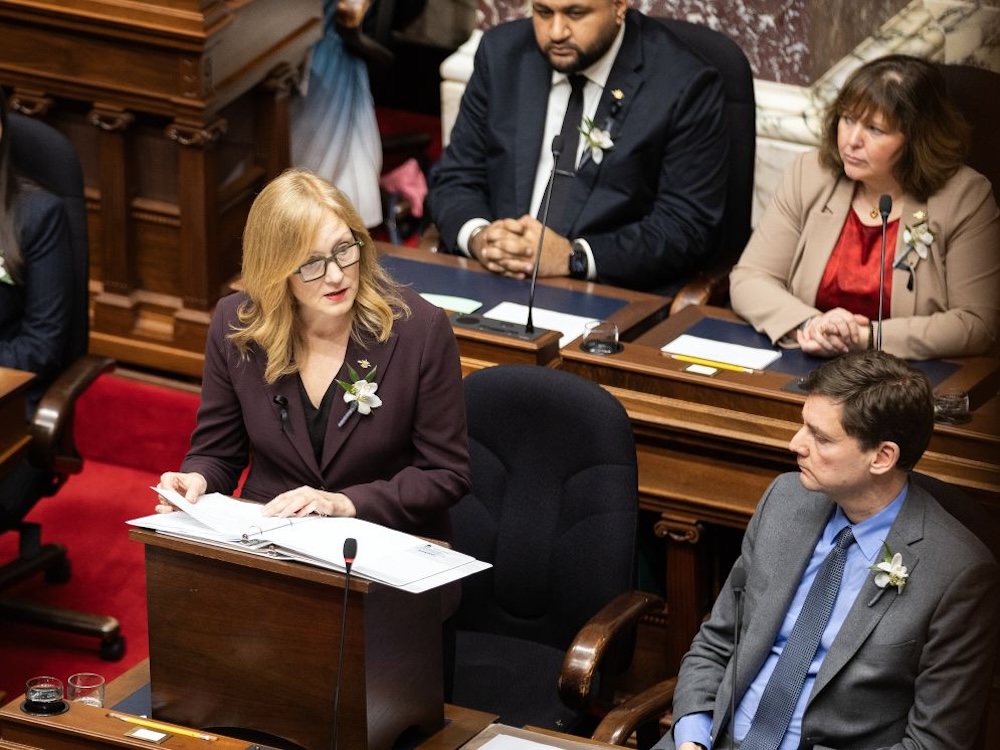
B.C. Finance Minister Brenda Bailey presented a budget today that continues to grow government spending while forecasting three more years of big deficits.
The budget makes a few significant changes, including raising income taxes for most earners, revising the terms for property tax deferrals for seniors and shrinking the size of the public service.
Bailey began her remarks to reporters saying it felt “out of sync” to talk about or work on anything else following the Tumbler Ridge tragedy. “We will continue our work, but we will do so with the people of Tumbler Ridge in our hearts,” she said.
The budget predicts a record deficit of $13.3 billion in the 2026-27 fiscal year. It includes revenue growth of $500 million, or less than one per cent, that’s outstripped by a $4-billion increase in spending, or 4.4 per cent.
It projects further deficits of $12.2 billion and $11.4 billion in the following two years.
Contrary to media reports in recent weeks, Bailey said, “I want to be clear, this is not an austerity budget.”
Some of the revenue increase comes from a 0.54 per cent hike to the lowest income tax bracket, which will be offset with increased tax credits for the lowest income earners.
Bailey said the average taxpayer will pay an extra $76 a year as a result of the change. The people most affected, those with taxable income over $140,000, will pay an extra $209 a year. The measure will raise $476 million a year, about a third of which will be returned to taxpayers through credits.
The province is also pausing the indexing of tax brackets to 2030, meaning they won’t go up with inflation and individuals will pay more tax as their salaries rise.
There is a significant change to property tax deferrals, a long-standing program that allowed homeowners over 55 to delay paying property taxes thanks to loans on favourable terms from the province.
People borrowing under the program in the future will pay an interest rate of prime plus two per cent and the amount they owe will include interest debt. Previously the loans were given at prime minus two per cent and homeowners paid a lower amount of interest and only on the initial amounts they borrowed and not on the interest.
They still won’t have to pay back what they owe until their property sells and they have the option of paying back the debt any time.
Bailey said the new rules bring the program closer to the terms that would be available from commercial lenders and discourage homeowners from borrowing on favourable terms to fund investments.
Homeowners in northern and rural communities will see a reduced homeowner grant. The grants were increased in the past to offset the carbon tax, Bailey said. The government eliminated the carbon tax last year.
More for health and schooling
The budget increases spending on health, education and child care.
Three-quarters of the $408 million added this year for health, mental health and addictions is to address caseload growth and increase access to primary care.
There’s $475 million over three years for children and youth with support needs, $90 million for child care, $84 million a year to respond to increased demand for Community Living BC programs and $55 million a year for a “new manufacturing and processing investment tax credit.”
The budget includes no increase to income and disability assistance rates, which have been frozen since a pandemic increase.
Thousands of public sector jobs targeted for cuts
The budget predicts a reduction of 15,000 full-time equivalent employees across the public sector by 2029, 2,500 of them from the core government.
The broader public sector employs 598,000 people, about 456,000 of whom are unionized. Core government includes 37,500 full-time equivalent employees. Reductions will come through “hiring restrictions, attrition, and where appropriate, reviewing the possibility of offering early retirement incentives,” the budget document said.
“This budget takes an approach that protects public services and driving down the deficit over time,” Bailey told reporters.
She said it responds to the uncertainty created by U.S. President Donald Trump, tariff threats and the new world order. In the current year, exports to the United States have dropped 2.7 per cent while exports to other countries have increased three per cent.
The budget does not include a forecast allowance as it has in past years, but it does have $5 billion a year for contingencies.
Douglas Scott, finance deputy minister and secretary to the Treasury Board, said in his notes included with the budget that the contingency fund “reflects funding set aside for uncertain or unforeseen matters, future initiatives, caseload pressures, and collective bargaining mandate costs.”
Including capital spending, the total provincial debt will rise to $183 billion this year and is projected to grow by another $50 billion over the next two years.
The increase will bring B.C.’s debt-to-GDP ratio to 30.6 per cent, which is about double what it was a few years ago, but which Bailey said was still lower than most other provinces.
The cost to service the province’s debt will rise to $3.8 billion in 2026-27, up almost 25 per cent from the current year.
‘They have a spending problem’: BC Conservative critic
Peter Milobar, the finance critic for the Conservative Party of BC, said the budget is disappointing. “It’s very clear who’s going to be impacted the most by this and it’s seniors and hard-working families,” he said.
The deficit is mostly driven by the government’s failure to control what it spends, Milobar added. “They very clearly have a spending problem and don’t know how to get themselves out of it.”
Changes to property tax deferrals will have a large impact on many seniors who are trying to stay in their homes, he said, including many in Premier David Eby’s Vancouver-Point Grey constituency. The new policy will pull $35 million more out of the pockets of senior citizens “at a time when we actually need seniors to stay in their own homes,” he said.
BC Green MLA Rob Botterell, who represents Saanich North and the Islands, said maintaining spending isn’t enough. “This is a status quo budget that’s not making the changes that are needed so everyone in British Columbia can have the lifestyle they deserve.”
It makes no sense to cut the Ministry of Indigenous Relations and Reconciliation at a time when the province is facing key questions about its relationship with First Nations, he said.
Nor did the budget include anything to advance the government’s conservation and climate goals, protect old growth or redesign the forestry industry. “This is a government that’s out of ideas. It’s out of ambition.”
Independent MLA Elenore Sturko from Surrey-Cloverdale said it was “depressing” that despite the Tumbler Ridge and Lapu-Lapu Day tragedies, the budget included no new resources to address mental health and addictions other than 100 previously announced beds.
Tax the wealthy: BC Fed president
BC Federation of Labour president Sussanne Skidmore said she was pleased the government followed through on increasing the funding for skilled trades training but added that more support for post-secondary education is needed.
The budget also could have included more measures to tax the wealthiest people in the province who can and should pay more, said Skidmore. “I think more intentional focus could have been on the wealthiest British Columbians because we know the working-class families are the ones dealing with the brunt of the affordability crisis.”
“Obviously we’re concerned by any cuts to the civil service,” BC General Employees’ Union president Paul Finch said, adding the province already has a very lean government and that any cuts to it will hurt the economy.
“I am happy to see we didn’t have any major cuts,” said Iglika Ivanova, senior economist with BC Policy Solutions. At the same time it failed to offer anything for the many people who are struggling with homelessness or having enough to eat without relying on a food bank, she said.
“I’m disappointed they didn’t raise income and disability payments,” she said. “I’m not surprised.”
It’s encouraging that the government is taking steps to raise revenue, said Ivanova, but it could have extended the increases across all of the tax brackets. “We are leaving money on the table.”
‘An entrepreneurial drought’: independent business spokesperson
“B.C. is in an entrepreneurial drought right now,” said Ryan Mitton, the director of legislative affairs for the Canadian Federation of Independent Business. “We’ve seen five consecutive quarters of negative business growth, so more businesses are leaving business than are entering in our province.”
The budget has nothing to address that trend, Mitton said, adding that adding the PST to various services will increase costs for small businesses. “A massive deficit, tax increases that will affect businesses, that will affect middle-class families that are running restaurants or owning shops.”
Seniors Advocate Dan Levitt said he was disappointed in the lack of spending on increasing seniors’ needs.
Aside from failures to better fund health care and grants for seniors who are renters, he said, the budget allows for 600 new long-term care beds a year at a time when the province needs to add more like 1,600 a year.
Leslie Gaudette, the president of the Council of Senior Citizens Organizations of BC, or COSCO, said advocates are supposed to be happy there weren’t big cuts, but with a growing and aging population the demand for services is increasing. “There’s no seniors strategy in place to say how they’re going to make it all work more effectively.”
Gaudette said it will be interesting to see how COSCO’s members react to the change in property tax deferrals. “A lot of people do take advantage of it.... I imagine that most people have been using it appropriately and it’s going to be hard if people that should be using it stop using it because of the change.”
Poor hardest hit: progressive economist
Marc Lee, a senior economist with the Canadian Centre for Policy Alternatives, said the budget will have “a negative impact on low-income households, folks who really aren’t able to shoulder that burden right now.”
The budget included nominal spending increases, he said, but they are short of what’s needed to maintain services at current levels. That will have a bigger impact on people with lower incomes as well and the wealthiest could have been asked to contribute more, he added. “We’re not all in the same boat. Some are in first class and some are below decks.”
David Williams from the Business Council of British Columbia said that in total the budget includes $4 billion in tax increases on households and businesses. “That’s a very negative signal to send people about whether to base and build their operations in the province or for young people whether they’re going to base their lives in B.C.”
The debt is outpacing the growth in the economy, and the budget had little to spur economic growth, said Jen Riley, president of the BC Chamber of Commerce. “If the economy stays the way it is today, we’re going to lack investment,” she said. “I don’t see our current businesses maintaining profitability, maintaining revenues and the standard of life they would like in their communities.”
A healthy economy makes for healthy communities, she said, adding that extending the PST to services businesses use will add costs for them and have a big impact.
“Every year is an austerity budget when you’re in the business of protecting the environment,” said Torrance Coste from the Wilderness Committee. ![[Tyee]](/design-article.thetyee.ca/ui/img/yellowblob.png)
Read more: BC Politics




Tyee Commenting Guidelines
Please note that email notifications for replies are not currently working due to a software issue which may be resolved in a future update.
Comments that violate guidelines risk being deleted, and violations may result in a temporary or permanent user ban. Maintain the spirit of good conversation to stay in the discussion and be patient with moderators. Comments are reviewed regularly but not in real time.
Do:
Do not: