


 SHARE:
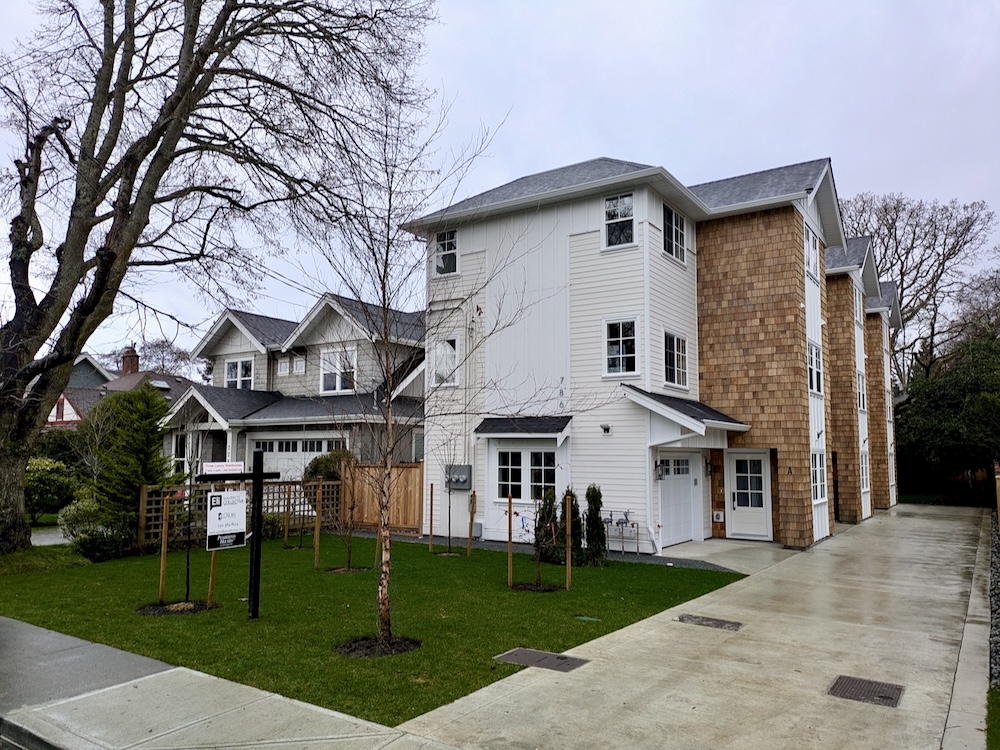
Whether or not neighbours and planners like the results, changes the British Columbia government made in 2023 are succeeding in getting more small-scale multi-unit housing built in neighbourhoods.
“This is the first program in a long time that really picked up immediately,” said Xeniya Vins, an architect who along with her civil engineer husband Janos Farkas runs Xquimalt Developments. “They passed it, and it’s definitely working. These are popping up.”
Bill 44, the Housing Statutes (Residential Development) Amendment Act, 2023, gave municipalities with populations over 5,000 until June 30, 2024, with some exemptions, to update their bylaws to allow three or four units of housing on residential lots previously zoned for single-family or duplex homes. It also allowed for up to six units on properties close to frequent bus service.
The provincial government passed it along with other bills that critics say undermine local authority and take away the ability to plan communities carefully.
The legislature is also considering a private member’s bill that would force local governments to accept reports from professionals like architects and engineers without conducting their own technical reviews.
The changes are appreciated by builders who find projects they couldn’t have built previously have become viable and by the people who are buying the units, said Vins. Her company has two such projects under construction and a third on the way. Through her design practice she’s involved in a dozen more owned by others.
“If you ask the neighbours, did it work out for them, they’ll probably say no just because they don’t like the change in communities,” she acknowledged. “I’m not expecting it to be universally loved, but I think there’s some necessary big positives that are coming out of it.”
Previously a similar development would require investing in the property and spending money to make a plan, then going to council to ask permission while facing opposition from neighbours, she said. The risk that projects would get blocked was too much for most potential developers.
“Now they just apply and they get the permit approved. That’s a big change,” Vins said. “If you’re applying for a project without variances, you have a high degree of certainty that this project is going to be approved and literally no one can stop you, and that is launching a lot of these projects.”
The result is more choice for potential buyers, she said, adding there are people looking for newer homes who may not care whether their property includes a yard.
Critics who say the policy won’t deliver cheaper homes are likely correct, Vins said. In many cases the three or four new units will each sell for about what a single-family home on the property would have cost.
For example, the four-bedroom, four-bathroom units in a triplex recently listed in Oak Bay are each offered at $1,549,000. The building is shown in the photo at the top of this article.
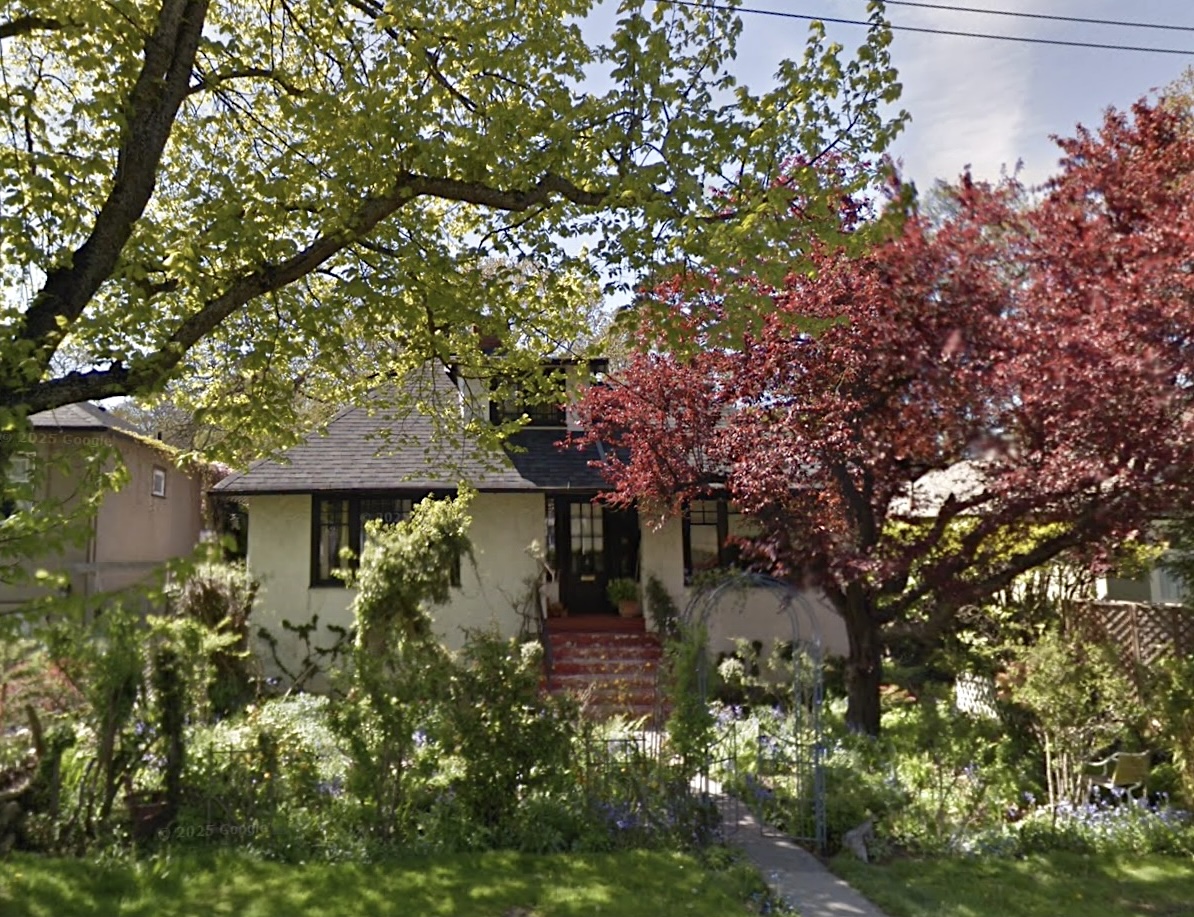
“These homes are not necessarily a lot more affordable because honestly they can’t be,” Vins said, adding that land prices, construction costs, financing and fees all push up asking prices.
‘A very big divide by age and class’
From Vins’ point of view, resistance to the projects reflects a generational shift in expectations.
“There’s a very big divide by age and class and it appears to be, at its core, kind of a class issue where older generations, simply put, want things left the way they know it, whereas younger generations don’t want to live in an 80-year-old house and/or can’t afford to and/or they want to live closer to urban centres.”
The people who are opposed tend to have the free time to go to council meetings, express their views on social media or otherwise share their opinions.
“It can appear that there is a lot of negative feelings, and there are some, but it’s definitely not everyone,” she said.
In January, a letter writer to the Goldstream News Gazette, Terry Cain, took issue with an Xquimalt fourplex next door to their home in the Saxe Point area of Esquimalt.
The development would add two 5,000-square-foot buildings in an area where most homes are smaller, they said. “They overwhelm the homes nearby and dominate the block,” they wrote. “The neighbourhood was never consulted about the enormity of the buildings coming to the area. The neighbours are not against building homes of this type, just the size of them.”
The letter echoes concerns raised since the province passed the bill.
‘A whole raft of issues from neighbourhoods to parking to infrastructure’
“I think we’re all agreed... that we need to provide more housing,” Richmond Mayor Malcolm Brodie said on a panel at the Union of BC Municipalities convention in 2024. “But as far as I’m concerned, the answer is not to throw it open and have four- and six-plexes everywhere when there’s a whole raft of issues from neighbourhoods to parking to infrastructure.”
Like other municipalities, Richmond had been carefully and strategically focusing density on major arterial streets and near transit hubs, he said.
“As far as I’m concerned, we want to stay the course.... The area of Steveston has nothing but small lots. If you put four, six units on all of those small lots, you’re going to absolutely destroy really a fine neighbourhood in our city.”
The province’s mandate would result in decentralized densification throughout the city, he predicted. “The effort to control the situation and to provide the services that we need is really limited.”
In an interview Brodie said his objections have not changed. “I said at the time that one size throughout the province does not fit all circumstances in residential areas, and I have seen nothing that changes my mind,” he said.
“I believe that this heralds the death of the single-family neighbourhood. It assumes that density can go anywhere and everywhere in residential zones.”
Concerns remain about the ability of the existing infrastructure to handle the added density, the impact of parking on surrounding streets and how larger buildings change the character of neighbourhoods, said Brodie.
A few Bill 44 projects have been built in Richmond so far with little public reaction, he said, but eventually people will notice how their neighbourhoods have changed for the worse.
“We will make sure they know who exactly to blame, because it certainly is done over our objections in the City of Richmond.”
Brodie stressed that the city has long supported adding density but was able to channel it into the city centre and along arterial roads. The province’s changes take away that discretion, he said. “Of all the planning restrictions that the province has imposed, I believe this is the biggest intrusion into local planning that has ever taken place. It’s not positive for the cities.”
View Royal Mayor Sid Tobias is seeking support from other local governments for a judicial review of the province’s housing bills.
The fundamental question, he said, is whether municipal governments are able to fulfil their role of planning communities and managing infrastructure, “or are we just a wing of the province, unable to negotiate amenities for large developments?”
There used to be negotiations over proposed developments with some give and take between developers and municipalities, Tobias said. Now local governments have little say on what gets built where.
“The real problem is you don’t know where they’re going to pop up in your neighbourhood.”
He hopes a court will order more engagement on the province’s changes and rule on whether they are consistent with the role municipalities have been given. Councils need to get back to building better communities instead of just more housing, he added.
Other critics have called the housing changes “jurisdictional overreach into municipal authority” and painted it as the muzzling of citizens to the benefit of housing industry lobbyists.
‘Huge impacts without proper democratic process’
Elizabeth Murphy is a project manager who previously worked with the City of Vancouver, BC Housing and BC Buildings Corp.
She’s also part of the Housing Reset group that includes former planners and other experts critical of the new laws and calling for a broader approach to housing affordability in Vancouver. “We’re just very concerned the city has moved away from doing proper community planning,” she said.
“It’s taken a few years for this to come to a head,” Murphy said, adding that the scale of the changes was at first overwhelming for many municipalities.
The province made those changes in response to industry lobbying and with minimal input from municipalities, the public or experts, so there was little awareness of what was happening, she said. “I think it is starting to show and there is getting to be some backlash on it.”
The new rules for multiplexes are just one of a series of changes that are remaking communities, she said. The bigger issue is how it changes official community plans, or in Vancouver’s case the Official Development Plan, which is up for approval on March 10, so that anything consistent with the plan will no longer require a public hearing.
“There are a lot of people who are very upset with this plan,” said Murphy. “That is going to have huge impacts without proper democratic process and again without proper planning.”
The prioritizing of new development comes at the expense of older buildings that are generally more affordable and that need to be protected, she added. “They’re going to lose much more affordable housing than they’re going to be building.”
Xquimalt Developments’ Vins acknowledged that many municipalities are unhappy to have the province force changes on them, but they had ample opportunity over many years to allow such developments on their own terms and failed to act.
The provincial government’s push was a long time coming, she said.
“It didn’t happen in a vacuum. It was systematically blocked and delayed for decades.”
The Ministry of Housing and Municipal Affairs didn’t have a figure for how many units have been added thanks to the Bill 44 changes but says 183 out of 188 local governments have confirmed they’ve adopted the small-scale multi-unit housing requirements. The other five have had extensions approved.
“We’re starting to see more housing options — like carriage homes, duplexes, triplexes and townhomes — planned, permitted and built in communities across the province,” Housing Minister Christine Boyle said in a statement.
“The intent of small-scale multi-unit housing is to open the door to more types of homes being built across B.C. faster, providing more choices for families, workers and people of all ages to find homes that meet their needs,” she said.
“I’m pleased to see the actions taken by local governments to support the delivery of these homes, and the interest shown by builders. We will continue to work with everyone who wants to make housing more available so families can afford to live in the communities they grew up in.”
Some, but not all, municipalities are starting to say publicly how many permits they’ve issued, a ministry spokesperson said. Kelowna has had 65 development applications for infill housing as of last September. By August Vancouver had 429 applications for multiplexes and had issued permits for 143 of them.
Surrey had issued 836 permits by January 2025 and reported a 59 per cent increase in applications after the legislation was introduced. Burnaby saw a doubling in the number of infill homes delivered to 1,325.
With the first buildings coming out of Bill 44 getting finished now, it’s almost too early to say whether they are a success, Vins said.
“For developers right now it’s working out. We’re building with more certainty than in the past. Smaller developers are definitely liking it.”
It will probably take more being built before communities have a feel for how they can work, she said.
“A few of these will get built and hopefully people will see it’s not as bad and [they’ll] get some more neighbours,” she said. “A lot of these are now in the ugliest stages of construction. Wet, plywood, it’s been gloomy skies. It’s hard to see the beauty in these and understand it.”
Overall, she said, she believes it will be positive, adding that people living in cities do need to be open to some level of change. “You might not love it, but you’ve got to make some room for these new families.” ![[Tyee]](/design-article.thetyee.ca/ui/img/yellowblob.png)
Read more: BC Politics, Housing, Urban Planning










Tyee Commenting Guidelines
Please note that email notifications for replies are not currently working due to a software issue which may be resolved in a future update.
Comments that violate guidelines risk being deleted, and violations may result in a temporary or permanent user ban. Maintain the spirit of good conversation to stay in the discussion and be patient with moderators. Comments are reviewed regularly but not in real time.
Do:
Do not: