

 SHARE:
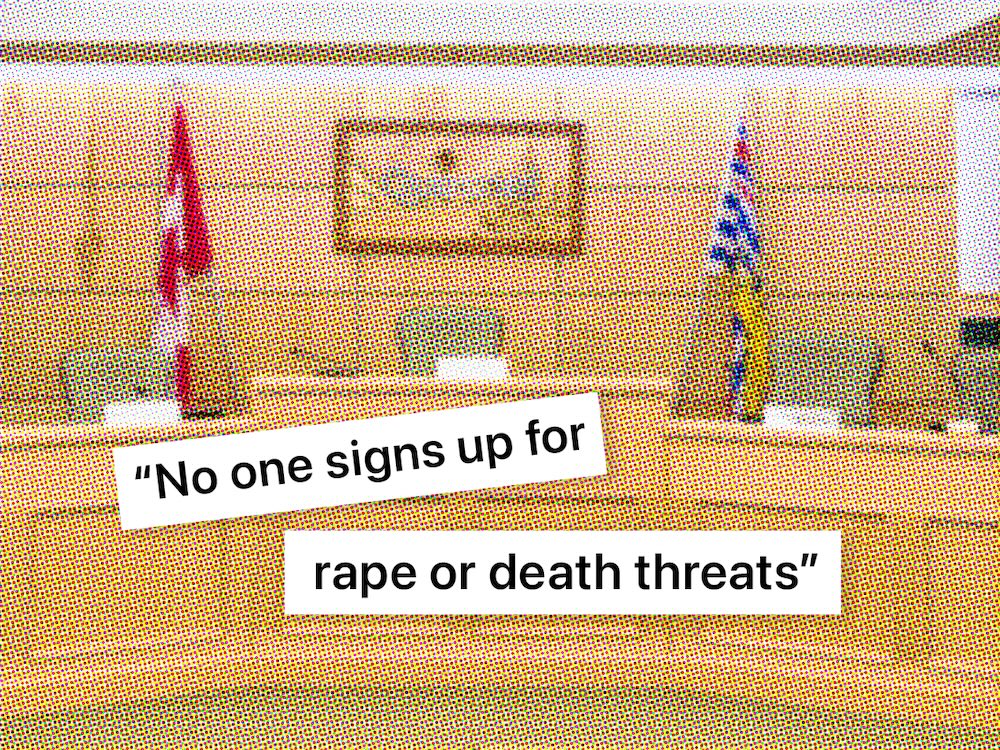
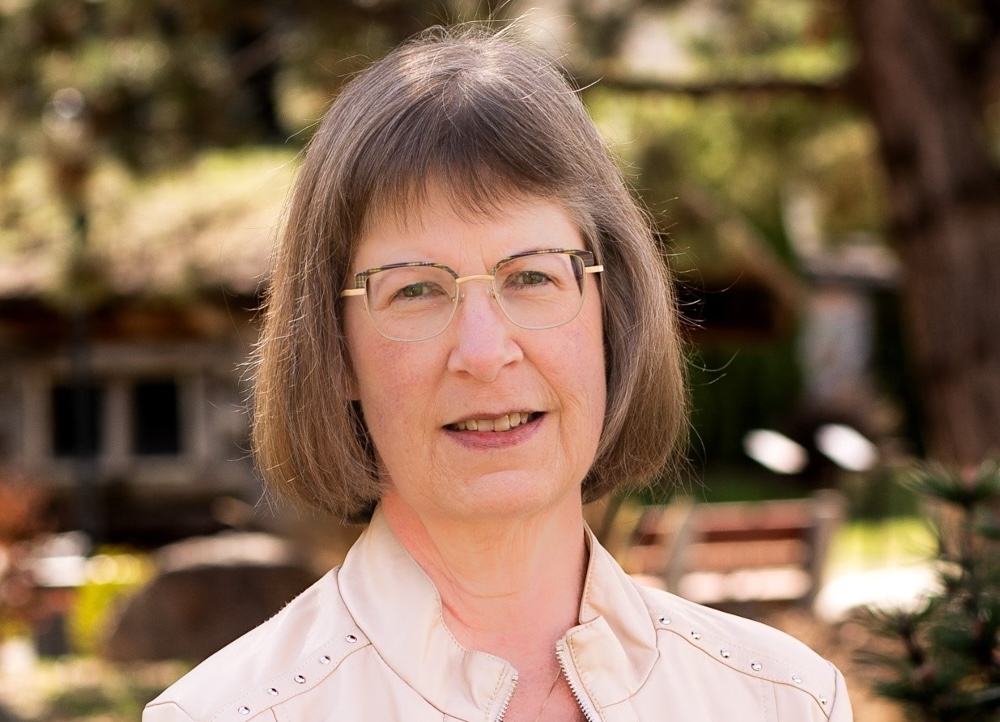
Barbara Roden loves being the mayor of Ashcroft. She loves meeting fascinating, brilliant, passionate people. And she loves helping her community.
“In some ways it’s the best job you can ever have,” said Roden.
But the role comes with a dark side, one that hasn’t always been there.
As communities across B.C. prepare for this fall’s municipal elections, potential candidates face a very different political climate than many of their predecessors. Increasingly polarized public debate, online abuse and growing hostility towards elected officials have raised new questions for those considering a future in local government.
Things started to change across B.C. in local politics during the COVID-19 pandemic, Clearwater Mayor Merlin Blackwell told The Tyee.
Blackwell said he saw potential to help move things forward in the small town, which is about 120 kilometres north of Kamloops. Blackwell became Clearwater’s mayor in 2018, was re-elected in 2022 and is hoping to serve another term. He was first elected as a councillor in 2011.
“It was a very simple time back then,” he said. “People just treated you nicely.”
The tone was coarsening in some communities — in 2017, Maple Ridge’s mayor was subjected to a series of online remarks such as “Slap dat ho.”
But Blackwell found that, for the most part, people respected one another.
Then the pandemic arrived, and local leaders were asked to help share information to update people on dynamic situations. At the same time, people from different sectors who were worried about government overreach began to band together. Local leaders became targets for some of these collective frustrations. While provincial and federal politicians might have been the ones making those decisions, they were harder to reach.
With social media allowing people to comment on decisions and community issues in real time, criticism was instant. It took longer for governments and local officials to respond, Blackwell said. Elected officials had to verify facts and formulate clear, accurate responses to often complex topics, while in the space of those few hours, arguments could spiral out of control online.
“It really started to change the tone in local politics all across B.C.,” he said, calling the time during the pandemic “a mess.”
Blackwell said he noticed the dynamic persisted into the 2022 election.
In small towns, local politicians cannot disappear after a council meeting. Citizens can find them at Tim Hortons, in the grocery store, at city hall or, often, at their main jobs. While accessibility is one of local government’s greatest strengths, it can also increasingly be one of its vulnerabilities.
The current political climate can make life pretty rough when tensions rise.
Ashcroft, BC
In Ashcroft, the small desert town 90 kilometres west of Kamloops where Roden is mayor, she has felt the anger of residents first-hand.
Since 2014, Ashcroft council has been considering installing water meters to address water conservation efforts. After the municipality was successful in attaining a grant to cover the cost of installing meters, Roden bore the brunt of some residents’ frustration.
At a community meeting in June 2025, Roden learned a resident had spray-painted “Fuck you Roden” in large black letters across the resident’s own walkway, next to her water shut-off. The woman then posted a photo of her graffiti online with a comment saying she hoped Roden died before her so she could defecate on her grave.
The same day, another resident yelled at Roden as she was heading into the community meeting. She said she invited the person in to speak to staff and get answers to his concerns, but the man swore at her and left instead.
Roden said the incidents aren’t common and that being mayor has mostly been a positive experience. But the tough moments leave a mark. She said some of her colleagues experience far worse.
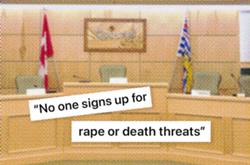
“No one signs up for rape or death threats,” she said.
Roden said she has come to realize there are some people who won’t ever be happy and want to have somewhere to direct their anger or frustration. She just wishes it didn’t result in personal attacks.
“It’s hard, it’s really hard, because if you love the job, your instinct is to make it right [and] you want to fix this,” she said. “We are human beings doing the best we can for the communities we love.”
Academics on abuse
Roden’s experience is increasingly common, according to research.
Studies suggest that the decline of basic courtesy in politics began before the COVID pandemic but has accelerated since.
A 2020 University of British Columbia report found that about 40 per cent of tweets directed at federal candidates in the 2019 election were uncivil. The report deemed 16 per cent abusive. Only seven per cent were positive. The incivility ranged from dismissive insults to racial slurs and threats.
UBC public policy professor Heidi Tworek, who was a co-author of the report, said incivility accelerated during the COVID-19 pandemic and has continued, and also affects municipal politicians.
“We do know... that it's affecting a significant portion of people,” Tworek said.
But while there may be more hostility, Tworek said volume is not the most important factor when considering the impacts. The intensity of abuse can mean single instances have larger and more lasting impacts on politicians and their staff than a large volume of negative messages.
“Let’s say you’ve got a couple of threatening messages, but they reflect things you’ve experienced in your real life, or they make you fear for the safety of your family. There doesn’t have to be 10,000 of them for it to still have an effect on you.”
Tworek and her co-author, Chris Tenove, recommended candidates create proactive plans to manage abuse and incivility and clearly communicate expectations for people hoping to engage with them online. They also called on social media platforms to improve transparency and reduce deception through fake accounts, bots and manipulated media and to design their platforms to incentivize productive discussions. Finally, they asked policymakers to improve laws and procedures aimed at addressing online threats or hate speech.
While there are no quick fixes, Tworek said the public needs to think about how they act online and how they seek information. The report suggests a lack of civility online towards politicians can spill over to create polarization between regular citizens, or lead to people becoming disengaged.
Insufficient mental health supports
While researchers are documenting online abuse and its effects, some local politicians have begun building their own support networks.
Brian Frenkel, a longtime Vanderhoof councillor who served as president of the Union of BC Municipalities during the COVID pandemic, described the time as “quite brutal” for many B.C. municipal leaders.
Frenkel said he received calls from elected officials so upset they spoke of ending their lives.
The experiences drove him and Coquitlam Mayor Richard Stewart to establish a peer network to provide mental health support to fellow leaders.
“Sadly, it’s needed,” he said.
Despite the frequency of online and in-person abuse or harassment, locally elected officials in smaller communities often receive little or even no financial coverage for mental health support.
The impacts of negative remarks and attacks on political figures are also not isolated to individual leaders. Staff can also bear the brunt of some of the attacks, as they may deal with the day-to-day communications or social media for a political figure, the UBC report found.
“I feel like I’ve been hardened into this cynical old lady inside... from the optimistic person who thought she could change the world,” one staff member told the UBC researchers.
Who runs next
Many leaders and academics worry that the increasing incivility will result in worse candidates, and poorly run governments.
“I really worry that highly qualified, high-functioning people are not attracted to public service,” said Wes Regan, a researcher in UBC’s school of community and regional planning.
Roden is concerned the abuse might mean that the people who run for office will be those who think aggressive online attacks are acceptable behaviour.
“If good incumbents aren't running again, and good newcomers are... scared off, who does that leave running?” asked Roden. “Those might not be the kind of people that you want running your community.”
So far, the discourse does not yet appear to be reducing the number of candidates, though it may be affecting who decides to run.
CivicInfo BC reports the number of candidates running in municipal elections across B.C. has remained steady since 2014 and outstrips the number of people choosing to run for federal seats from coast to coast to coast.
Loud critics are not representative
Blackwell, who has had vocal critics in his community, is careful not to overstate the problem.
While a small percentage of commenters can cause disruption, that doesn’t always translate to political change or impact.
“The amount of noise doesn’t generally equate the amount of votes at the polls,” he said.
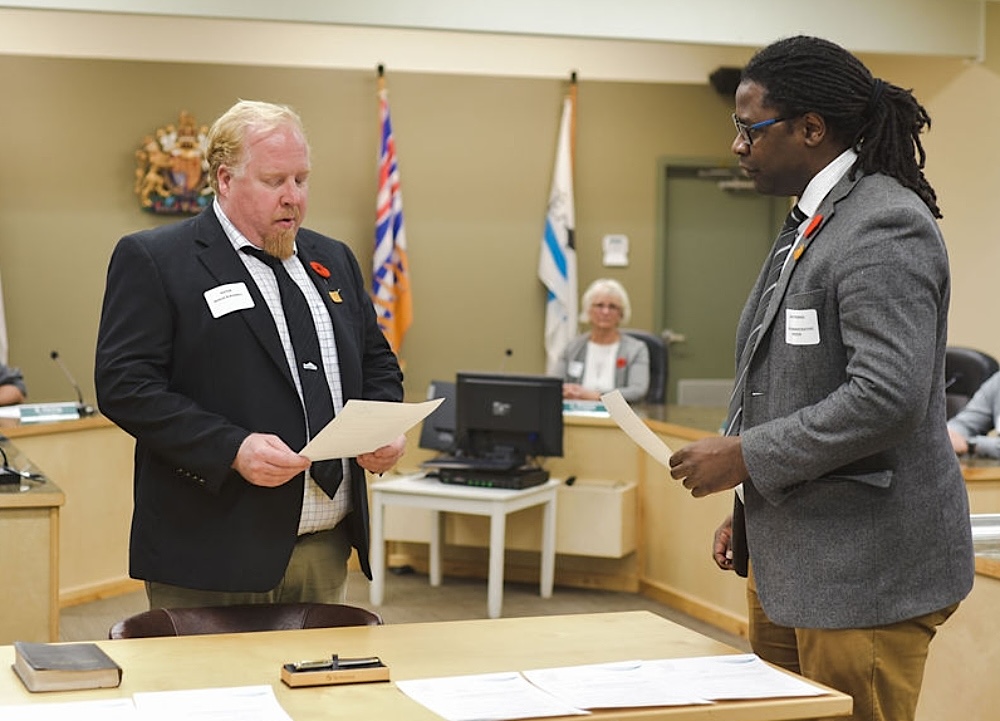
Some organizations and governments are taking steps to try to address the issues. The provincial government has proposed a more rigorous code of conduct for B.C. municipalities that might allow councils to rein in civic leaders who share misleading or incorrect information. The new legislation would mandate a standard code of conduct across provincial municipalities, establish a more standardized complaint process aimed at more transparency and provide more options for sanctions, including suspensions without pay.
In June 2025, Williams Lake Mayor Surinderpal Rathor made a public appeal at a city council meeting for people to tone down their online behaviour after comments beneath one council member’s social media post included a reference to a firing squad.
The Centre for Civic Governance has launched a new program to address what it calls an “escalating crisis of racism and online harassment targeting elected officials.”
An initial pilot program report that specifically looks at the experiences of racialized individuals in rural communities in B.C. found more than three-quarters of elected officials interviewed had experienced online harassment during their tenure. The program also created a tool kit as well as a mental health and legal resources document for elected leaders facing harassment or abuse.
Grassroots efforts are also taking place.
Frenkel has teamed up with a former Kamloops councillor and launched a podcast that seeks to provide information on how local government in B.C. works. Frenkel is not going to run for Vanderhoof council this fall but hopes to encourage younger voices to step up to fill seats in local councils.
Frenkel first entered politics because he saw it as a natural progression from the volunteer work he had been doing. He still believes that. A local political role, he told The Tyee, can be “the most rewarding thing you’ve ever done for your community.”
Roden agrees, despite the challenges she has faced.
She credited the support of her son and husband in helping her handle the stress involved in her role.
Roden, who edits the local paper and covered council meetings as a reporter before she ran for office, already had substantial knowledge about how local government works, but said she still faced a steep learning curve.
“You get into it and you run smack up against the fact that things do move a lot more slowly than you would probably like them to,” she said.
She said reasonable citizens can also make a difference in shaping the tone of community discussions.
“If you see people on social media making these comments, and you think they're unfair, abusive, derogatory, harassing, bullying, say something,” Roden said. “Otherwise, the people making those comments at the first place, they go, ‘Oh, OK, everyone's good with it.’”
Back in Clearwater, Blackwell plans to run for another term as mayor, despite the toll the role can take and the need for more supports.
“I think the only way to turn the tide on this is for good people with good intentions to run for office,” he said.
He said leaders with personal agendas and “not the best intentions” can hurt a community, especially if it results in council dysfunction, legal costs, staff turnover or bylaws not moving forward.
“It can set your town back years and years and cost your town tens and hundreds of thousands of dollars.”
But if people are not up for running for office themselves, he said, the next best thing is to vote.
“Apathy is no longer an option,” Blackwell said. “And if you’re brave enough, run.” ![[Tyee]](/design-article.thetyee.ca/ui/img/yellowblob.png)
Read more: Municipal Politics







Tyee Commenting Guidelines
Please note that email notifications for replies are not currently working due to a software issue which may be resolved in a future update.
Comments that violate guidelines risk being deleted, and violations may result in a temporary or permanent user ban. Maintain the spirit of good conversation to stay in the discussion and be patient with moderators. Comments are reviewed regularly but not in real time.
Do:
Do not: