

 SHARE:
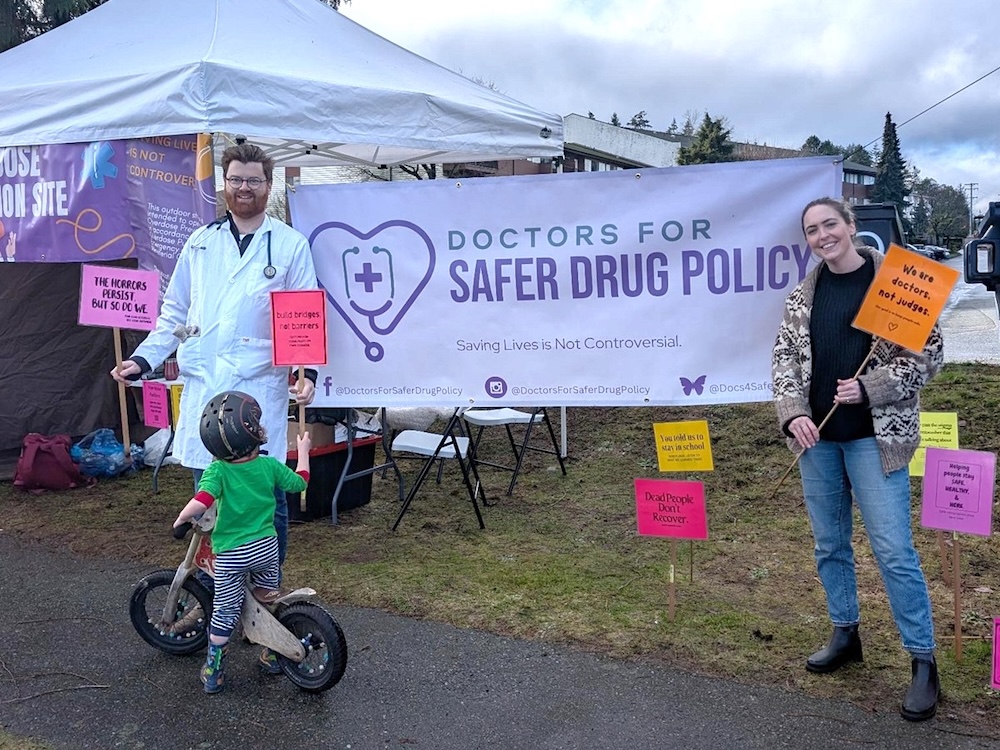
It was 2014 when I first heard of fentanyl entering the unregulated drug supply. Of people wanting heroin, being used to heroin, but getting fentanyl instead, and dying. Or people who didn’t even use opioids getting fentanyl accidentally, and dying.
I was a medical resident at the time — an apprentice doctor — and I was spending much of my clinical time in Vancouver’s Downtown Eastside. I have a sharp memory of patients who previously were doing quite well suddenly destabilizing. The medications we typically prescribed were no longer working as well as they used to. The doses would go up and up, and yet patients found themselves needing to return to street drugs with increasing frequency. We just couldn’t compete with the potency of fentanyl the way we could with heroin. And the deaths kept mounting.
In 2015 I finished my residency and continued on a path that allowed me to serve people with substance use disorders. I have, therefore, been living and working in this “emergency” for all of my career.
It was a hopeful moment in 2016 when former public health officer Dr. Perry Kendall declared the public health emergency. In those early months, things really seemed to move in the right direction. Access to naloxone was liberalized. Peer-led overdose response was endorsed and scaled up. Additional overdose prevention sites were authorized, many of them sites that were already unofficially running thanks to the efforts of volunteers. Some work was done to expand access to life-saving opioid agonist therapy, including via the deployment of a mobile medical unit that was originally created to serve the 2010 Olympics. I have another clear memory of working shifts in those strange trailers that had accordioned outwards to form an impromptu clinic in an empty lot on East Hastings.
There were many, many people — professionals, peers, mothers of people who lost their lives to toxic drugs — who were ready, able and prepared to put our heads down and do the work required to beat this thing. The sentiment was “Just give us the resources and the tools that we need, and we’ll take care of it.” And that remains true today. Most of us are still at it.
While some of that effort had positive effects provincewide, most of it was targeted at only a very specific segment of the population that was vulnerable to overdose: residents of the Downtown Eastside. Although new overdose prevention sites were sanctioned or opened, very few were outside the Lower Mainland.
Meanwhile, insufficient efforts were made to help the most likely victims of the crisis: people who lived in their own homes and who used drugs alone after a long day of work at a physically demanding job. Although we knew that housed, employed folks were the heart of the crisis, very little was done to reach those people.
Perhaps it just wasn’t politically palatable to acknowledge that much of this crisis stretched far outside “Canada’s poorest postal code.”
There were other failures, too, including a failure to scale up injectable diacetylmorphine treatment (also known as pharmaceutical-grade heroin) to “catch” heroin-dependent folks before they became hooked on fentanyl.
And so the crisis grumbled on, and on, and on.
Until, in an almost accidental way, we were handed a gift. The arrival of the COVID-19 pandemic, while terrible for many reasons, opened the door to a form of safer supply. This is an old concept for which advocates had fought for some time. But now, we had been granted access to a limited form of it.
We could see its problems right away. These were not the medications that would likely have the greatest positive impact on our patients. Hydromorphone, the main “prescribed alternative” suggested by a BC Centre on Substance Use guidance document, was at best a distant cousin to fentanyl. Pharmaceutical-grade fentanyl, long in use as a pain medication and the most obvious replacement for unregulated fentanyl, wasn’t widely discussed. Although most people who use drugs in B.C. inhale their substances, no inhalable options were made available. But it was a start. It made us hopeful. It made our patients hopeful too. For the first time since 2016, we had a novel tool to help stem the tide.
We saw results. In some patients, access to prescribed safer supply made a clear difference. It brought stability, fewer overdoses and reduced survival activities such as sex work or theft to the lives of many people I care for. What we saw in practice was then validated, unambiguously, by some very well-run studies.
The program remained limited by its reach — a mere 5,000 recipients out of a population of 110,000 with opioid use disorder — and by the relative lack of potency of the medications that it made available. But still, it was useful and a point of hope.
Until it wasn’t.
As former chief coroner Lisa Lapointe has said, the government has yet to produce any evidence that this program was causing harm. In fact, there is some evidence that the government knew that no significant harms were occurring. This did not stop a full-blown moral panic from developing among media figures and the political classes in the province, culminating in Health Minister Josie Osborne’s December 2025 announcement that she would be enforcing an end to this promising practice.
And now we see a classic trope rear its ugly head once more: the criminalized addict, dressed in the humane-sounding rhetoric of “involuntary care.” Going back to the Opium Act of 1908, locking people up for using substances has never solved anything and only harms people, no matter what the facilities are called, what they look like or what form of “treatment” is attempted there. What’s more, if we know our history, we can be reasonably certain that these sorts of measures will be disproportionately levelled at racialized people, most especially Indigenous British Columbians. This policy shift could set up our generation’s ’60s Scoop.
As an addiction medicine specialist, I am familiar with the scientific evidence. Involuntary treatment does not produce durable benefits. Not only that, but it sets people up for more danger, releasing them back into communities with a lower opioid tolerance — and, as a result, a higher risk of overdose.
Further, the increasing focus on treatment exclusively as the solution to this crisis ignores the obvious: not everyone who uses drugs has an addiction. Of those who do, not all need or want or are ready for residential treatment. Focusing on treatment alone offers no workable plan for keeping all of those other folks alive.
When confronted with this depressing chain of events, politicians often blame public opinion, as if the British Columbians who access the unregulated drug market — all 225 000 of them — were somehow not members of the public. As if public opinion were some force from without, a deus ex machina that they cannot influence.
Somehow, the government just can’t seem to muster its communicative power when vulnerable people’s lives are at stake. In one form or another, B.C.’s auditor general, human rights commissioner and representative for children and youth have all called attention to the government’s failure to communicate the rationale and the utility of its own policies that reduce harm.
Sometimes, it feels as though flawed or weak versions of evidence-based policies have been deliberately adopted and designed to fail or to exist only as short-lived “pilots,” so that we could all move on, saying “See, that didn’t work.”
When this is over — and it will end — how will we live alongside those who could have stopped it sooner but chose not to? How will we forgive them?
Historically in Canada, we have been able to move the ball forward on drug policy because of the rulings of our courts, not action from legislators. The Supreme Court of Canada seems to understand governments’ positive responsibility for preserving human lives, even if governments themselves do not. And on that score, we will all continue to watch the Drug User Liberation Front case closely. And the Ophelia Black case in Alberta. And others like them. Because, in the end, it’s cases like these that are the little candles lighting the way.
We will emerge into a landscape of rational drug policy, even if it remains pretty dark until we get there.
I am not a person of faith, but I think fondly of an aphorism from the Jewish tradition, which says, “It is not your duty to finish the work, but neither are you at liberty to neglect it.” Let us not neglect it. ![[Tyee]](/design-article.thetyee.ca/ui/img/yellowblob.png)
Read more: Health











Tyee Commenting Guidelines
Please note that email notifications for replies are not currently working due to a software issue which may be resolved in a future update.
Comments that violate guidelines risk being deleted, and violations may result in a temporary or permanent user ban. Maintain the spirit of good conversation to stay in the discussion and be patient with moderators. Comments are reviewed regularly but not in real time.
Do:
Do not: