


 SHARE:
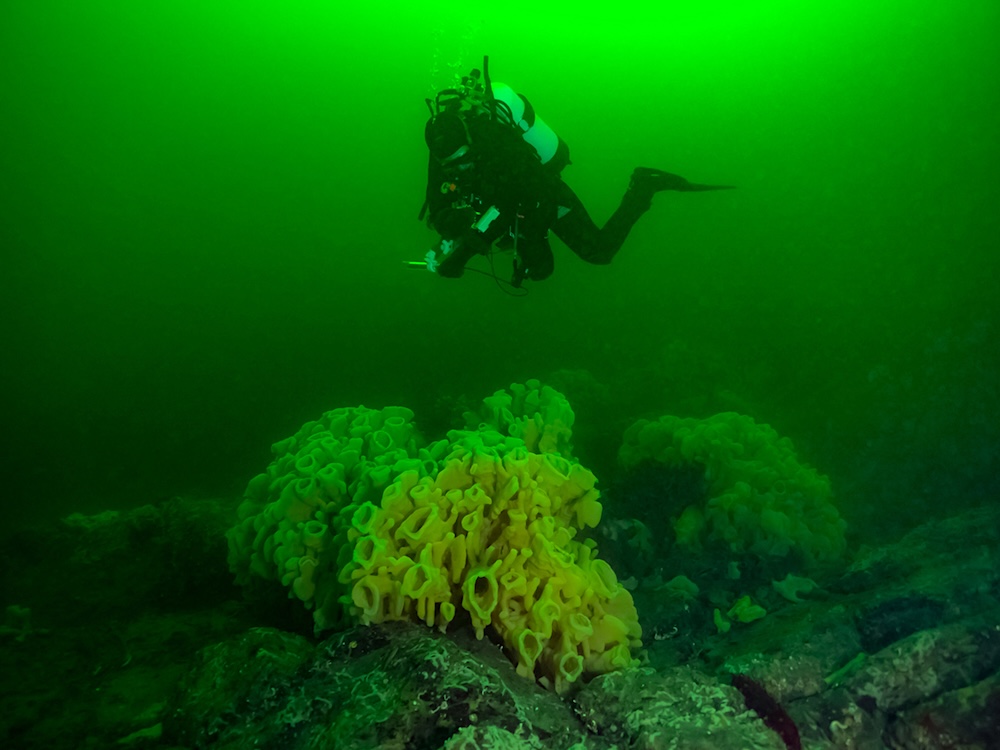
When Canadian scientists discovered ancient glass sponge reefs off B.C.’s coast 40 years ago, they were both elated and concerned.
Elated because the reefs — which look like futuristic condos and grow as tall as eight-storey buildings — were thought to have gone extinct 40 million years ago. One excited researcher said it was like “discovering a herd of dinosaurs on land.”
And concerned because large chunks of the reefs, which are deep-sea biodiversity hot spots, were dead.
Did the reef die-offs occur hundreds or thousands of years ago — or did they occur more recently, due to changing ocean conditions? Did human activity cause their demise? And is there any hope the dead areas can grow back?
Federal research scientist Anya Dunham and five of her colleagues set out to answer those questions by studying glass sponge reefs in Howe Sound near Vancouver, Chatham Sound near Prince Rupert, and Hecate Strait near Haida Gwaii.
Their research, which will be published in August in the journal Estuarine, Coastal and Shelf Science, shows that damage caused by bottom-contact fishing likely killed the reefs, some of which are more than 9,000 years old.
“It points the finger to humans as the culprit of reef demise,” Dunham, who works for Fisheries and Oceans Canada, told The Tyee.
But there’s good news as well.
In both living and dead reef areas, researchers found baby glass sponges — teeny creatures the shape of a vase — searching for a place to anchor.
If what’s left of the reefs remains healthy, the living sponges “could send their larvae, the baby sponges, into those damaged areas,” Dunham said.
“If the dead skeletons of the previous generations are solid enough, those baby sponges might be able to anchor and continue growing. And if that happens, then those areas would become functional again.”
‘Cities of glass’
Glass sponges are found in oceans all over the world. But living glass sponge reefs exist only along the Pacific Northwest coast, where the water is cold and contains high concentrations of silica.
The sponges filter silica out of the water and make spicules, which form the skeleton of the sponge. New sponges settle on top of skeletons from previous generations to build what Dunham calls “cities of glass.”
The living reefs filter water and provide homes for more than 100 species, including rockfish, spot prawns, sea stars and squat lobsters. The reefs also sequester about the same amount of carbon per square metre daily as kelp forests and old-growth forests, according to Dunham.
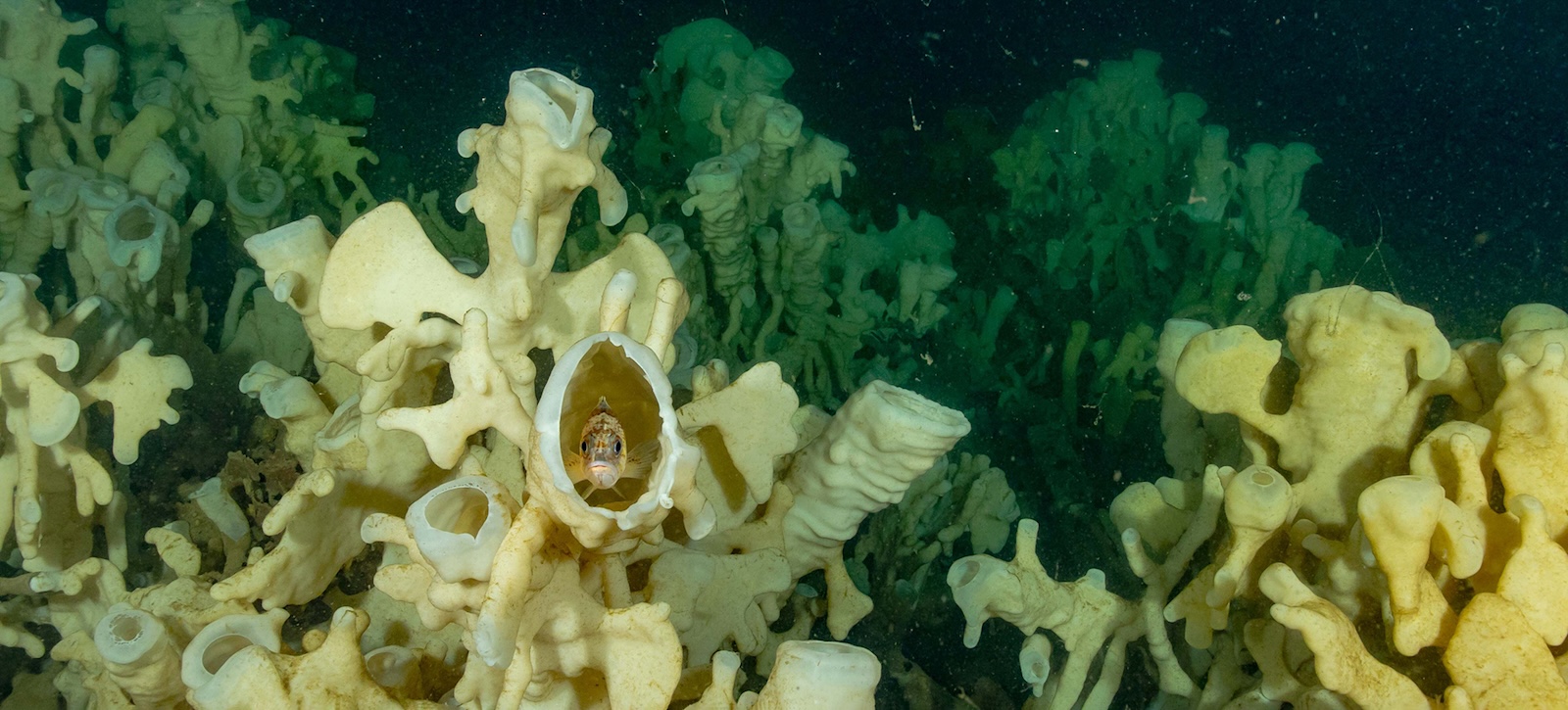
Scientists already had evidence that bottom-contact fishing, such as trawling and dredging, destroys and damages glass sponge reefs.
But Dunham said this is the first time that researchers have matched historic fishing records to the dates that large sections of the reefs perished, ruling out death from natural causes.
The study’s findings counter the argument that glass sponge reef protections aren’t needed because the reefs died a long time ago, so “maybe it’s not humans that are causing the damage,” she said.
To date the reefs, Dunham and her colleagues used remotely operated vehicles and ship-based sampling to drive tubes into the sea floor and extract sediment samples. They couldn’t use radiocarbon for dating because glass sponges, unlike corals and bivalves such as clams, don’t contain carbonates.
Dunham said the age of the sediment around a reef reveals when death occurred.
All the areas the scientists sampled had died over the past 70 years. Parts of the Carmelo Point glass sponge reef in Howe Sound, near Bowen Island, died over the past 20 years.
“Many of those areas had been quite heavily fished in the past, and some of that happened even before the reefs were known to science,” Dunham said.
Fishing can damage reefs by crushing them, either through trawling, trolling or placing traps on the delicate reefs. “But there’s also damage through sediment disturbance, [from] dragging gear across the sea floor,” she said.
Four glass sponge reefs in Hecate Strait and Queen Charlotte Sound are safeguarded in a marine protected area.
But the 12-kilometre-long Chatham Sound reef — one of the largest living reefs ever discovered — is not protected, though the sound has been closed to the groundfish trawl fishery since 2012 as part of a coast-wide habitat protection initiative.
The Chatham Sound reef was discovered in 2013 by crews surveying for a proposed underwater liquefied natural gas pipeline route.
When Dunham and her colleagues surveyed the reef, they found about 90 per cent of it was dead, with some areas looking like “glass sponge rubble.” But they also saw baby sponges everywhere.
“So there is some hope that that area can come back to life, and perhaps especially so if protection is extended to that area,” Dunham said.
Glass sponge reefs need to have a buffer zone to protect them from sediment disturbed by nearby activities such as trawling or laying a pipeline, Dunham said.
“They don’t like to have too much sediment in the water. That clogs them up and damages them,” she added.
Reefs damaged by illegal fishing
Eden Luymes, conservation campaigner for the Canadian Parks and Wilderness Society’s B.C. chapter, called the lack of protection for the Chatham Sound glass sponge reef “a glaring omission.”
“These reefs are an oasis that help benefit our fisheries,” Luymes told The Tyee, highlighting spot prawns as an example of a species that uses glass sponge reefs as nurseries.
Luymes said there’s no process to protect glass sponge reefs immediately after they are discovered, adding that it takes far too long to secure protections.
She said it took decades of work to create the Hecate Strait/Queen Charlotte Sound Glass Sponge Reefs Marine Protected Area, which was announced in 2017.
Ben Stanford, a spokesperson for Fisheries and Oceans Canada, told The Tyee that the federal government “has taken many steps to protect fragile marine areas along the coast and will continue to do so.”
Stanford said the Chatham Sound glass sponge reef falls within the Northern Shelf Bioregion area, where plans are underway to create a network of marine protected areas.
“As Marine Protected and Conserved Areas are established, activities that pose a threat to conservation objectives will be prohibited,” Stanford said.
He said Fisheries and Oceans Canada is committed to an ongoing planning process for the bioregion that involves a co-ordinated approach to marine conservation across Indigenous, federal and provincial jurisdictions.
Stanford also said Fisheries and Oceans Canada uses tools such as fisheries area closures and restrictions on some types of fishing gear to prevent and mitigate the impact of fishing practices on marine species and ecosystems.
For instance, glass sponge reef marine refuges in the Strait of Georgia and Howe Sound prohibit all bottom-contact fishing activities, including fishing for prawns, shrimp, crabs and groundfish such as halibut.
But illegal fishing is still a problem.
Last October, the captain of a fishing vessel was fined $40,000 for setting prawn traps in a glass sponge reef area in Howe Sound, near West Vancouver.
In 2024, the captain of a commercial fishing vessel was fined $250,000 and ordered to forfeit $80,000 worth of equipment after he was caught setting prawn traps in a glass sponge marine refuge near Sechelt, B.C.
Luymes said casual or recreational spot prawn fishers in Howe Sound often don’t know about the closures, “so it’s even more of an uphill battle to get people to adhere.”
“Protection on paper for these reefs is not enough,” she said. “It needs to be matched by monitoring and enforcement on the water, even in the protected areas.”
There are also no guarantees other resource extraction industries won’t damage glass sponge reefs in Howe Sound and other areas with fishing closures.
Woodfibre LNG, a liquefied natural gas facility under construction near Squamish, B.C., is being monitored by the B.C. Environmental Assessment Office to make sure that sea-floor anchoring systems for floating worker accommodations minimize impacts to glass sponges.
In an inspection record posted on June 8, the assessment office noted that Woodfibre hasn’t conducted followup surveys to evaluate “the effectiveness of measures to minimize impacts to glass sponges.”
“No evidence was provided of post-installation underwater surveys conducted to assess the effectiveness of those avoidance measures, or to confirm that glass sponges were not disturbed as a result of the mooring installation,” the office noted, adding that it may verify compliance during a subsequent inspection.
Woodfibre LNG did not respond to The Tyee’s questions by press time.
Luymes said the glass sponges were found by Woodfibre during site assessments and data about the population is very sparse. A strong baseline is lacking, so “it will be hard to determine the impacts” from the disturbance, she said.
She called for a more detailed assessment, saying glass sponges are likely distributed around the entire work area because they reproduce by dispersing larvae, “so where there are some, there are likely others nearby.”
She also said Woodfibre’s 15-metre glass sponge buffer zone is “hardly sufficient” given recent studies that show a six-kilometre buffer zone is necessary to prevent adverse impacts to reefs from sediment clouds in Hecate Strait.
“All of this speaks to the need for better protections of the reefs themselves,” Luymes said. ![[Tyee]](/design-article.thetyee.ca/ui/img/yellowblob.png)
Read more: Science + Tech, Environment









Tyee Commenting Guidelines
Please note that email notifications for replies are not currently working due to a software issue which may be resolved in a future update.
Comments that violate guidelines risk being deleted, and violations may result in a temporary or permanent user ban. Maintain the spirit of good conversation to stay in the discussion and be patient with moderators. Comments are reviewed regularly but not in real time.
Do:
Do not: