



 SHARE:
The first Vancouver match in the FIFA World Cup takes place on Saturday. Meanwhile soccer has taken over a good portion of the city. Everywhere you look, there are soccer balls. Big ones and little ones hang in store windows, or dangle off souvenir keychains. There is even a giant version plopped in the middle of the plaza at Granville and Georgia streets downtown.
Alongside the citywide ball-a-palooza, there have been more substantial changes, such as blocked-off streets, postponed local cultural events and lingering questions about whether or if the World Cup will contribute meaningfully to local youth soccer infrastructure.
If you need to find a way to feel better about the incursion of the 2026 World Cup, information, historical context and political commentary are always useful.
Start at Vancouver’s Science World, which has been transformed into a giant soccer ball. A new exhibition offers an encompassing look into the science behind the game. To say it is complex isn’t quite sufficient. Just about every possible aspect of soccer has been subjected to rigorous and intensive study, from the design of balls to the biometrics of the players.
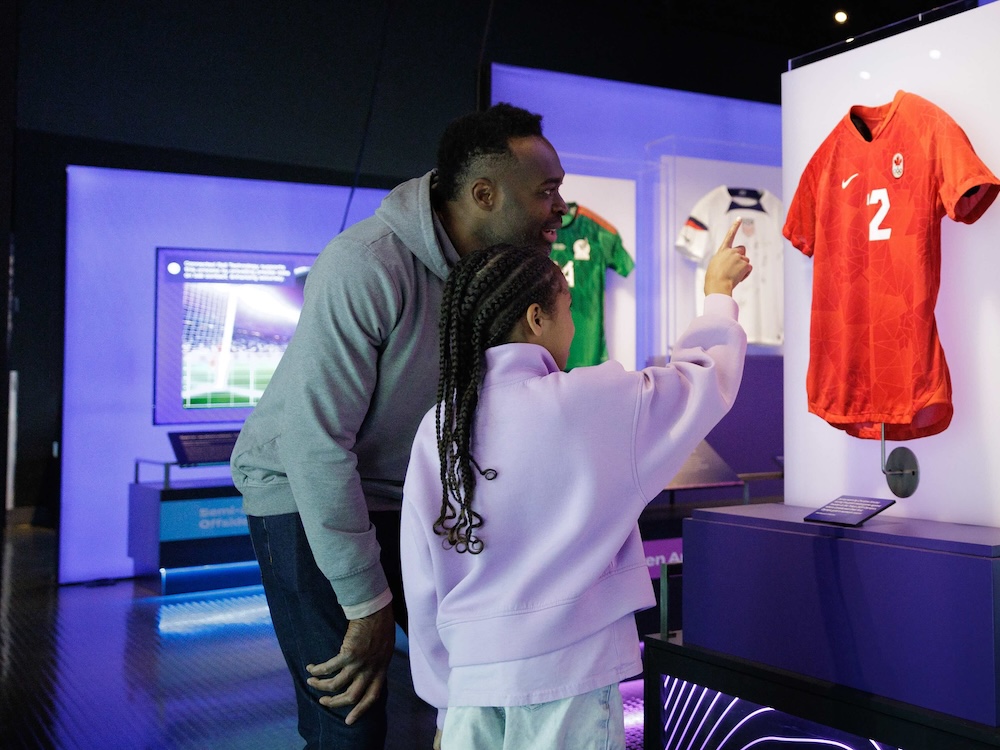
Soccer & Technology from the FIFA Museum, presented in partnership with the province of British Columbia, draws from the considerable footie collection housed in FIFA Museum’s Zurich headquarters. There’s extensive history on display, including the cameras used to televise the 1954 World Cup and the jersey worn by Canada’s all-time goal scorer Christine Sinclair during the gold medal game against Sweden at the 2020 Olympics in Tokyo.
The five zones in the exhibition break down the science employed to bring soccer to the world, from media coverage to cameras capable of capturing every possible nuance. Ball technology is also big. Yes, Virginia, more balls!
The official ball of the current series employs something called “Connected Ball Technology.” The Adidas Trionda, the official match ball of the current World Cup, is emblazoned with colours and imagery derived from the 2026 host nations, namely Canada, the U.S. and Mexico.
The balls themselves are embedded with a motion-sensor chip to connect the action on the field with analysts poring over every possible data point.
To understand the stakes, watch these films
What doesn’t quite come up for close examination in the Science World exhibition? The politics underscoring the World Cup. For that, one must venture further afield. Luckily, there are documentaries aplenty about the beautiful game and its sometimes less-than-lovely repercussions.
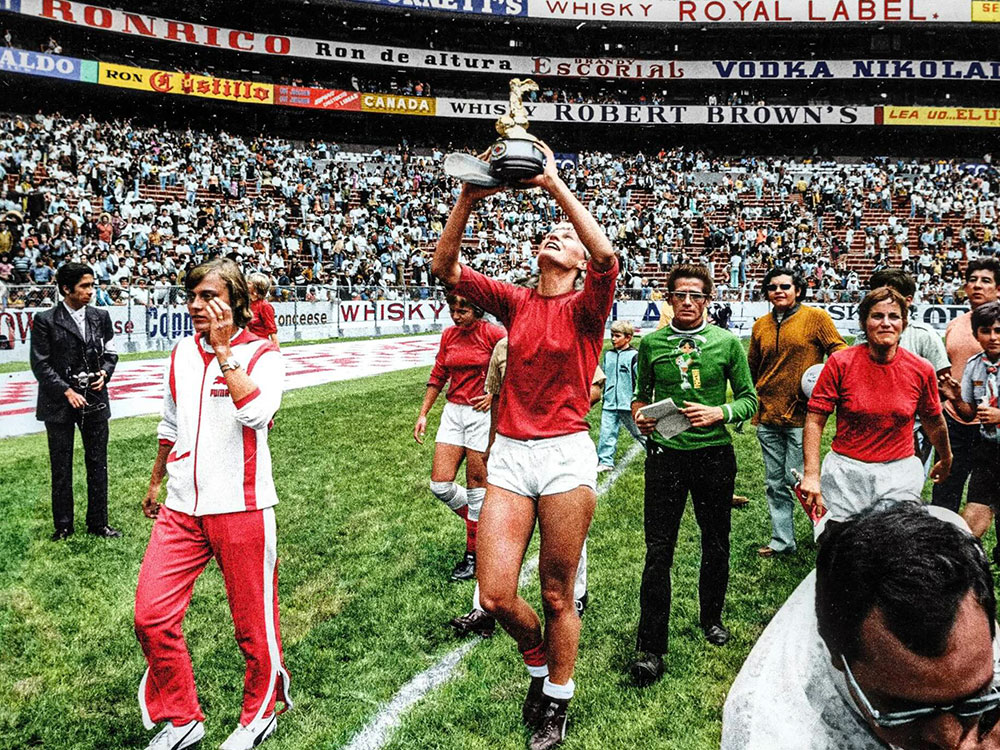
I highly recommend COPA 71, a 2023 documentary now available for viewing on the Knowledge Network. It is a truly amazing story of the fight for equality in women’s soccer — all the more so because it’s a fight that continues to be largely unknown, excised from history and buried by soccer officialdom.
The 2009 documentary The Referees is also an excellent primer on the politics of European soccer. The film’s original title, Kill the Referee, offers a better sense of the stakes involved. Made with extraordinary access, the film follows teams of officials from European nations. British referee Howard Webb’s controversial call in the UEFA Europa League 2008 finals between Austria and Poland brought on death threats, including one from the then-Polish Prime Minister Donald Tusk.
I also recommend Mike Brett and Steve Jamison’s 2014 documentary Next Goal Wins — and skip the terrible 2023 feature film based on the doc starring Michael Fassbender. Next Goal Wins tells the true underdog story of the American Samoa team in their efforts to qualify for the 2014 FIFA World Cup, following a 31-0 loss to Australia.
A new documentary outlines one of the most infamous competitions to ever take place on the soccer pitch.
The Match retells the story of the 1986 World Cup series played by England and Argentina, not long after the Falklands War. The film premiered at the Cannes Film Festival this spring and is set to stream on Disney+ in the summer.
Directors Juan Cabral and Santiago Franco have a wealth of archival material to play with, including footage of the infamous “Hand of God” goal, wherein Argentina’s superstar Diego Maradona scored the opening point.
The moniker was given to the illegal manoeuvre that awarded the first goal to Argentina in the quarter-final game. None of the referees witnessed Maradona using his hand, so the goal was allowed to stand.
Less than five minutes later, Maradona’s “Hand of God” goal was followed with what came to be referred to in soccer lore as the “Goal of the Century.” Even 40 years after the fact, the footage of Maradona’s remarkable skill still takes one’s breath away.
The win against England helped propel Argentina to their second World Cup victory, but it did more than that. As Maradona explained, he viewed the “Hand of God” goal as “symbolic revenge” against the British for their actions in the 1982 Falklands War.
Maradona reconsidered the experience in director Asif Kapadia’s 2019 documentary Diego Maradona.
"We, as Argentinians, didn't know what the military was up to. They told us that we were winning the war. But in reality, England was winning 20-0. It was tough. The hype made it seem like we were going to play out another war. I knew it was my hand. It wasn’t my plan, but the action happened so fast that the linesman didn’t see me putting my hand in. The referee looked at me and he said: ‘Goal.’ It was a nice feeling like some sort of symbolic revenge against the English.”
The Diego Maradona documentary has a curious resonance with the current moment as the sound and fury around the current World Cup continues to mount.
With referees being denied entry to the U.S. and pre-approved travel visas reverting to unclear status, events around the games are getting more intense by the moment.
None are more tragic than the Iranian national team wearing pins with the number 168, a reference to the number of children killed in a U.S. airstrike against a girl’s school in Minab.
Don’t forget the true GOAT
If you need something to remind yourself of the humanity and athletic potential beneath the political rivalries, the corporate tie-ins and the mounds of money, technology, and resources dedicated to a World Cup game, I recommend another documentary.
Christine Sinclair: Kind of a Big Deal, a short film from director animator Eoin Duffy, features Vancouver’s own Ryan Reynolds telling the story of the greatest goal scorer of all time. The GOAT, in the parlance of sports culture.
The film is screening at Science World as part of the Soccer & Technology exhibition as well as online via the Knowledge Network.
Born in Burnaby, Sinclair’s 23-year career with the Canadian national team is nothing short of extraordinary. It’s not just the goals scored, but also Sinclair’s ability to champion women’s soccer with steadfast integrity, humour and a humility that is frankly a bit staggering.
In addition to three Olympic medals, or as Reynolds refers to them in the film, “garbage trinkets,” and six World Cups, Sinclair holds the record for the most international goals scored by a man or a woman. That number is 190, beginning with her first goal in the year 2000 at age 16.
Over the course of her career, Sinclair leveraged her leadership to help the women’s team achieve pay equity with that of the men’s. As she explains in the film, after the Canadian women’s team won the Olympic gold medal in 2020, the moment was right. In 2026, Canada Soccer ratified an agreement that included equal pay for both the men’s and the women’s national teams.
How’s that for the GOAT?
‘Soccer & Technology from the FIFA Museum’ is on view at Vancouver’s Science World until Sept. 7, 2026. ![[Tyee]](/design-article.thetyee.ca/ui/img/yellowblob.png)
Read more: Media










Tyee Commenting Guidelines
Please note that email notifications for replies are not currently working due to a software issue which may be resolved in a future update.
Comments that violate guidelines risk being deleted, and violations may result in a temporary or permanent user ban. Maintain the spirit of good conversation to stay in the discussion and be patient with moderators. Comments are reviewed regularly but not in real time.
Do:
Do not: