


 SHARE:
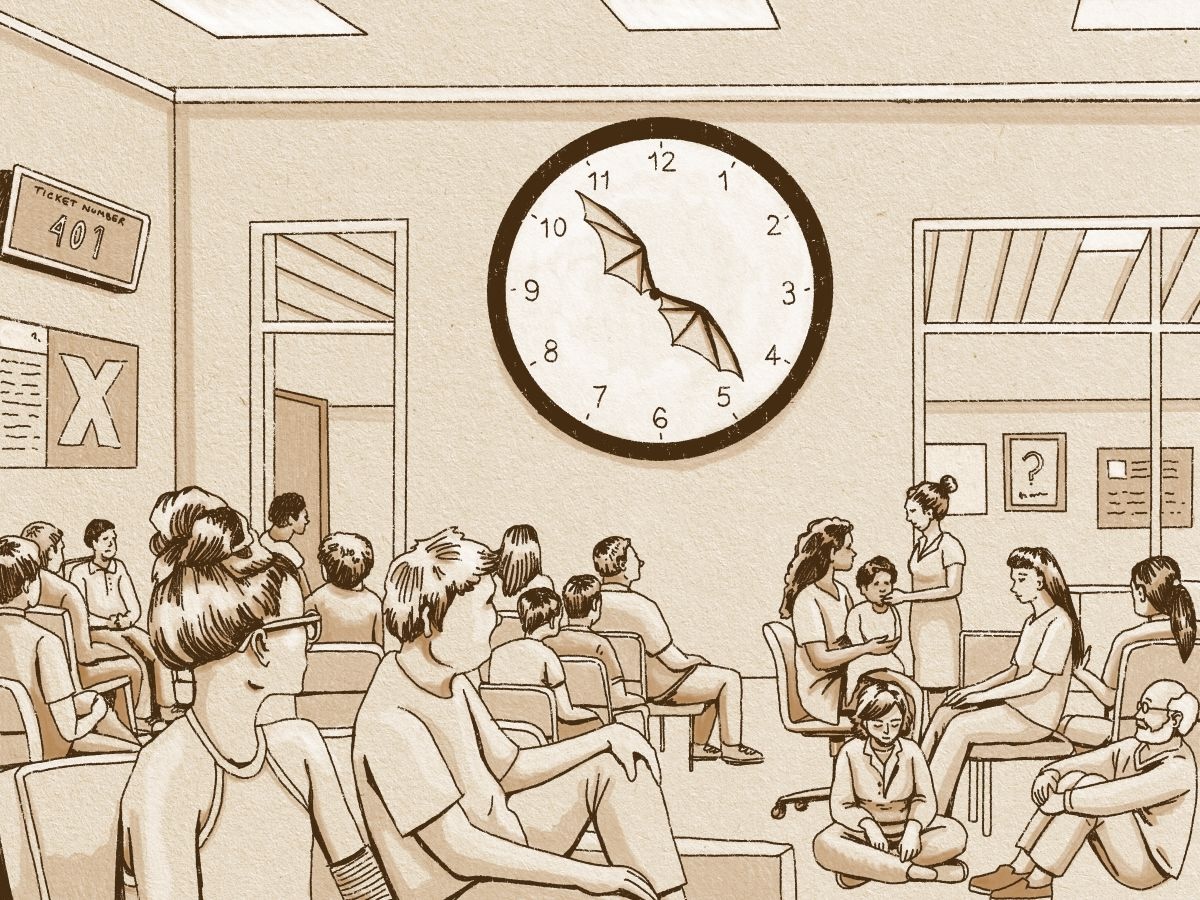
I like bats. Their ears are adorable. They’re the only mammals that can truly fly. As a mother, I love the idea that female bats take turns looking after one another’s babies. And then there are the multiple services that bats provide: they eat mosquitoes and agricultural and forest pests and pollinate crops.
But my fondness for bats wobbled last weekend, after an encounter with a bat in a stairwell. And what happened afterwards severely shook my faith in B.C.’s emergency health-care system.
We were staying with friends on Lasqueti Island, an off-grid island one hour by passenger ferry from the small community of French Creek, just north of Parksville on Vancouver Island. Our friends have a delightfully rustic setup with a charming little house, a sunny and bounteous vegetable and flower garden, and a guest room above a large workshop whose big sliding doors are open year-round. The stairs to the guest room bend at a right angle, and it was here, just before 10 p.m. last Saturday evening, that a bat flew into me.
It happened in the space of a second or two, maybe less. A fleeting dark shape above me. The whirring of wings. A sensation on the side of my head. Heat on the top of my left ear, which was exposed. The passageway was narrow and low-ceilinged, and the bat, no doubt startled by the light we’d turned on and the thud of footsteps on the stairs, was only trying to escape.
I was a bit concerned, but the internet was off and we had no cell reception, so there was nothing to do but go to sleep. We were already scheduled to leave the island on the first ferry the next day, at 1 p.m., and I told myself I’d deal with things in the morning.
We’d stayed above the workshop on previous visits and knew there were bats. I’d never worried about them. But I’d read a news story about an increase in rabies in bats on Vancouver Island and thought I should probably make a few inquiries. One of our friends had mentioned that their resident bat population seemed to be in decline. They were seeing fewer bats than usual. Several weeks earlier, a bat had flown out in the middle of the day and collapsed right in front of them. I knew that white-nose syndrome, a deadly fungal disease that has decimated bat populations across North America, was unlikely to be found this far north, since it had only recently been detected in B.C.
The bat could have collapsed from heat stroke, I learned the next morning when I Googled. Or rabies. It was decided then; I’d go to emergency when we got back to Victoria later that day — a Sunday — and seek further advice. Did I need a rabies shot? I was pretty sure I did.
Ideally rabies shots are administered within 24 hours of contact, so as soon as we arrived home I rushed off to emergency at Royal Jubilee Hospital, without eating dinner. The triage nurse told me I was lucky; the emergency room was relatively calm after a crazy Friday and Saturday. My case, the nurse said, was a “cherry” — one that was straightforward and easy to treat. The doctors would squeeze me in before the 24-hour window passed. It was still four hours away.
I found a seat in the emergency room, across from an older American couple who had been on a cruise ship and had been told to go to the nearest hospital in an ambulance when the man experienced symptoms that might be a stroke. “Don’t worry,” I told them. “You’re in good hands here.” And sure enough, soon a nurse came along who did the stroke FAST test on the man and told him he didn’t have stroke symptoms. However, the nurse said, they’d do a CT scan to check for evidence of a transient ischemic attack, sometimes called a mini-stroke; he might have to wait an hour or two for his name to be called. I commiserated with them about the wait, telling the couple proudly that, in Canada, sometimes we had to wait a few hours, but health care was free.
Four hours went by as the rest of the room filled up. I got up from my uncomfortably hard seat and went to the staff desk to explain my situation and politely ask if they knew, ballpark, when I might be seen. Instead of answering, a staff member marched out from behind the glass-screened desk and bellowed at the entire room: “Do NOT come and ask how much longer you have to wait!”
Stuck in limbo
By this time, it was 9:30 p.m. Most of the two dozen or so people in the room had the glazed eyes of folks stuck in airports, when time is somehow both compressed and expansive. A few looked daggers at every staff member who walked past. A volunteer offered ice packs, water and warm blankets, but then she disappeared. One young man used the blankets as a pillow and went to sleep on the floor, but he was roused by staff and told in no uncertain terms to get back in his chair.
Some people moaned; others cried. A Code Red was called — a fire alarm had been pulled on the psych ward, the woman waiting next to me, whose son worked in the hospital, informed us, as she clutched an ice pack, wincing in pain. The alarm clanged and clanged, infusing an apocalyptic air into an already somewhat grim and soulless scene. The trickle of people called in to examination cubicles stopped.
Just after 12:30 a.m., a friendlier staff member came into the waiting room and told everyone that unfortunately the doctors on duty were caring for people who were very sick, and no one in the room would be seen until the morning. If anyone wanted to leave, they could. A roll call would take place in a few hours. If someone wasn’t there, they’d be crossed off the list.
By this time, having not eaten a meal since lunch, I was decidedly hangry. I don’t necessarily make good decisions when I’m hangry, especially if I’ve been sitting in a horridly uncomfortable chair for seven hours and my contact lenses are sticking to my eyeballs, my Kobo is out of juice and the 24-hour window advised for a rabies shot has come and gone. So much for the cherry.
Just before 1 a.m., I bailed. I went home, ate dinner and slept for a few hours. Then I drove back to emergency and checked in all over again. At 6:30 a.m., many of the same people were still in the waiting room. The Americans, who had to make their own way to Seattle for a scheduled flight home that evening at the end of their cruise — the ship had departed for Seattle without them — were gone.
I arrived just in time for another announcement. There were no doctors at all in that part of the emergency department, a nurse told the full waiting room. Then another nurse did a roll call and scratched some names off the list when people didn’t respond.
Roused to action
I went into full-fledged journalist mode, pulling out my laptop, hot-spotting, researching and asking the triage nurse questions. Where else could I get a rabies shot? I might be able to get one at the Victoria Health Unit, the triage nurse told me.
A few more hours ticked by before the unit, a community health facility operated by Island Health, opened. I left a voice mail message. I’d already tried the urgent and primary care line, hanging up when a recording informed me that I was number 36 in line to speak to someone, with no guarantee I’d be seen that day or the next.
Then my luck suddenly turned. A nurse from the health unit — my saviour! — called and asked questions about my bat encounter. The nurse said they would contact a medical health officer and get back to me within half an hour. When they phoned, as promised, the nurse asked more questions about the incident. Did I feel anything sharp on my ear? Did the bat attack me?
As I answered, in full earshot of everyone around me in the emergency waiting room, the nurse was instant messaging with the medical health officer. They soon had an answer: good news, the nurse said. I didn’t need immunoglobulin, which can be administered only at a hospital. But I did need to get a rabies shot as soon as possible. The medical health officer said I should have a double dose to start. How quickly could I get down to the health unit?
Thirty-five minutes later, I had a rabies shot in each arm and a schedule for two more. The nurse at the health unit may never know how much it meant to me, after a sobering, uncomfortable and sometimes infuriating sojourn waiting in emergency for a total of almost 11 hours, to hear a friendly, concerned voice asking questions about my predicament — someone who could finally help me.
I only hope my fellow travellers in emergency that night and morning found the help they needed in our understaffed and under-resourced health-care system that is clearly stretched beyond capacity.
And I wish the bat, which is facing its own challenges in a changing world, nothing but good health and to be on the receiving end of a little compassion. ![[Tyee]](/design-article.thetyee.ca/ui/img/yellowblob.png)
Read more: Health, Environment










Tyee Commenting Guidelines
Please note that email notifications for replies are not currently working due to a software issue which may be resolved in a future update.
Comments that violate guidelines risk being deleted, and violations may result in a temporary or permanent user ban. Maintain the spirit of good conversation to stay in the discussion and be patient with moderators. Comments are reviewed regularly but not in real time.
Do:
Do not: