


 SHARE:
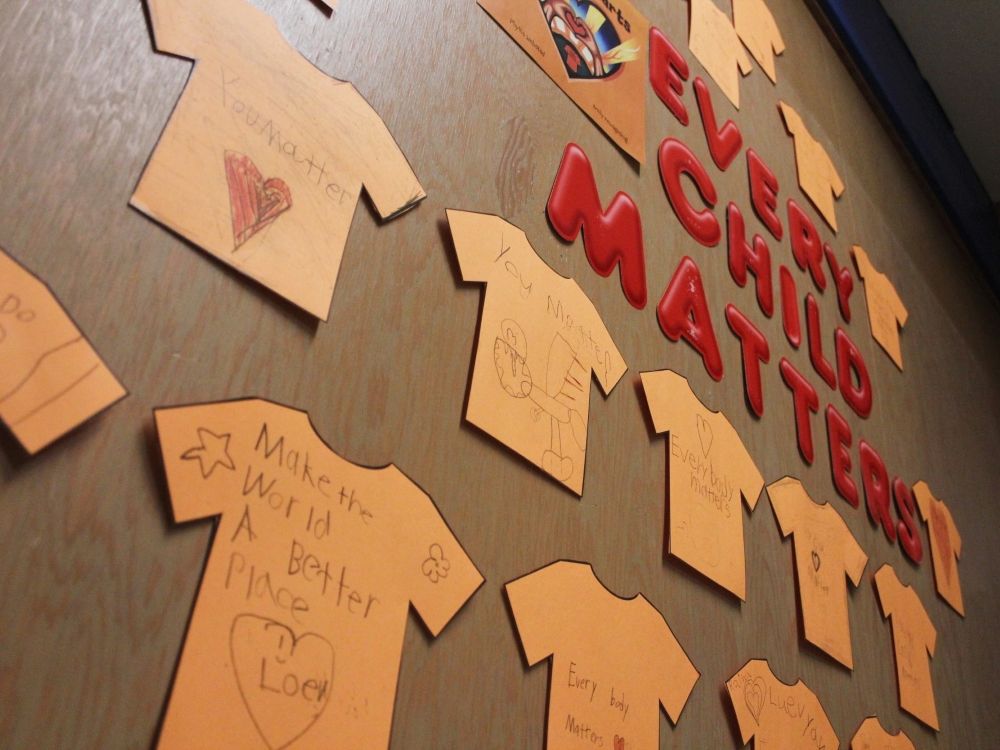
[Editor’s note: This piece is part of a weeklong series of writing in The Tyee to mark the National Day for Truth and Reconciliation and the 10-year anniversary of the release of the Truth and Reconciliation Commission of Canada’s 94 Calls to Action.]
In the early 1920s, on the banks of the Peel River next to the community of Fort McPherson in the Northwest Territories, Dinjii Zhuh (Gwich’in) families gathered in grief. Anglican missionaries were loading children, some as young as two, onto boats bound for the St. Peter’s Indian Residential School in Hay River, close to 2,000 kilometres away by water.
Teetł’it Gwich’in Elder Mary Effie Snowshoe recalled this moment as a “sad story” passed down from her parents. At the centre of it stood Chief Julius Salu. Having lost his daughter to the school earlier that year, Salu declared:
“No more. Nobody is to send their children away again. If anybody is threatened that they are going to go to court over their children, I’m going to be there. If anybody is going to go to jail for this, I’m taking it.”
This was not only an act of defiance but an expression of guut’àii — a Gwich’in principle often translated as “acting with one mind,” or collective strength. Guut’àii reflects the ethic of strength, protection and collective governance that guided our families through the residential school era.
Today, as residential school denialism grows louder in Canada — guut’àii offers lessons for how to resist.
The same strength that sustained our families a century ago can guide us in facing the current assault on truth.
Strength in a northern context
In my book, By Strength, We Are Still Here: Indigenous Peoples and Indian Residential Schooling in Inuvik, Northwest Territories I argue that strength is an important way to understand northern experiences of residential schooling. Strength was not about individual toughness but about kinship, collective responsibility and ancestral knowledge. But this doesn’t mean the system was not genocidal, or that children didn’t endure violent, prison-like conditions.
The North complicates and sharpens this idea in the following ways:
- Distance. Given the far reach of Inuvik’s residential schools — Grollier and Stringer Halls — many children travelled thousands of kilometres. Strength meant writing letters, protecting siblings and holding onto language under isolation.
- A multi-nation student body. Dinjii Zhuh, Inuvialuit, Métis, Inuit, Sahtú, Dënesųłįne, and Tłı̨chǫ, Cree, and others lived together. They built solidarity that later fuelled pan-Indigenous political movements in the 1970s. There are a number of Survivor memoirs that outline these stories, including by Stephen Kakfwi, Antoine Mountain and Nick Sibbeston. I also document in By Strength, We Are Still Here how students’ cross-cultural alliances shaped the development of pan-northern activism.
- Timing. While southern schools were closing, the North became a testing ground for new institutions into the 1950s and 60s, and until the closure of Grollier Hall in 1996.
Naming genocide
Residential schools were not well-intentioned mistakes. They were designed to destroy Indigenous families, governance structures and societies by targeting children. The United Nations definition of genocide includes “forcibly transferring children of the group to another group.” Canadian Indian residential schools fit this definition.
Survivors’ testimony, collected by the Truth and Reconciliation Commission, is evidence of both harm and strength. As scholar Eve Tuck reminds us, research should not be “damage-centred,” but no damage does not mean no pain. To speak of strength is to hold both truths — genocide and survival — together.
Denialism today
Despite overwhelming historical evidence — the most important being Survivor experiences — as historian Sean Carleton and anthropology graduate student Benjamin Kucher recently wrote, residential schools denialism is increasingly visible in public debate. My contribution here is to show how Gwich’in teachings of strength (guut’àii) offer a framework for resisting it.
Denialists claim that schools weren’t that bad, that the number of missing children is exaggerated, or that Survivors are lying. Others minimize the past by saying times were different. These narratives are not neutral — they undermine Indigenous testimony and weaken public commitments to truth and reconciliation.
How strength resists denialism
Here is where Gwich’in teachings matter.
Strength reframes Survivors not as passive victims but as key advocates of governance and solidarity. Chief Salu’s declaration, mentioned above, is proof of refusal.
Agency under duress is not consent. Acts of solidarity inside institutions of genocide do not absolve those institutions — they indict them. Strength resists denialism by showing how Indigenous Peoples fought to hold communities together, even in the face of attempted destruction.
What’s at stake
Denialism affects how Canadians respond to families still searching for missing children. Demanding “proof” through exhumations ignores the overwhelming evidence already available and pressures communities to move at unsafe speeds.
Surveys show that while Canadians broadly support reconciliation, many still lack meaningful knowledge of residential schools. A 2024 Ipsos poll found that 75 per cent of Canadians believe governments should do more to recognize this legacy.
A 2023 Innovative Research survey found that while 73 per cent of Canadians report being familiar with residential schools, knowledge drops when specific questions are asked. Despite the TRC’s 94 Calls to Action, this knowledge gap creates fertile ground for denialist propaganda.
The good news is that readers do not have to look far for ways to learn and act. For example, the TRC Calls to Action continue as an ongoing initiative, as do the Calls for Justice from the National Inquiry into Missing and Murdered Indigenous Women and Girls.
Readers could also consult resources like 150 Acts of Reconciliation or the vast collection of online resources at the National Centre for Truth and Reconciliation.
Dinjii Zhuh strength as a guide forward
What would it mean to confront denialism with guut’àii — acting with one mind?
It would mean centring Survivors’ voices, supporting families with resources and time and refusing to separate stories of suffering from stories of collective strength. It would mean teaching Canadians Indigenous strength is not just survival but structural transformation.
Children who endured residential schools sometimes went on to live full lives and, by Canadian standards, have successful careers. This was despite the system, not because of it. This was because of Indigenous forms of strength, like guut’àii.
This ethic also shapes my forthcoming book with anthropologist Sara Komarnisky, Talk Treaty to Me: Understanding the Basics of Treaties and Land in Canada, which helps Canadians understand the treaties that continue to govern our shared lives. Treaties, like guut’àii, are about collective responsibility — commitments made “with one mind” that remain central to our future together.
Refusing isolation, insisting on truth
When Chief Salu promised to go to jail for his people, he modelled what it means to act with one mind. His words remind us that the history of residential schools is not only a history of harm, but also a history of strength and collective governance.
By standing with Survivors, supporting Indigenous-led truth-telling and rejecting denialism, we can ensure Canada’s future is built on honesty, justice and respect.
Strength is not just survival. It is how Indigenous Peoples have always transformed oppression into collective action, and how we will face denialism today.
![[Tyee]](/design-article.thetyee.ca/ui/img/yellowblob.png)
Read more: Rights + Justice









Tyee Commenting Guidelines
Please note that email notifications for replies are not currently working due to a software issue which may be resolved in a future update.
Comments that violate guidelines risk being deleted, and violations may result in a temporary or permanent user ban. Maintain the spirit of good conversation to stay in the discussion and be patient with moderators. Comments are reviewed regularly but not in real time.
Do:
Do not: