


 SHARE:
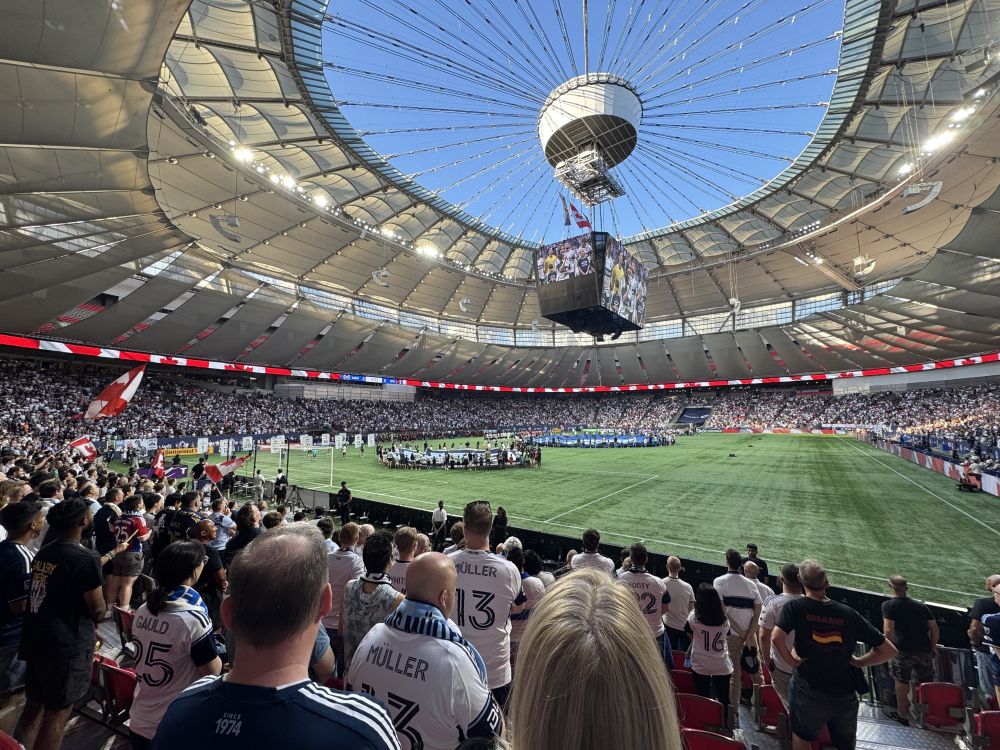
Believe no one.
That’s what I learned a decade ago as a reporter covering the relocation of a junior hockey team, and the same holds true today when it comes to the future of the Vancouver Whitecaps.
The last months have seen a flurry of news stories about the future of Vancouver’s Major League Soccer team and its potential relocation to another city. The Whitecaps’ owners are hoping to sell the franchise, having said the team’s revenues are among the lowest in the league despite the large crowds the team draws to BC Place. And Las Vegas is beckoning with a big potential payout.
Did it have to come to this, ask fans who have given their hearts to the Whitecaps? Could, as Premier David Eby mused, Vancouver-born movie star Ryan Reynolds save the day? Will the province and the city be able to help the team make the finances work? Or, despite assurances by the owners and the league that they want the Whitecaps to stay in Vancouver, is heartbreak inevitable because, in the end, it’s global money that does the talking?
The irony of all these questions coming now is lost on no one. The Whitecaps have never been more successful on the field. The team advanced to the MLS final last year, and with Vancouver gearing up to host a series of World Cup games this spring, media across North America have highlighted the irony of having the Whitecaps future be in question at this specific moment.
In fact, it can all seem just a little too ironic if you have watched a version of this sports drama before.
The relocation song and dance
As long as North American sports franchises have pulled up their roots and left for other cities, they have used that threat to try to leverage concessions and help from local governments. And there is nothing like a well-timed leak to get a government to reconsider their reluctance to hand over a piece of public property to a sports team.
One doesn’t need to be overly cynical. The owner of a franchise doesn’t have to outright lie about their economic predicament. They just have to not tell the full truth about their personal business calculations. Sometimes, they might even be deceiving themselves.
And in the case of the Whitecaps, the problem isn’t necessarily that the team is going bankrupt, but that it’s found itself in a situation where, as the old saying goes, it hasn’t been able to keep up with the Joneses.
A brief history of Vancouver soccer
Professional soccer in Vancouver has a long and financially fraught history that dates back to the 1970s, when a team called the Whitecaps first began playing games at Empire Stadium in the North American Soccer League. But North American soccer was a touch-and-go financial proposition for decades, and professional soccer in Vancouver was only ever as strong as the leagues in which its teams played.
The original Whitecaps folded in when the NASL collapsed in 1984; the Vancouver 86ers played in the Canadian Soccer League until that league also folded and the 86ers were adopted by the American Professional Soccer League, which later became the United Soccer League. The club later renamed itself the Whitecaps. All the renamings hint at how hard it was to make money on soccer.
In 2002, A Vancouver-based software mogul named Greg Kerfoot bought the Whitecaps. How much he paid is a big question. A 2002 Globe and Mail story suggested he took over the club by assuming $100,000 of debt accumulated by the USL after the club’s previous owner bailed on the franchise. Several recent stories have reported he paid $30 million for the team. That figure’s original source is unclear and $30 million would have been extremely high for a struggling USL outfit.
Either way, Kerfoot kept the Whitecaps afloat and, in 2009, found partners to jointly pay $35 million for a Major League Soccer franchise that would begin playing in Vancouver in 2011.
Major League Soccer was the top North American soccer league, albeit, then and now, one or two steps below those in Europe.
The ownership group, which remains in control of the Whitecaps to this day, included fellow tech tycoon Jeff Mallett, American businessman Steve Luzco and NBA star Steve Nash, whose brother Martin played on the team. The four owners, by one estimate, are worth more than $2 billion.
The Whitecaps bid was bolstered by a promised $150 million renovation of BC Place stadium. The renovations included improvements to the aging building for hosting the 2010 Winter Olympics opening and closing ceremonies. After the games ended, the province added a retractable roof. The total cost came to about a half-billion dollars in public money
While BC Place was being renovated in 2011, the Whitecaps entered MLS playing at a temporary stadium at the PNE Fairgrounds, on the former site of Empire Stadium. The stadium was a makeshift facility, but one that resembled soccer-only facilities across Europe, where fans sat in close proximity to the field. On March 19, 2011, the Whitecaps hosted Toronto FC in their first MLS game. I sat in the rattling stands as a sold-out stadium celebrated a 4-2 victory. The future seemed alive with possibilities.
Soccer works
Fifteen years later, it’s hard not to proclaim the Whitecaps a massive success. Yes, BC Place is a less joyous place to watch soccer than the Empire Stadium rebuild but the Whitecaps are a fixture of the local sports scene and draw crowds that often match that of the Vancouver Canucks.
When the Whitecaps joined MLS in 2011, the hope was that they and their Cascadia expansion brethren the Portland Timbers could replicate the success of the Seattle Sounders and form a northwest base that would provide stability for a league that was still finding its legs. And it worked. Maybe too well.
The Whitecaps success has come amid a flourishing of professional soccer across Canada and the United States. When the Whitecaps started play in 2011, there were 18 MLS teams. Today there are 30, all but three located in the United States. Most MLS teams now play in stadiums built specifically for soccer. Some facilities have received public financing, others were privately built. But most teams now draw sustainable, NBA and NHL-size crowds to modern facilities, and are financed by hefty sponsorship deals with major corporations.
That revenue is needed because as the MLS has grown in prestige, expenses have also continued to rise. Soccer is a worldwide competition in which attention depends on the talent on the field and fans compare the local product to games they watch every weekend on TV. Although salaries are capped, exceptions allow MLS teams to pay millions of dollars each year to lure top stars from Europe. Add on travel expenses, inflation and the rest, and balancing the annual books remains a challenge.
The Whitecaps have been losing money for years, their owners say. It is likely true, though just how much money is unclear. It’s also hardly an anomaly in global soccer. Except at the very highest reaches of the game, it’s hard to make an annual profit in soccer. Indeed, while a handful of other MLS clubs are making sizeable money, many others appear to be struggling.
That doesn’t necessarily mean that soccer has been a bad investment. Instead, owners have prospered not from making money each year, but from seeing the value of the clubs as a property grow.
In a world with lots of rich people who like soccer, owning a soccer club is now a little like owning a mansion. Both can be expensive to maintain. But they’re nice to look at and brag about and, in recent history at least, they have significantly appreciated in value. MLS owners have themselves made money by taking a cut of the increasingly large expansion fees paid by new teams entering the league.
Herein lies the problem for those who want to keep the Whitecaps local. The franchise’s owners would either like to make money on a yearly basis or take their MLS payout and run with the sizeable profits. And that’s left the franchises future in doubt, their fans concerned and their owners with a dilemma.
On the annual profit side of things, a core challenge may be BC Place, an aging stadium owned and operated by a provincial Crown corporation called Pavco.
The Whitecaps lease at BC Place runs out in 2026 and the owners say the facility doesn’t enable them to make ends meet on a year-to-year basis, even if the actual book value of the team has soared since the Whitecaps entered the league in 2011.
B.C. Jobs Minister Ravi Kahlon, who leads on this file, has said meetings this year have already led to ideas that will cut the Whitecaps costs by $2 million and increase revenue by $3 million.
The Whitecaps have signalled they would like to run BC Place. And although Eby has said the province won’t sell the site, there have been discussions about whether the Whitecaps could operate the site on a sort of running basis. The Vancouver Sun/Province’s Patrick Johnston has reported that Kahlon and Premier David Eby are potentially open to such an arrangement, but that they are skeptical that it might actually make any difference for the team’s books.
But although BC Place is a problem and land is tricky, there would seem to be other potential solutions. Just five months ago, the team and the city swore there was a better way, signing a memorandum of understanding “to explore a new stadium and entertainment district at Hastings Park.”
The idea was that the city and team could team up to get a stadium built at the old racetrack site. Or, at least, the deal would pave the way for the Whitecaps to be sold to a new consortium to take that project on.
“We’re grateful for the city’s partnership and look forward to working together to determine whether Hastings Park can become the location for a future home of our club,” Whitecaps FC CEO Axel Schuster said in a press release.
But in deciding whether to sell the club or build a new stadium, the Whitecaps owners will not just be trying to make ends meet.
Time to cash out?
Major League Soccer’s popularity has grown to the point where the fee to set up a new franchise is now at least $500 million. That helps sets the floor for the Whitecaps value; someone who wants an MLS team in their city could start from scratch or they could buy the Whitecaps and relocate them. And MLS cannot continue expanding forever. Most soccer leagues have far fewer teams, and no top-tier North American sports league has more than 32 teams.
So the Whitecaps owners aren’t comparing bids for their franchise against what they have spent on the club over the last two decades. Instead, they’re evaluating each proposal against the hundreds of millions of dollars a Las Vegas businessman is waving in front of their face. And although the league may want to avoid the optics of having a well-supported team leave their home city, they will also be also evaluating Vancouver against the glitz of Las Vegas.
Kahlon came out and said that this week.
“We understand the owners want to sell. We understand the value has gone from $35 million to close to $500 million, and they see an opportunity to cash in on that,” Kahlon said.
The Las Vegas bidders may themselves be posturing and overstating their enthusiasm to pry the Whitecaps from Vancouver. But the interest could also be why the Whitecaps owners haven’t appeared to be seriously interested in building a Hastings Park stadium that can turn the team profitable under their continued ownership.
In negotiations, everyone fibs
Inevitably, a team’s private interests will drive what they say in public and what the public will learn. Sometimes that will take the form of outright deception.
This is the dynamic I reported on 15 years ago, when I covered the Western Hockey League’s Chilliwack Bruins for a local, now defunct community newspaper. Rumours spread about the team’s possible sale to a group in Victoria. The team denied the rumours and so did the Western Hockey League.
“It’s clearly our desire to keep [franchises] where they are,” the league’s commissioner told me at the time. An owner of the franchise told another reporter he would be surprised if the team relocated.
And then, within a matter of weeks, the owners and the league announced the team was leaving, with it soon revealed that the league and the owners had been planning the relocation for months.
At the time, I was shocked by the deception.
But I have since come to realize that the public’s awareness of negotiations — including but by no means limited to those concerning sports relocations — is always fraught with deception. And we would all be better off if we acknowledged those deceptions.
There are, broadly, two types of negotiation-information paradigms.
The first is the one I encountered in Chilliwack, wherein pretty much everything is done behind closed doors with the intention of sealing a deal before the public catches wind. Again, these silent negotiations are hardly limited to the sports realm. Businesses and governments frequently and sometimes obsessively work to keep negotiations under wraps, lest information leak out and lead external voices and actors to intrude and jeopardize the deal.
This makes some degree of sense and is the default setting for negotiations, especially in Canada, where most people are habituated to keeping their traps shut about discussions internal to their organization or with other parties.
Then there are the negotiations that become public.
When details of negotiations end up reported by journalists, the information almost always comes from an interested party seeking to change the course of negotiations or add pressure or exert leverage over the other party. In Chilliwack, this occurred when some of those with knowledge of the situation opposed the plan to move the team. In the case of the Whitecaps, both the owners and the province are willingly fielding reporters’ questions about whether the team will stay in Vancouver. This is a choice — governments and businesses are happy to say “no comment” when the moment suits them — and while both parties may be answering truthfully, their answers inevitably will reflect their preferred course of negotiations as much as it does the truth.
It’s in the interest of both parties to get the best deal possible for their side, and they use the media to subtly exert pressure and signal their inability and unwillingness to do more than the bare minimum. That, inevitably, means their answers and the resulting media coverage tends to reflect the problems and limits each side faces. Some may be real, but neither side has an incentive to say “Actually we would be happy with X, but would like to try to get the other side to settle for Y.”
The public deception is unfortunately as much part of the negotiation game as a well-timed dive in soccer. That doesn’t mean the public has to fall for it though.
Guard your heart closely, Whitecaps fan. And believe no one. ![[Tyee]](/design-article.thetyee.ca/ui/img/yellowblob.png)












Tyee Commenting Guidelines
Please note that email notifications for replies are not currently working due to a software issue which may be resolved in a future update.
Comments that violate guidelines risk being deleted, and violations may result in a temporary or permanent user ban. Maintain the spirit of good conversation to stay in the discussion and be patient with moderators. Comments are reviewed regularly but not in real time.
Do:
Do not: