


 SHARE:
Imagine the world in the year 2100. Global warming has reached only 1.8 C over pre-industrial levels, when it could have reached 4 C if global heating had kept increasing as it did in the 2020s.
In this imagined 2100, the average labour hours per employed worker are down from 2,100 hours a year (based on a full-time work schedule of about 40 hours a week) to about 1,000 hours (under 20 hours a week). Average monthly pay, everywhere in the world, is 5,000 euros, or about C$8,000.
In every country, per capita education spending has risen to $8,400 euros, or C$13,600. Health spending is now 14,400 euros per capita, or C$23,300. Working hours dedicated to education and health are 43 per cent of all labour, up from 11 per cent in the long-ago 2020s.
The bottom half of the world’s population has increased its wealth to 30 per cent from two per cent — a 15-fold increase. The wealth share of the billionaire class has fallen to 0.05 per cent from six per cent, leaving that class with about one per cent of its former wealth.
Instead of living in a culture where status depends on endless consumption, people are content with enough.
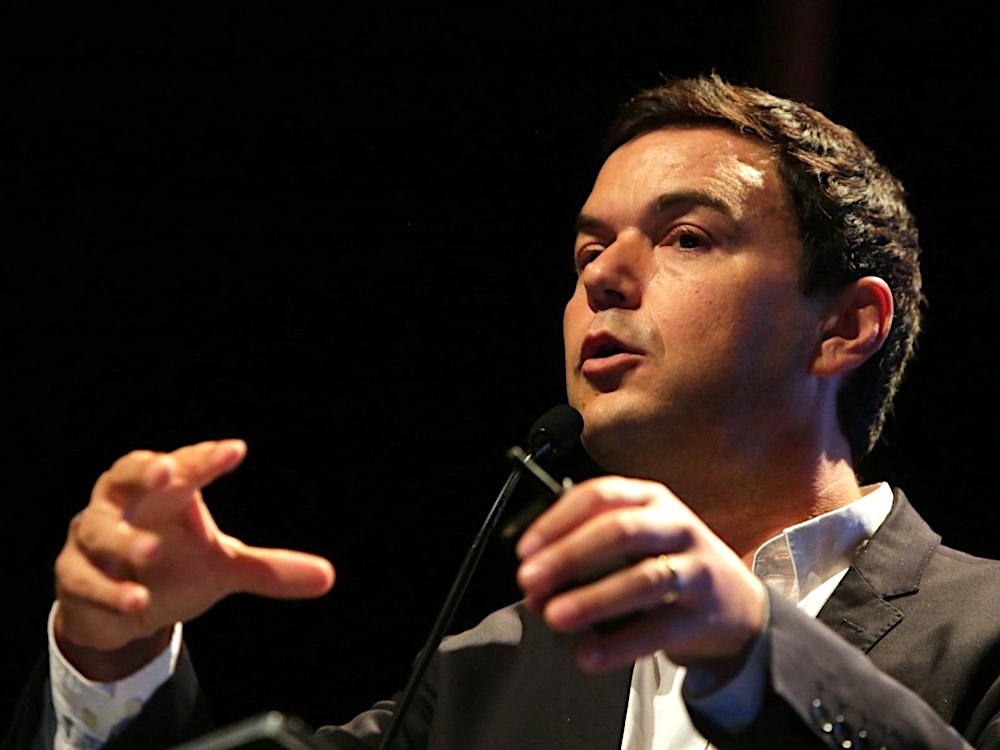
The idea sounds like science fiction. But it is a very serious proposal, put forward by French economist Thomas Piketty and his colleagues at the World Inequality Lab, a global research centre studying how to reduce social and economic inequality. The World Inequality Lab recently published its 2026 Global Justice Report, which envisions economically, ecologically sustainable progress around the world from the years 2026 to 2100.
Piketty and his colleagues are no utopians. They offer a practical solution to our critical problems of climate change and wealth imbalance. It makes sense.
But they don’t offer any way to reach it except to vote for it.
Centuries of injustice
The Global Justice Report has a simple premise: rich people get rich by stealing from poor people on a national scale.
By extension, rich countries get rich by stealing from poor countries on a global scale. Rich countries take poor countries’ resources, enslave their people and corrupt or overthrow their governments. This has gone on for centuries.
Among the consequences of this enrichment, we have so-called “developed” nations and “undeveloped” nations, cutthroat competition for resources, immense consumption by the few and poverty for the majority, and the worsening climate breakdown caused by carbon dioxide emissions from manufacturing and consuming. The peoples of the poor nations are already suffering more from global warming, though they have contributed much less to it.
The situation we are in is, in a word, unjust. The solution to our climatic and economic problems must therefore be just as well as effective.
The report proposes a breathtaking solution to these problems: a “Global Justice Fund,” receiving revenues from a global income tax and a global wealth tax, the proceeds of which go into “country dividends.” These dividends would go to countries on a per capita basis as investments in health, education and climate infrastructure. They would prime the pump and encourage countries to invest still more.
The global wealth tax kicks in for people who own 10 times the world average wealth. The report describes the steps:
“Tax rates rise gradually from zero per cent at the level of 10 times average world per adult wealth (about 1.1 million euros in 2026) to one per cent at 20 times average wealth (2.2 million), three per cent at 50 times average wealth (5.5 million), five per cent at 100 times average wealth (11 million), 10 per cent at 500 times average wealth (55 million), 15 per cent at 1,000 times average wealth (110 million) and 20 per cent at 5,000 times average wealth (550 million).”
These measures, the report tells us, target “around one per cent of the world population.” Canadian homeowners could congratulate themselves on being in that top one per cent.
The Global Justice Fund also supports a “World Sovereign Fund,” described in the report as “an active portfolio of sustainable assets reaching 10 per cent of the world capital stock (or equivalently, to 60 per cent of the world GDP).”
A huge boost for international development
The revenues from these funds also go to countries on a per capita basis to fund health, education and climate infrastructure. Poor countries will get more, and the people in them will be the chief beneficiaries. The report estimates that between 2026 and 2060 the Global Justice Fund’s country dividends and investment flows would reach 10 per cent of world GDP per year.
“In comparison,” the report says, “current official development aid and the combined budgets of the UN, International Monetary Fund, and World Bank account for less than 0.4 per cent of world GDP.”
The report, in effect, takes “Tax the rich” and turns that slogan into a step-by-step plan for decarbonizing, decolonizing and deimperializing the world.
The report argues that almost everyone in the world will benefit: “About 89 per cent of the world will double their monetary income between 2026 and 2100; over 95 per cent gain in the Global South, and between 85-95 per cent in the Global North. Over 99 per cent of the population is better off when the value of leisure and planetary habitability is included.”
Piketty and his colleagues cite some injustices that we in the rich nations are still reluctant even to think about. Nations enriched by slavery are now being asked to pay reparations to the descendants of those they enslaved. Something similar is owed to Indigenous Peoples displaced and oppressed by imperialist nations. The Global Justice Fund would make restitution in the form of education and health care.
No government whose wealth is based on ancient slavery will be eager to join this fund and begin restitution.
Elon Musk will not be eager to pay a yearly 20 per cent tax on his wealth of $1.7 trillion — and then pay 90 per cent of the income gained every year from that wealth.
How could such entrenched interests yield to an entirely new world order?
A weakening global plutocracy
Piketty and his colleagues think it might be easier than it looks. They see the present order as a “global plutocracy” in which rich nations, since the end of the Second World War, exert power over poor nations by controlling institutions like the International Monetary Fund, or IMF.
But the plutocracy is weakening. “Generally speaking,” they write, “we stress that the current international system faces a serious legitimacy problem and that it is a lot more fragile and unstable and much less frozen than is commonly thought.”
The United States, in particular, has been steadily losing its economic and political clout. Its gross domestic product is a shrinking proportion of global GDP, and therefore of its voting power in institutions like the IMF.
The report proposes a change from global plutocracy to global economic democracy. The Global Justice Fund would be set up immediately and include all nations. It would make decisions based on a “double majority”: 55 per cent of the member countries representing 60 per cent of the world’s population.
If the rich countries balk at this, a more gradual transition to a population-based voting system could take place over the next 25 years.
“In effect,” the report argues, “we would gradually move from a system where each inhabitant of Europe and North America/Oceania has about 16 times more votes than each inhabitant of sub-Saharan Africa and South and Southeast Asia to a system where all inhabitants of the world have the same voting power.”
But the rich countries would still have excess influence at the beginning and might use it to reduce global income and wealth taxes. This could postpone economic equality for decades, if not indefinitely, while poverty and climate change worsened.
Even that could be prevented if voters in rich countries elect governments that commit to global justice and economic democracy. After all, most people in rich countries aren’t very rich themselves and would directly benefit from the investments made by the Global Justice and World Sovereign funds. So political parties that endorse creating the funds could make an attractive appeal for votes.
They would, of course, face bitter opposition from the billionaires and their politicians. The report suggests, not entirely persuasively, that the next economic crisis could create an opportunity to oust the oligarchs and install economic democracy.
It’s possible, but economic crises have historically been spun into rescue operations for the oligarchs and their banks and corporations. In effect, they screw up and we bail them out with our tax money, over and over. Every time, the poor give to the rich and get nothing in return but continued immiseration.
Governments run by parties committed to global justice could, however, let the oligarchs go under, and then nationalize their corporations. That could help launch the Global Justice and World Sovereign funds.
In his book Value(s), Mark Carney argues: “More equal societies are more resilient, they are more likely to invest for the many, not for the few, and to have robust political institutions and consistent policies. And few would disagree that a society that provides opportunity to all of its citizens is more likely to thrive than one which favours an elite, however defined.”
If he really believes that, the Global Justice Report offers a chance to make Canada truly thrive as an economic democracy. ![[Tyee]](/design-article.thetyee.ca/ui/img/yellowblob.png)
Read more: Rights + Justice, Environment









.jpg)
Tyee Commenting Guidelines
Please note that email notifications for replies are not currently working due to a software issue which may be resolved in a future update.
Comments that violate guidelines risk being deleted, and violations may result in a temporary or permanent user ban. Maintain the spirit of good conversation to stay in the discussion and be patient with moderators. Comments are reviewed regularly but not in real time.
Do:
Do not: