

 SHARE:
For a decade, Jonathan Wilkinson symbolized the new Liberal party that Justin Trudeau had built.
A former New Democrat and clean-tech CEO, Wilkinson arrived in Ottawa surfing a Liberal wave built on sunny ways and bold ambition, especially on climate change. He would emerge as a point person in the Trudeau cabinet, first as minister of the environment and climate change, then as minister of energy and natural resources, treading a fine line between climate action and resource extraction.
Prime Minister Mark Carney took a different approach. A month after the 2025 federal election, Carney dropped Wilkinson from cabinet and replaced him with Tim Hodgson, a former Goldman Sachs banker and adviser to Carney when he was governor of the Bank of Canada. With Hodgson racing around Canada to negotiate a new West Coast pipeline and former environment minister Steven Guilbeault quitting cabinet in protest, it became clear that this government would not simply be a continuation of the Trudeau years.
Wilkinson resigned as an MP and is now Canadian ambassador to the European Union. Carney’s minority government became a majority earlier this year with successive floor crossings from both former Conservative and NDP MPs; the party also added seats when it won three byelections this April. With the Conservatives in the doldrums and an uptick for both the New Democrats and the Greens, North Vancouver-Capilano will be a good barometer for just how popular the Liberals are. Voters will go to the polls on Aug. 31 to choose a replacement MP for their North Shore riding, which includes all of the city of North Vancouver and parts of the district of North Vancouver and eastern West Vancouver.
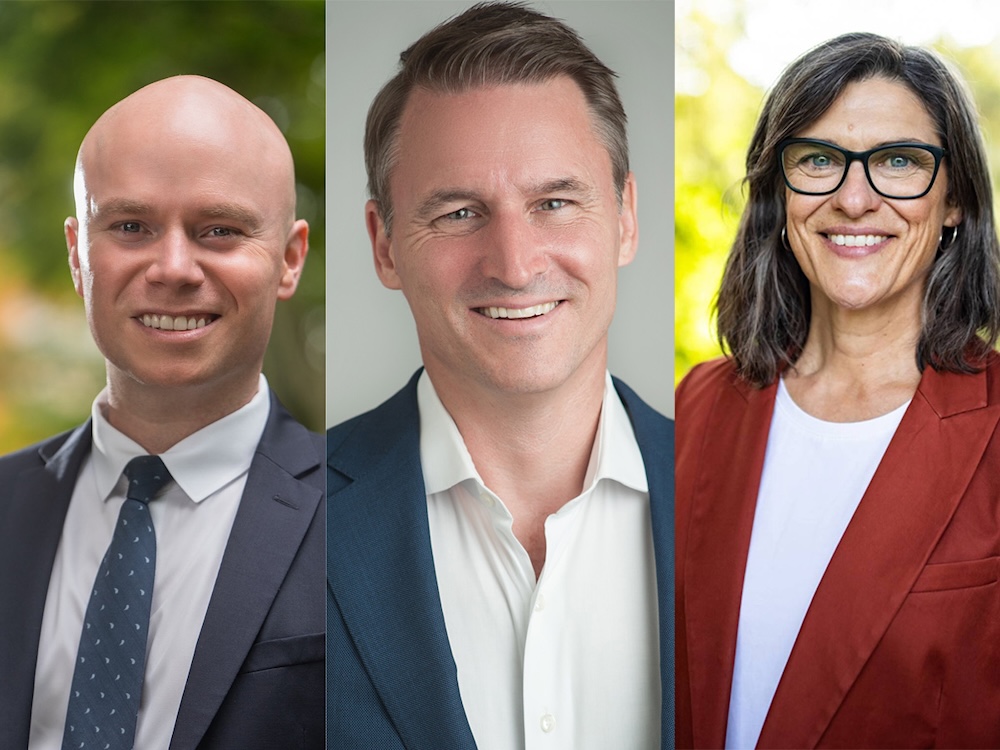
The Liberal candidate, Braeden Caley, has had a hand in shaping both the Trudeau and Carney governments. (Politically obsessed Vancouverites might also remember Caley as director of policy and communications to former mayor Gregor Robertson — Robertson himself is now a Liberal MP and federal minister of housing and infrastructure.)
After years working as a Liberal staffer in different capacities, Caley was appointed president and CEO of the progressive think tank Canada 2020 in 2022 — the same year Mark Carney joined its advisory board.
In the twilight of Trudeau’s leadership, it was Caley who reached out to the producers of The Daily Show to launch Carney’s political career into prime time. He would spend the next year and a half by Carney’s side, first as his leadership campaign director, then as the Liberals’ national campaign co-director and lastly as deputy chief of staff in the Prime Minister’s Office.
Caley grew up in Richmond, lived in Vancouver for most of his adult life and recently moved to Central Lonsdale after time away working in Ottawa. Now, he wants to step out of the backrooms.
“As this year went on, the economic opportunity of the country kept coming back to my home, British Columbia, where the most potential was,” he says. “Trump’s threats have brought them into clear perspective, and I want to bring those opportunities to bear for the benefit of people across the North Shore and really all of B.C.”
Nick Hosseinzadeh, a former North Shore politico who now works as chief of staff to Township of Langley Mayor Eric Woodward, sees a unique offering from Caley. “I mean, who’s going to be able to call the prime minister or staff any time he needs help on something?”
Whether Caley will know what exactly to call the prime minister about is a question his opponents will demand an answer on. No matter their position on the political spectrum, his rivals can claim the one thing Caley cannot — they are longtime North Shore residents who have lived with the problems they want to solve in Parliament.
NDP candidate and provincial constituency staffer Stephen Tweedale, who has lived on the North Shore for over 26 years, says that voters are “puzzled by the Liberal candidate, who’s been parachuted into the riding and has no connection with the community here.”
Conservative candidate Stephen Curran agrees.
“Local knowledge takes time,” the lawyer and longtime North Vancouver resident argues, “and it grounds me in local priorities, not Ottawa’s.”
Curran is confident that in his second run he will be able to beat Caley on local issues such as bridge congestion and rising property taxes.
Green candidate and former Sierra Club campaigns director Shelley Luce also emphasizes her local bona fides in comparison to Caley. “Win or lose this election, I’m not going anywhere. I live here.”
So what do the residents of North Vancouver-Capilano care about? It depends on where you look. If one had to cleave the riding in two, it would be along the Trans-Canada Highway.
Above it, neighbourhoods such as Upper Lonsdale, Lynn Valley and Capilano are dominated by suburban single-family homes where median incomes are over $100,000. In these neighbourhoods, fewer than a third of residents in the area are renters.
Usually, that would be enough to make the polling places there a standard Liberal-Conservative two-way race. However, proximity to the North Shore mountains and culture of hiking, skiing and mountain biking have given residents here a bit of a green thumb. In 2019, when climate consciousness surged, the Greens outpolled the NDP here, especially around Upper Capilano.
That environmentalist streak could put the federal Liberals in an awkward position. Carney’s first move as prime minister was to axe the consumer carbon tax, and he has since staked much of his economic agenda on getting Canadian resources — with a big emphasis on oil and gas — to international markets.
For Luce, that represents a fundamental mismatch between the government's economic priorities and the concerns she hears at the door.
“People feel precarious now in ways that maybe they didn't in the recent past,” she says.
To her, the government’s focus on supporting fossil fuels is a sign they are focused on the wrong issues.
“People can connect the dots between the rising cost of living and rising fuel costs and spending $50 billion on a pipeline,” Luce says.
Her central critique is that Ottawa, having originally promised that the proposed pipeline project would be privately funded, is now asking Canadians to accept taxpayer money being used for yet another subsidy, while households struggle with the cost of basic necessities.
To the NDP’s Tweedale, the pipeline is evidence of a government with misplaced priorities.
“People are struggling to afford the basics, especially housing, at the moment,” he says. “And instead of helping people with the cost of living, he's blowing billions on an oil pipeline, in a climate crisis.”
Curran, the Conservative candidate, is more supportive of resource development but is skeptical that a pipeline will actually be built. “This is not a very different government, and there’s a very slim chance we get a pipeline. Look how resistant some MPs in his caucus have been.”
Below the highway, the suburbs give way to a more urban landscape of condo towers, townhouses and low-rise apartment buildings. Here, housing affordability and the cost of living loom large.
These neighbourhoods have also seen an influx of transplants from downtown Vancouver.
“People who lived in Vancouver and had some valuable condo appreciation over time were selling their homes and moving to North Van,” Hosseinzadeh says, “where maybe they can upgrade to a townhome or a single-family home.”
By moving across Burrard Inlet to raise a family near nature, these millennials also brought their progressive voting habits with them. The riding swung between the Liberals and Conservatives in the 2000s. But with Trudeau’s 2015 victory, the riding took a decisive swing to the left.
In 2025, that win came with an asterisk. The same families who stretched themselves thin to buy a condo or townhome in the 2010s were repeatedly hammered by rising mortgage payments and property taxes. Younger homeowners are still grappling with the effect of post-COVID interest rate hikes for their condos.
These pressures have also shaped the politics of the North Shore’s newer immigrant communities, most notably its largest one — Persians. For newcomers, the cost of living bites even more with no family to lean on for support. Another factor fuelling the Iranian diaspora’s rightward shift is anger at Canada for not being strong enough in its response to Iran.
Since the end of the Joint Comprehensive Plan of Action intended to prevent Iran from ever obtaining nuclear weapons, relations between Iran and Canada have become more hostile. Since winning the Conservative leadership in 2022, Pierre Poilievre has courted Canada’s Iranian diaspora. Events like the Women, Life, Freedom protests as well as unrest earlier in the year have spurred Iranian Canadians to demand a crackdown on regime-affiliated individuals in Canada.
These factors combined to drive a Conservative swing in the North Shore’s heavily West Asian neighbourhoods in the last federal election.
In the three polling stations in the Cedardale neighbourhood, for instance — which has a majority West Asian population, according to the census — the Liberal vote declined while the Conservatives made gains. That trend stands in contrast with vote share across the entire riding, where the Liberal vote jumped 15 points while the Conservatives ticked up only four points.
Since then, concerns over Iran’s hardline regime have jumped due to escalating hostilities between Iran and the United States. While that could spill over as voter backlash against the Liberals, Hosseinzadeh cautions against treating the Persian community as a monolith. Many have lived in Canada for decades, and their primary political concerns are rooted in local priorities.
“For a lot of the Persian community, we've been here for a long time,” he says. “Canada has been their No. 1 country. It's their home.”
In North Vancouver-Capilano, you do not have to be fluent in Farsi to see the effects of the war on Iran. You just have to go to the nearest gas station and check the prices. Caley, Tweedale and Luce have all endorsed an expansion of bus rapid transit to save people money and speed up their commutes, and that same surge in gas prices has been a driving force in Carney’s quest for energy security.
This byelection will not determine who forms government in Ottawa, a fact that Caley’s opponents have seized on. Instead, they hope to make the campaign’s central question this: Who best understands what these global pressures mean on these streets?
James Knight, Curran’s campaign manager and founder of Next Gen Political Strategies, thinks Caley may be in for a surprise. “I’m not sure he knows North Vancouver-Capilano as well as he thinks he does.” ![[Tyee]](/design-article.thetyee.ca/ui/img/yellowblob.png)
Read more: Politics



Tyee Commenting Guidelines
Please note that email notifications for replies are not currently working due to a software issue which may be resolved in a future update.
Comments that violate guidelines risk being deleted, and violations may result in a temporary or permanent user ban. Maintain the spirit of good conversation to stay in the discussion and be patient with moderators. Comments are reviewed regularly but not in real time.
Do:
Do not: