


 SHARE:

I stood amused and delighted, watching my daughter behind the counter. She was learning how to make espresso at a local café, her new place of employment. She struggled with frothing: how much air to add for a latte, a cappuccino, a flat white, a macchiato. She carefully calibrated the ideal temperature of each beverage by touch, for prime sweetness. She precisely changed 18 grams of fine and coarse espresso grind while administering the ideal 23-to-26-second pour.
Someone stood beside her, patiently explaining the machinery. They demonstrated the proper sequence of tasks, and watched intently as she mirrored. Tiny errors, invisible to the customers buzzing about, were corrected. She practised. Made mistakes. Tried again. And again. This took discipline. The machine didn't become simpler, but after hours of persistence she slowly persevered.
Watching her, I reflected on a conversation I had with a family member shortly after they were elected to city council in B.C.’s Interior. They had no prior experience with municipal politics. I asked if new councillors received training or orientation before assuming the important responsibility for public budgets, land-use decisions, staff reports and the countless other things crossing a councillor's desk.
The answer: surprisingly little.
Almost immediately after they were elected, their inbox filled with hundreds of pages of jargon-filled reports, carrying assumptions about how the city functions, what trade-offs matter and what constraints are real — assumptions that had accumulated like sediment over decades. Legal requirements, technical recommendations, administrative conventions, financial constraints and political choices appeared side by side, without discrimination.
Winning the voters’ trust earned them office, but winning an election doesn’t automatically grant new city councillors the deep institutional knowledge needed to make informed governance decisions. To govern effectively, they need grounding in municipal finance, provincial authority, regional governance, infrastructure, land economics, administrative law and the relationship between council and staff. But by and large, comprehensive training for new elected officials is simply not available.
Competence must be cultivated in many ordinary forms of work. From coffee shops to call centres, we provide — and expect — instruction, supervision, repetition and feedback for countless seemingly menial tasks. Yet we treat democratic authority as though it arrives by magic, fully formed on election night.
The problem extends well beyond elected officials.
We ask residents to participate in municipal decisions without explaining where authority lies, what has already been decided or when their influence still matters. We ask councillors to govern complex institutions without preparing them to interrogate the systems they inherit. Meanwhile, public servants, working within specialized departments, are separated from the history and intent behind the rules they administer.
Municipal democracy, as we know it, depends on residents, councillors and staff understanding enough of the same system to question one another meaningfully. But, increasingly, they don’t.
The result isn’t simply a knowledge gap. It’s a civic system in which different participants speak different languages, even when they’re arguing about the same city.
Three reasons why city politics feels broken
A familiar scene in city hall: A public hearing runs late into the evening. Residents take turns speaking. Some support the proposal. Others oppose. Staff present technical analyses. Councillors ask questions. After hours of testimony, council votes.
The next morning, participants carry entirely different understandings of what happened. Some believe democracy worked as intended; others think the outcome was predetermined. Some feel heard, others ignored. Many wonder if their participation mattered at all. This experience captures something larger than any single public hearing.
Municipal politics often feels intensely important, physically immediate, yet strangely difficult to understand. It attracts cynicism as a result.
Part of the reason it can feel so broken is that the city we experience is not governed from one place. A housing proposal may be shaped by municipal zoning, provincial legislation, federal financing programs, regional transportation decisions, infrastructure capacity, land economics and private lending.
A transit project may involve TransLink, the mayors’ council, the province, individual municipalities and the federal government. Homelessness is experienced most visibly on city streets, even though many of its causes and potential responses involve health care, income assistance, housing policy and other provincial responsibilities.
Responsibility is distributed. Political blame, rarely so. Municipal government, the institution closest to daily life, frequently absorbs frustration for decisions it only partly controls.
A second reason is timing.
By the time most residents first encounter a municipal proposal — through a postcard, open house, development sign or news article — much of the consequential work has already been done. Staff and applicants have spent months discussing height, density, servicing, transportation, public benefits and financial feasibility. Plans may have already been guided by policies adopted years earlier — some spanning political cycles — through processes that attracted little public attention.
Most citizens don’t understand that public engagement begins within confined boundaries rarely obvious to participants.
People may be asked about landscaping, public-realm details or the treatment of a lane, while assuming that the larger proposition remains open for reconsideration. These questions aren’t meaningless, but they’re different from deciding whether the project should exist in its proposed form.
Being informed about a decision isn’t the same as shaping it. Being invited to speak at a public hearing doesn’t mean every option remains available. A consultation process can be sincere while still producing an outcome its participants oppose.
This is where one of the most important distinctions in municipal democracy appears: Participation and power are not the same thing.
The third reason is political communication itself.
Municipal issues are slow to explain and difficult to compress into a slogan. Campaigns, news cycles and social media reward something else: certainty, conflict, heroes, villains and simple causes.
Candidates promise results without explaining whether the city possesses the power or money to deliver them. Governments describe consultation in terms of volume without clarifying the boundaries of public influence. Advocates present technical assumptions as settled facts when those assumptions may contain political judgments.
Civic literacy is thus not merely absent from political debate. The political environment can benefit from its absence.
A public that doesn’t know which government holds the authority is easier to redirect. A council that can’t distinguish a legal constraint from an administrative convention is easier to overwhelm. A technical report whose assumptions are inaccessible to non-specialists is harder to challenge.
Civic literacy is democratic infrastructure
Civic literacy is often understood as knowing the names of elected officials, the date of an election or the steps through which a bylaw is passed. These matter. But civic literacy is also something more practical: it’s the ability to understand where a decision is being made and who is responsible for it, what legal and financial constraints apply and which parts remain political choices. And, importantly, when meaningful intervention is still possible.
For residents, that knowledge creates leverage. It helps people direct their concerns toward the institution that possesses the authority to respond. It allows them to participate earlier, recognize when public consultation has simply become public notification, and distinguish between genuine constraints and convenient excuses.
For councillors, it creates capacity for sound judgment. Elected officials shouldn't be expected to arrive as well-seasoned planners, engineers, lawyers or accountants. Their role is not to replace professional expertise. But they need enough institutional understanding to ask informed questions of that expertise and expose biases. They need to know when a staff recommendation reflects law, when it reflects professional judgment and when it reflects a policy choice that council is entitled to reconsider.
For staff, civic literacy takes another form: institutional memory. Public servants need to understand not only what a rule says, but why it exists, how it has been interpreted and what it has produced in the city.
Years ago, Vancouver recognized this need. They put a planner by the name of Martin Chee in charge of keeping track of how the city’s zoning schedules had been interpreted and how those interpretations had evolved.
Chee created an internal, after-hours course on the zoning and development bylaw for planning staff who wanted to deepen their understanding. Well-known historian and civic commentator John Atkin took staff into neighbourhoods to examine zoning in the physical city. Each walk focused on a single zoning district.
Participants studied the wording of the schedule, its rationale and history, then looked at the buildings and streets it had produced. The program had three levels, each with a certificate of completion.
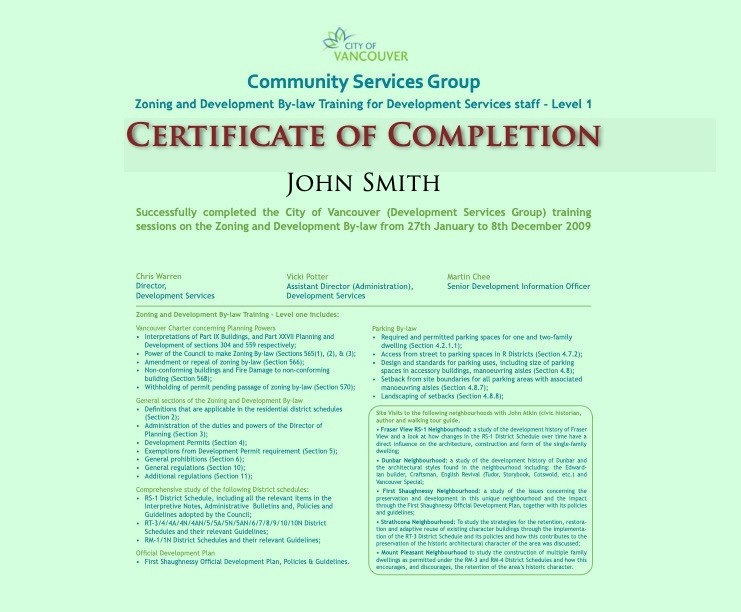
The exercise revealed something that a written bylaw couldn’t convey on its own: the words on the page weren’t intended to be read literally or in isolation. Their meaning depended on intent, precedent, interpretation and changing circumstances. Staff could see where a rule worked, where it failed and where the physical city no longer resembled the assumptions embedded in the regulation.
The city itself became the classroom.
That kind of institutional learning matters because rules cannot interpret themselves. A zoning schedule may remain enforced for decades while the reasons behind it gradually disappear. Staff retire.
Departments reorganize. Informal interpretations become habits. Words written for one historical condition are applied to another. Eventually, an institution can continue administering a rule after it has forgotten the problem the rule was intended to solve.
Expertise is not something an institution simply possesses. It is something the institution must continually teach, test and renew.
Understanding is not obedience
There is an obvious danger in making the case for civic literacy. Calls for greater understanding can become polite ways of telling residents to trust the experts, accept institutional constraints and stop opposing decisions they dislike. That is not the argument I’m trying to make.
Civic literacy shouldn’t make people more obedient. It should make them harder to mislead.
A resident who understands the process may become more sympathetic to genuine legal or financial constraints. But that same resident also becomes better equipped to identify performative consultation, jurisdictional buck-passing, unsupported claims and decisions made before public participation began.
A councillor with greater institutional knowledge shouldn’t simply defer more readily to staff. That knowledge should allow the councillor to question staff recommendations with precision, examine assumptions and separate technical findings from political judgments.
Staff literacy matters for the same reason. Understanding the history of a rule shouldn’t bind staff forever. It should help them recognize when the rule no longer serves its original purpose.
A city is something we do together
Most people don’t spend their days thinking about municipal government. They think about finding housing, getting to work, paying taxes, walking children to school, meeting friends in a park, avoiding construction detours or wondering why a familiar street is changing. They think about the city itself, not the institutional machinery helping to shape it.
But that machinery is everywhere.
Every park, sidewalk, apartment building, community centre, transit station, bike lane and public space reflects decisions accumulated over time. Some were made by councillors. Others were shaped by city staff, residents, applicants, community organizations, courts or provincial legislation.
The city we inhabit is the physical residue of those countless formal and informal choices.
That doesn’t mean everyone has equal influence. Participation requires time, knowledge, confidence and resources that are unevenly distributed. Technical language can conceal choices. Provincial governments can alter local authority. Consultation can empower some and leave others invisible. Those limitations are real.
But cities remain our most ambitious collective projects — places where millions of individual decisions produce shared consequences. Where conflicting interests must inhabit common streets, institutions and futures. Municipal government is one of the mechanisms through which those conflicts are managed. The goal of civic literacy is not consensus. Cities are too diverse, their choices too consequential, for disagreement to disappear.
The goal of civic literacy is better disagreement.
A sophisticated capacity for disagreement at the civic level looks like this: an ability to argue about decisions being made, hold the institution with authority directly accountable and intervene while alternatives are still available.
What voters should ask before the election
As this fall’s municipal campaign approaches, candidates will tell us what they intend to accomplish. They will make promises about housing, safety, taxes, transportation, public space, affordability and neighbourhood change.
Smart voters should ask another set of questions: ones that demonstrate candidates’ understanding of the institutions they hope to govern; that reveal their understanding of what powers belong to the city, and what belong to other governing bodies; and whether they know how to distinguish technical recommendations from political decisions.
Voters deserve to know how candidates plan to prepare themselves to evaluate hundreds of pages of staff reports, consultant findings and legal advice. And how municipal finance will constrain their campaign promises.
We should ask not only what candidates want to do, but how they understand the machinery through which they intend to do it.
Political parties and civic institutions should also take greater responsibility for preparing people to govern. Incoming councillors need substantial, transparent orientation that extends beyond procedure and departmental introductions.
The public should not be excluded from that learning.
We tend to treat civic literacy as a personal virtue, something diligent citizens acquire on their own. It’s better understood as democratic infrastructure. And like other infrastructure, it must be built, maintained and made broadly accessible.
When it’s neglected, the system may continue operating, but fewer people understand where it is going, who is steering it or how its direction might still be changed.
My daughter’s trainers at the coffee shop didn’t assume she would understand the espresso machine simply because she was allowed to stand behind the counter.
Municipal democracy deserves at least the same seriousness.
Understanding the city is where meaningful civic participation begins. ![[Tyee]](/design-article.thetyee.ca/ui/img/yellowblob.png)
Read more: Municipal Politics












Tyee Commenting Guidelines
Please note that email notifications for replies are not currently working due to a software issue which may be resolved in a future update.
Comments that violate guidelines risk being deleted, and violations may result in a temporary or permanent user ban. Maintain the spirit of good conversation to stay in the discussion and be patient with moderators. Comments are reviewed regularly but not in real time.
Do:
Do not: