


 SHARE:
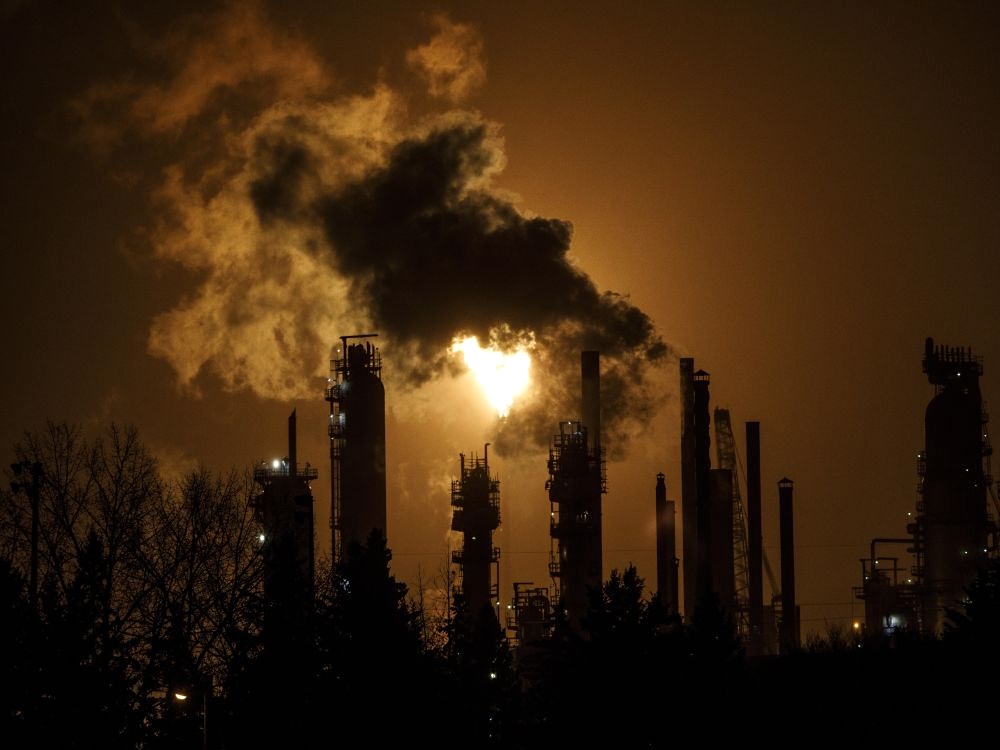
Canadians are reading labels again.
Since Donald Trump launched his trade war against Canada, many of us have renewed our commitment to buying Canadian whenever we can. Politicians are talking about building Canadian, buying Canadian and reducing our dependence on the United States.
Behind all of this is a pretty simple idea: ownership matters. Where something is made matters, but so does who owns the company making it and where the profits ultimately end up.
Maybe it’s time to take a closer look at the label on “Canadian” oil.
According to a recent analysis from Canadians for Tax Fairness and the Alberta Federation of Labour, the four companies that dominate oilsands production — Canadian Natural Resources, Cenovus, Imperial Oil and Suncor — are close to three-quarters foreign-owned, with approximately 60 per cent of their shares owned by Americans. None are majority-owned by Canadians. Together, these companies account for more than 80 per cent of oilsands production.
In recent years, a striking share of the record-breaking profits generated by these companies has been funnelled to shareholders through dividends and share buybacks. Between 2021 and 2024, the big four distributed almost $80 billion to shareholders. The Canadians for Tax Fairness report estimates that nearly three-quarters of that went to foreign owners, including more than $6 out of every $10 to U.S. shareholders.
The current disruption of oil shipments through the Strait of Hormuz is only intensifying this dynamic. Canadian consumers pay more and corporate profits go up, with much of it going directly into the pockets of foreign — primarily U.S. — investors.
So just as Canadians are doing our best to ensure that the money we spend stays in this country, billions of dollars generated from Canadian resources are flowing south of the border.
Yet most Canadians probably do not think of the companies that dominate the “Canadian” oil sector as majority foreign-owned, or that they are increasingly operated primarily to maximize returns to foreign shareholders. Instead, many are likelier to think of this industry as something that is inherently Canadian, an essential aspect of “who we are and what we do,” as former Conservative politician Jim Prentice once put it.
Why?
Misled by ‘symbolic nationalization’
For more than two decades, the oil industry and its political supporters have mounted a remarkably successful campaign to portray this corporate, heavily foreign-owned industry as something that belongs to all of us. Oil becomes “Canadian energy.” Its exports become “our exports.” Policies that increase corporate revenues become investments in Canadian prosperity.
I call this symbolic nationalization. The “Canadian” oil industry is a corporate, for-profit enterprise managed first and foremost in the interests of private, often global, shareholders. Yet a flood of advertising, public relations, political speeches, industry advocacy and sympathetic media coverage has relentlessly encouraged us to imagine the sector as though it had actually been nationalized and operated in the public interest.
Symbolic nationalization performs a kind of political alchemy: it transforms the specific interests of the oil sector into the general interests of all Canadians. So what is good for Suncor, Imperial Oil or Cenovus becomes good for all of us. In three open letters published in the months following Trump’s initial attacks, some of Canada’s most powerful CEOs seized upon the threat to Canadian sovereignty to pitch an agenda of expanding fossil fuel production, higher corporate profits and regulatory rollbacks as nation building of the first order.
Higher profits for the oil industry become prosperity for all Canadians. Expanding fossil fuel production and infrastructure becomes an exercise in economic sovereignty. Dismantling environmental protection and climate policy becomes a pragmatic strategy to “Build Canada Now.”
The gaslighting — when you think about it — is truly breathtaking.
When Pierre Trudeau’s government introduced the National Energy Program in 1980, it proposed a modest program of “Canadianizing” an oil industry that was then largely foreign, predominantly U.S.-owned. The NEP aimed to increase Canadian and public ownership, insulate Canadian consumers and businesses from volatile global oil prices and distribute petroleum revenues more broadly across the country.
Industry hated it. And together with the Alberta government, they fought it ferociously.
But once even this modest experiment in “Canadianization” had been defeated, industry and its political allies gradually realized that symbolic nationalization offered enormous political benefits without any of the economic obligations.
Norway’s stronger path
If we want to see a petroleum sector actually organized to prioritize the public interest, Norway provides a compelling comparison, and an especially revealing one for Canada.
Norway created Statoil as a wholly state-owned oil company in 1972 and today still owns 67 per cent of its successor, Equinor. It also used petroleum revenues to build a sovereign wealth fund, now worth US$2.3 trillion, that was designed to ensure that resource wealth serves the long-term interests of the Norwegian people.
Ironically, Norway initially looked to Alberta for inspiration. Peter Lougheed created the Heritage Savings Trust Fund in 1976 to turn oil royalties into lasting public wealth. But his successors chose a very different path: regular contributions to the fund ended, and government adopted an industry-designed regime that applied very low royalties to attract private investment and accelerate development. Alberta decisively moved away from using the sector to build public wealth just as Norway was demonstrating how effective that model could become.
This context matters as Canadians think more broadly about how to respond to Trump’s trade war. Reading the label on “Canadian” oil requires more than knowing where the resource comes out of the ground. It means asking who owns the companies producing it, how they are governed and where the profits go.
This is especially important when governments spend public money in the national interest.
Consider the Trans Mountain expansion project, or TMX.
In 2018, the federal government literally nationalized the pipeline after Kinder Morgan concluded that it was no longer willing to tolerate the financial and political risks associated with the expansion project. Ottawa paid $4.4 billion for the existing pipeline and then financed construction as the cost of the project exploded from roughly $5 billion to more than $34 billion once it was completed in 2024.
TMX was relentlessly pitched to Canadians by Justin Trudeau, Rachel Notley and others not simply as infrastructure, but as a project in the national interest. There is little question that the completed pipeline generates economic benefits for oil producers and the government of Alberta. It has increased the capacity to export Western Canadian crude to overseas markets, reducing reliance upon the United States, and thereby helped to narrow the discount that oil from Alberta receives compared with global prices. But higher profits for oil companies and increased revenues for the Alberta government are not equivalent to gains for Canada as a whole. Treating them as though they are is precisely the work that symbolic nationalization is designed to do.
While business headlines may trumpet the revenues that TMX contributes to the federal government, a deeper dive into the project’s finances raises serious questions about whether that profitability is an accounting illusion. Tyee reporting reveals that much of TMX’s massive debt has been shifted to a separate government-owned corporation, TMP Finance. Once that debt and interest costs are included, the project as a whole is in the red. While the completion of TMX has increased profits for predominantly foreign-owned oil companies and royalties for the Alberta government, Canadian taxpayers have been left on the hook for the project’s massive debt.
Another pipeline sell job
Reading the label matters. When economists or politicians pitch us pipelines as bringing economic benefits to Canada, the question we need to ask is: benefits whom? Where do those benefits actually flow? Foreign shareholders? Private oil companies? Alberta’s treasury? Revenues for the federal government? Workers? Local suppliers? These are all fundamentally different outcomes. The differences matter a great deal. Yet symbolic nationalization routinely collapses them all into a single national balance sheet — “good for Canada” — that hides far more than it reveals.
And here we go again.
In November 2025, Ottawa and Alberta agreed that a second pipeline to the B.C. coast would be privately constructed and financed. Less than a year later, that commitment has disappeared. With no private company willing to lead and finance the project, taxpayers are once again called upon to shoulder the costs and risks of infrastructure designed to serve massive, highly profitable and majority foreign-owned oil companies. The estimated cost is already between $35 billion and $44 billion. Given that the cost of TMX increased more than sixfold before it was finished, there is little reason to assume the bill will stop there.
Private profit, public risk. Again.
Which brings us back to the trade war.
Alberta’s big no to an export tax
Canadian workers and businesses in vulnerable sectors are facing significant — and, in some cases, existential — risks. Governments are spending billions to defend affected industries and communities. Canadians are changing what we buy and where we travel. Our prime minister consistently describes buying Canadian and building Canada’s economic independence as acts of solidarity and sovereignty.
But when the prospect of imposing a tax upon oil exports is raised as a strategic option in Canada’s response to Trump, the quintessentially “Canadian” character of “our oil” abruptly disappears. “Canadian” energy suddenly becomes Alberta’s resource, and the national interest gives way to the specific interests of oil producers, their shareholders and the Alberta treasury.
For Premier Danielle Smith, when Alberta needs Canada, oil is Canadian. When Alberta wants a pipeline, it is a test of “whether Canada works as a country.” But when Canada needs Alberta, oil is categorically off the table, even as most Canadians — including a majority of Albertans — support an export tax if necessary.
From gaslighting to clean energy
Whether Canada ultimately imposes an export tax is a short-term tactical question. The much bigger question — and the opportunity created by our renewed collective focus upon the national interest — is what actually makes an industry, or an investment, good for Canada.
Released earlier this year, the federal government’s “Powering Canada Strong” explicitly prioritizes abundant and affordable electricity as essential to Canadian competitiveness, energy security and economic sovereignty. It calls for investments that reduce our exposure to external shocks, lower costs for households and businesses, expand domestic manufacturing and supply chains and create high-wage jobs.
These are precisely the kinds of criteria that we should be using to determine whether an industry or a public investment serves the national interest. And they provide a revealing standard against which to judge the Mark Carney government’s growing willingness to commit public dollars to support the oil industry.
Even setting aside the devastating climate impacts of expanding oil production, subsidizing an industry whose largest companies are predominantly foreign-owned, that sends much of its profits to shareholders outside Canada, sheds workers even as production increases, thrives upon global price shocks that raise energy, food and other costs for Canadians and leaves behind enormous environmental liabilities stands in stark contrast to the criteria explicitly prioritized in the federal government’s own strategic planning.
By contrast, ensuring that public investments prioritize clean electricity and the energy transition can lower household energy costs and insulate Canadians from volatile global oil markets, strengthen domestic supply chains and manufacturing capacity, support millions of clean energy jobs and build the infrastructure and skills that can anchor a more prosperous, resilient and sovereign Canada.
Why are core principles of affordability, resilience, domestic capacity, sustainability and economic sovereignty not applied when pipelines and other fossil fuel projects are declared to be in the national interest? That is the enduring power of symbolic nationalization: it turns the interests of the oil industry into the interests of us all, without ever asking whether this is actually the case.
It’s time to see this rhetorical trick for what it is. Because when we actually read the label on “Canadian” oil, we’ll start to demand that our governments make different choices about where our public dollars are spent, and which investments will actually make Canada stronger. ![[Tyee]](/design-article.thetyee.ca/ui/img/yellowblob.png)










Tyee Commenting Guidelines
Please note that email notifications for replies are not currently working due to a software issue which may be resolved in a future update.
Comments that violate guidelines risk being deleted, and violations may result in a temporary or permanent user ban. Maintain the spirit of good conversation to stay in the discussion and be patient with moderators. Comments are reviewed regularly but not in real time.
Do:
Do not: