



 SHARE:
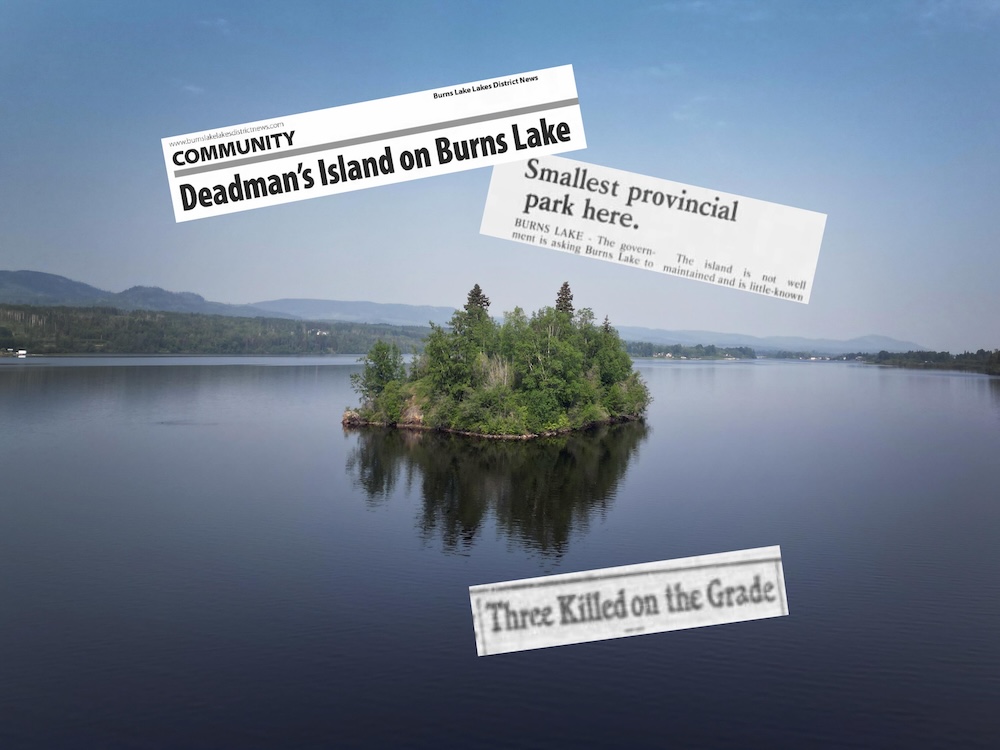
Dead Man’s Island rises, ghostly, from Burns Lake.
It sits on the horizon amidst a haze of early-season wildfire smoke that has drifted to central B.C. from the northeast. Two spruce trees reach above its deciduous canopy like a pair of triumphant devil horns.
We launch our canoes at Radley Beach, in the heart of the village of Burns Lake, and begin the two-kilometre paddle over glassy water, the sun just beginning to warm the day.
The island, a place of local legend, is proudly claimed by Burns Lake residents as B.C.’s smallest provincial park.
In its early days, the park was home to a cabin owned by the Young Rangers, a local youth group that trained in wildfire fighting in the 1930s and early 1940s. In more recent decades, it has hosted Mother’s Day picnics, barbecues and canoe races.
But its name hints at a more sinister legacy: a tragic railway accident rumoured to have killed more than a dozen workers over a century ago. Details of the story have been worn away by time. But the memory of those who died building the railway through northern B.C. lives on at Dead Man’s Island.
“It just seems to be a fitting homage to the people that actually did lose their lives while building the train tracks through here,” says Lynn Synotte, a local resident who spent decades volunteering on the island’s park board.
Dead Man’s Island Park was established by an order-in-council in 1933.
It was the first provincial park in northwest B.C. and among the first in the province. At roughly 100 metres by 50 metres, it is just under half a hectare — or about one acre.
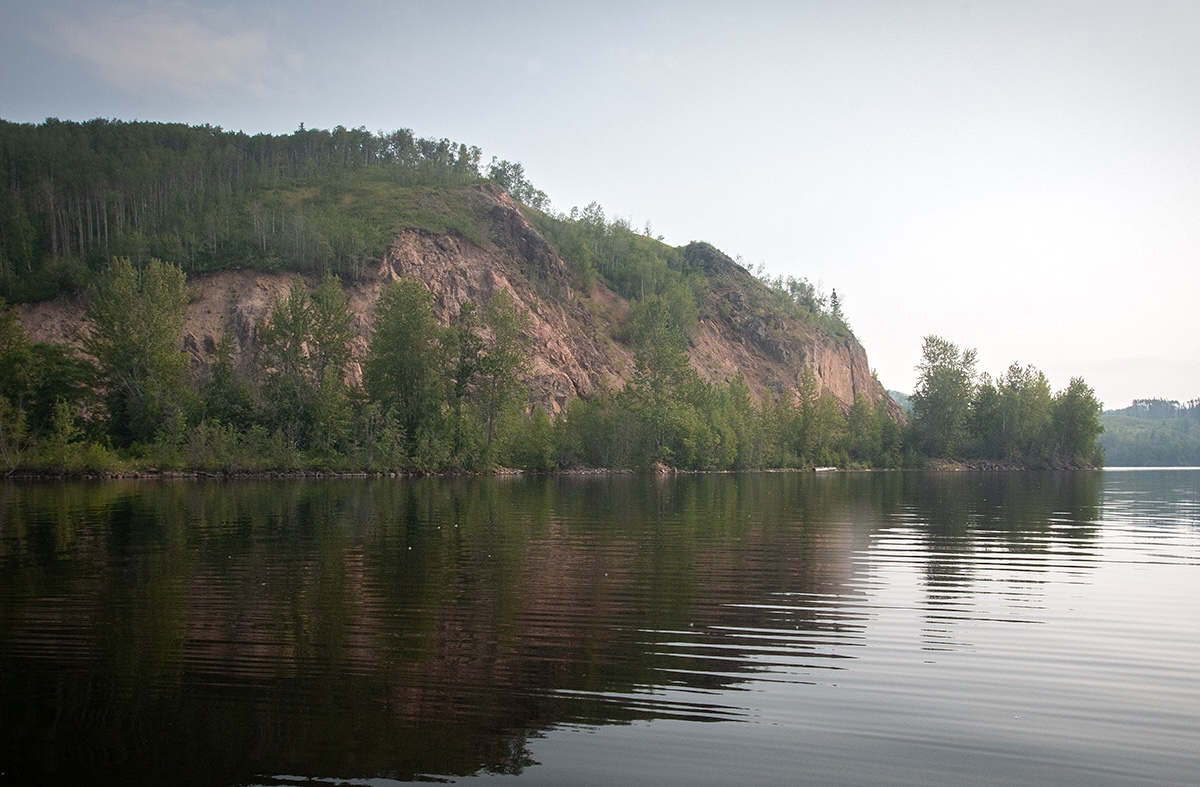
The island sits about 200 metres offshore. Along the shoreline, the railway hugs a rocky promontory that once plunged directly into the southern end of Burns Lake. As the railway was under construction in the early 1900s, that rocky promontory presented a significant barrier.
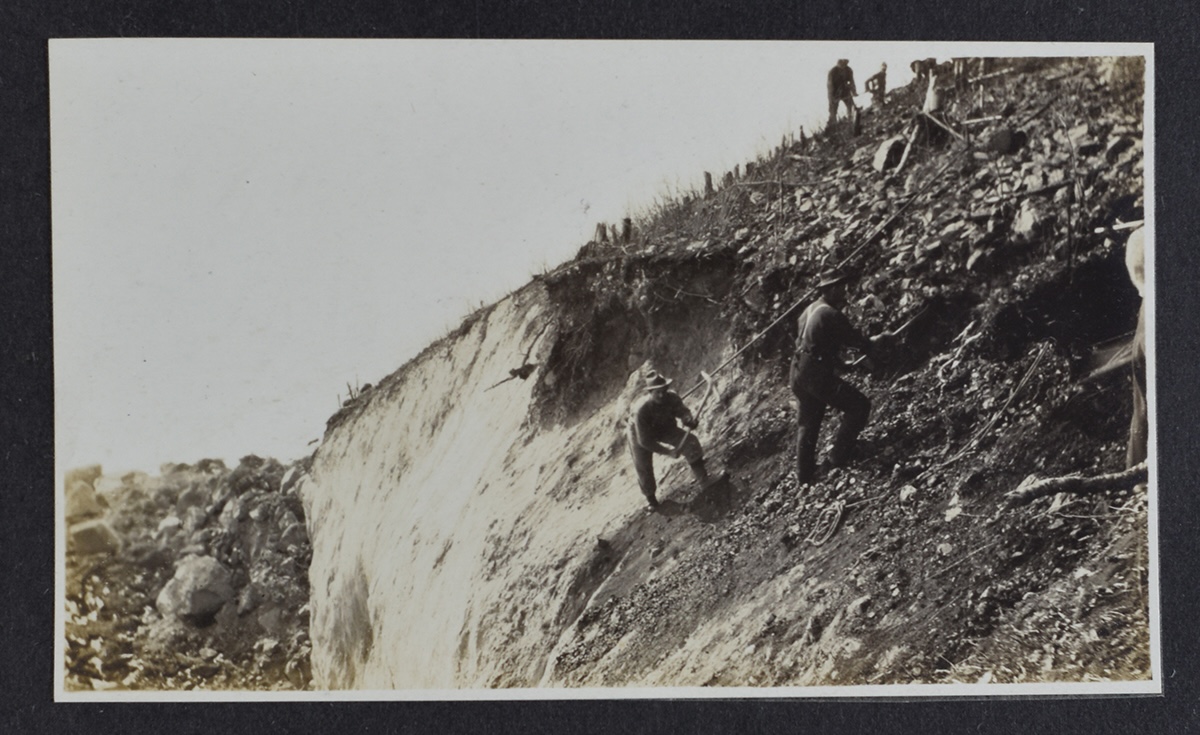
So, over two years, from 1912 to 1914, railway contractor Foley, Welch and Stewart (known to employees as “Fool’em, Work’em and Starve’em” for its deplorable working conditions) used dynamite to blast away the cliffside. Roughly 1,500 workers then used picks and shovels to remove the rock by hand and deposit it into the lake, where it now forms the railbed.
According to local lore, the Big Cut was the heaviest section of rock work along the Grand Trunk Pacific Railway.
A lot of deadly explosions
Horse teams continually hauled more labourers, explosives and other supplies from Hazelton, 200 kilometres to the northwest. In his 1977 memoir, Where the Rivers Meet, teamster Jock Glen recalls one harrowing trip carrying three tons of “black powder.”
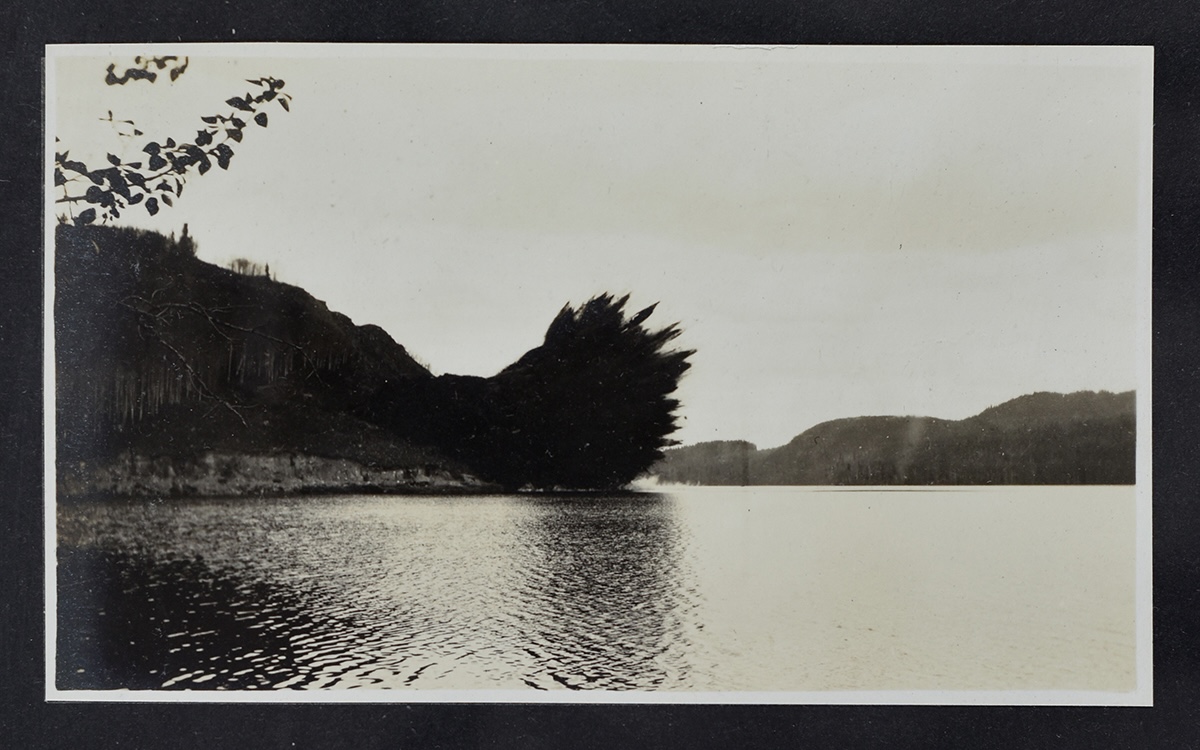
He watched as the dynamite he’d delivered was used to fill tunnels drilled into the rock face, and then detonated.
“I have often wished that I could remember how many tons of explosives went into that mighty shot,” Glen writes. “But I do know that the ice on Burns Lake was shattered from one end to the other, all the windows in the camp were broken and a canoe belonging to Billy Gow had been blown from the beach to the top of a tall spruce tree.”
Glen acknowledges the high death toll on the railway, saying that “at least one life was lost for every mile of track that was laid.”
But he describes that particular explosion as a success.
A similar story featuring Gow’s canoe does not end so well.
Pat Turkki, a local journalist who spoke extensively with old-timers employed by the railway, heard the story of an ill-timed explosion from Patrick (Paddy) Carroll, a former railway worker, more than half a century ago.
“The powder monkey, who was supposed to schedule the blast, allegedly got thirsty and went to town. Somebody dropped a cigarette in his absence,” Turkki writes in her 1973 book Burns Lake and District: A History Formal and Informal. The premature blast blew “20 men still at work and thousands of tons of rock into the lake.”
It caused a “gigantic wave” that swept across Burns Lake, tossing the company doctor, who had borrowed Gow’s canoe, into the water and forcing him to cling to trees along the far shore.
In Carroll’s telling, the canoe was “broken to pieces on the rocks.”
“Allegedly 15 other men, on an island in the lake at the time, died as a result of the blast,” Turkki writes. “Since that day, the island has been known locally as ‘Dead Man’s Island.’”
In the years since, several pieces in the Burns Lake Lakes District News have reported that two Chinese railway workers were killed by the explosion. Other accounts range from three to “more than a dozen” men who died.
It’s possible that a story in the Smithers Interior News on Jan. 25, 1913, provides a clue to the disparate number of fatalities.
It describes an explosion at a railway construction camp at Burns Lake that was “responsible for the deaths of three men and the probable fatal injury of 10 more.” They were all Austrians, according to the Interior News.
According to a more recent article in the Lakes District News, the three men who died at the camp that day were named Mike Koh, Tony Miller and Carl Smith. They were buried at the hospital in Burns Lake, it says.
A similar story appears in Jane Stevenson’s 2010 book The Railroader’s Wife. It describes an unplanned explosion in January 1913, as men unloaded dynamite at the work camp. The blast threw the men 60 metres, killing them instantly.
Accidental explosions, often resulting in fatalities, were frequent at that time. A search of newspaper archives from 1913 shows that hundreds of workers died in multiple unrelated mine explosions that year. Dozens more were killed when a ship exploded in the Baltimore harbour. A man succumbed to injuries sustained when an old ship exploded in what is now the Port of Vancouver. And windows were blown out across Nanaimo when the SS Oscar’s load of dynamite exploded.
In Scotland, an entire town was flattened for “a radius of several miles” when a dynamite factory blew up, according to the Vancouver Province.
Explosions were also common along the Canadian railway line, which was under construction across the country.
And within a week of the Burns Lake blast in January 1913, four Austrians were “blown to pieces” in a strikingly similar incident involving Canadian Pacific Railway construction near Sudbury, Ontario. Eight more men, all of them Italians, died six months later in an explosion at a CP construction camp near Kingston, Ontario.
In short: it’s possible, if not downright likely, that more than one deadly explosion occurred during the construction of the Big Cut.
Michael Riis-Christianson is curator at the Lakes District Museum Society in Burns Lake. Like his mother, Pat Turkki, he is a journalist and author of a local history book, History Matters: Stories and Photographs from the Archives of the Lakes District Museum.
In his recent book, Riis-Christianson includes the tale Carroll shared with Turkki about the deadly explosion, with the caveat that there is “no evidence to support this version of events.”
Sitting at the old forest ranger’s cabin that now houses the museum in downtown Burns Lake, Riis-Christianson says that Carroll was a “wonderful storyteller” who was also prone to exaggeration.
But he adds that there are many stories about accidents at the Big Cut.
“We know that there were blasts that occurred there and went wrong,” Riis-Christianson says. “There is still a certain amount of truth to the fact that it could be called Dead Man’s Island specifically because of those incidents and the fact that people did die on the Big Cut.”
The company did not keep good records, he says.
In addition, as railway construction moved progressively east, the nearest coroner became increasingly distant. According to the Interior News, the coroner was stationed more than 300 kilometres from Burns Lake, likely in Terrace, at a time when transportation through the region was gruelling.
But while death was common along the railway, there’s another, far more mundane theory about how Dead Man’s Island got its name.
A “deadman” also refers to the anchor used to stabilize structures and transfer heavy loads. It consists of a large object, often made of concrete, that is buried in the ground and connected to a structure by a tensioned cable.
The island is said to have hosted a deadman anchor, long since removed, which was tethered by guy wire to the bluff as the Big Cut was underway.
“That’s one of the ways that they would have lifted big chunks of rock up and dropped them into the lake,” Riis-Christianson says.
Riis-Christianson believes that an impression left by the anchor remains. “At the east end of Dead Man’s Island there’s a pit, and the edges of it are very regular. It cannot be natural.”
What, if anything, is buried at Dead Man’s Island?
The Tyee reached out to BC Parks for more information.
In an email, a spokesperson for the Ministry of Environment and Parks wrote that the park protects a unique population of sub-boreal spruce. It was established for its high recreational value and popularity with boaters and picnickers.
“To this day it remains a popular day trip destination for lake users,” the spokesperson wrote, adding that there is a picnic shelter, an outhouse, three picnic tables and a dock.
But there’s one thing the island doesn’t have, the spokesperson emphasized: burial sites.
The presence of actual gravesites has been a point of discussion over the years. Riis-Christianson believes that the island’s thin topsoil overlaying bedrock was too shallow to accommodate a human burial.
But by some accounts, railwaymen were laid to rest there.
In May 1981, the Lakes District News reported that five students had been hired to build a wharf, toilets and benches and install signs at the island. They would also “fence the graveyard from which the island got its name,” it said.
The following month, the newspaper published a letter from a former Young Rangers member who recalled summers spent fishing and berry picking at the island.
“We were told the island was so named because a ‘dead man’ was buried there during railway construction,” Dick Nourse wrote. The youths “dug, scratched and poked” at the earth, but could find no evidence of graves.
“I have read accounts of both a premature explosion and a miscalculated overload including a tidal wave that overturned boats on the far side of the lake,” Nourse wrote. “I can’t help but lean toward the less popular and seldom referred to ‘cable anchor’ version.”
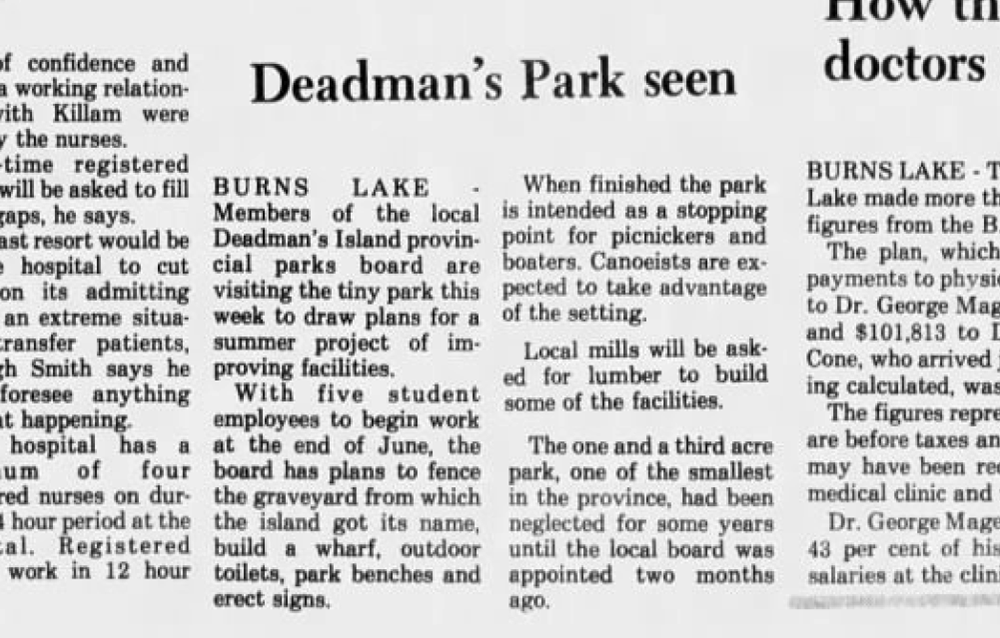
BC Parks says that, in 1982, student workers spent two months clearing brush, creating trails, constructing picnic tables and a pit toilet, and clearing a site for a picnic shelter on the island.
“There is no mention of a graveyard,” a spokesperson adds.
In 1989, the Lakes District News reported that there would be an archeological dig at the island. But according to BC Parks, that excavation was unrelated to the railway explosion.
It directed questions about the dig to the B.C. Ministry of Forests’ heritage and archeological site branch. A spokesperson with the ministry responded that The Tyee would need to file a freedom of information request for details about the dig.
But is it the smallest?
Confusion also swirls about the island’s status as B.C.’s smallest provincial park.
News articles frequently reference its limited expanse with pride. Promotional materials point out that the region hosts both B.C.’s smallest provincial park and its largest.
Even a sign, authorized by BC Parks and posted both to its website and at the park, makes the claim.
But at its recorded size, which is one hectare, Dead Man’s Island is in a close race with several other parks for the title of B.C.’s smallest.
The Tyee reached out to the ministry for clarification.
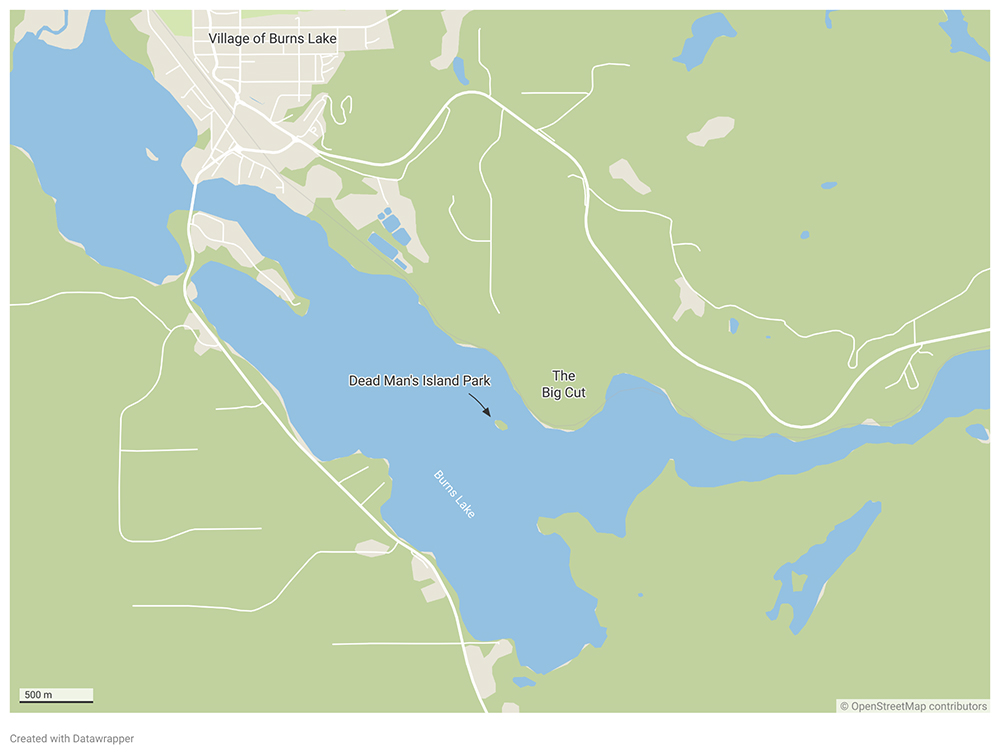
In response, a spokesperson wrote that Dead Man’s Island Park was the smallest when it was established in the 1930s. “However, this is no longer the case,” they added.
It has since been surpassed by Echo Bay Marine Park (0.9 hectares) and Memory Island Park (0.915 hectares). It is tied for third-smallest provincial park with Seton Portage Historic Park, the ministry says.
So The Tyee measured Dead Man’s Island.
According to satellite imagery, the island is not one hectare. Instead, it is roughly half that size. At just over 0.4 hectares, it is instead one acre, making it, in fact, B.C.’s smallest provincial park.
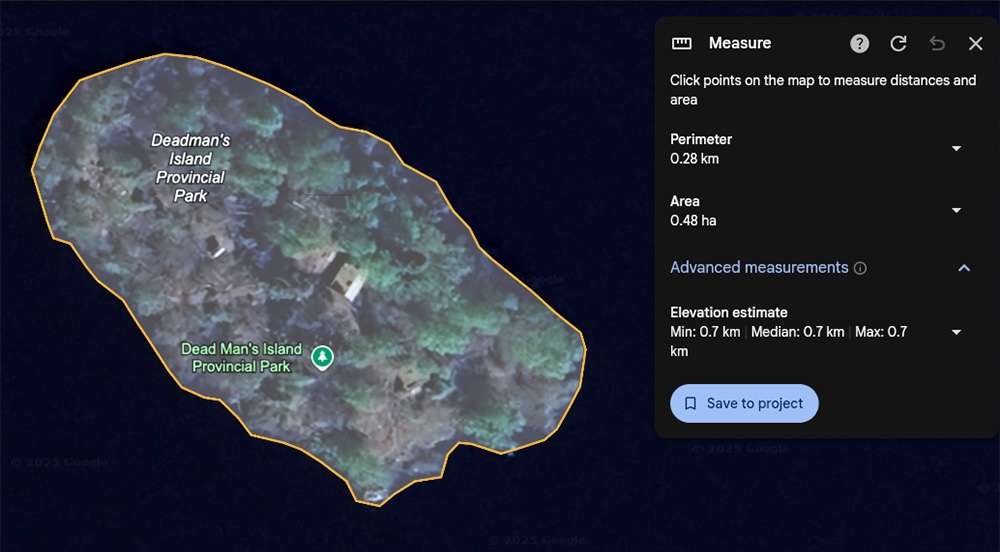
But B.C. government communications would not confirm or deny The Tyee’s measurements.
A fitting tribute to railway fatalities
A pair of leery loons guard the island’s shore from a safe distance as we paddle up to its aluminum dock. We tether our canoe and disembark. It’s peaceful. Quiet birdsong belies the deadly blast credited with giving the island its name.
The island’s only trail, which extends 100 metres from end to end, has recently been cleared of brush. Just off the trail, on an east-facing slope that gazes out at the Big Cut, there’s an impression in the earth. Measuring roughly one by two metres, it is filled with decaying leaves and overhung with willow.
Nearby, nestled amidst a tangle of wild rose bushes, is a small monument. Standing waist-high, its stones have been carefully placed and bound together by concrete. It bears no plaque or other markings, just years of accumulated moss.
As sunlight filters through the island’s deciduous overstorey, it’s easy to feel as if you are standing somewhere sacred.
After the Big Cut was completed, railway construction continued east. Within 100 kilometres, its crew met with workers who had been progressing westward from Winnipeg. They met in Fort Fraser, where the last spike on the Grand Trunk Pacific Railway was driven on April 7, 1914.
There is no official record of how many died during the line’s six-year construction. There is no formal monument. There is just this island, quietly keeping watch over what was likely the most difficult and deadly stretch of railway construction through northern B.C. ![[Tyee]](/design-article.thetyee.ca/ui/img/yellowblob.png)
Read more: Media, Environment










Tyee Commenting Guidelines
Please note that email notifications for replies are not currently working due to a software issue which may be resolved in a future update.
Comments that violate guidelines risk being deleted, and violations may result in a temporary or permanent user ban. Maintain the spirit of good conversation to stay in the discussion and be patient with moderators. Comments are reviewed regularly but not in real time.
Do:
Do not: