


 SHARE:
Few issues provide a clearer window on Alberta’s top-down politics than the issue of coal mining.
The latest chapter in a long saga sheds more light on Premier Danielle Smith’s pretend support for bottom-up democracy like citizen-initiated referendums.
Indeed, the way Smith works to centralize political authority in a petrostate offers similarities to how Vladimir Putin governs. The Russians call it “the vertical of power.”
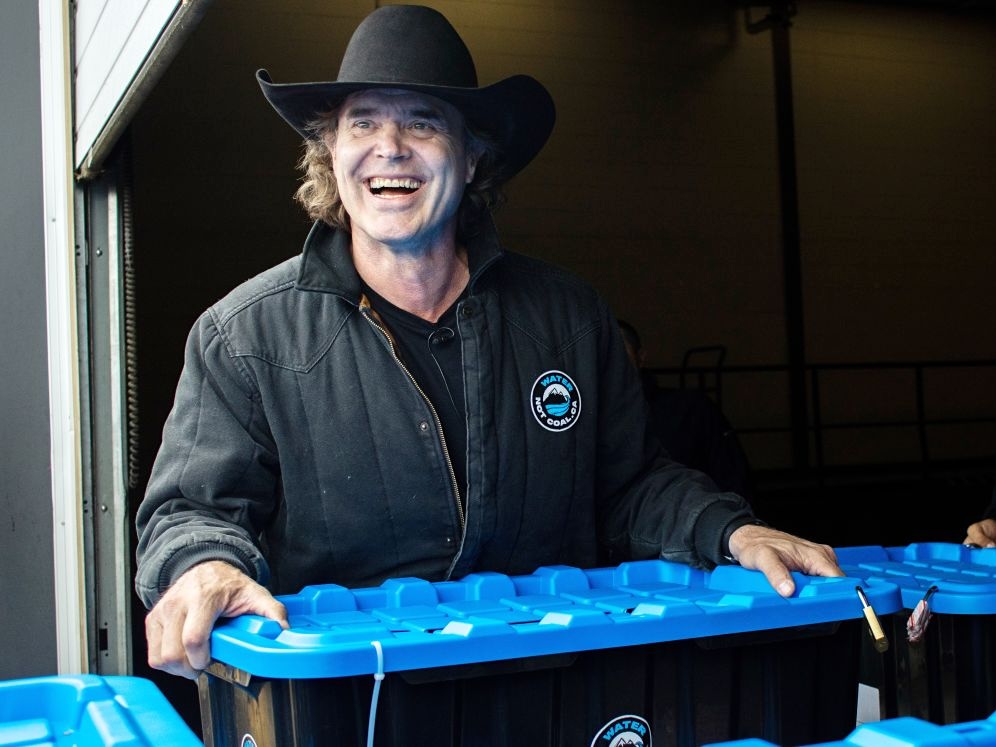
Let’s begin with the Water Not Coal referendum petition drive led by country music singer and ranch owner Corb Lund. After he and his team concluded they had the required signatures and made their submission, Elections Alberta decided last month to quash it.
The Water Not Coal referendum, had Albertans voted for it, would have banned coal mining in the Rocky Mountains to protect critical watersheds, including Valory Resources’ giant underground Blackstone proposal and the controversial Grassy Mountain project owned by Australia’s richest person, Gina Rinehart.
Smith is an ardent supporter of coal mining, so Lund and all who signed the petition were daring to defy the will of the premier and her United Conservative Party government.
After 3,000 canvassers circulated the petition across the province for four months, Lund submitted 207,435 signatures to Elections Alberta. Approximately six per cent of the voting population of Alberta signed the petition.
According to the 2021 Citizen Initiative Act, Lund needed approximately 178,000 signatures to spark a public referendum on the coal issue or force the government to make legislative changes.
Then Elections Alberta, which was created to be a non-partisan and independent office of the legislative assembly, got to work. Its review concluded that only 196,088 signatures were valid and of those only 172,088 were verified based on a random sample of 384 signatures. Water Not Coal was a no go.
‘Unreasonably rejected’
But on Thursday, Lund filed a judicial review application saying Elections Alberta arrived at the shortfall “in a procedurally unfair manner.” The agency is accused of not only misinterpreting the Citizen Initiative Act but using unreasonable verification rules and applying a flawed statistical sampling model that resulted in a process that overcounted invalid signatures and undercounted valid ones. On that basis Lund argues that Elections Alberta’s decision to nix the petition was both incorrect and unreasonable.
Lund’s application singles out the agency for "creating or imposing higher or stricter standards in the validation process relating both to electors and canvassers than were required by the statutory scheme, resulting in signatures being unreasonably rejected, thereby frustrating the underlying purpose of the [Citizen Initiative Act] which is to encourage citizen participation in direct democratic initiatives."
In a statement Lund noted that “more than 200,000 Albertans signed the petition in good faith and they deserve a fair and reasonable process.”
“We believe Elections Alberta applied standards that were stricter than the law requires, and that thousands of Albertans were effectively shut out by verification processes that don’t make sense,” he said in the statement. “This judicial review is about ensuring that citizens’ voices weren’t lost in technicalities.”
Lund and his lawyers weren’t the only ones to notice that things didn’t add up during Elections Alberta’s process. Jeffrey Rosenthal, a professor of statistics at the University of Toronto, looked at the same numbers and analyzed them for CBC.
“It seems that their sampling method is seriously flawed and could vastly underestimate the percentage of valid signatories,” he said.
Separatists reported the same issues after Elections Alberta put their petition through the same validation and verification process last month. The agency counted 286,593 signatures but found only 279,337 valid. Statistical sampling later whittled that figure down to 222,597 as verified.
Although the Stay Free Alberta petition was approved, the separatists aren’t happy with what they call a questionable and bureaucratic process and have called for a full legislative review.
According to Stay Free Alberta, “Electors were recorded as failed verifications despite clearly remembering signing, simply because they could not recall minor details months later, such as the exact signing period, whether they showed identification, or whether a unit number appeared on their address.”
A press release added this important explainer: “Because each sampled verification was statistically weighted, a single rejection affected the validity of more than 700 signatures, and electors were never warned. None of the discrepancies suggested a signature was fraudulent or that the wrong person was contacted.”
Moving the goalposts to win
The tangled story doesn’t end here. Smith’s government has a chronic habit of changing the rules for citizen-initiated referendums and other election laws. Since 2023 her government has amended the act three times. One prominent amendment lowered signature requirements to 10 per cent of general election turnout — a move that appeased separatists in Smith’s party and paved the way for an independence referendum.
Another amendment changed the rules once again because Smith didn’t like a court ruling that challenged the constitutional validity of a proposed referendum that would replace the Canadian Constitution with an Alberta one, and all without First Nations consultation.
As a consequence, Smith centralized her government’s control over the act by reducing the duties of chief electoral officer. Changes also pointedly removed “the ability in the act to refer questions about citizen initiative proposals to the court.”
These timely amendments, made last December, also had the effect of killing Lund’s first application for a Water Not Coal petition, which started before the changes. As a result of Smith’s tinkering, Lund had to start the whole process over again in January.
Smith has boasted about her support for citizen-initiated referendums and how they empower regular folks to make democratic change. But when the premier realized that Lund’s anti-coal petition would cross the threshold of 178,000 signatures last June, she abruptly changed her friendly tune.
The Water Not Coal petition question had the potential to be the only one generated not by her government technocrats but by citizens. After repeatedly promising it would appear on the province’s controversial October ballot, Smith twice stepped backwards.
Although Smith declared in a major speech last May that “muzzling the voices of hundreds of thousands of Albertans wanting to be heard is unjustifiable in a free and democratic society,” she did just that.
Smith said there was no way the Water Not Coal question would ever appear on the ballot this year. Maybe next year. No guarantees.
In another one of her verbose press conferences Smith justified the delay by explaining that there was a long and winding process for the coal referendum question that would involve hearings and legal advice. In other words, a non-partisan petition with 200,000 names carried no weight in a government that changes laws and rules to benefit coal oligarchs.
Smith then explained that banning coal mining in the eastern slopes would raise issues of property rights and the government would have to study that — implying that the property rights of a rich Australian coal baron matters more than those of ordinary Albertan water drinkers.
The premier also implied that the government would have to consider the results of a local coal referendum in the municipal district of Crowsnest Pass before making any decisions.
That 2024 referendum stands as a master class in how to exert the vertical of power to undermine a democracy. Smith directly encouraged the vote, knowing it could legitimize her government’s support for a dead and rejected coal project owned by Rinehart, the richest person in Australia.
Not surprisingly, the people of Crowsnest Pass, an old coal mining district, voted in favour of the Grassy Mountain mine. During the run-up, Rinehart’s company supported their athletic clubs and even drove voters to the polls.
But the referendum was designed to obfuscate an inconvenient geographical truth. The proposed open-pit mine is located in a neighbouring municipal district where ranchers remain overwhelmingly opposed to it. Smith thought it was OK for citizens to vote on a project not in their own municipal district while 200,000 water drinkers living downstream of the project had no representation whatsoever.
Referendums as ‘arms of the government’
So even before Elections Alberta put the Water Not Coal signatures through its problematic statistical modelling, Smith had shown her hand. Every citizen-initiated referendum must become a Smith question with a desired outcome. The message is plain. A Smith autocracy works well for coal developers, AI data centres, oil barons and natural gas producers. But not for citizens who wish to question these priorities.
This explains why none of the 10 questions on constitution and immigration being forced on Albertans this fall are the product of citizen initiatives.
Even the independence question is a complete Smith invention. The 400,000 Albertans who supported the Forever Canadian petition did so because they didn’t believe an independence referendum was justified or legitimate.
But Smith couldn’t respect that citizen initiative either. Thomas Lukaszuk, who began that petition, has repeatedly noted: “Our question is not on the referendum [ballot].... It is the premier’s question. It’s not our question.”
In Smith’s rather Russian world, referendums exist only to expand the power of a ruling party and are open to endless manipulation. Scholars have a name for this practice: “Referendums as extended arms of the government.”
That’s the cynical game being played in Alberta. ![[Tyee]](/design-article.thetyee.ca/ui/img/yellowblob.png)
Read more: Alberta












Tyee Commenting Guidelines
Please note that email notifications for replies are not currently working due to a software issue which may be resolved in a future update.
Comments that violate guidelines risk being deleted, and violations may result in a temporary or permanent user ban. Maintain the spirit of good conversation to stay in the discussion and be patient with moderators. Comments are reviewed regularly but not in real time.
Do:
Do not: