


 SHARE:
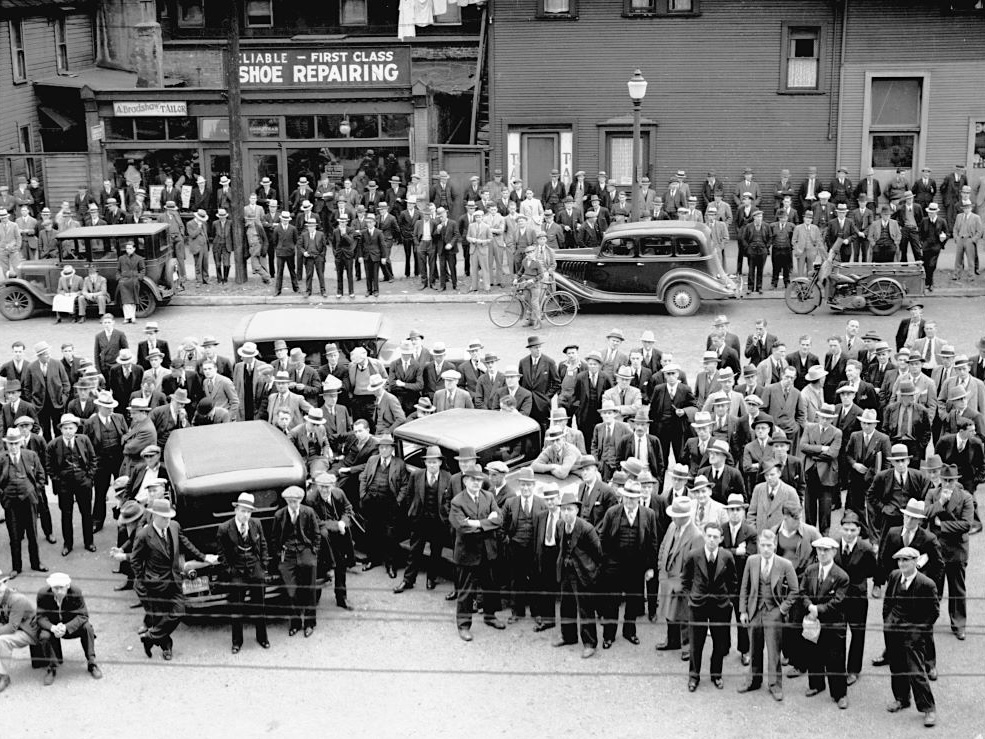
One hundred years ago this month, a crowd of thousands of baseball fans gathered daily outside a Vancouver newspaper building to “watch” the World Series.
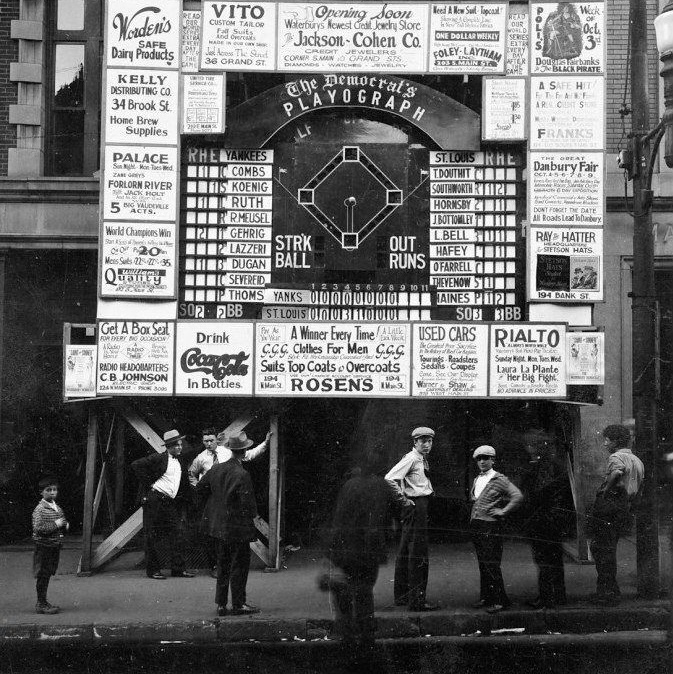
Two unseen operators moved a ball and markers around a contraption known as a Playograph. A large wooden board displayed pitches being thrown, outs being made and runners reaching base. For seven games played over eight days, the operators were guided by a private leased wire direct from the ball parks — Forbes Field in Pittsburgh and Griffith Stadium in the U.S. capital. It took mere seconds for a play to be relayed over the wire to the scoreboard across the continent in British Columbia.
In the days before live sports radio broadcasts and long before the advent of television, the possibility of following a sporting event as it happened thousands of miles away seemed a dream.
Newspapers in 1925 printed inning-by-inning accounts and even partial linescores on the front page when a game continued past one of a day’s several deadlines.
Baseball fans had to wait weeks to see moving images of the game when newsreels arrived in movie theatres to be screened, as it was in Vancouver in 1923, between performances by a male choir, a romantic comedy titled Don’t Flirt and a main feature starring Rin Tin Tin, the famous police dog.
This year’s World Series pitting the Toronto Blue Jays against the Los Angeles Dodgers is available via live radio, television and online streaming accessible in even some of the remotest corners of British Columbia, including Haida Gwaii. The ubiquity of instant communication makes it hard to imagine how the Playograph was a mind-blowing marvel of modern technology in 1925.
‘The thrills and excitement of the real game’
The Playograph was imported by the Daily Province, the city’s largest newspaper by circulation, which gained exclusive rights with its lease. The newspaper promoted its acquisition on the front page. “It shows every play from the time the ball leaves the pitcher’s hands until an ‘out’ is registered or a run scored,” the newspaper stated. “It pictures the progress of a runner once he reaches first base, and also gives the running box score.”
The operators manipulated the green board from behind it, much the way it still happens with the scoreboard at Fenway Park in Boston.
“Without having seen it,” Billboard magazine reported, “it is impossible to appreciate what it is. Its most distinguishing and original feature is its moving ball. The eye ever follows this ball as it passes over the field as it is pitched, batted or thrown in a real game, giving the spectator the thrills and excitement of the real game.”
A baseball attached by wires rested on the mound before being manipulated on every pitch, swerving to the left or right for a curveball, or straight down the middle for a fastball. If a batter made contact, a “fly ball” indicator let the audience know whether the ball was in the air or on the ground as it moved around the board. A base hit resulted in an X marker taking a base, while an out was shown with an O.
The newspaper also broadcast the play-by-play on CKCD, the 750-watt radio station it had launched in its offices two years earlier. Radios were stationary objects in those days, popular with hobbyists but with bulky, expensive sets not yet widely owned. The station also aired World Series bulletins the previous year with the information being relayed to the paper’s offices in New Westminster, where a man used a megaphone to share the information to whatever crowd gathered at Begbie and Columbia streets.
Special constables kept clear a single lane of traffic on West Pender Street at Cambie Street as thousands gathered to watch the Playograph erected at the rear of the Province’s building. The rooters argued the merits of the teams and players, and undoubtedly a few wagers were placed among the throngs.
Baseball was a different game in 1925. There were only 16 major-league teams (compared with 30 today). The nearest big-league city to Vancouver was St. Louis. The season lasted 154 games (162 games today) with no post-season other than the World Series. The 1925 showdown was only the 22nd time the National League and American League pennant winners faced off. The Baseball Hall of Fame in Cooperstown, New York, would not open for another 14 years. Games were played in the daytime and often lasted less than two hours. Starting pitchers were expected to complete the game.
Those who followed the Playograph all week “saw” Walter (Big Train) Johnson of the Washington Senators pitch three complete games, winning games 1 and 4 before losing Game 7 and the series in a messy 9-7 loss to the Pirates in Pittsburgh in wet and sloppy conditions.
More importantly, major-league baseball was a racially segregated sport, as it would be for another two decades. Almost every player was a white American.
The Playograph returned to Vancouver in 1926. A drenching rain barely dampened enthusiasm, as fans in overcoats huddled under umbrellas to watch. The wealthiest parked their automobiles across the street in the school grounds, so they could stay out of the rain.
Thomas MacPherson, a Glasgow-born Great War veteran and a salesman for Home Oil, wrote a letter to the newspaper offering thanks for the free service, adding, “I would also like to tell the operators behind the board that the announcement of all the ‘inside plays’ added greatly to the interest in the game and taken altogether made it all very easy to follow.”
By 1931, the Province also employed an announcer who addressed the crowd over a loudspeaker with anecdotes about the St. Louis Cardinals and the Philadelphia Athletics, while also providing a running commentary about events in the game.
This added service seemed newsworthy when Canadian Pacific Railway sought to reach one of its engineers to run an unscheduled train. The company reached the trainman’s wife at her West End home. She got word to the newspaper and the announcer informed John Upton to report to work, as his anticipated day of leisure was over.
The rival Sun newspaper introduced a board of its own for the showdown that October. It was possibly provided by a rival company to the Playograph, such as the Star Ball Player Co. (The two companies engaged in a lengthy legal battle over copyright.) The upstart Sun was smaller in circulation despite declaring on its front-page nameplate to be “the people’s paper,” as well as the “only Vancouver evening newspaper owned, controlled, operated by Vancouver men.” A crowd gathered a block east on West Pender from the rear of the Province’s building. The Sun also operated a similar board outside its offices in New Westminster.
Rumours of baseball on television
By 1932, the Province arranged a hookup with a U.S. network, Seattle radio station KOMO and local station CKWX to broadcast a live radio play-by-play carrying announcers from Yankee Stadium in New York and Wrigley Field in Chicago. Four radio receiving sets were stationed behind the newspaper’s building.
The Playograph fell out of fashion as live radio broadcasts became more common. Places like the Hotel Abbotsford at 921 W. Pender in the business district, which boasted a cigar shop and a taxi stand, placed large chalkboards outside so passersby and gathered crowds could see an up-to-date linescore of the game.
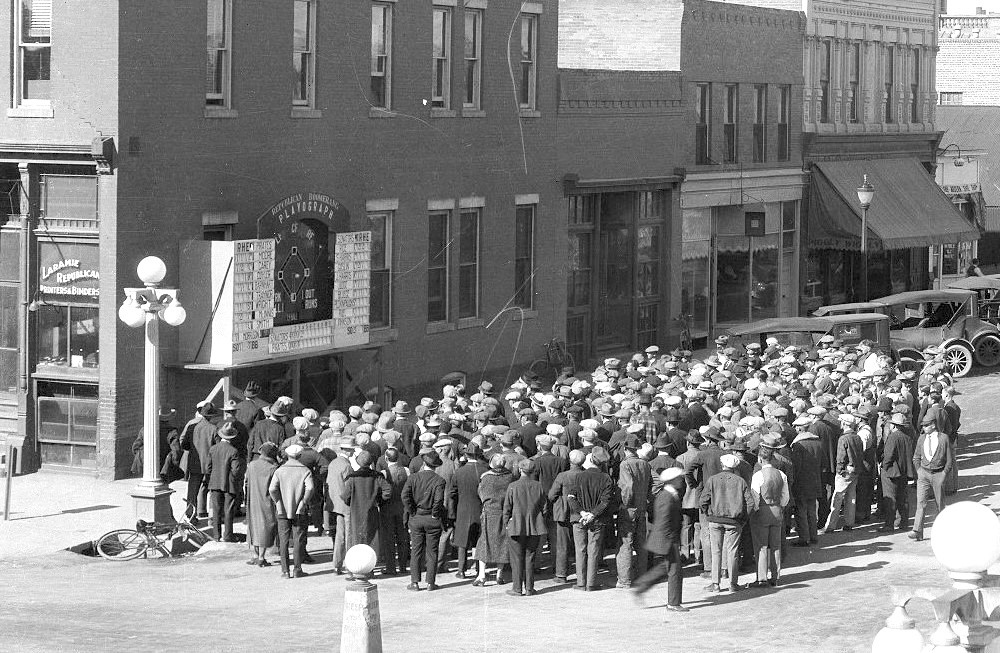
While baseball’s languid pace works well on radio, the conjuring of imagination paled next to the possibility of witnessing an actual game. As early as 1929, a Vancouver newspaper article predicted baseball would soon be available through the miracle of television, a possibility that seemed like science fiction. The Depression and the Second World War delayed that development.
The 1947 World Series was the first to be televised, as stations connected by coaxial cable in New York, Philadelphia, Washington and Albany-Schenectady in upstate New York showed the Yankees defeat rookie Jackie Robinson and the Brooklyn Dodgers in seven games. An estimated four million Americans watched those broadcasts, most of them doing so in bars or standing on the sidewalk looking through store windows. The first coast-to-coast World Series broadcast in the United States took place in 1951.
That year, fans in Vancouver could watch a one-hour recap of the day’s game, airing at 11 p.m. and shown by KING-TV in Seattle.
An enterprising Vancouver sports fan named Bernie Rosen, who coached track and played goalkeeper for the New Westminster Royals and other soccer teams, believed television was going to be a sensation.
He purchased the Evergreen Coffee Shop at 5802 Fraser St., got a cabaret licence from the city and removed tables to make way for 20 shuffleboard tables for league play. He also got a television receiver, which would play while the cabaret hosted afternoon tea dances.
Clancy Loranger of the Vancouver News-Herald teased the evangelist for the new technology in print, saying his slogan was “Come up and TV sometime.”
Rosen charged patrons $1.10 (almost $13 in today’s money) to watch the hour-long recaps in an annex to his cabaret. The screen was located on a wall above a jukebox.
Only 43,000 Canadian households, about one per cent, owned a television. They were expensive and unwieldy, housed in heavy cabinets and requiring installation and antennas. A 16-inch Admiral, manufactured in Port Hope, Ontario, cost $409.95 ($4,794.38 today), while a 17-inch Philco went for $619.50 ($7,245.07 today). The average weekly salary in British Columbia was about $47.90.
The first live World Series television broadcast available to viewers in southern British Columbia aired at 9:45 a.m. on Oct. 1, 1952, from Ebbets Field in Brooklyn. The images were transmitted across the continent to Los Angeles, then to Portland and on to KING in Seattle by coaxial cable before being sent out on the airwaves on Channel 5. Province radio columnist Dick Diespecker suggested viewers watching on TV might prefer to turn the sound off to listen to the superior announcers carried by radio station CJOR.
The popularity of the new medium was such that social clubs and community groups got local businesses to cover the cost of the sets. They held viewings for free or charitable donation. Television was a phenomenon, as Rosen had predicted.
The Dodgers once again fell to the Yankees in seven games in 1952. Another casualty was Rosen’s Evergreen Cabaret. Shortly after baseball’s conclusion, bailiffs seized and auctioned off an adding machine, a cash register, a Coca-Cola cabinet, a deep fryer and griddle, other restaurant ware, and his beloved television set.
In 1953, KVOS-TV in Bellingham, Washington, installed a microwave relay tower atop Mount Constitution on Orcas Island, the highest point in the San Juan Islands, offering a clearer Channel 12 to Vancouver and Victoria viewers. The station aired the baseball games each morning before signing off until the regularly scheduled evening programming. In December, the Canadian Broadcasting Corp.’s CBUT-TV became the first television station in Western Canada.
By the end of the decade, more households in Canada owned televisions than had flushing toilets.
Over the years, the increasing affordability of televisions eventually turned the watching of broadcast baseball from a communal experience with strangers to more of a solitary one. But at least it can be enjoyed indoors in a comfy chair free from the elements. ![[Tyee]](/design-article.thetyee.ca/ui/img/yellowblob.png)
Read more: Media









Tyee Commenting Guidelines
Please note that email notifications for replies are not currently working due to a software issue which may be resolved in a future update.
Comments that violate guidelines risk being deleted, and violations may result in a temporary or permanent user ban. Maintain the spirit of good conversation to stay in the discussion and be patient with moderators. Comments are reviewed regularly but not in real time.
Do:
Do not: