


 SHARE:
On Nov. 22, 1970, the CFL Western Final was played at Taylor Field in Regina. In those days, the final was a best-of-three and this was the third game, pitting the Saskatchewan Roughriders against the Calgary Stampeders. Game-time conditions were inhuman. The temperature was 3 F (-16 C on the not-yet-adopted Celsius scale) with 40 m.p.h. winds creating a wind chill of 36 below. Snow carpeted the turf. “It’s very difficult to pick up the stripes on the field,” said CBC-TV play-by-play announcer Don Wittman. Analyst Frank Rigney called the conditions “ridiculous.”
The Burgess family were sports fans. Although we lived in Brandon, Manitoba, we were diehard Roughrider supporters thanks to five previous years spent in Regina. And we were worried.
Saskatchewan had just enjoyed its best season ever, a dominant 14-2 campaign led by quarterback Ron Lancaster, who would later be named the CFL’s Most Outstanding Player.
But on game day the chill at Taylor Field was not entirely due to the weather. Lancaster had suffered cracked ribs. He would be replaced at quarterback by backup Gary Lane. The game was sloppy, plagued by fumbles and miscues. Late in the third quarter the Roughriders were on the Calgary one-yard-line when Lane plunged forward. The goal line was covered in snow. One referee signalled a touchdown. He was overruled. No touchdown was awarded. Lane fumbled on the next play.
Still, the Roughriders were clinging to a two-point lead with only three seconds on the clock. The Stamps were at the Rider 32-yard line and their star kicker Larry Robinson was preparing a field goal attempt, into the teeth of a howling wind.
At that moment, the TV signal cut out. Panicked Burgesses scrambled for the radio, tuning in just in time to hear the jubilant player celebrations and the shocked silence of over 18,000 frigid fans. Robinson had done it. The Stampeders had won, 15-14.
My older brother Jock went downstairs to his bedroom, blocked the door and attempted to smash all the furniture.
House of pain
Pro sports are often portrayed as a pageant of triumph. It happens, certainly. Championships are won. Celebrations occur, often in Florida or Los Angeles. But sports fandom is not usually about victory. It is about pain. Bruising, repetitive pain, administered by forces over which the subject has no control.
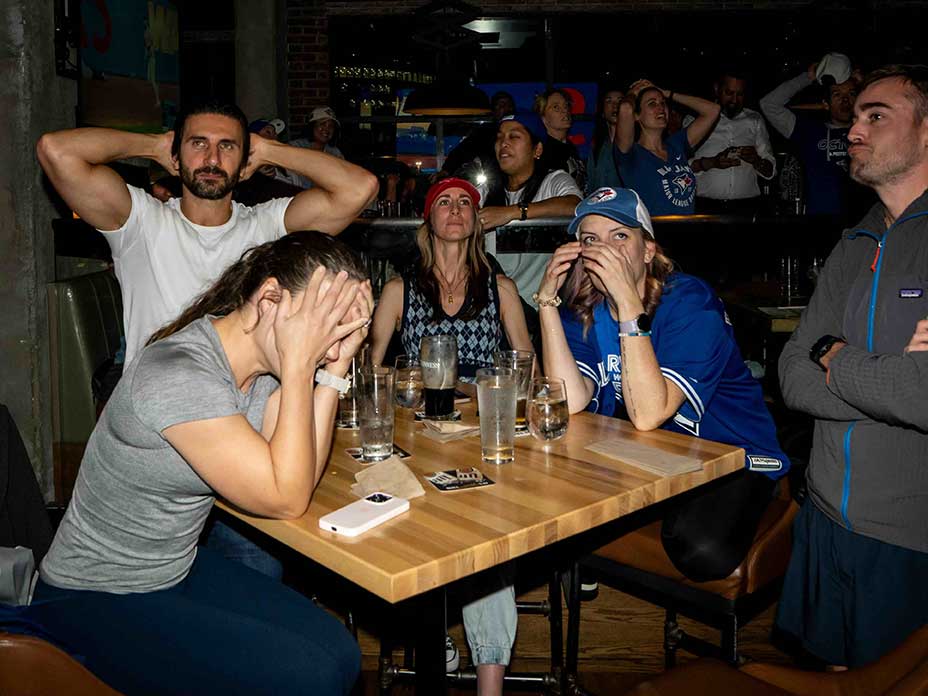
It’s a lesson Toronto Blue Jays fans learned yet again on Nov. 1 via a heart-rending loss to the LA Dodgers in Game 7 of the World Series.
The circumstances, although different in kind to the 1970 CFL Western Final, were eerily similar in effect.
The Jays were two outs away from victory when a home run tied the game; then, with the bases loaded in the bottom of the ninth, Blue Jay Ernie Clement hit a fly ball to deep right field.
Dodger Kiké Hernandez was running — it was clear from his frantic demeanour that he would not reach the ball. Victory was ours.
And then centre fielder Andy Pages was there, colliding with Hernandez but somehow making the catch.
Two innings later, with the Jays down a run, a lead-off double by Vladimir Guerrero Jr. was left stranded and the nation’s fans left in shock. There was no justice to it. Only pain.
A devotion that makes no sense
The Saskatchewan Roughriders, Vancouver Canucks, Toronto Blue Jays, the late, lamented Montreal Expos — I have suffered and celebrated with them all. I wish I understood why.
In addition to being a sports fan, I am arachnophobic. Neither condition makes much sense. I understand that spiders are our friends and an essential reason why we are not waist-deep in flies. That is irrelevant. My fear of being trapped indoors with a spider dwells in the dark basement of my cranium, immune to logic. So it is with sports.
I know that the Canucks’ inability to score does not reflect on me, my abilities, or my circumstances in any meaningful way. And yet a loss can leave me feeling wretched. The pain can be relatively fleeting, but big events leave scars.
The grief is real, no matter how illogical. As a dedicated fan, you are farming out your mental well-being to people whose actions you are powerless to affect.
There is no therapist who can advise you to take matters into your own hands by, say, scoring more goals, or hitting a few homers. Such a therapist could offer only one effective remedy, and that is to stop caring. Good luck with that. (Having said that, my mother felt she could impact the outcome of a tight baseball or football game by leaving the room and washing dishes. I cannot disprove her theory.)
Canucks fans need not be schooled on the pain of defeat, both the dull quotidian angst of a losing season and the more exquisite torment of championship failure. Over 55 seasons, we’ve seen it all. Except a Stanley Cup.
‘If you follow the local team, it’s hard to feel lonely’
Daniel Wann of Murray State University believes sports fandom is a positive force. “One thing fandom allows people to do is be a part of these groups,” he told the American Psychological Association. “If you follow the local team, it’s hard to feel lonely, it’s hard to feel isolated, and it gives you this critical link to others.”
That link is often forged through shared tears. A particularly cruel aspect of fandom is that victory does not necessarily erase defeat. You might think, while your team is mired in chronic ineptitude, that on some happy day winning will wipe out all the agony of previous failure. It doesn’t. It’s like a bad relationship — a subsequent happy one does not necessarily reset your emotional clock.
Letting go of the past is hard. Sports fandom is like that too. Victory can become almost confusing — why do you not feel a joy commensurate with your previous pain? What do you do with all these bad feelings, acquired through years of crushed hopes?
Often the chronically disappointed fan’s reaction to victory is more akin to relief — pre-game dread, post-game relief, like the old comedy routine about the man who repeatedly hits himself with a hammer because it feels so good when he stops.
Some will tell you to appreciate the game regardless of outcome. Such people are either sages, steeped in the wisdom of many athletic seasons, or pious posers who never really cared anyway. Cut them and they are likely to bleed regular blood. Cut a true fan and they will bleed blue, or green and white, or if the Canucks are in their retro jerseys, a sort of orange/red/black scheme.
Can the hopeless fan be cured?
It’s true that watching a well-played game between teams one does not much care about can be a pleasant and relatively relaxing experience — many a championship game fits that description. But it’s not the same as being invested. (There is of course another form of investment, one that now pollutes every broadcast of pro sports — sports betting, increasingly free of legal restriction and offering its slimy come-ons to credulous marks everywhere. But that is a topic for a different essay.)
Even traditional fandom, though, can lead its victims down strange rabbit holes to arcane financial and statistical calculations — contracts, salary caps, and advanced analytics, metrics far removed from little league ball diamonds or playground courts. For the dedicated fan, sports becomes a way of life, ranking somewhere in the middle of the needs hierarchy, possibly rivalling food and shelter.
If it seems strange even to a believer like me, to an outsider it can be incomprehensible. “About 20 per cent of my sport fan psychology class are absolutely not sports fans,” Murray State University’s Wann told the APA. “They detest sport, they’ve never followed it, and they don’t understand it. So they take the class to try and figure out what in the world is going on with all these people that are putting all of this time and money into these activities.”
Can the hopeless fan be cured? In 2011, I experienced one possible method: overseas travel. It can help to remove yourself from the partisan culture entirely, to place yourself among people indifferent to your team.
And it so happened, due to travel plans made months earlier, that I found myself in Rome as the best Canucks team ever assembled battled the brutish Boston Bruins in the Stanley Cup Final. The games took place in the middle of the night Roman time, and there was no way to watch them anyway. The stress may have been somewhat reduced. Yet I still went to bed before the June 15 Game 7 full of dread, and awoke to discover an outcome worse than I had imagined. Not only had the mighty Canucks lost to the hated Bruins, but some idiots had rioted downtown, just as they had in 1994.
In hindsight it seemed fitting that I received this information in the city where sports fanaticism was incubated. In Rome’s Circus Maximus, millennia ago, partisans of different charioteers created lead prayer tablets cursing their opponents: “I adjure you, demon whoever you are, and I demand of you from this hour, from this day, from this moment, that you torture and kill the horses of the Greens and Whites and that you kill in a crash their drivers...and leave not a breath in their bodies.” I still feel that way about Brad Marchand.
The same situation developed for my brother Jock this year. Little suspecting that the Jays would make the World Series, he and his wife Deb planned a trip to Portugal, leaving the very night of the Jays’ opening victory over the Dodgers (Toronto Pearson Airport, they said, was going crazy as airport screens showed the team piling up runs).
At first the accidental cure seemed to work well. Jock, erstwhile furniture-smasher, found himself with a healthy sense of emotional remove, relaxing on a Portuguese beach. Alas, modern technology allowed for greater international access than I had experienced back in 2011, and soon he and Deb were staring at a screen at 3 a.m., agonizing with all the Jays fans located in more comfortable time zones.
Another downside emerged for Jock and Deb — the realization that they were the only ones in the vicinity who cared. It may have helped lessen the pain but it also highlighted the one undeniable upside of serious fandom: solidarity with others.
Sports can unify, as the Blue Jays demonstrated so well this fall by bringing fans together across Canada. During the post-season our family — brothers, sisters, spouses, nieces and nephews — kept up running email threads before, during and after games, conversations sometimes punctuated with celebratory phone calls.
‘To be a fan is to be emotional’
There is no doubt that sports can bond communities — no one who was in Vancouver the day Canada won Olympic hockey gold in 2010 can doubt that. I also have fond memories from the Canucks playoff runs of 1994 and 2011 (I was in town until after the conference final), high-fiving strangers and bonding over the heroics of Trevor Linden and Kirk McLean, and later the Sedins and Roberto Luongo. It felt wonderful, until it didn't.
Dr. Wann agrees that there is a psychological price to pay for loving a team, but points out it is an essential element of the experience. “If you were to take away the emotional response of being a sports fan, you would take away the point. To be a fan is to be emotional, the elation from the win, the disappointment in the loss, and every emotional range in between.”
As Globe and Mail sportswriter Cathal Kelly put it after the World Series: “In return for your money and attention, they give you big feelings. Most years they don’t even give you that. When the feelings are finally delivered, nobody guarantees they will be good.”
Wann feels sports fans become more resilient in dealing with disappointment, purely out of necessity.
“They have this sense of helplessness that can intensify the frustration when they lose, but the beauty of it is that nobody has perfected coping strategies quite like sports fans. People will often ask me, what’s the craziest thing about sports fans? I believe the craziest thing is that there actually are sports fans. This has to be the only voluntary activity where half the people know they’re going to be upset when this thing they consume voluntarily is over.”
Not everyone suffers. I have a good friend who is completely indifferent to sports. There are times, he admits, when he feels a little left out — certainly he lacks that convenient source of small talk that is second only to the weather as a handy dab of social glue. For the most part though, he is content in his indifference.
When I compare his attitude to my own, I am envious. I want what he has. But for this malady there is no effective program, no proven cure. There is only the knowledge that on one day each year, at last, the pain will cease. The team will lose, and the journey will be over.
And then comes spring training. ![[Tyee]](/design-article.thetyee.ca/ui/img/yellowblob.png)










Tyee Commenting Guidelines
Please note that email notifications for replies are not currently working due to a software issue which may be resolved in a future update.
Comments that violate guidelines risk being deleted, and violations may result in a temporary or permanent user ban. Maintain the spirit of good conversation to stay in the discussion and be patient with moderators. Comments are reviewed regularly but not in real time.
Do:
Do not: